flags aloft and a thief’s mouth gnashing atop the masthead
glimpsed from orbit bombs mistaken for flowers of love
navigating the anthills of Europe as well
will we ever see the last of us
Weekend
we hike through Muir amidst sequoia and unsung bluebell. lured by pounding Pacific, beached jellyfish shimmering.
barefoot as clouds or scudding dreams.
as all roads slim to trails, as springs to rivers, to oceans, to saltless precipitate, firmly destabilized, hungering,
as cyclones ravaging the landscape are wont to be.
Jay Passer‘s work has appeared in print and online periodicals and anthologies since 1988. He is the author of 12 collections of poetry and prose, most recently The Cineaste (Alien Buddha Press, 2021). Passer lives in San Francisco, the city of his birth.
Pass me on streets disturbed, anguished, or sunk in unpayable debts of yesterdays or tomorrow’s that begin with light and end with dark voids lacking the velvet softness of dreams of the unfamiliar shadings of hope.
But today I see a man on a mild and pleasant day wearing several sweaters, shirts, and pants.
His smile so genuine I wanted to buy him a suitcase.
Two corner boys higher than a trapeze artist decide to play him for sport, shouting: hey old timer what you gonna do when it gets cold?
With the friendliest of smiles, he stops thinks, then answers I’ll put on some more clothes.
This Idiot and a Half
Almost caught me stepping out of my apartment building in the middle of the day on some kind of motorized scooter on the goddamned sidewalk. You asshole! I yelled He looked back, but kept on going down the block into the street and gone.
Had his bike hit me I would have been in the hospital with something broken maybe more than one thing.
Some men dream of blondes built like starlets, yet delicate as a baby’s breath.
Others dream of enough gold to remake the entire world with their name everywhere.
Or they want to be president, but really mean dictator.
Me, I’ve simple tastes I’d like to catch one of these motorbike idiots speeding on sidewalks and stiff arm them into tomorrow with their bodies going one way and their bikes another.
Then just leave them there opened mouthed and confused. Not a lot to ask for, but failing that I’ll take the blonde and a few gold ducats.
5:35 am
Daylight is an hour away, so I finish the last of five poems, go to the kitchen and find sausage and eggs, then check the mail and discover none. It’s now 5:47 am, still dark. I seldom drink coffee before 6. I read the poems and wait. It’s the exciting life of a poet in New York city.
Rp Verlaine, a retired English teacher living in New York City, has an MFA in creative writing from City College. He has several collections of poetry including Femme Fatales, Movie Starlets & Rockers (2018), and Lies From The Autobiography 1-3 (2018-2020).
You can find more of Rp’s work here on Ink Pantry.
I think I was in an art lesson at school the first time I saw the work of Frida Kahlo. I’m not quite sure how old I was, but I remember the impact it had on me. I was intrigued and completely spell bound. I remember how the colours stood out, but also how they seemed to weave together to tell a story.
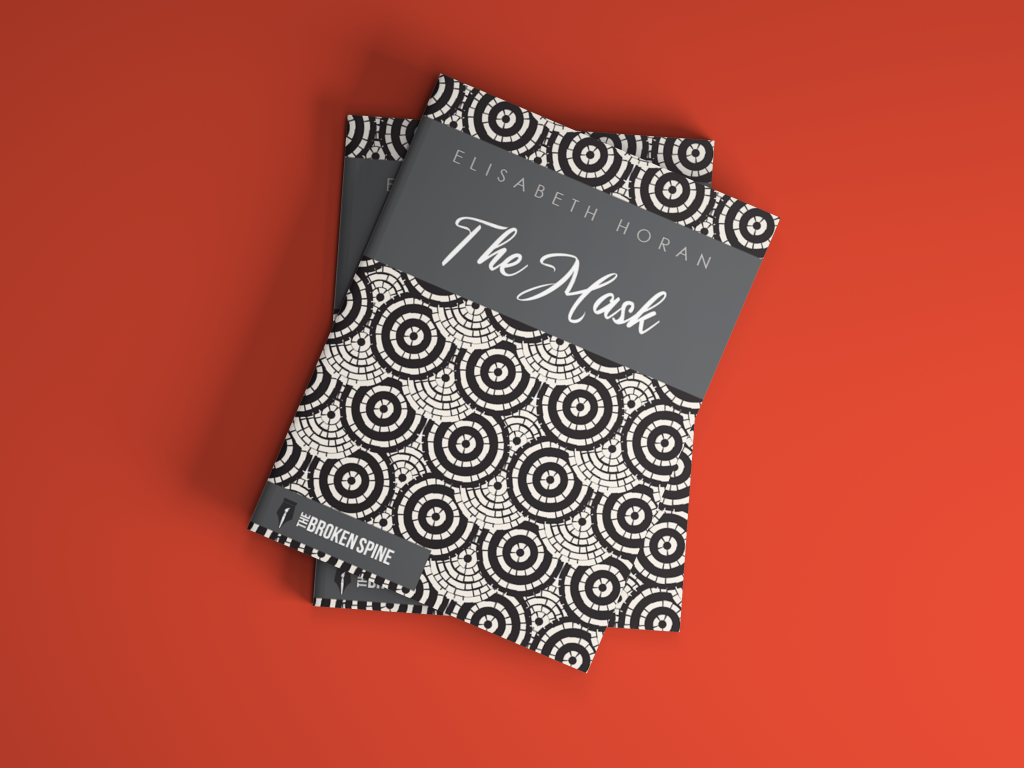
The Two Frida’s is an artwork which has stayed in my memory bank for years. That was until I read The Mask by Elisabeth Horan, and the image came flooding back to me. The Mask is the second collection of ekphrastic poetry by Horan in response to the artwork of Frida Kahlo.
What interests me the most about ekphrastic poetry is connection. How the reader connects with poetry through art, and how poetry can provide the reader with a different interpretation of the original work. Ekphrastic poetry also raises questions about the relationship between the reader and writer, and I was interested in whether my reactions or interpretations would be the same as Horan.
The Mask provides a mix of emotions, and Horan’s work has a touch of raw honesty and openness to it. Sometimes difficult to read, but worth the effort. The words, much like Kahlo’s colours, are intense, sometimes fierce, but each one adds value and strength to the story of both women.
There were a number of poems in this collection which stood out for me. Of course, The Two Frida’s, an inner struggle about duality with themes of desire and attraction, of who you are underneath, and who you want to be on the surface.
In Con Mi Cama (Ella y Yo), Horan describes the inter dependence and relationship between a cripple and her bed, with a dream like quality.
‘I know you are only a bed, amora / And I, but a cripple…/That’s what we have together~~~/
To touch and to love each other / Not to turn away / As the other burns.’
Nectar of the Gods and a Woman’s Throat is based on the self portrait with Thorn Necklace and Hummingbird. A painting full of symbols and meaning. For me Horan’s words emphasise not just the pain Kahlo is presenting, but also strength and resilience of a woman searching for love and security.
The Mask, Vol 2 was perhaps the most impactful poem in this collection for me, and I feel this highlights Horan’s skill as a writer. Shocking the reader with the opening ‘I want the voices / to cease / shushing me’. The words reflect the darkness and uneasiness of the painting which inspired it.
Female strength and resilience feature heavily in this collection, but if you’re a fan of Kahlo, and are familiar with her work, I think you’ll enjoy reading this. Horan says the poems are a celebration and tribute to Kahlo, and I think this collection is a remarkable group of poems influenced by Kahlo’s art. The Mask by Elisabeth Horan is published by The Broken Spine.
Up there a helicopter herds cows to safety while the hills are dowsed by tiny firefighters; down here I pour boiling water on an ants’ nest and scan the rivulets to slaughter survivors.
Ray Miller is a Socialist, Aston Villa supporter, and faithful husband. Life’s been a disappointment.
You can find more of Ray’s work here on Ink Pantry.
One morning, Banging issued from down the hall. Our professor opened the door, said, “Could you please do that another time?” A voice, some worker’s, said, “When the hell am I supposed to do it, then?” Our professor’s face blanched, then reddened.
But the banging ceased.
The lecture resumed, The excitement over.
S.F. Wright lives and teaches in New Jersey. His work has appeared in Hobart, Linden Avenue Literary Journal, and Elm Leaves Journal, among other places. His short story collection, The English Teacher, is forthcoming from Cerasus Poetry.
This marching, these banners, remind me of Tot, gently spoken, dreadlocked, who once offered to construct a house for our kids in the tree at the end of our garden. He’d protested at the Newbury bypass, built and inhabited his own tree-house, so we figured he’d take just a few days or so. He laboured all summer, hampered somewhat by a refusal to hammer nails into wood because of the pain that caused the tree, and a penchant for stopping and staring at the world from his heightened aspect. He dropped dead last year, only 57, a heart attack busking outside the train station. His partner crowd-funded to pay for the wake and that would have met his approval. It was unlike him to exit so quickly, she said, but he’d never have stood for a bypass.
Ray Miller is a Socialist, Aston Villa supporter, and faithful husband. Life’s been a disappointment.
You can find more of Ray’s work here on Ink Pantry.
Jerome Berglund is an author and fine artist who cowrote a television pilot which at a festival for them received numerous accolades including best in show. He graduated summa cum laude from the University of Southern California’s Cinema-Television Production program, with emphases in screenwriting and philosophy. Berglund is author to the novel Havenauts and the story collection Dick Jokes. His short fiction has been exhibited by the Watershed Review, Paragon Press, and the Stardust Review. His poetry appears in Abstract Magazine, Bangalore Review, Barstow & Grand, and most recently O:JA&L. A drama he penned was published in Iris Literary Journal. Berglund is furthermore an established, award-winning fine art photographer, whose black and white pictures have been exhibited in galleries across New York, Minneapolis, and Santa Monica. Berglund has some indigenous ancestry, identifies as lgbtiqa+, and is neurodivergent.
You can say of Yeshua Messiah that he was made a little lower than the angels, however he was also in the beginning and without him was not anything made that was made. A man is the highest created being in the universe. What is man that thou art mindful of him? You can say Lucifer was the highest created being, but the covering cherub surrendered his position for the sake of himself, went after his own thoughts whose end is among the shells of the qliphoth, the end of death, from which there is no rescue as there is for the highest created being. You cannot even say angels are the highest created beings, even though they are more powerful in apparent dimensions, for of which of the angels did he say, thou art my son, meaning that where ever men turn, Yeshua Messiah precedes them. Those men made in the image of Yahweh take on the nature of the son, which is not to despise angels but not to worship them.
You cannot say the highest created being in the universe is the universe. Well you can say it, but you become an idolator. You cannot say that the highest created being in the universe should be amended to the highest created being in the earth, for remember, creating heaven with a touch, his fingers, he gave to man dominion of his hands. Everywhere you turn Yeshua Messiah makes Man the highest created being in the universe, and dignifies earth as much as Yeshua taking the form of a man dignifies a man. Sarah called him lord. Earth is his home, to be remade to suit him in his true state, this both at the end of Isaiah and Revelation, and everywhere between. The man remade inhabits the earth remade. The superficial evolved states of the biome are going to be redone.
Man is the highest created being in the universe.
Earth is the jewel, the masterpiece of all the worlds.*
There is a negative proof mentioned in all the attempts to neuter a man by science. Astronomy, mythology, every agency of civilization seeks to enthrone the demonic skulls. These forces have had their day. Approaching full flow they are to be dry as the Red Sea before they are engulfed. It is important to them to prevent the man from realizing he is the highest created being in the universe. A man’s enemies reveal a lot about him. Natively, it sounds wrong to say man is created highest because that title should be reserved for Jesus. But Jesus, blessed, is not created. Jesus, blessed, was the same in the beginning with Yahweh. Putting him in the place of man promotes the man. According to his enemy, not the man but the universe is the highest creation and is creation itself. More negation from the demonic skulls and their surrogates.
Man is a sculpture event. He is being fashioned as a man as we live. And what does that say about woman? How do you think he gets here! These sayings require a hearer. The first was said to Aeyrie after his two week tour of mid country, yesterday. When I heard it I was shocked. The corollary was said to Eden this morning in bed.
AE, Andrew Edwin Reiff works at Forms of the Formless Ceramic. He ran a Pharmacy garden for the U of Texas, taught at Fayetteville State University and again at Bishop College-Dallas, studied acoustic phonetics and took a doctorate in literature of the renaissance.
You can find more of AE’s work here on Ink Pantry.
Our grandson, starting high school, Wants to be sure he has the right book bag. I think back to the salt & pepper sports coat In which I went off to college, Random flecks of this and that Against a background I recall As a vaguely purplish blue. Mortifying. I paid to have the pleats Removed from gray flannel slacks, That useless belt and buckle Appended to the back. (This was 1955, As you perhaps have guessed.) When I finally got myself A proper muted brown Herringbone jacket, It was from the wrong store.
Recognitions
At his college The reunion was commencement day, Steps in different directions: The newly degreed and their kin Exchange congratulations, With old alums, A pleasantness instinctive, spontaneous, Someone’s plan.
At his fraternity, Rife with the debris of Last exams, last parties, They found his class picture, An off-hand, unsought kindness. Rows of young men With dark, severe hair, dated, Is this you?
At the banquet He recognized people Who did not recognize him, Which had also been the case In nineteen fifty-nine.
Robert Demaree is the author of four book-length collections of poems, including Other Ladders published in 2017 by Beech River Books. His poems have received first place in competitions sponsored by the Poetry Society of New Hampshire and the Burlington Writers Club. He is a retired school administrator with ties to North Carolina, Pennsylvania and New Hampshire. Bob’s poems have appeared in over 150 periodicals including Cold Mountain Review and Louisville Review.
You can find more of Robert’s work here on Ink Pantry.
This is Mitteleuropa. Guns are a merchandise. Have special privi- lege. No retail tax or any of the other taxes, no broken contracts. Everything in its place, & nothing left over. Let things remain as they are. A perennial extension of fran- chise to continue one’s labours. The
words rattle. Surely we have heard this before. The bodies so flamed in the air, took flame. Flames flowed into sea. For three days now as if snow cloud over the sea. & for three days, & none after.
A line from Margaret Atwood
This talk of films made in the early 21st century, as if it was so very long ago, is making me thirsty. But then I’m more concerned with some
different points of view, working on something done a century earlier, 1913, de Chirico’s The Uncertainty of the Poet, with its strange foreground,
a bunch of bananas, poised against the shadowy background porticos. So much was going on in it: but now, with a 90° rotation & the use of much erasure I’ve
reduced it to unlinked islands of activity. Have kept its focus — though with the certainty of a poet have retitled my piece A Last Banana for Giorgio de Chirico.
geographies: Chorley
Sometimes the Bolton & Preston Line of the Lanca- shire & Yorkshire Railway Company goes swimming
in the Chor. Sometimes, when the rain is heavy, the reverse can occur. Neither bears the other any ill will.
Cursive script
I sit in a chair in a room lit only by the lost light of late evening
eating dried fruit from a mini- pack made of a dull paper that stamps its own taste upon the contents
& think about moving to a house in the country where the words don’t have to be summoned
but come of their own accord when they’re ready to be milked.
Mark Young’s first published poetry appeared over sixty-two years ago. Much more recent work has appeared, or is to appear, in The Sparrow’s Trombone, Scud, Ygdrasil, Mobius, SurVision, NAUSEATED DRIVE, Unlikely Stories, & Word For/Word.
You can find more of Mark’s work here on Ink Pantry.