In liminal space, Epiphany blooms Then fades in eclipse, In ennui. The serendipity feels like a chimera. Leviathan in Metropolis, This totem of confusion Transforms into mosaic rhapsody, A labyrinth of alchemy. Epitaph carved on the monolith. The mind becomes a quagmire, A parallax of what is real, What is true.
Harbinger
The red mirage from the hearth, looming, cascading, echoing an ember glow from the solstice, under the celestial canopy.
A turpentine mucking haven, with silts and shards chiseling the pinnacle— a verdant glade of hollow, where meadowlarks chirp.
In the thicket, in the tundra, beneath the dune, through mire and glade, the tempest orbits.
First Place
I saw a smooth surface beneath my soft palms that once awkwardly held a pencil. Glossy green-blue or cotton candy pink, sometimes scarred with little scribbles. A rectangle whose sharp edges were softened for small hands. I trace the thin grey lines, feel the rubber lining, soothing me from inside.
The ceiling saw blocks of rectangles forming a blueprint for a square. Gaps in between some, some crooked, some deviating from others. But always together.
The carpet saw the underneath, where no one pays attention. Ancient gums that hardened into fossils, boogers pressed into corners. Drawings of stick figures, words carved with defiance– “Stupid,” “Dog poop”– rebellion in permanent markers.
The windows saw blurs of identical shapes. A line of possibility. Where the soft brains were hardened. Where the soft hands learned how to find themselves.
“I like my life,” it whispers, through scratch surfaces and wobbly legs. “I know I’m loved. I know I’m needed.” “They come and go, but I stay here, ready to be a second home.”
Once so big, not intimidating but embracing. My place in the world, solid and certain. Thought it would never change. Now it fades in memory when I sit—if I could sit— it would barely hold me. Reminding me of the distance between who I was and who I’ve become The time between it and me.
Alexis Lee is a high school student and emerging poet who finds inspiration in fleeting moments, music, and the quiet details of daily life. Her work explores themes of memory, transformation, and human connection. When she’s not writing, she enjoys reading contemporary poetry, listening to indie music, and exploring local bookstores.
She feels close to depth, Like a necklace, you notice after looking for a while.
She changes the feeling of the room without meaning to, Grey suits her. Her smile is small and unforced, like it’s just where her face settles.
Arched eyebrows, not to impress anyone. Eyes with softness, not emptiness.
She doesn’t remind you of anyone else. No earrings, no necklace, the crashing waves of her hair,
Not trying to be seen, And doesn’t demand attention
Silence is her language, She understands it as well as speech.
Thin oval-shaped lips, bottling up words of wisdom Forehead showing experience more than worry
If she were part of a story, She wouldn’t be the centre of it. She’d be the depth underneath, The part that connects things And make everything else feel real. Like a bluer story, if present.
Umbrella for Two
Standing in the rain Beneath the sky that weeps An elegy for one
Holding an unopened umbrella A silent companion to the storm A quiet witness
The rain speaks gently The way a mother may
Standing still The air and rain learns my shape
Each drop a promise That breaks apart before it reaches me
Still, I look up Just in case the clouds might remember The child they left behind
Diamond in the Rough
From Within Plastic green trees Green Snow that never escapes A glass dome, Holding a tiny world Foggy glass No cracks, no scratches Just a wall That separates their world from ours On the bedside table for years A mere shape Brand new once, Now a diamond in the rough
Serena Park is a high school student who writes poetry and creates visual art in the quiet corners of her day. When she’s not working on a piece, she’s usually listening to music—especially rock, with a special place in her heart for Kurt Cobain.
Through the tomography’s tungsten lens, I saw a strange constellation, like that of the cosmos — It was shaped like a labyrinth.
The ephemeral nature of the scene drew a paradox to the striking intricacy of the view— And a myriad of nebulae flashed beyond my sight, pulses send here and there.
Its flashing vista encapsulated me in a state of utter perplexity, And caught me mesmerized by its ever-enigmatic nature.
Then was when, amidst the cascade of vividness, where I witnessed a wild tempest, an enigmatic oblivion, the cosmos of my mind.
A Matter of Perspective
All that could be seen was a glimpse of light breaking through the metal wall. There was a room one covered with red paint, yet shallow. Coated with slick mahogany paint on the outside, its surface reflected a smooth brilliance.
Hovering across the horizon, all that could be seen was a square of red, standing alone in the midst of an intersection.
Bikes, cars, and children sped fast through the road And the city bustled with vivacity, Yet it seldom had any visitors. Only when men dressed in blue caps went by was it ever visited
Lying on the ground, nothing could be seen but darkness the wall was illuminated from its left, right, front, and back, and a slight hue of red.
Wind was bustling through, in and out as if it were to tickle the empty hollows of the lonely red box.
Here
The middle-aged men wearing a fuzzy, apricot hood and a brand-new purple hat waves towards a child who is running across the street with a big smile on his face
The young man, leaning towards an old wall made of reddish bricks and grey stones is wrapped around a brown leather jacket and a white turtle-neck.
crossing the street light with a crooked expression, A teenage girl with her right eyebrow lifted both her ears are covered with a set of headset that is decorated with stars-stickers
A student wearing a uniform is riding bicycle across the river, her hair fluttering golden in sunlight. Holding a briefcase in one hand and a light-blue duffel bad bag behind her back, she closed her eyes sniffing the soothing smell of soil and grass;
A street-singer wearing hot-pink skinny jean recites her song atop of a brisk cardboard box. Holding her guitar one hand and a bottle of water on another, she looks up into the sky, up into the baking sun.
Alina Lee is a high school student at an international school in Seoul, South Korea. Her writing explores memory, identity, and the quiet moments between people. When she’s not writing, she enjoys hiking, running, and playing the ukulele. Her work is inspired by the natural world and the rhythms of everyday life.
I bought it because my hands looked unfinished, because silver means something to people who notice hands. The jeweler said it would age beautifully. I wanted people to forget I had fingers without it.
I practiced talking with my hands, the way people do when they’re certain, the way I wasn’t. I couldn’t stop adjusting it
At the meeting, I left my hands on the table knuckles up, like a small declaration. No one mentioned it. That meant they noticed.
Then one Thursday, I forgot to wear it and still took up space at the table. My hands still worked The reassurance I was looking for was never in the silver
Checkout Line
The woman in front of me is placing her groceries on the conveyor belt while the cashier, maybe seventeen, hair up in a messy bun, keeps her eyes on the register screen The woman’s bag is canvas, reusable, expensive looking and she’s pulling out coupons from a shiny leather wallet, each one unfolded carefully The cashier’s shoulders go tight when she sees them, I can’t tell if she’s annoyed by the coupons, the extra work of scanning, or if the woman said something while I was still choosing between checkout lines, something about expired sales or wrong prices or the way things used to be done. The woman probably said something about organic foods, and how she always buys organic in this annoying voice, using an uncomfortable amount of vocal fry and the word ‘like’ the cashier nods but doesn’t look up. Maybe the cashier is tired of women like this, women who need everyone to know about their stupidly expensive, pseudo-healthy diet choices. The woman taps her credit card against her palm one, two, three times while waiting for her items to ring up. The rhythm says hurry up, says this is taking too long
I decide she’s the type of person who thinks the cashier is incompetent, too slow, not meeting whatever impossible standard she’s invented for how quickly her organic quinoa should be scanned. The cashier still won’t make eye contact Good for her, I think. Don’t let this woman make you feel small. The woman tilts her head, says something I can’t hear the cashier pauses over a bunch of kale The woman’s voice gets louder “I’m sure it was two-for one” There it is. I knew it. She’s going to make a scene over 50 cents, over needing it to be right, over needing this teenager to admit she knows better The cashier calls for a price check and the woman crosses her arms. I want to say, Just let it go, just pay the extra dollar and stop making her day harder, stop needing to win.
But then the manager comes over and snaps something at the cashier, not at the customer. The cashier’s face goes red and she ducks her head. The transaction ends. The woman takes her bags, glances back at the cashier, says, “You’re doing great,” and leaves. The cashier exhales. I step forward with my items: frozen meals for one, a can of soda, the same kale I was so sure would be the problem. I don’t say anything. I swipe my card. She bags in silence.
Outside, I see the woman loading groceries into a sedan, careful with each bag, and I realize I needed her to be careless. Needed her to be the villain of someone else’s shift so I wouldn’t have to think about how I move through the world which lines I hold up, whose patience I test, who’s been kind to me when I was too wrapped up in my own small urgencies to notice I was being difficult. The sedan pulls away. I stand there holding my single bag, the receipt already crumpled in my hand.
Rubber Band
I’ve kept a single rubber band Looped around my bedpost for 3 years It’s gray now, rimmed with rings of dust and lint, Stretched thin in places where my thumb Kept worrying it during conversations I didn’t want to have
It was there the night before my presentation when I couldn’t sleep, when I wrapped it around my finger too tight Counting how many seconds until The tip of my finger turned white
It was there the morning I got the acceptance email when I snapped it across the room At the wall that heard me rehearse the same hopes twenty times It slid behind my bed But I dug it out with a broom because it belongs on my bedpost, not there
My younger cousin held it once And I showed him how to weave it between his fingers into a star He wore it on his wrist for the rest of the day, then set it down on my desk before he left Like he knew I couldn’t lose it
Sometimes I think it’s waiting to be used for something ordinary bundling the stack of photos on my shelf, keeping a crumpled page from escaping, looped around a moment I’ll need it later
Today I moved it from the bedpost to my pocket
It weighs almost nothing, but carries what I cannot
Katie Hong is a high school student based in Seoul, South Korea, whose love for poetry is surpassed only by her passion for baking and spending time with her puppy, Loki. With a gift for words and a keen eye for detail, Katie weaves intricate tapestries of emotion and imagery in her poetry, inviting readers to embark on self-discovery and introspection. When she’s not immersed in the world of poetry, Katie can be found in the kitchen, experimenting with flavors and textures to create delicious treats that delight the senses. With a zest for life and a boundless imagination, Katie is committed to sharing her voice with the world and making a meaningful impact through her writing.
You can find more of Katie’s work here on Ink Pantry.
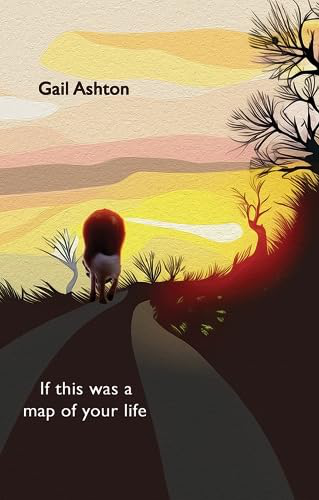
Former university lecturer in medieval literature and teacher of English and Drama, Gail Ashton is well-known for her academic works with Bloomsbury, Macmillan and Routledge. She is also published by Cinnamon Press and has brought out three previous collections of poetry, most recently, ‘What rain taught us’. In 2015 she edited a collection of writing about place called ‘Meet Me There’ and in 2019 she wrote an experimental memoir called ‘Not the Sky’. ‘If this was a map of your life’ is her fourth collection of poetry and it is a Joint Winner of the Geoff Stevens Memorial Poetry Prize, 2023. She lives in rural Herefordshire.
The collection contains 41 poems with the title poem coming at the close. Unity of theme is one of Ashton’s strengths. In this case, it is the seeking of solace and contentment as seen through the lens of the natural world. Poems about friendship and loss find expression in focussed attention to detail.
Within the poems themselves there are some notable turns of phrase. ‘What if we were to ask for fire’, for example, ends with the couplet
You will never know your voice is full of sherbet lemons.
‘Once all this was fields’ opens with the lines ‘October’s here early my love, all snap and witch- / bone light’. Descriptions of a garden are often neatly phrased with some well-chosen vocabulary. ‘What would it look like, this letter to myself?’ begins as follows:
Tethered to home I wander from room to room shocked by purple and gold spiking the garden, a last flush of roses alight in a tawny acer.
In ‘You would love that’ The names of specific plants such as agrimony, coltsfoot, smellfox, fairy flax and alkanet, add beauty and variety to the poem. Ashton uses her extensive botanical knowledge to good effect in her poetry. She is also good at employing memorable imagery drawn from the natural world. In ‘Well, we’ll just have to see’, a doctor’s bleeper is described as being like ‘a bird fluttering / away down a treeless corridor’.
Ashton’s passion lies in nature. There is a sequence of poems about oak trees and a garden is often in her sights. Several poems are addressed to family and friends. Some poems have been inspired by quotations from other writers such as the French writer Annie Emaux and the American poet Mary Oliver.
Visually, there is some experimentation with the way the text is presented on the page. Stylistically, the unexpected use of rhyme at the end of some of the poems brings with it a sense of satisfaction and completion. These quiet poems reward us with their diligence and detail.