Inky Interview Special: Poet Emma Purshouse

emma

Can you please tell Ink Pantry about your journey as a performance poet?

I’d always written ever since I was a child. My first poem was published in the ‘Brownie Magazine’ when I was about six or seven. I remember the excitement of seeing my name in print, of feeling that something I’d done was valued.

I’ve only been performing my poetry for just over ten years. A work colleague knew I wrote and asked me to read at a charity event he was putting on. He was very persuasive, and I said yes. I was sick with nerves the first time I read, it was almost like an out of body experience. However, the audience laughed at the punch line and that was me hooked. That’s the best sort of buzz for me, making someone laugh.

From there someone asked me to perform somewhere else, and so I did. And that just seemed to keep happening.

Have you any advice for budding poetry slammers? How do you prepare for a slam? 

Don’t take slams too seriously in terms of the winning and losing. They are very subjective. I’ve gone out in the first round with the same poem that I’ve also won a slam with. In my opinion, it’s best to treat slams as a chance to showcase for three minutes, six if you’re lucky, and nine if you’re very lucky. Plus, it’s a superb way to network and meet other poets. The poetry scene is lovely and supportive in my experience. I always prepare for slams by putting in the work to rehearse my pieces over and over. I also time my work, including anything I want to say about the poem. Slams have strict time limits for the rounds, so you need to get it right.

What do you care about? What themes keep cropping up in your writing?

I care about people and how they live. I like to write in character a lot. I love to experiment with voice. Homelessness is a recurring theme in my work, and the creation of an underclass in this society. The outsider is a constant source of fascination for me, as are the people and dialect of the Black Country which is where I’m from.

You received Arts Council Funding for your one-woman performance poetry play. What was it about and what inspired you to create it?

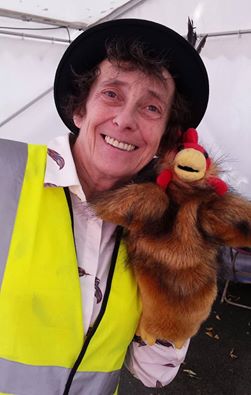
I was inspired to write my first one-woman show by watching Jeremy Kyle and thinking it was like some kind of horrible bear baiting phenomenon. I started to see parallels between that TV show and the traditional Punch and Judy show, so I ended up taking the characters from Punch and Judy and creating a performance piece where they were telling their stories as people might do on the Jeremy Kyle type of TV show. It was called ‘The Professor Vyle Show’. It had poetry, puppets, quick changes, Burberry punch hats, a blow up doll, a full size Punch and Judy booth. It was a mad show, but really fun to do.

Where did you do your MA in Creative Writing? Please tell us about your experience during this time and what you gained from it. Do you think it is worthwhile for a writer to complete an MA and for what reasons?

I did my MA at Manchester Met. I did the novel route though, not poetry. I enjoyed a lot of the experience. It was a good way to network and a good way of making myself write to a deadline. I guess it depends on the individual whether this type of course is relevant. I’m not sure if it’s helped me in my performance career as such. I sometimes teach as a visiting lecturer in universities so maybe I wouldn’t get that type of work without having done the MA.

Who inspires you as a poet?  

All sorts of people. This changes on a regular basis. Originally I was inspired by a book of poetry that my Granddad wrote. Everybody used to look at it with such respect. I never really knew him as he died when I was still very little, but I felt the sense of pride when family members talked about his book (I’m not even sure anybody except me read it). Roger McGough inspired me when I was at school. That was the first poetry I came across other than my granddad’s.

I’m currently into Liz Berry in a big way. I think she’s given people permission to write beautifully using dialect. There are so many brilliant performers who I love to watch and learn from. I love Holly McNish, Jonny Fluffypunk, and Brenda Read-Brown. There are also people who I enjoy working with like Heather Wastie who I’ve done a few bits and pieces with over the years.

Can you tell us about the Write On project?

That was a schools project run by Writing West Midlands. Now much of their work with young people is done through the Spark Young Writers’ groups. They run lots of them across the West Midlands region. I run the group in Stoke-on-Trent. I love it. We get up to twenty youngsters turn up and write their socks off for two hours once a month on a Saturday. Great fun.

You write for children. Have you any advice for writers who are new to this genre?

Listen to what children tell you about what they like. I sometimes ask children for subjects and then write poems to order. Get gigs reading to children so that you can see what works and what doesn’t. There aren’t many places to send work that you write for kids. ‘Caterpillar Magazine’ in Ireland is beautiful, and I’ve had a couple of poems in there in the past. Go and see some children’s poets in action, you can learn a lot from what others do.

Tell us about one of the best days of your life.

I’ve lived on a narrow boat for the past eight years. One of the best days ever was when we went to fetch it after having moved heaven and earth to have pulled off that dream. We didn’t know anything about boating. It was a fantastic learning curve.

What is your creative space like?

I don’t have one particular space really. I move about a lot and write wherever I am. I just take my notebook and pen or my computer with me in a bag. I’ll write on buses and trains. I’ll write in pubs. The day before yesterday I worked on a bench by the river in Bewdley (the library was shut!).

What is it about poetry that you love?

The sounds, the puzzling through when you’re trying to make a poem work, the joy when the poem gets a response when you perform it. The fact that there truly are poems for everybody. The diversity. The fact they can make you think, laugh, cry. The intimate connection between reader and writer. Wow, I’m bigging it up here! I’ve just read all that back, but I do genuinely believe those things.

What is next for you? Have you any plans?

I’ve just completed a rather long project, so I’m in poetry free fall at the moment. No plans. None. I’m open to offers. 😉
Emma’s Website

Nantwich Speakeasy Poets: Debbie Breeze Davies

debbie-davies-head

Debbie Breeze Davies is a Nantwich based poet and artist. She has been a member of Nantwich Speakeasy since June 2016. A qualified Art Teacher with 25 years experience in working with traumatised and challenging young people, she currently works with pupils who have been excluded from mainstream education. Her active engagement with writing began in August 2015. Poets that have particularly inspired her interest include David Whyte, Lemn Sissay, Hollie McNish and Sunny Patterson.


I’ve Snaffleaffulled the Fuffenhuffers

I’ve snaffleaffulled the fuffenhuffers

Eaten every one

I’ve snaffeaffulled the fuffenhuffers

And now…

Well…

they are all gone


Seeing the crackly-wrappery-packet was how it all began

With images so enticing

of spicy dome shaped biscuits,

smother-lovelied in thick hard icing


The pictures seduced me

Taste buds produced juices

My tongue got slippy

Then licked my lips – see

Some were dippa-lippulled in chocolate

Can you imagine such a sight?


And I know I shouldn’t have

I know it was wrong

But I thought, ‘I’ll just have one little bite’


And hardly-breathing-I-eased open the packet

So as not to make a sound


It was then the aroma of;

Vanillary-Spicy-Sugary-lemony

Deliciously-risky-biscuits, entered my nose

And once I sniffa-whiffulled them

My tummy was grumble-umbling

My mouth ready for the textured surface crumbling

I reached in and touched my different options

Some hard and smooth, some slightly-stickily-softer

some rough with deep cracks, revealing moistness underneath

ready for teeth

ready for my teeth to sink in….


I quicka-lickulled the topping

Nibble-ubbled the edges

chompa-lompulled up the middle

muncha-crunchulled the next…

and the next

and the next….


I’ve snaffleaffulled the fuffenhuffers

Eaten every one

I’ve snaffeaffulled the fuffenhuffers

And now…

Well…

they are all gone


And what shall I say to Mum?

What on earth will placate her?

It’ll be no good to say:

‘I was just going to have the one and then save the rest for later’


I’ve snaffleaffulled the fuffenhuffers

Eaten every one

I’ve snaffeaffulled the fuffenhuffers

And now…

Well…

I’m really sorry Mum.


Nantwich Speakeasy Poets: Helen Kay

Helen face

Hula Hoops

I hunter gather in the corner shop

by the towers and flats of cardboard city

with its own creole of rustle and crunch,

while silver-clutching kids niggle my nostalgia.


YOU GETTA A WHOLE LOTTA HULA FROM A HOOP!


It’s not just a 30p, 30g, two E’s

and two hundred calories

packet of oral bliss, but the ring

of a ritual unwinding from work to rest


which punctuate the weekly fix

of Coronation Street. I lay my exhibits

on the catwalk of my chair, they trundle

my playtime thoughts: quoits or bangles,


paper chains or drains or chimney pots;

an assault course of potato pleasure.

An up and under finger sweeps. A tongue

squeezes inside like an ugly sister.


While love and drama swim my eyes and ears,

jaws crunch and crunch. A jousting spear

picks off each ring – then only the bits remain

remind my unwound self of a want to rewind.


I getta a whole lotta hula from my hoops!


Porridge 

This food has history, Goldilocks

Oliver, doing time. A bowl of moon mud

hugs a winter tummy. Its goodness

seeps, a tasty, toasted superfood.


I’m told my grandad cut a slice or two,

wrapped in paper, ready for the pit

with a can of cold sweet tea and sweat,

back bent by the higher-pay seam.


Mum waltzed the spoon around the pot,

ate her oats thick with Lyle’s treacle.

Before the diabetes Dad slurped breakfast

with isles of syrup, an estuary of milk.


My sister beads its woolly skin with bling,

seeds, blackcurrants, even nuts.

I like it just right, not too hot, not too cold.

Jumbo flakes and milk splutter together.


I puzzle how granddad could cut slices,

how they clouded his dust black fingers,

how he ate where he’d seen his father die

crushed inside the earth’s intestine.


 Cheese Show

This is the pilgrimage of cheese,

Of every shade and race and shape.

Unpacked and laid on trestle altars.

Cooled, aligned, smoothed out and scraped.


Sexy Gouda, sealed halloumi,

Swaddled bundles, rusted blues.

Set to be smelt and felt and tasted

In oil, in foil, full moon, half-moon.


The cheese iron burrows the skin,

Uncorks a flubbery pillar

Whiskered judges nibble, discuss

The balance, fruitiness and colour.


Apples clean the expert palettes

of years of tastes. The quest is on

to find the king, the best in show.

The cheese of cheeses, the chosen one.


Making Tarts with Laura

The morning is thrilled by lemon curd.

Your impish hand dives in the yolky pool


of yummy love and deeper, spooning

down clouded glass sides, scooping


the corners of my youth. ‘It’s like

chic bath gel, mum, ‘ she smiles.


She tugs at its checked shower cap.

Cottage logos and curly fonts


evoke a different past from mine,

a phlegmy kid smearing grey tarts


licking gluey dregs from fingers.

Assuming there is always more,


she crams the cupped pastry palms

The scoop and dollop wipes away


my bitter, frugal aftertaste,

the rustic roses grow on us.


Coffee with Pat

“A coffee please.”

“Mocha or Americano? One shot or two?

Latte or expresso, milk, cream or soya?

Skimmed or semi-skimmed or will full fat do?

Sugar? Crystals, lumps, rocks or sweetener?


Decaff  or caff,  white or brown, large or small-

or regular is popular? Take in, take away?

Syrups – caramel, nut or none at all?

Cocoa topping, swirly top? “It was taking all day.


The yuppies behind us became agitated

and seize-the-day Pat -who is terminally ill

doesn’t want the illusion of choices

in a round of Mastermind at the till.


It drove me so potty I bought a biscotti

but when I sat down I forgot where I put it-

went to the counter feeling very dotty

to ask for another-and the wrapper, couldn’t cut it.


Imagine the embarrassment two hours later

in the loo, when I found, in my bag, one crushed

biscuit. Back to the counter for two shot

explanations and all over strawberry blush.


Felt like marshmallow melting down the glass,

but Pat is far from ready to melt away,

and has ordered a second larger than, triple-topped,

chemo free, marshmallow, death by hot chocolate day.


Listening to Music in Enzo Café     

So I conjure composers: baroque

drawing room recluses, locked out of sight,

locking out words; but this girl in docs


and jeans took flight in our café, right

by my table, gifting a tune.

The keyboard was unboxed, set alight


and as she played, she swayed, a spoon

stirring sweetness into the air. There’s me,

wanting the comfort of chords festooned


with lyrics, suddenly feeling these

patterns I don’t understand, unfold

a script in my brain, turning this coffee


and this chic Enzo bistro to one gold

moment touched by her spidery thread,

weaving stories waiting to be told.


Welcome to the drawing room she said.

Feel the prelude frothing in your head.


2008: What Mum Loves Best

In summer she is armed with chicken spears,

breaded bites and fiery turkey sticks

to feed her hungry brood. Open the beers,

the barbie sizzles. Sharp tongs take their pick.


Come winter and her life is neatly packed

with furred up festive gifts, in tempting wrappers:

furred mushroom baubles; painted tikka snacks;

samosa platters; shrimps and brandy snaps.


But best of all are chocolate strawberries dipped,

cased lipsticks, robbed from summer, boxed away

in the dark underworld of frozen dreams.

They wait to brighten up cold nights, let rip

splash out, rekindle hopes of sunny days.

Persephone, uncoated, smeared with cream.


Young Girl Eating Physalis

Today her tomorrow is orange,

not ribbed segmental hours

and pips, but as this amber shine

that doesn’t know its beauty,

a Cinderella shedding torn

petticoats to add its magic

to two scoops of pub ice cream


Her finger and thumb twizzle its stem

as if this fruit could spin her choices:

Chinese lanterns, cape gooseberries,

ground cherries, golden strawberries.

Each name occupies a different world.

She bites firmly, chews things over,

Breaks to her first orange smile.


Helen Kay’s FB Page

Poetry Drawer: Sunday Mornings by Raine Geoghegan

sun

He plays for me on Sunday mornings,
his own compositions.
His shoulders rise and fall as he
deftly runs his fingers across the keys.

My body sways tentatively,
drinking in the melody.
It falls into discordant notes,
a painter venturing into dark shadows.

I am cloth, unravelling.
Like a dervish,
I whirl, my heart opens as
the music builds into a crescendo.

A sweet essence flows back into my blood,
as if it were remembering the warmth of youth,
of wellness.
Of being in the sun.

Raine’s Website

Poetry Drawer: There is a River by Raine Geoghegan

Poetry Drawer: The Last Day by Raine Geoghegan (for my father James Charles Hill)

Inky News: Event: Symposium on Mildred Taylor’s Roll of Thunder, Hear My Cry by Sarah Layzell Hardstaff

mississippi

It’s no exaggeration to say that one of the most exciting moments of my life was receiving the course materials for the Open University’s EA300 module in children’s literature. It was the start of an epic quest that is still ongoing as I work towards my PhD in children’s literature.

One of my favourite things about EA300 was the balance of classic and contemporary children’s literature. One notable novel on the course list which falls into both categories is Mildred Taylor’s Roll of Thunder, Hear My Cry, now in its fortieth year in print.

mild

I’m currently helping to organise a symposium to celebrate Taylor’s novel, which will take place on Friday 23rd and Saturday 24th September at Homerton College, Cambridge. We’ll be taking Roll of Thunder as our starting point for wider discussion on children’s literature, literature in the classroom, and issues such as diversity, representation and authenticity in books for young readers.

We’re also hoping to bring together a broad group of people to join in these discussions, so whether you’re a writer, teacher, student, academic or librarian, why not come along?

You can find out more about the event here:

http://www.educ.cam.ac.uk/events/conferences/rollofthunder40/


Inky Articles: Berenice Smith on Page Design

B book


Berenice Smith is a print and digital designer with a Masters in Graphic Design and Typography. She runs her own design practice in Cambridge (http://www.berenicesmith.com/) and is a partner with Dialogue (http://www.dialoguecreative.co.uk).


We often judge books by their covers but many readers forget to pay attention to the page design. Unlike the shining cover, the page design carries the bags of words, gently helping the reader through the information inside. Dr. Watson to Sherlock’s start, if you like. Just like Watson, it should be reliable, quietly invisible but occasionally challenging. I have been reading The Shock of the Fall by Nathan Filer. In this fascinating first person narrative, the changing format and typography is part of the plot. Many readers and writers are astonished to know that a designer even touched the inner pages. But yes, we do! Even e-books. A reference or educational book requires more navigation and perhaps a ‘how to use the book’ section. Clear titles, section headings and features. Designers will select typefaces according to the hierarchy of content. How the format works in print and the transition to an eBook is an important consideration too. What does the designer do and how can you apply it to your book?

Technical details. A designer will consider the trim of the page and the number of pages. Your printing method and budget may decree a certain number of pages and your designer will keep this mind when looking at typefaces (as different fonts are not equally sized) and overall page sizes. A good designer will know the differences between different printing techniques such as litho and print on demand and how this affects colours and photos.

White space. Margins and gutters (the gap where the book is bound) matter even though they do not contain any text. Does the text require two columns? What is a suitable line length? Does the text have any extracts and should these require indenting? How does this white space affect the balance?

The typeface. I believe that the typeface used in a book can decrease or increase the enjoyment of a book. A book may require more than one but getting the balance right is critical to the success of the page design. Incidentally a typeface is a set of typographical symbols and characters. It’s the letters, numbers, and other characters that let us put words on paper (or screen). A font, on the other hand, is traditionally defined as a complete character set within a typeface, often of a particular size and style. Fonts are also specific computer files that contain all the characters and glyphs within a typeface. • Way finding. Navigating a book can take the form of running heads, folios, page numbers, sets of features such as quotes, tips, mapping end notes or footnotes.

Prelims and endlims (also referred to as front and end matter). Fiction books are making use of what may have been a notes section in the past. Book group questions, extracts from future novels and interviews can be found in this section. How does the overarching page design relate to these important introductions and lasting impressions? Any good book be it written to help you learn or to entertain when you curl up in bed, you can be certain that page has been designed. And if you don’t notice it, then the designer has done a good job!


Inkspeak: The Traveller by Mark Sheeky

icey


Frozen gloves,

crisp with glass

crazed with flakes of transparent wonder.


Snow in cracks on eyebrows bent low.

Light blue eyes look back

at eyes of thunder.


An explosion of mist-breath

curls and dances in cold static air.


Words float like fish

that swim in the winter world there.


”Goodbye…”


The house before is dark brown wood,

roof heavy, with snow and memory.


Each deep look is understood,

as he turns, from ice to sundown’s flood.


Inky Interview Special: Poet Jim Bennett by Kev Milsom

JIM

Hello Jim. Many thanks for agreeing to this interview. I’m sure that our readers will benefit greatly from your extensive experiences within poetry and creative writing. Can I start by asking you about the earliest foundations of your writing? Were English & English Literature subjects that came naturally to you at school, and who were your very first creative & literary inspirations?

I was adopted by a working class Liverpool family that had no educational expectations for me. I managed to live up to that by abandoning school from the age of eleven. I seldom went and when I did it was in the front door and out of a window. I hated school because I was bullied mercilessly by pupils and teachers but I loved learning and had discovered what I wanted to do at about the age of seven, when I read a book of poetry. I went to my dad and told him that I wanted to be a writer. He thought about it seriously and instead of dismissing it suggested that the way to be a writer was to first read, and that is what I did, and still do. He gave me a notebook and suggested I wrote down things that I thought were well written; this included words I had not come across before and phrases that I thought were very descriptive. So in all respects, my dad provided the seed of my first creative development. I tried to read everything that came to hand. I still do that, and these days average about forty novels each year, 200+ books of poetry and as many poetry journals that come my way. I often wonder how he had thought to give that advice as he had left school at thirteen to work as a tea boy on the docks in Liverpool and hardly read a book in his life, but his insight helped me lay the foundations for my writing. Although I like to recognise quality in what I am reading, I probably learn more from weak writing. That first book of poetry I had read was by John Betjeman, and his publication a few years later of Summoned by Bells kept him very high on my reading list until I discovered Beat and the New York School and moved away from traditional poetry.

In my ’60s & ’70s school days, I remember poetry being largely devoted to the works of Shakespeare and Tennyson. When I heard a poem by the Liverpool poet, Roger McGough, aged eleven, it blew my mind open as it felt like he was talking directly to me. Could you share some words on what it was like to be a part of the massive Liverpool creative scene in the 1960s, and to be writing/performing poetry with a very distinctive, ground-breaking style at such an early age?

For me, the Liverpool style in the early 1960s was much diffused, but became more focused after the arrival of Allen Ginsberg in 1965. I was thirteen when he came to Liverpool on a reading tour, and stayed there for a short time. I had started going to readings in O’Connor’s and other places, long before I was old enough to do so, taking the floor with my early poems – a couple of which have hung around. Roger and Adrian Henri were often there, but they were just part of a much larger scene I was involved with, including music, poetry and spilling over into all aspects of performing and visual arts. So when Allen Ginsberg said that Liverpool was ‘the centre of the creative universe’, there were not many who would have disagreed with him at that time, certainly not me. His visit was during one of my long absences from school, so I was able to hang out and listen to the dark conversations related to Beat; what it meant, how to capture it, bottle it, smoke it, etc. When Allen left Liverpool, he took a lot of people with him to attend the first big Albert Hall poetry event in London. As I was so under age at the time, I was not able to go. It was this event, captured in Peter Whitehead’s documentary ‘Wholly Communion’ that changed the perception of poetry in the UK and began the process of redefining poetry and its relevance.

As for myself, I performed in many of the open mic events around Liverpool and was invited to read in featured spots at some. I was also involved in the folk scene and went to many of the folk nights, still prolific due to the British Folk revival, which again Liverpool had taken to its heart. The other thing to be remembered is that ‘performance poetry’ was ridiculed by many in the poetry world and thought to be trivial, or of little value. Even the Liverpool Poets who had been included in two major anthologies that helped them break through (McGough, Henri and Patten) had a struggle to be taken seriously, and the word ‘popular’ was often applied in an arch way as a put-down.

Even back then I was experimenting with delivery styles and I had a vision of the spoken word as akin to a song without music. I saw poetry as part of the folk scene, a way to engage with an audience with words, and even today I still think about it like that and it continues to inform the way I perform my poems. I sometimes get told that I deliver too slow, or too fast, or exaggerate a pause, but in fact I am delivering the words to an internal melody that I think goes along with it. I can also point detractors to the fact that I have won numerous slams and awards for performance.

Could you share some thought with our readers about the processes involved in the construction of your poetry, Jim? 

Most poems start with the germ of an idea, something seen, heard, remembered, and I collect those together. But then I have to decide what the theme of the poem is to be and how the elements I want to write about will approach the theme. Just as an aside, this is the root of ‘show don’t tell’, as the various elements of the poem need to be informed by the theme. Quite often the theme will not appear in the poem at all although taken as a whole that is actually what the poem will be ‘about’. I look for juxtaposed elements that will bring something new to the idea or illustrate it in a different, unusual or surprising way. I then over-write the poem getting the general feel for it, when I believe that it is approaching the ideas I want to engage then I start to reduce it. This process continues until I have the raw structure of the poem. At that point I start to consider the final form it will take. I have, of course, simplified the process here, but generally some aspects of this process are involved with every poem I write.

The exception to this are commissions; poems written to order or for a specific purpose come from the root idea provided in the commission. I enjoy commissions and see them as a challenge. I also enjoy working with other poets and I often work on collaborations with a friend who is a very fine poet. When I am conducting courses, I feel it is only fair that when I set a task for students I should do the same. So I do have a lot of stimuli and write a fair bit.

Are you a spontaneous writer, whereby inspirational thoughts have to be completed while you are creatively ‘in the zone’, or are you a writer who likes to mull and ponder over ideas, editing and refining them over time?

Well, both at different times, is the only truthful answer. At one time, back in the late 70s, I morphed into a punk poet, and for a while MC’d at Eric’s Punk Club in Liverpool. At that time, I would spontaneously generate poetry improvised from words shouted up by the audience. I carried on doing it in performance for years, and sometimes the results were better than others but it was always entertaining. The results were awful but, thankfully, the nightmares they left behind are fading now. To give a flavour of this, I did it at a reading a year ago. I was challenged (by my son) to see if I could still do it, and it was recorded. And this is it, written down exactly as said with the addition of breaking it into lines and stanza. No further alterations have been made. It has lots of faults, but I was interested in the subtext that in some ways must inform a lot of what I write. So here it is warts and all.


I started writing this on the day I was born

language came and books read

sixty years of sunsets and smiling at strangers

walking maps and dreaming

as I watched my children play this poem grew


and the words settled somewhere

with images of life like protein photographs

of all the people in my life that mattered to me

and the places that I lived and the ebbs and flows

that brought me to this place to write some words


that come in an instant and let me say this is poem

dedicated to everyone who helped me make my way

you are there between the lines with all my life

with everything I came to be

whoever you are perhaps you will know


these are the spontaneous

thought as I touch the cave paintings of my childhood

and the hieroglyphs of adolescence

the monuments of my later years

before they crumble into dust


I have never developed this further but may do so at some point. At the moment it stands with its flaws. This was created in the moments that it took to say it, and the ideas it generates touch on all my writing I think.

More generally I prefer to craft a poem. Develop it and take it through generations to a final product. Poetry is and has always been a way to explain how life works, the big themes, and this is as true today as it was when Donne was writing. The ethos of teaching literature has changed and the available texts have also expanded. Fifty years ago, Hughes and Heaney, although alive and writing at the time, had not broken through into the public consciousness. We have also seen the cross pollination of culture through multiculturalism, so this has also broadened the available texts. For me, though there is still a problem with some aspects of teaching poetry, I think more care should be shown in the selection of texts as popular does not necessarily relate to exemplar.

Can I ask for your personal thoughts on how poetry has changed within the last fifty years? Do you feel that the breadth and range of poetry taught to students has expanded during this time, especially compared to the poetry and literature that children/students were exposed to in the first half of the twentieth century? 

The teaching of poetry in the first half of the 20th century was also supported with a grounding in classics, which made the poetry more relevant to the curriculum. Later, as teaching became modernised and moved away from the traditional method, poetry had less relevance to both teachers and pupils. For me, poetry becomes relevant when the teachers encourage the students to question it in different ways. A poem is a map to an unknown land; what the poet intended is mainly irrelevant, and the students should be encouraged to find their own path to what it means to them. Approached in this way, a poem is an adventure and an expression of creativity by both the poet and the reader.

University courses are a little different. Courses in creative writing and poetry have become very popular in recent years. Many focus on the students’ self-analysis and the production of a portfolio, with the emphasis on some courses being towards the linguistically innovative. In my courses I tend to steer towards the Black Mountain Poets, New York Poets, Imagism and, of course, Beat, together with the Modern British Movement. Many of the online courses I offer through the Poetry Kit (www.poetrykit.org) attract poets of all standards, from beginners wanting to see if there is anything in poetry for them to experience and well known poets who want to give their writing a boost. My starting point with all courses is to find great poems that the student has not read before.

But back to your original question, the start of it asked how poetry has changed in the past 50 years, and for me the main change has been the internet. This has allowed many more poets to find a medium for sharing their poetry; the result has been an explosion of outlets for poetry, and as long as you never expect to be paid for it or for it to be read by anyone, then the world is your bivalve mollusc saltwater clam. If you just want to be published and call yourself a poet then you can, someone somewhere will publish you, or if not you can do it yourself.

Wider development of poetry is also evident in popularity of open floor events, which give much wider opportunities for poets to find an audience.

Poetry in the centuries up to and including the early 20th Century basically followed trends and styles, so you had Romanticism, Symbolism, Imagist, and Modernism. But once you get to the mid and later part of the 20th Century, the proliferation of styles broadens so that there is no real dominant style. Elements of all of those previous styles persist together with Post-Modernism (a catch all for many different styles of linguistically innovative poetry), Confessional Poetry; the list goes on and on. In many respects that makes it a very diverse and interesting time to be writing poetry.

As a teacher of Creative Writing, what are the most important lessons that you seek to get across to young, enthusiastic writers, Jim? 

This is very difficult to answer because there are as many answers as there are people. If someone is taking a course then their enthusiasm for the subject should be taken for granted, though it will express itself differently for everyone. The big problem is to try and guide without blunting that enthusiasm. I suppose the things I find myself saying mostly relate to craft, which is a distinct part of the writing process. Bringing the ideas together that help create the poem or other text is only a small part of the overall creative process. This is the point at which many people stop, thinking that the piece is done but really what should follow is the hard work that enables the writing to reach its potential and its audience, and this means possibly rewriting, revision, editing, tweaking.

I believe that attention should be paid to the tools we use, the most important of which are words. So reading is as important as writing; explore how people use words and find the best word for the job in hand. Listening to the rhythms of speech and how one word sits with others. This does not mean using the most obscure word; for me, the simplest most direct way of saying something is the best, but knowing a variety of possible ways to present what you want to say allows you to explore the possibilities available to you. Having a limited vocabulary limits the way you can express yourself.

I also ask writers to work within limitations of form so that they can learn about how the right words can be used to achieve an effect, so sonnets, villanelles, pantoums all have a place in the development of a writer who is serious about their craft. Doing these as challenges and bringing in some fun elements without being too serious about the outcome seems the best approach. Many poets who work only with free form try to dismiss fixed form as no longer relevant to them, but really there is so much to learn from using fixed forms. It is a bit like an artist painting in oils using a limited pallet, not through choice, but because they do not know about the missing colours. Using a similar analogy, an artist like Picasso first learned to paint in very traditional forms before setting his creativity free; the same is true of Van Gough and many others. So for a poet, even if they intend to write exclusively in free form, learning to manipulate lines through the use of fixed forms can help to develop skills in word selection and use, phase and line to best effect.

Another important aspect is reading good poetry by great poets. There are many to choose from but the ones I always recommend are Bob Dylan, Billy Collins, Charles Bukowski, Frank O’Hara, Allen Ginsberg, Emily Dickinson, Gertrude Stein, Robert Frost, Ezra Pound, Wendy Cope, Liz Lochhead, William Carlos Williams, Elizabeth Bishop… (the list changes depending on the needs of the students and the course.)

From reading a selection of your poems, Jim, I’m immediately struck by the wealth of detailed, mental images that start flowing into my mind. For me, your words have a powerful ability to make this happen. Are you artistic or creative in other areas, such as art and music, and/or do you take pleasure & inspiration from other creative arts?

I do write songs and have done since I started. In fact, the very first thing I ever wrote was a song. Visual art, film, plays are all part of the input that helps me relate to the world. I have written many ekphrastic poems and poems with intertextual relationships to a broad cultural base. If you live in the world and have an interest in hard and soft culture, it is difficult to get away from those influences, and I don’t think I would want to.

I would also add in science, the natural world, and perhaps the fundamental aspects of cosmology, understanding time and our relationship with it. Philosophy and psychology are areas I have studied, and I see the influences of those in my poetry, although I must say that I do not proselytise or try to foist any philosophical viewpoints as that is not the purpose of what I do.

When it comes to writing, do you have a specific location where your creative inspiration feels happiest. Also, are you a writer who feels happiest typing on a computer, or someone who utilises a variety of notebook and pens?

The simple answer is no, I keep to a writing schedule and write wherever I am. I do not have much truck with ‘waiting for inspiration’. For me, that is an excuse for a day off. My problem is forcing myself to stop writing. There are clear and easy techniques to ensure that I am ready to write, and I keep to those. I keep a PUKA PAD notebook with me at all times together with a small pen and this is used to jot down odd ideas, words, conversations, things seen, anything really that takes my fancy. I also collect things, postcards, odd things that pique my interest.

I usually write for several hours each morning, and later in the day deal with correspondence. Most writing starts as notes in my notebook, and it is when ideas start to coalesce that I use a computer.

Poems such as ‘Radio Days’ and ‘It was November’ create a wonderful pathway back to your past memories which, as a writing student, fascinates me by the glorious ease in which you make the words come to life. Is there an aspect of writing that you find positive and therapeutic, Jim, and is this a ‘spark’ that compels you to keep maintaining the creation process? 

Thank you for your kind words, but the answer is no, there is no therapy in writing for me. I am not even sure what that really means. Poetry described as therapy or ‘heartfelt’ is usually a turn off for me. I made a career choice to be a poet and that is what I did and continue to do and I have never really done anything else. All my life experiences, and that includes direct experience and those things assimilated through reading, watching and listening, are all just grist to the mill of my output. I wonder, having written that if it is true or not, but consciously that is how I think it is. I do find it satisfying to be able to earn a living at something I would do anyway and I love being involved with the facilitating of courses. Since 1997, I have been involved with the Poetry Kit website (www.poetrykit.org) and that explores new poetry through the Caught in the Net series, and keeps me in touch with competitions, awards and new magazines.

I’d like to thank you again for sharing your thoughts with our readers, Jim. It’s been a personal joy to read some of your work and to learn from it. In conclusion, could you share some thoughts on what has been inspiring you to write during 2016 and are there any major writing plans for 2017?

I finish between six and twelve poems each month, sometimes more, sometimes less, then after I have the basic poem, I leave it for a while then return to it after a few months and see it to completion, so I hope to continue to do that. I have a suggestion for a pamphlet from a publisher, and I am working on an edition of selected poems for US publication in 2017. I enter competitions and submit to journals each month so I hope to carry on in the same vein. I also enjoy readings and although I do not often turn up at open floor events, I am happy to get invitations and try to accommodate them when I can.

Poetry Kit

Indigo Dreams


Books From The Pantry: Any Means Necessary by Jack Mars: reviewed by C. S. Evans

Mars

Any Means Necessary is Jack Mars’ debut novel; a political thriller about a terror plot targeting no less than the President of the United States. Nuclear waste has been stolen with the aim of creating a dirty bomb, and Luke Stone, an ex-SEAL now embedded within the ranks of the FBI, is called upon to stop the jihadists.

What follows is a fast-paced thriller with plenty of intrigue and backstory thrown in. We learn a lot about our hero’s past and follow him as he struggles to keep his family safe, while carrying out the task to which he has been assigned – even when that means bending the rules to breaking point.

For a first novel, this is an ambitious and complicated plot. There are many characters to get to grips with; as well as our ‘good guys’, Mars gives us some insight into the lives and motives of the other main players – the terrorists, the politicians, even those within the FBI trying to keep Luke Stone on a leash. The events which unfold rapidly from the first chapter are also quite a challenge to keep up with, and I found myself having to flick back a few pages to stop getting a little muddled at times! In addition to this, you have to suspend belief in what’s feasible when it comes to some of the ‘stunts’ our protagonist has to execute. Somehow, such ideas seem less acceptable from the pages of a book than on the big screen from Hollywood. Incidentally, this novel would probably make a great movie given a decent cast to make it more believable.

The dialogue is mostly snappy, without gratuitous profanity, but the narrative contains excess use of words like ‘BOOM!’ and ‘BAM!’ for my liking. I’m also not sure I can forgive Mars for using the line ‘Come with me if you want to live’ either!

If I had to name the worst thing about this book, it’s the cliff-hanger ending. By all means, hint at the possibility of future visits to your characters, but don’t dangle parts of a new plot in front of us and then cut us off.

For all my criticisms, I did really enjoy this novel. It delivered what it promised – racing action, moments of great tension and shock, and plenty of intricacies and twists to keep you turning the pages in the small hours. For a debut, it points towards a great writing future for Jack Mars.


Inkspeak: If Bach Had Been a Beekeeper by Charles Tomlinson, guitar by Dave Hulatt


Musical-Bee


If Bach had been a beekeeper

he would have heard

all those notes

suspended above one another

in the air of his ear

as the differentiated swarm returning

to the exact hive,

and place in the hive

topping up the cells

with the honey of C major,

food for the listening generations,

key to their comfort

and solace of their distress

as they return and return

to those counterpointed levels

of hovering wings where

movement is dance and the air itself

a scented garden