Inky Interview: Joanne Hall by Inez de Miranda

spark carouselforget

You are an editor, chair of BristolCon, a bestselling writer and very active on social media in all those functions – how do you manage to combine so many activities?

I am a wearer of many hats, and to be honest, I’m not entirely sure (other than by avoiding housework wherever possible). I’m lucky that I really enjoy everything I do, so it doesn’t feel like work, and if I get tired of, say, editing I’ll go and work on a novel for a couple of hours. It is hard work, though – anyone who tells you that full time writers spend their afternoons sipping gin in the garden has never been one! I work every day, including weekends and holidays, and often on  into the evening if I can.

You became a full-time writer in 2003. What made you take this decision and are you happy with how it is working for you so far? What would you do differently if you knew everything you know now?

I was in a job I hated and I could feel it sapping my creativity every time I walked in through the doors, so I saved up a bunch of money and told everyone I was taking six months off to write. Then I kind of accidently on purpose never went back to work… I would say I’m very happy with it – there are times when it’s been financially very tough, and I’ve felt like a terrible person for putting myself and my long-suffering partner through what was essentially a decade of fairly dire poverty, but we’re coming out of that a bit now. It’s not something that I would recommend everyone to do – if you’ve got children or you need the security of a regular wage I’d absolutely recommend NOT giving up your day job. But I wouldn’t change it – I think it’s helped me to become a better writer, more confident, and it’s also made me aware of just how far a person can stretch very little money, which is a useful life skill!

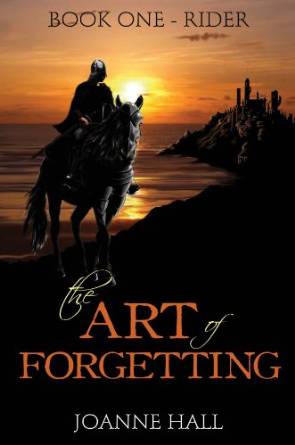
It was only a few days before I sent you this interview that your novel The Art Of Forgetting: Rider is now an Amazon bestseller on both sides of the Atlantic. Many congratulations! Did you eat cake to celebrate? Oh, and, do you have a theory about how you managed this achievement? (Bragging is allowed.)

We didn’t have any cake but I did have a big bar of Dairy Milk and a little boogie around the lounge. The number one on Amazon came off the back of a big Bookbub promotion organised by my publishers, Kristell Ink, who have to take most of the credit because they work incredibly hard. It’s nice that it managed to stay at number one for a few days, and it’s had a knock-on effect of driving sales of my other books, so that’s all awesome.

You are one of the editors of the recently published anthology Fight like a Girl, a collection of short fantasy and sci-fi stories featuring female fighters. What is your personal opinion about the representation and characterisation of different genders in SFF? Does this opinion impact your own writing and if so, in what way?

I confess, it wasn’t something I paid much attention to until I started looking for it, but now I’m thinking more about the representation of genders in my own work, it stands out like a sore thumb for me when I read a book that has no female characters, or a book where all the women are relegated to roles as tavern wenches or prostitutes, or exist only as a prize for the hero. What I want to see when I read fantasy and SF is women with agency, doing stuff and making their own decisions, and when I read a book where that doesn’t happen, it annoys me. It’s lazy writing, to relegate an entire sex to bystanders in your story, and it’s not hard to include Women Doing Stuff. Even if you’re writing about a strict patriarchal society, it doesn’t mean that women don’t exist, or that they don’t have opinions to be expressed.
Luckily there aren’t as many books like that published now as there were, say, in the 1970s, which makes the odd book that has no active women in it stand out even more.
It’s made me more conscious than ever, not only of trying to make sure I include a variety of women in a variety of roles, but also making sure that some of the more traditionally ‘female’ roles are occasionally taken by men. Because why not?

Continuing the women in SFF topic: as a female fantasy author, what are your thoughts about the position of women authors in the fantasy and sci-fi genres?

This might get long, sorry in advance…

We have come a long way, again, since the 70s. I don’t know why I tend to default to the 70s, probably because I was born then and it seems like a long time ago. 😉 But we still haven’t come quite far enough. Just this morning there was yet another ‘List of Essential SFF’ going around on Twitter that comprised of seventeen men and one woman, and this happens on a pretty-much monthly basis. We KNOW there are heaps of incredible women writing heaps of incredible SFF, but they’re not getting on these lists; they’re not getting onto the display tables in big high street booksellers; they’re not getting on awards shortlists (or not nearly as much as they should). And when I speak to male friends (predominantly) and ask them to scrutinise their own reading, even those that are passionate supporters of women in SFF have come back to me and confessed that they tend to read far more men than women. So my two big issues are – why is this happening, and what can we do about it?

It’s my belief, based on no scientific basis whatsoever beyond observing the industry from all sides for a very long time, that in the first place women don’t put themselves forward as much. They don’t submit as many novels and short stories, they don’t put themselves forward for panels or readings as much as men do. And this might go right back to ‘little girls should be seen and not heard, and little girls certainly shouldn’t show off’. It might not. Whatever the reason, there appears to be an intrinsic reluctance for women to put themselves forward, which leads to less women on panels, less women being published, less female best sellers, less female award nominees – it just goes on and on.
In the last ten to fifteen years it’s got better, and more people have made a conscious effort to promote women’s SFF writing, but still, when you see lists every month telling you that all the important, cutting edge SFF has been written and continues to be written almost exclusively by men, it’s disheartening and demoralising to women as a group. That’s why representation is so vital – to demonstrate that there ARE women out there at the cutting edge of SFF writing brilliant things and saying brilliant things on panels and winning awards and selling millions of books.

Which brings me in an extremely roundabout and rambly way to the second question of ‘What can we do about it?’ And the answer to that one is a bit simpler. Read women. Review books by women. Talk about female writers you have enjoyed. Encourage women to submit stories, and then publish them. Make sure women are represented; in your reviews, in your anthologies, in your awards shortlists, in your reading. It’s really not hard. I’ve been running a Discoverability Challenge on my blog (www.hierath.co.uk) for about three years, challenging people to read 12 new-to-them female authors per year and review the ones they have enjoyed. If you love reading and you read loads of books, it’s not hard to read twelve new female authors a year. And it gets people talking and making recommendations, which is great.

Can you tell us about how the anthology Fight Like a Girl was conceived and put together?

Fight like A Girl was born on Twitter and instigated by Danie Ware. It was born out of frustration with those issues addressed at length in the previous answer, and Danie said how great it would be to have an anthology on the subject of fighting women that was entirely written by women. And it kind of snowballed from there – it’s not only a collection that’s entirely written by women, it’s also edited by women (myself and Roz Clarke), the cover is by Sarah Anne Langton, and it’s published by Kristell Ink, who are a publisher owned and run by two women (Sammy HK Smith and Zoe Harris). So it’s like a stick of rock – there’s women all the way through!

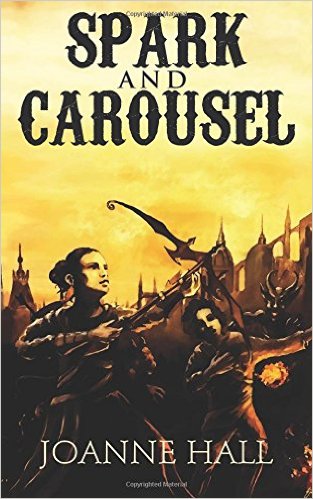
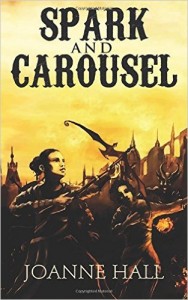
About your most recent novel Spark and Carousel – the old cliché questions: what was your inspiration for this story?

Well I’d recently finished writing The Art of Forgetting and I wanted to write something that was a bit lighter and more of a romp, with more magic in, and I knew I wanted to set it in a city because I hadn’t really done that before. Every book is about looking to see if I can stretch myself in a slightly new direction and try things I haven’t done before.

I have read this book, and my favourite character was Allorise. Without giving too many spoilers, can you tell us how she was developed? I love her name, too, did you make it up?

Yes, I made it up. It just sounded right in my mouth for a frilly, flouncy, spoiled posh girl who wants her own way – though the way she went about getting her own way was obviously pretty dark and nasty! I didn’t want her to be out-and-out bad, she needed to have some motivation for the way she acted, and just because she’s well-off doesn’t mean that she has that many more options in life than a street kid like Carousel. So they had that similarity between them, of being shut in and deprived of agency, but Allorise obviously handled her situation in a much more extreme and dangerous way. It was fun to see how far she would actually take things. I think that’s what’s entertaining about her, is that nothing is too far for her, there’s not a point where she’ll take a breath and go, ‘hey, maybe this is a bad thing I’m doing’! She’s a very extreme character, which makes her tremendously fun to write. I enjoy writing characters who aren’t overburdened with morals…

And finally, are you working on or do you have plans for a new novel or novel series at the moment? If you are, can you give us a teaser?

I’m working on a few things at the moment, but the next thing I have coming out is The Summer Goddess, which is due out this winter from Kristell Ink. It’s kind of a stand-alone sequel to The Art of Forgetting and it’s set in the same world.

Blurb:

When Asta’s nephew is taken by slavers, she pledges to her brother that she will find him, or die trying. Her search takes her from the fading islands of the Scattering, a nation in thrall to a powerful enemy, to the port city of Abonnae. There she finds a people dominated by a sinister cult, thirsty for blood to feed their hungry god.


Haunted by the spirit of her brother, forced into an uncertain alliance with a pair of assassins, Asta faces a deadly choice – save the people of two nations, or save her brother’s only son.

Thank you for having me!

Amazon

Facebook

Twitter

Poetry Drawer: This Time by Clair Chapman

mersey

I left my joie de vivre down by the Mersey,
The sun shone and the wind whipped and I knew.
I didn’t look back to see if she had found it,
I left it on the riverside with you.

This city’s broken hearts for generations,
Through famine, music, slavery and love.
But still she never fails to show her beauty,
As she takes your trembling hand inside her glove.

When she takes your joy to add to all others,
You don’t feel it till you’re back amongst your own.
You still live in the town that you were born in,
But somehow you can never call it home.

My soul lies still along the Mersey,
It’s up there with my heart and joie de vivre,
And everytime I go back there to find them,
I swear that this time…
This time…
I’ll never leave.


Poetry Drawer: Dust by Bruna Vitacca

dust

You start your life in mud.

You craft and learn new tricks.

Your spirit’s born in blood;

You hunt with rocks and sticks.


The day you lost your primal gills,

You worked with tools, you played with fire.

Good manners, words, fine motor skills

All techniques you must acquire.


Many wars and treaties later,

Paint your present like a painter.

Now you’re ready, swap the cavern

For the plastic house with pattern.


Earthly treasures please your pocket;

There’s nothing you’d not buy.

Tricks and lies live in your locket

Play your cards until you die.


Conquer new worlds! Your greatest ambition;

Greeting the nations became your new vision.

You live among stars, within iron and steel,

Competing and beating to find the best deal.


Oh, great deceiver, stir up passions!

Steal their lands and rob them blind!

Power games will be old fashioned;

Schemes and scams left far behind.


Your barren earth expels formations,

None of them are God’s creations.

You.

Too old to be human, too new to be rust;

Begin a new chapter before you are dust.


Easter Poetry Drawer: Never chase your chickens by Helen Kay

_RJE547

I wanted sitting ducks, dust-bathing.

My hands raked the air, erring.

Half-ruffled hens shook, shocked,

fled to shade, distressed, distrusting.


Watching, father said take time, tame.

Let the twitching hens come, calm.

Gently fold feather-fingers

to clasp pulsing bodies, buddies.


Now writing, I scribble, scrabble

to catch flighty thoughts, fight

to hold on. They elude, evade,

crouch in hedges aggrieved, afraid.


Envoi

Father’s echo comforts, confirms

not to chase chickens; luck follows fallow

times, melts on the mind, mine,

here to stay, not scared, stroked,


hatching memories that hold him close.


Easter Special: Inky interview with poet Helen Kay

DSCF0680

You have written a wonderful collection of verse called The Poultry
Lover’s Guide to Poetry. Can you tell us about your journey of writing the
poems and what inspired you at the time?

The pamphlet is inspired by my five silkie hens, but is also about childhood memories of my family keeping chickens. The first poem about never chasing your chickens caused me to think about how chicken poems could enable me to explore different themes in a new way. Some things I did not think of at first, for example, the gender issue and the role of my father.

You have also been working on poetry about dyslexia, being a tutor
yourself. Can you give us an example, or a snippet of a poem? What is it
about dyslexia that fascinates you?

So the first two lines of the dyslexia sequence could be this, but it may change:

in the beginning was a din of words

the lexical vomit of paint on salt dough

I think this sequence is a lot more emotional than the first one- I felt I have to write it. We all know what dyslexia is and lots of good things are being done to support dyslexic learners, but there are still many painful experiences and it can become overlooked. I also wanted to look at the creative potential of dyslexia and other ways of using language.

Being a Sylvia Plath fan, which poem would you choose and why?

Tulips. The way Plath responds to the kindly meant flowers in a negative, but creative way says so much to me about mental health.

Have you always written poetry from a young age?

Yes I have always scribbled poetry, though there were big gaps where other things, such as children, took over. At a recent school reunion a friend still had a school magazine with some of my poems in. I wrote my first hen poem when I was eight and can remember the first line: ‘a fluff or a puff is my silkie called Fairy’.

_RJE547

What is your creative space like? Do you have a study or write
on-the-go, or both?

We live in a small house, so my space is in bed with a netbook and a bag of popcorn or on the living room table. Being around my family keeps me grounded. I am a lark; my best writing time is between 5 and 8 in the morning.

What else do you care about? What themes keep cropping up in your
work?

I care about too many things, for example, I have written a few poems about what is happening in the NHS and other news items. I write about friends in hopes of healing pain or celebrating good things. People, and how they connect with places, are very important in my poems. Friends have to be beware that they might end up in a poem! I am also interested in environmental issues and the interface of town and country.

As a poet, you are perhaps very observant! What is the funniest
conversation you have overheard?!

I love conversations on trains, especially mobile phone ones, where you imagine the receiver. A few months ago, during one of those gales, I heard a drunk man on Wigan Station, telling his girlfriend that he wasn’t coming back and half an hour later he was saying he was catching the next train home. Odd how people spill out their emotions in public and how narratives, in this case, predictably, develop.

 Which other poets inspire you?

I am inspired by many contemporary poets: Judy Brown, Hannah Lowe, Helen Mort, Jane Weir, Mark Doty, Ian Duhig. Yeats is always special. There are so many good poets; some are there to challenge me and others just open my eyes to something or embody how I feel.

Tell us about one of the best days of your life.

Well one of the most exciting poetry things was when I won the Wigan Greenheart competition in 2012. I went to the ceremony and I did not know I had won. The prize was £1,000 which was mine to spend on poetry.

What plans have you got for the future?

.At the moment I am spreading my wings to do a small performance based on the chicken poems. I am also trying help develop local poetry groups. I help with the poetry strand of The Words & Music Festival held in Nantwich every year. I don’t tend to think of long term goals. As you get older you realise things just happen.

Twitter

Get your copy from Indigo Dreams

Facebook Page

Nantwich Speakeasy on Twitter


Special Book Launch: Inky Interview: James L. Weaver

Poor boy

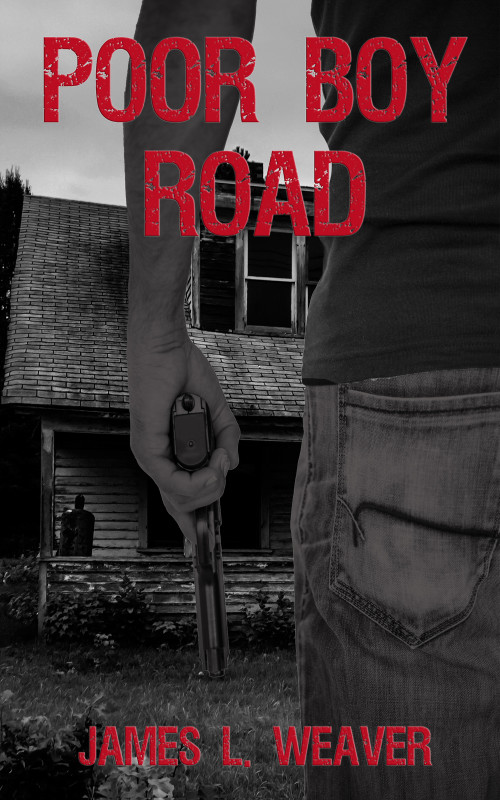
Today we’re joined by James L. Weaver, author of the adult thriller Poor Boy Road, the first in the Jake Caldwell series. Released this week – congratulations James! – it already seem to be a hit with readers.

Let’s start at the start! What were you like at school? Were you good at English?

I was a good student overall, but could have been excellent if I’d really applied myself. I did well in English when the subject appealed to me, but I vehemently hated Shakespeare and poetry and fared poorly in those areas. 10th Grade did result in my first true creative writing endeavour – some fantasy tale about a knight and a monster that is embarrassingly bad. I think it’s still stashed in my basement somewhere. I had a creative writing class in college at Kansas State University taught by a woman named Nina Hajda who was an aspiring writer herself. Her praise and encouragement helped spark the idea that I had at least some measure of ability.

Do you write full-time or part-time? Do you have a special time to write or how is your day structured?

I write part-time, usually between the hours of 10 pm and midnight. I have a full-time job, two active kids who keep my wife and I running around, and a handful of television shows I refuse to give up. I usually sit at our kitchen table with my laptop and write. Sometimes it’s a paragraph, sometimes a chapter, sometimes three or four chapters. There are times when I know what I’m spewing sucks and I give up for the night. I’d like to say I write every day, but it would be a lie. If I’m stuck on a plot point, I might let it stew for a day or two before the resolution reveals itself.

How do you think you’ve evolved creatively since the first thing you wrote?

I’ve studied the craft and read a hell of a lot more by people who do it well than when I started. I thought you could just sit down and pound out a story and the agents would come running! Maybe that’s true for the select few, but I learned a ton reading Stephen King’s book On Writing and Don’t Murder Your Mystery by Chris Roerden. I’ve learned that you can outline and plot all you want, but the story will take you where it wants go – fight it at your peril.

The book is part of the Jake Caldwell series, tell us a little about it?

I absolutely love authors who write about the same character in different settings and adventures. John Sandford’s Lucas Davenport, James Patterson’s Alex Cross or Lee Child’s Jack Reacher. I love finding the Easter Eggs they drop referring back to previous tales. You can read them as a stand-alone novel, but you grow with their characters and can’t wait for the next one to be released.

So, this is the first of the Jake Caldwell novels. The “sequel” Ares Road is set in Kansas City and will be a faster paced book. We’re targeting a 2017 release though I would love to get it out by Christmas. I’m tinkering with some plot ideas for the third book, but I love that I can literally take Jake and put him anywhere in the world in any circumstance and spin a tale without having to rely on what happened in the book before. I find that non-linear track very attractive.

Do you read much and if so who are your favourite authors? What book/s are you reading at present?

I try to read as much as I can because I think it keeps your writing fresh. There’s a handful of authors whose books I will either pre-buy or get as soon as they hit the shelves. In addition to Sandford and Child that I mentioned above, Stephen King is a must buy for me and I’m dying for Gillian Flynn to release another book. Her stuff is amazing.

I just finished an outstanding book called All the Light We Cannot See by Anthony Doer. Fantastic imagery and story-telling. I’m currently reading an advanced reader copy of A Falling Friend which is set for an April release from Lakewater Press.

If you could have been the original author of any book, what would it have been and why?

Ooooh, good question. You can’t tell, but I’ve been sitting here drumming the keyboard for a good couple of minutes trying to come up with a good answer. My favourite all time book would probably be The Stand by Stephen King so I’ll go with that. King is such a master of setting a scene and telling the tale that blurs the line between the natural and supernatural.

What advice would you give to aspiring writers? Do you have any tips for readers or advice for other writers trying to get published?

Step One: Find something you want to write. If you try and write what you think others will want to read, it will show.

Step Two: Write it, spend a little time pulling your hair out in the editing process, then put it away for at least a month or two. Then go back and rewrite it.

Step Three: Give it to someone who will give you an honest opinion. I wrote a blog on it several months ago, but you have to have multiple people who will tell you what sucks, what’s unbelievable, what’s awesome, what connected with them and what fell flat. Nothing’s worse than getting back your book and all they tell you was “It’s good”. That doesn’t help me!

Step Four: Polish from your reviewers’ feedback. Kill those darlings!

Step Five: Find an editor. Nothing’s worse than reading a book and having to edit it in your head. I’ve stopped many a self-published novel because I can’t get into the tale for mountain of little things a good editor would have caught.

Step Six: Start shopping for an agent or publisher. Just as you would with your novel, have someone you trust critique your query letter.

Step Seven: While you’re waiting for the pre-printed rejection letters to hit your mailbox or the agents not to respond at all, enter your work in writing contests. You’ll get great feedback and you never know what could happen or what doors it will open.

The most important thing is DON’T GIVE UP!

What about non-literary entertainment? What are your top rated television shows?

I love to work-out and run. As for TV, this can be a little controversial and I’m sure I’ll get a “How can you leave XYZ off your list?” But, my best all-time television shows are: The Walking Dead, Sons of Anarchy, The Shield, Breaking Bad, Friday Night Lights and Battlestar Galactica (the new one, not the campy 80s one). If you haven’t binge watched any of those, do so now…and buy Poor Boy Road so you have something to do while your Netflix or Amazon Prime is buffering.

Favourite All-Time Movie?

The Shawshank Redemption.

What can readers who enjoy your book do to help make it successful? How can readers discover more about you and you work?

Tell other people about it! Tell them you just read Poor Boy Road and it blew your socks off! Seriously though, if you like it, post a review on Amazon or Goodreads. If someone tells me about a book, I do look at the reviews and see what kind of feedback it’s received to see if I want to invest my diminishing free time on it. It also encourages the author to write more. We authors are a self-doubting bunch at times and need a little positive reinforcement to keep the juices flowing.

Shoot me an email at weaverbooks@gmail.com. Follow me on Twitter @WildcatJim2112. I do have another book out there called Jack & Diane – a coming of age tale that anyone who grew up in the 80s will enjoy and relate to. I also have a blog called weaverwrites.wordpress.com that I need to post more on.

Fantastic! Thanks so much, James. We’ll be sure to read and review Poor Boy Road as soon as possible.

If you want to purchase your own copy, here might be the perfect place to start Amazon.co.uk


Special Book Launch: Inky Interview with author R.L. Martinez

Cover


We’re delighted to welcome author R.L. Martinez to the Pantry today. With her first fantasy, In the Blood, released today (review to come), it seems like a fitting time to question her about all things writing related!

Hi R.L., thank you so much for joining us. So, let’s start at the beginning, what were you like at school? Were you good at English?

I was one of those middling students – not popular, but not an object of ridicule. In high school I took part in colour guard so I had a small, tight circle of friends I enjoyed spending time with.

Besides maths, school was pretty easy for me so I maintained high grades throughout college and university – particularly in English and literature classes. But I think the main reason for that is I actually love to learn. I think I would still be in school today if I could afford it. And I was always an avid reader, so I had bits and pieces of information floating around in my brain at all times.

Do you write full-time or part-time? Do you have a special time to write, or how is your day structured?

Well, that’s a tricky question. I stay at home (my husband works) but not necessarily by choice. I’ve tried finding paying work outside of the house for three years now and have been unsuccessful. And, though you would think that allows me to write all day, I have two small sons (four and six years old), one of whom is not in school yet. So, I’m not able to spend very much time on my writing during the day.

How do you think you’ve evolved creatively since the first thing you wrote?

One of my biggest developments as a writers is losing my penchant for over description and purple prose. College and various writing workshops/critique sessions have whittled me down to a cleaner, more straightforward storyteller. I sometimes still meander towards overwriting, but am better able to see that when doing revisions. Plus, I have beta readers and an editor who help shave off unnecessary descriptions and words.

This book is part of what looks set to be a bestselling series; tell us a little about it?

The Witchbreed is a loose trilogy that follows members of the Dominax family and their adventures (e.g. misadventures) in a pre-industrial world on the verge of world war. The first two books revolve around twin sisters Oriabel and Ottilde Dominax, while the third book focuses on Oriabel’s child.

Do you read much and if so who are your favourite authors? What book/s are you reading at present? If you could have been the original author of any book, what would it have been and why?

Reading is my second favourite pastime! I try to read a book a week – though that doesn’t always happen. Some of my favourite authors are Sharon Shinn, Jane Austen, Stephen King, Marge Piercy, Joy Harjo, Margaret Atwood, Charles Dickens, Sherman Alexie, Toni Morrison, and Michel Faber.

Hmmm… If I could have authored any book… well, I guess I would say I wish I had already authored the books that are still in my pipeline. I wish they were all already out in the world.

What advice would you give to aspiring writers? Do you have any tips for readers or advice for other writers trying to get published?

  1. Keep EVERYTHING you write. Even if you think it’s horrid and will never use it, keep it.
  2. Read. A lot. Nothing irritates me more than hearing other authors dismiss the need to read widely and deeply. And you might be surprised to know just how many writers think reading is unimportant to their craft. To me, that is the height of disrespect and amateur thinking.

For readers I would say, don’t force yourself to read a book you aren’t absolutely loving – I say that even if you are reading MY book at the moment. What a waste to slog through stories that do not engage you! Life is way too short for that sort of nonsense.

As for writers hoping to be published, I advise taking a good, honest look at your skills when deciding between indie and traditional publishing. For example, I like many aspects of indie publishing (ultimate control over product being paramount), but I just do not have the marketing mind to make it successful. So, I might be able to put out a decent book with a pretty cover, but it will never go anywhere because I don’t know how to get it into readers’ hands. Take a look at my one – and only – indie-published title, Wild Horses Don’t Stop at Whoa. I have still never received a penny for it because I’ve never been able to reach the minimum number of sales for Amazon to send me a royalty check.

What can readers who enjoy your book do to help make it successful? How can readers discover more about you and you work?

Write a review! Reviews and person-to-person recommendations are the best marketing out there. Every time you tell someone about an author you’ve enjoyed, you’ve helped increase that author’s reach.

If you want to learn more about my work, visit my website at http://robinLmartinez.com

Yes, we say definitely check out and follow R.L., if the first reviews of her book are anything to go back, she’s about to make some serious waves in the fantasy book network! And, if you’d like to read – and review! – In the Blood, these links might help!

http://www.amazon.co.uk/Blood-Witchbreed-Book-1-ebook/dp/B019X8WCWI/ref=sr_1_1?ie=UTF8&qid=1458575808&sr=8-1&keywords=in+the+blood+martinez

https://www.goodreads.com/author/show/8121315.R_L_Martinez

Thanks so much for joining us, R.L., we wish you all the best!

Lyrical Craft: Interview with musician Mick Masser by Deborah Edgeley

MICKMICK 2

Can you tell Ink Pantry about your Video Theatre?

My Video Theatre project had varied reasons for its emergence; personal and professional reasons dictated a new start. When I left Sheffield, I no longer had a band or studio. I’ve always wanted to ‘get on with it’, and also finding the right band can be a long and disappointing task. Moreover, studio allows for your full imagination and bands have been a skeletal idea – like acoustic versions of an idea. I wanted to draw on all my musical inspirations in a flexible, eclectic way. It has allowed me to explore with complete freedom from classical to dub, prog and pop. Anything! I like the holistic, and wanted to explore my interest in the elements of all the arts, hence each song has its own symbolic video that relates to the lyrics via a collection of animated stills. I play with the relationships relating the translation in a kind of vice versa symbiosis. So metaphors become literal and so forth. It’s fun!

I didn’t want it to be a simulation so I make it obvious that it’s a studio production. I mix the tracks via PA at volume; very dry so it has a live flavour. The beats are basic and percussive and the sounds are cut and paste loops, like how dance music is created. The bass parts are BIG and done as performance with traditionally played bass, which for me is crucial. The organic flavour creates the juxtaposition against the laptop; the irony – Primitively Modern: the title of the project. The overall content explores this concept throughout from Mayan history to modern issues. The stuff we talk about round the campfire!

You have been writing lyrics for many years. Can you give us a history of your journey as a songwriter? 

My journey as a lyricist has emerged from the punk ideal. Allowance to speak. Having something to say was the motivation to play. An observational approach has diversified over the years and inspiration now comes from spiritual issues and imagining being born under a paving slab!

Can you share with us a couple of your own favourite lyrics?

There are many of my lyrics I like. The crap gets thrown away. One of my faves is anecdotal; simple but big like a haiku. ‘Rooms in houses uncannily did this to me.’ This comes from a focus on idiosyncrasy/constructs. ‘Rooms in Houses’ is from a collection of songs called ‘Common Scenarios of Quite a Strange Man’.

Who inspires you, lyrically? 

Again, loads of inspiring lyrics and writers. Peter Gabriel’s US album is lyrically beautiful, and the Lighthouse Family say some nice things. In contrast, I like the inarguable and simple statements that Discharge used to make too. Hawkwind’s single sentence ‘Space is there’ is, of course, implosively poetic.

Do you read a lot? What book has affected you the most?

Never get time to read. A Kestrel for a Knave has done much to shape the way I think, particularly the implications in institutionalised learning. Billy’s skills and motivations are not on the curriculum. When he finds his true interest, he’s an A-star pupil.

You live on a boat, away from the rat race. Is this the perfect, peaceful setting for a creative person? 

Paint a picture of your day for us.

I live two lives on the boat; week on, week off with my boys. This is a good symbiosis because my domestic week grounds me from a workload that has me awake at ridiculous times and drinking too much coffee. It is delightful when I get to do boater things. I like the resourcefulness such as having solar energy, sawing logs, etc. The relaxing moments with candles, fire and hooting owls are well earned. Of course, my ever changing ‘garden’, I’ve no doubt, is unconsciously calming and inspiring.

Do you think like a poet, perhaps in images, or do ideas come first, then images?

I think in an integrated way, but the visual arts have much to do with the abstraction. It’s all about juxtaposition, texture, composition. I work lyric to maximise meaning in a mind map way and choose words that strengthen a previous reference; like an echo. Put simply…moon, dark, night, stars, etc. It seems obvious but clearly when writing it’s more interesting than that. It has to be, of course!

How do you motivate yourself to write? Or is it an innate passion that constantly needs release?

I used to sit and sing nonsense with guitar and catch/shape lyric as it spilled out. These days, I build soundscapes starting with experimental sounds and loops as well as conventional playing. The ‘painting’ in turn inspires lyric and story.

What do you care about? Which themes keep cropping up in your work?

Spiritual freedom, harmony, peace and being happy. I used to have a lot to say. Now I change the world from where I can actually do something about it – from within. I trust my feelings. I try to be nice. I’m absolute about boundaries. If I’m uncomfortable, I have the right to leave and not have to answer for it.

Tell us about one of the best days of your life.

I have two best days: the days my boys were born. I love them to bits – as you do! They map my future and fill me with purpose. They grow and provide me with continually changing interest.

Any plans for future projects?

Every intention for continual future projects. I have irons in a few fires. I’ve been enjoying writing top lines with harmony for some great producers recently and now have an opportunity to travel too. The variety is great stimuli and takes me to fresh musical/lyrical places (mainstream with a touch of craft). Such co-writes yet again present new landscapes from the imaginations of other artistes, thus stimulating new lyric territory. It helps give my own work a rest and recharge. My Video Theatre remains paramount as it is the vehicle for my deepest thoughts and experiences. It also grants poetic licence unlike the former, which comes with a label brief. Quite difficult at times.

https://www.facebook.com/thevideotheatre/?fref=ts


Inky Interview: Open University’s Dr Mike Johnson by Patricia M Osborne

OLYMPUS DIGITAL CAMERA

When it comes to writing, what is your preferred genre?

Definitely poetry! I love the play between condensed and yet multiple possibilities of meaning that poetry can offer. I often aim at ‘crossover’ poems i.e. ones that may appeal to a wide age-range and/or push through genre borders.

How easy is it to fit your writing around your work?

Surprisingly difficult: because teaching Creative Writing requires a spectrum of constructive critical perceptions, it can be difficult to get over these when starting my own pieces. Sadly, my first reaction to something just written is often, ‘Hm, I have read something like this before.’

Is there a special time or place you like to write and what motivates you?

In bed, early morning for getting first ideas down, then re-drafting can be any-place, anytime (and endless). Motivation comes from literally anywhere: general life events, partially heard conversation on the train, TV, radio, music, reading (of course), the Internet and so on.

Who is your favourite poet and why?

Wow! That is a difficult one. But if you are going to restrict me, I would have to say Stevie Smith, because she was so unique.  Rules (both structural and semantic)  were meant to be broken for her and she could convey so much in a few words. ‘Not Waving But Drowning’ is a most incredible poem.

As a writer it is also important to be a reader. What are you reading right now? What are some of your favourite books?

For poetry, see above: plus (in no particular order), S T Coleridge, Steve Sneyd, Emily Dickinson, Edward Lear and Miroslav Holub. For prose: favourites are Solaris – Stanislaw Lem, short stories by J L Borges, Cat’s Eye – Margaret Atwood,  Frankenstein – Mary Shelley, the Alice books – Lewis Carroll. (These lists do tend to change frequently.)

I am currently reading Music at Midnight  a biography of the 17th century poet George Herbert by John  Drury: ‘Enjoy your Symptom’ –  cultural criticism by Slavoj Zizek: and the poetry of Edwin Morgan. I have just finished Extreme Metaphors – by J G Ballard.

Which three words best describes you?

Philosophical. Creative. Dog-lover.

What are you working on at the moment?

I am revising some visual and non-visual poems for a crossover collection coming out later this year, plus about five poems which are at various stages of completion.

Can you tell our readers about Semiotics and Visual Poetry?

Visual poetry draws upon both visual and verbal semiotic modes i.e. they are an example of what is termed multi-modality. Here’s some provisional definitions:

  • semiotics = the theory of codes or signs
  • semiotic channel = sight, sound, the sense of movement e. kinaesthetics, touch, taste, smell.
  • semiotic mode = conventionalised codes for communication
  • multi-modality = more than one semiotic mode used simultaneously.
  • visual art = any direction, non-discrete, iconic
  • Verbal art = specific direction, discrete, symbolic .

What I’m doing at the moment is using the semiotic channel of sight i.e. the written word (specifically the semiotic mode known as the English language). To process this semiotic mode, you are drawing upon your knowledge of the conventions of English, as your brain is busily accepting or rejecting possibilities of meaning. Hopefully, what you receive from my writing is not too distant from what I am trying to convey! Let’s look at a visual poem:

SUNSET


                  O


h o r i z      n

      h o r i z O n

                                                     h o r i z O n


h o r i z      n

When you process this visual poem, you are simultaneously invoking two semiotic modes: the title ‘Sunset’ is verbal, with a relatively limited meaning. However, the variations in the word ‘horizon’ and the letter ‘O’, which feature in a different position in each line, act out meaning i.e. they are potentially verbally, visually and kinaesthetically meaningful, as they simulate the sun’s movement caused by the Earth’s rotation. I particularly like the fact that a blank space conveys potential meaning, too!

When analysed, the processes of realizing multimodal artefacts turn out to be a surprisingly sophisticated series of mental activities.

Re:Bus, below, again utilises the left to write and top to bottom of the page conventions of English, but despite seeming to be more complicated is probably less sophisticated than ‘Sunset’. (The title is a pun, another technical term for the inclusion of visual elements in a written text is a ‘rebus’ and one reference in this poem is a bus.) I won’t cover all elements, because they should be fairly obvious.

The clock face suggests Time.

The N suggests I.

l8 (= late), d8 (= date) and 4 got 10 (= for-got-ten), common-places of texting, include numeric shapes, which are converted to sounds, then to meaning in a different context.

The image of the Earth is used both literally and metaphorically (and hyperbolically).

The twisted arrow  suggests  ‘turn’ and ‘up’.

2 – a shape becomes a sound, then meaning in a different context.

The cross is used in a similar way to the numbers – a shape becomes a sound, then meaning in a different context..

The tick is used in the same way – a shape becomes a sound, then meaning in a different context..

The strange image (  * ˜ *  ) hopefully suggests a bear. (A koala bear in fact – this is my favourite bit of the poem).

The two bent lines are meant to be a ‘knee’, from which you remove the k, then add a d.

Finally, the last line features a quarter being indicated past a three, plus the image of a bus.

RE:BUS

‰  was getting  l8,

had   N   4 got 10  the right  d8?

Where on  ü were they;

would they   È 2day?

Bgan  2  get  nervous, † and franP,

couldn’t  (  * ˜ *  )  2B  thought  T  H  I  C  K:

no   ╗←─k+d   2 fuss,

they missed the  3→¼ v!


Time was getting late,

had I forgotten the right date?

Where on earth were they;

would they turn up today?

Began to get nervous, cross and frantic,

couldn’t bear to be thought thick:

no need to fuss,

they missed the quarter past three bus!

Rather like explaining a joke, this explication of multi-modality ends up squeezing some fun out of the almost instant set of realizations actually achieved, but I hope it has been useful – and that you enjoyed the poems! Here’s two more that use alternative visual effects to work on yourselves:

THE ICEBERG THAT SANK THE TITANIC

Well,

it wasn’t

my fault, I thought

I had the ocean to myself:

drifted off the ice-shelf, was

 hhhhhhhhhhhhhhhhhhhhhhhh

enjoying  the  sensation  of  a  casual,  carefree

melt. Who would have thought, in the wide

North Atlantic? Out of the mist came the

Titanic! Yes, changed my life – as I

said to the wife – my big chance

to  become  a  celebrity.

Next time  you see

a movie with

some ice in

that’ll

be me.

AUTUMNFALL

leaf


leaf                                                                                          leaf

leaf


leaf                                                  leaf

leaf


leaf                                          leaf


leaf

leaf


leaf                                                                  leaf

leaf

leaf

leaf      leaf                              leaf

leafleafleafleafleafleafleafleafleafleaf

leafleafleafleafleafleafleafleafleafleafleafleafleafleaf

leafleafleafleafleafleafleafleafleafleafleafleafleafleafleafleafleaf

leafleafleafleafleafleafleafHEDGEHOGleafleafleafleafleafleafleafleafleaf


http://www.open.ac.uk/blogs/WritingTutors/

http://www.open.ac.uk/blogs/WritingTutors/?p=907


World Book Day at the Pantry: Boy by Roald Dahl: reviewed by Kev Milsom

Boy

‘This is not an autobiography. I would never write a history of myself. On the other hand, throughout my young days at school and just afterwards, a number of things happened to me that I have never forgotten…I didn’t have to search for any of them. All I had to do was skim them off the top of my consciousness and write them down. Some are funny. Some are painful. Some are unpleasant. I suppose that is why I remembered them so vividly. All are true.’

At some point, probably within our earlier years of life, countless of us will have been captivated and enthralled by the words of Roald Dahl – a gifted writer who brought his imaginative stories to life with a succession of memorable fictional characters in books such as: ‘Charlie and the Chocolate Factory’, ‘The BFG’ & ‘James and the Giant Peach’.

A lesser-known book of the author – who would have celebrated his 100th birthday in 2016 – is a 1984 autobiography, simply entitled ‘Boy’. Within these pages lie a multitude of adventures and tales from the author’s childhood during the 1920’s and 30’s. It is also the first half of Roald’s autobiographical accounts, being followed by his amazing story during World War II in a book entitled ‘Solo’ – a thoroughly recommended read.

Boy’ begins in his father’s native Norway and gives a fascinating account of the Dahl family.  At times, even though the accounts are true, it’s difficult not to get caught up in Roald’s writing style and wonder if he is building up more fascinating characters for a new novel. Tales abound, such as how his father lost an arm aged 14, yet successfully managed to adapt without it and never saw it as a problem in life…the only mild inconvenience ever aired being the fact that he could never manage to remove the top from a boiled egg.

Clearly, school years play a pivotal role in Roald’s childhood and it is here that we gleam fascinating insights into life during the 1920’s. In particular the reader is witness to the cruel barbarity of life within the interior of educational facilities; mostly undiscovered by the parents of the poor children enduring often-terrible treatment by vicious teachers.

Not that Roald was an angel. Carried along by his words, the reader is exposed to the planning and operation of ‘The Great Mouse Plot of 1924’ – a true escapade of naughty boys doing naughty things.  With a suitably wincing expression we can also discover how adenoids were removed in the 1920’s and also how Roald nearly lost his nose when the entire Dahl family decided to drive an early, massive car along tiny country lanes, complete with just an hour’s driving lesson. (No tests required back then).

The writing style of the book is magnetic, but then it’s Roald Dahl and perhaps we might expect nothing less from a writing master. However, there is something magical occurring between the pages of ‘Boy’. Writing this in 1984, Roald was already 68 years of age and yet the writing appears fresh; spoken like a child in a child’s wondrous, enquiring voice.

Through his words we witness the horror of public schools, with often-vile headmasters and the rigmarole of ‘fagging’. Yet we also hear of pleasant, inspiring teachers. We also visit the Norwegian fjords and delight in Roald’s innocence at encountering such natural beauty, alongside his loving, caring family.

By the time we reach the final pages of the book we have walked alongside Roald through his entire childhood and watched him arrive at a responsible adulthood, just prior to the outbreak of war in 1939. The fact that this is the easiest of processes is due to the beautiful writing structure of Roald Dahl.

Always the story-teller.

 ‘The writer walks out of his workroom in a daze. He wants a drink. He needs it. It happens to be a fact that nearly every writer of fiction in the world drinks more whisky than is good for him. He does it to give himself faith hope and courage. A person is a fool to become a writer. His only compensation is absolute freedom. He has no master except his own soul and that I am sure is why he does it.’