Poetry Drawer: At The Post Office by Robert Demaree

Putting in the mail
A copy of my new collection:
The clerk asks about
Liquids, perishables…
Liquid—no, I tell him;
Perishable is another matter,
Words and pages.
To be sure, it has a
Library of Congress barcode,
So I suppose you could
Present yourself in Washington someplace
And be led to the right shelf.
Or I may be imaging that.
Poets do not set out to be famous,
Insights and images stuffed
Into the backs of drawers.
I think of 19th century composers,
Famous at the time,
Their works no longer performed,

We have saved copies
For our grandchildren, which
Their grandchildren may find
In a box somewhere,
Unless someone’s wife has hauled them
To the church book fair,
In which case they will
Take their chances, like
That single manuscript of Lucretius,
But will know better than to count
On a particular monk.

Robert Demaree is the author of four book-length collections of poems, including Other Ladders, published in 2017 by Beech River Books. His poems have received first place in competitions sponsored by the Poetry Society of New Hampshire and the Burlington Writers Club. He is a retired school administrator with ties to North Carolina, Pennsylvania and New Hampshire. Bob’s poems have appeared in over 150 periodicals including Cold Mountain Review and Louisville Review.

Poetry Drawer: Brethren…by Hunter Boone

Notice
the Pope’s
white skin beneath the red velvet robe.
Contemplate the thin papery silhouette
of Italian hands touching himself –
sometimes lovingly smoothing finger tips
of the right hand
over his perfect belly.

God has called him while
he drifts toward sleep and
the kingdom of his dreams –
a sometimes white world of goodness
made salient from the footprints left
by tiny angels, the ones who have danced
across the filigree of his indefectible
batiste shirts
angels who have enjoyed trampolining
off the springy fat of his cheeks.

Hunter Boone is published in Sappho Magazine under the pen name of J. Hunter O’Shea, has a BA in Creative Writing, studied with Stuart Dybek, Eve Shelnutt, Herb Scott and Jaimy Gordon whilst completing a MA of Fine Arts at Western Michigan University, and plays a Fender Stratocaster.

Poetry Drawer: Joan of Arc in Thomas De Quincey’s Eyes by Dr. Susie Gharib

Thomas had insisted that Joanna was a Lorrainer
who conversed with angels in the heart of solitude,
a shepherdess who saw God in forests and fountains,
the fountain of Domrémy where fairies and fawns
sought the sanctity of the woods.

The sagacity of her guileful judges
is worth nothing but ridicule.
They asked what language the angelic visitors
employed in their discourse with her
as if God could not breathe his whispers
into her pure, innermost thoughts.

The Pucelle d’Orleans died grandly
in her battle with fire and falsehood.
The soldier who planned to throw a faggot
on her scaffold regretted his plot.
He spent the remainder of his life a penitent
after he had seen the fluttering dove
rise out of the ashes of the Maid of Arc.

Susie Gharib is a graduate of the University of Strathclyde with a Ph.D. on the work of D.H. Lawrence. Her poetry and fiction have appeared in multiple venues including Adelaide Literary Magazine, Green Hills Literary Lantern, A New Ulster, Crossways, The Curlew, The Pennsylvania Literary Journal, The Ink Pantry, Mad Swirl, Miller’s Pond Poetry Magazine, and Down in the Dirt.

http://www.inkpantry.com/flash-in-the-pantry-a-blemished-slate%ef%bb%bf-by-dr-susie-gharib/


Poetry Drawer: Advice from Miles Davis to all the poets I know by D.S. Maolalai

Coltrane went
crazy, playing
these long

30 minute
solos
all on a long tour
of America,
on a stage
behind Miles Davis.

he spun it out
in silver
like a spider
with a web,
catching flies
and sometimes
juxtaposition.

supposedly
in a bar once
after ending a show
with another one
he said
“I don’t know
I just can’t seem
to stop playing”

and Miles
looked at him
over his sloe gin
and said
“you ever think
about taking the horn
out your fucking mouth?”

D.S. Maolalai is a graduate of English Literature from Trinity College in Dublin and has been nominated for Best of the Web, and twice for the Pushcart Prize. His poetry has been released in two collections, Love is Breaking Plates in the Garden (Encircle Press, 2016) and Sad Havoc Among the Birds (Turas Press, 2019).

Poetry Drawer: blackout intervals by Jonathan Hine

once he gripped
it from this conflagration
of the concordant
horizon which
arranges itself and
is tossed and
merges with
the fist which would
grip it as one who
threatens destiny and
the winds deep inside weighs
the shadow hidden in the
yawning depth that surges over the
submissive graveyard
with faded finger

Jonathan Hine’s work has recently appeared in Dissident Voice, Academy of the Heart and Mind, Under the Bleachers, Duane’s PoeTree and Horror Sleaze Trash. He has forthcoming poetry in Cajun Mutt Press and North of Oxford.

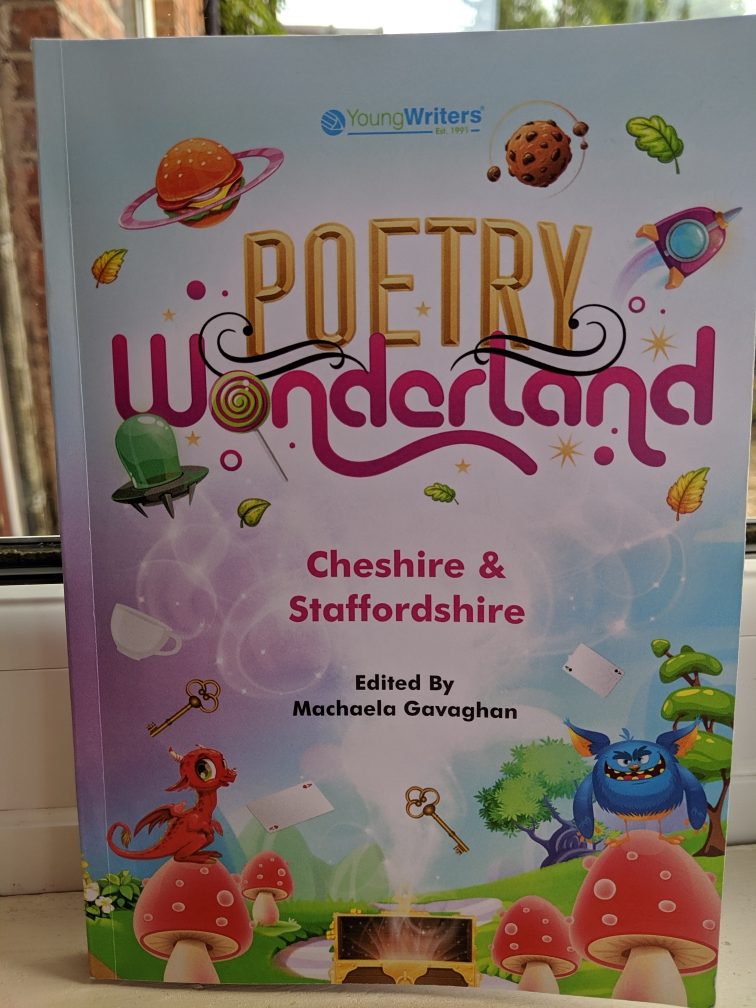
Books From The Pantry: Poetry Wonderland by Young Writers edited by Machaela Gavaghan reviewed by Claire Faulkner

Knowing that I enjoy reading poetry my Mum mentioned a book of poems written by children from schools in the local area. ‘Would you like to read it?’ she said, ‘I can get you a copy.’ I agreed, and a few weeks later, as I was leaving my parent’s house following Sunday dinner, Mum handed me the book. ‘It’s very good’ she said, I’ve enjoyed reading it.’


Poetry Wonderland is an anthology edited by Machaela Gavaghan. The book was published and organised by Young Writers, a group who run competitions and work with schools up and down the country.


For this competition and publication, Poetry Wonderland invited primary schools from Cheshire and Staffordshire to create wild and wonderful poems on any topic they liked, the only limit was the limit of their imagination.


In an age where funding of the arts in schools is decreasing it’s a real joy to see children in primary schools being encouraged to use their imagination and enjoy the experience of writing poetry.


On a personal level, I find that there’s something very honest in poetry written by children. It’s expressive, truthful and open, Poetry Wonderland had some great example of this. There is a full range of poems in this book, a mixture of styles and structures, some rhyming and some following a set pattern.


If I Had Hope is by Lily-Mai Jackson aged 9 from Wistaston Academy in Crewe and describes hope through each of the senses. It opens with:

If I had hope
I would touch the falling hearts that are far away
and fill them with magical tears…

This beautifully written poem finishes on a dream:

…If I had hope
I would dream of smiles and perfume for
Christmas

The freedom of imagination in these poems also makes me smile. The Picnic On The Moon by Millar Anderson aged 11, from The Ryleys School in Alderley Edge, is just brilliant in its approach and explains what might go wrong if you decide to go to the moon:


The picnic on the moon,
It was a nightmare…

The tea was cold,
The drinks floated off,
The aliens ate all the sandwiches…

Determination and positivity also come through in many of the poems. One example of this is, I’m Walking On A Rainbow by Poppy-Jane Powell aged 8 from Burton Manor Primary School in Stafford:

Imagine if you could walk on a rainbow,
Who said you can’t?
W is for walk
A is for another rainbow
L is for learn to walk on the rainbow…

Creative writing also gives a platform for freedom of expression, and I think we can all relate to Tired by Grace Ivell, aged 9 from Broadbent Fold Primary School in Dunkinfield:

My neighbours alarm clock is loud…
…they need to get a new one
A bit quieter, I think.

To me, anthologies like this show how important it is to develop interest in the arts for younger children. Hopefully all those involved in this project will have had fun and this will encourage them to read and write more poetry in the future.


My Mum was right. I have enjoyed reading this book. It’s reminded me to have fun with my own creative writing, be more open with ideas and to read more children’s poetry.
For more information on Young Writers and Twitter

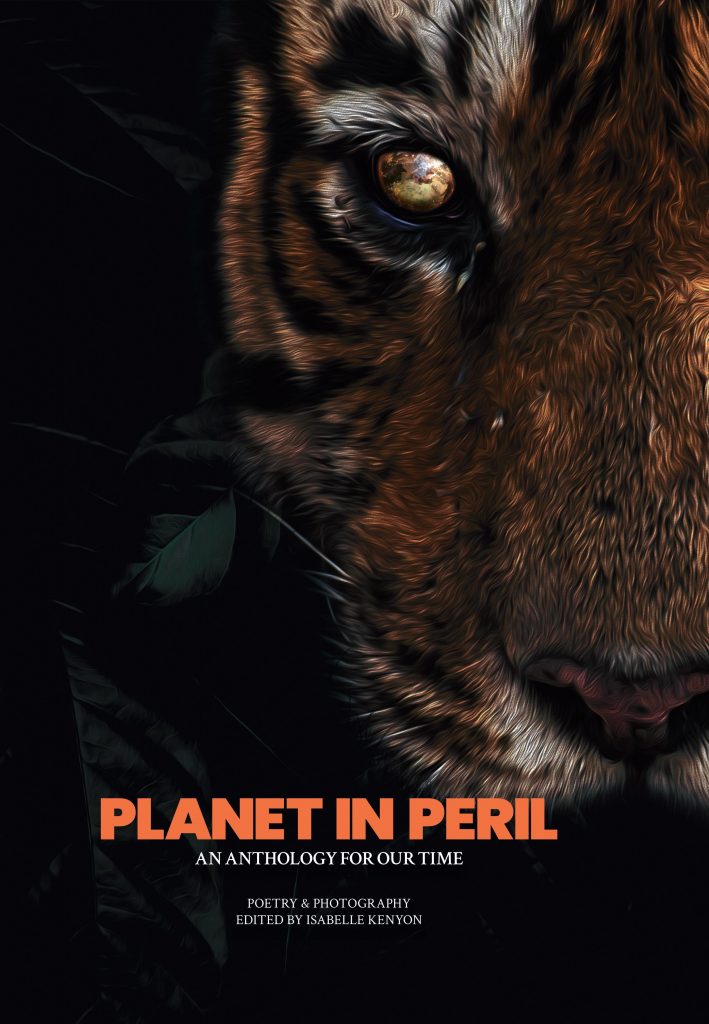
Books From The Pantry: Planet in Peril: An Anthology For Our Time edited by Isabelle Kenyon of Fly On The Wall Press

A new metaphor is as useful in the climate fight as a new solar panel design. We need poets engaged in this battle, and this volume is proof that in fact they’re in the vanguard!

Bill McKibben, Schumann Distinguished Scholar at Middlebury College and leader of the anti-carbon campaign group 350.org.

Editor Isabelle Kenyon speaks about brand-new anthology of eco-poetry, photography and art: Planet in Peril.

“Fly on the Wall as a Press aims to talk about the most pressing issues of our time, and I knew that there is possibly nothing more urgent than our current fight against the rising temperature of our planet. Anthology “Planet in Peril” is founded upon the belief that words have the power to change and I have been extremely heartened and emboldened by the passion and heart of the creatives featured, aged 8 to 80. I believe that no book can ever come close to describing the devastation which climate change is currently causing and will continue to cause to many ecosystems. However, in my humble opinion, this anthology certainly comes close. Divided into sections of vital ecosystems and continents, the artists weave the world as they see it: the beauty, the intricacy, the devastation and the vulnerability. Some imagine a dystopian future, or perhaps what is now becoming a reality, for our future generations.

For this project we will be fundraising for WWF and The Climate Coalition. Dr Michelle Cain (Oxford University), has kindly written a foreword which really brings home what this book aims to do: interweave scientific research with artistic disciplines. The former Derbyshire Poet Laureate, Helen Mort, and Brazilian based wildlife photographer, Emily Gellard have been commissioned and really bring a sparkle to the book.

This project will extend beyond print media, however. Our children and our children’s children will have to live with the potentially irreversible effects of climate change. Consequently, I have decided to run several initiatives intended to involve and educate children of all ages in this project. First, the anthology showcases a section for twenty poems submitted by writers under the age of 18. Two poetry workshops have taken place and so far, three school visit are planned, designed to engage them in poetry writing and art inspired by the book and its themes.”

Further details can be found at Fly On The Wall Press. Enquiries should be addressed to IsabelleKenyon@hotmail.co.uk

Pre-order your copy of Planet in Peril. Special discount code to Inksters:
INKPANTRY10 (valid until the 4th of August 2019).

Extract from Kittiwakes by Sue Proffit

Bursting from the cliff-face
in an urgency of light,
catherine wheel of wings
flinging its spirals seawards

over glittering water,
they pocket the cliff
in hairs-breadth nests
where chicks stick, smudge-eyed –

the growing silence
is sucking them out
of rock, water, rapturous air,
leaves me bereft –

so few of you left.

Extract from ‘where she once danced’ by Anne Casey

she is drowning in a sea awash with cobalt
deadly metals fill the channels where she breathes

her lovely limbs are shackled down with plastics
her lungs are laced with deadly manganese
a crown of thorns to pierce her pretty head
a bed of sludge to lull her in her dreams

Poetry Drawer: Permanent Segments by R. Gerry Fabian

Once
She asked how
powder was made
and he replied
from the eyes of goldfish.

Another time
they played fictional characters.
He was Stanley Kowalski

In one of those
paper thin moments
that psychologists journalise,
she asked him
‘Will you ever love me?’
He told her,
‘The Big Dipper held the answer.’

Today her home contains
an aquarium,
the complete works of Tennessee Williams
and a skylight in the bedroom.

The man that she married
doesn’t understand
why she looks out the skylight
when they make love.

R. Gerry Fabian is a retired English instructor. He has been publishing poetry since 1972 in various poetry magazines. He is the editor of Raw Dog Press. He has published two poetry books, Parallels and Coming Out Of The Atlantic. His novels, Memphis MasqueradeGetting Lucky (The Story) and Seventh Sense are available from Amazon, Apple Books, Barnes and Noble. He is currently working on his fourth novel, Ghost Girl.

Zines From The Pantry: Butcher’s Dog Magazine (Issue 11) reviewed by Claire Faulkner

I was lucky enough to be gifted a copy of Issue 11 of Butcher’s Dog Magazine recently, and what a wonderful present it was. Butcher’s Dog publishes two magazines a year, each issue has an original art cover and features up to 25 exceptional poems. Issue 11 was edited by Dr Jo Clement, Will Barrett and Ali Lewis.

As a magazine, it’s beautifully made. The cover piece by Qi Fang is awash with soft blues, purples and pinks. It feels lovely to read. The poems flow and work together, supporting each other but still have their own identity and voice.

The thrill of getting publications like this is the introduction to new poets you might not have read or discovered before, and there are some outstanding poems in this issue.

I have read my copy several times now, it has accompanied me on train journeys up and down the country. Each time I found a new favourite, a new meaning or a new interpretation of one of the poems. Which makes this a difficult review to write. The poems I mention in this review are the ones which captured me somehow, or which stayed with me long after my train journeys were over.

Even the dedication of this issue captured my soul and made me wonder about Buckley. I can picture the joyful dog at the beach with his “…golden tail held high, / face to face with the ocean’s spray.”

Sheep in flood by Iain Twiddy is a beautiful piece of writing centred around nature, memory and loss. There’s an urgency in the structure and language used, which to me emphasises the strength and struggle in both life and death.

“…You pulled it in, your ninety-year-old forearms
and shoulders and spine, dragged at that boulder,
slippy as rock moss, heaved it, gripping, up
through the mud, then gasped back into the bank,
panting in the mist, your heart a shudder
thumped again when it instantly upped
onto its stump-black legs and ran off…”

Armistice Day by Victor Buehring captures the moment of a two-minute silence with vivid clarity, but could also be questioning the readers perception of peace within society today.

Your daughter is looking for you in the library by Claire Collison, completely entered my imagination. I enjoyed the structure of the poem, and how imagery was used to search for someone within items and documents. There’s a haunting quality to this piece, and by the end I could see into that microscope. 

“…Your daughter couldn’t work out your brass microscope

                                                                                                root tip of hyacinth

so we can’t see what you saw

                                                                                                blood smear

in slides the size of sticking plasters –

                                                                                                pike scales

all that you gave up,

                                                                                               Spiracle (side) Dytiscus

under glass.”

Two elephants in a room by Tom Sastry struck me the moment I read it. It’s both beautiful and dark at the same time.

“…I did see a mirror.
I saw what a mirror makes me feel.
I didn’t understand it.
I had no use for it…”

Is this poem about seeing the truth, self-identity or survival? It’s a striking piece of writing, with a well-deserved place in a strong and inspiring magazine.

I could go on and on about this issue of Butcher’s Dog Magazine, instead I recommend that you seek a copy out for yourself, dive in headfirst and see what gems you find for yourself. You can find out more information on Butcher’s Dog or Twitter

Poetry Drawer: Imagination Dance by Hunter Boone

You started it
by wearing the slinky
tigress outfit
the one that snaked over your hips
to lay bare
your tawny body
beneath liquid cellophane.
I have no idea
why I did not have enough sense
to leave you
where I found you –
in the contortionist’s cage
on Times Square
where you always humped your best
in front of an audience to the beat
of a long line of mule-eyed
protagonists.
“Their numbers are as the stars in the sky.”