Poetry Drawer: Hangovers: History of Spanking: Late Night Martini Talk: Legions of Angels: Cornucopia by Vern Fein

Hangovers

A world-wide experience–
Perhaps cave dwellers
quaffed remedies like mastodon blood
for the pain of sloshing down boozes.
The Roman poet Pliny–ate fried canaries,
raw owls eggs – but died of fumes from Pompeii.
Birds may be the key – the Assyrians
in the time of the cruel Sennacherib,
who was certainly a drunk, chewed
ground bird beaks mixed with myrrh.
In medieval times, maybe even the monks
slurped raw eels and cracked bitter almonds.
Placidly the Chinese sipped green tea – and still do.
Maybe the worst, Mongolians recovered with pickled sheep’s eyes.
But the Japanese only pickled savoury plums.
The good old Wild West – Prairie oysters, raw egg yolks
Worcestershire sauce, Tabasco sauce, salt, and pepper.
A football player I knew slugged down five yolks daily
before he was thrown off the team.
You might want to avoid Puerto Rican bars,
cuz of their preventive deodorant—
lemon slices under armpits.
Bloody Marys are quite common now,
but Hemingway downed Bloody Beer.
I’m sure there are many more, maybe you have a favourite?

But if you’re a lush, a souse, a binger,
no matter– none of them work.
So you’re sitting at your special bar
or home with your favourite elixirs.
You know, you know, damn well you know–
The best and only cure is to cork the bottle.
Good luck!

History of Spanking

Mrs. Furness, my second grade teacher,
long dead now, told my mother,
“If I believed in geniuses, he is one.”
Made me her pet, skinny me, buck teeth,
owl glasses, unruly cowlick,
left in charge of the class
when Mrs. F. went to the Ladies Room.

Watched over her desk, stopped
kids from messing around.
Janie did, despite my protests,
stuck out her tongue.
Class clown, tipped over
the inkwell on all the papers,
fled to her desk just in time.

“Who did this!.” screeched Mrs. F.
“Who did this!,” spit my name.

I was mute. Janie and the class
prayed I would not tattle.

What would the kids do?
Push me off the monkey bars?
Flip me off the Teeter-Totter?
Refuse to play?
Billy once spit on Stuart.

Mrs. F., arms akimbo, glared:
“Either you tell who
or I call your Father.”
Terror squeaked out, ”Janie.”

She dragged her up front,
flashed her ruler, whipped her,
ripped her dress,
sent her to the office,
the class yelled, cried, glared.

It is said: Spare the rod, spoil the child.
And they spanked, switched
and whipped, even beat
until Dr. Spock—the Dr. Seuss for butts—
said: Wrong thing to do.

In Texas, they allow paddling again.
Triumphant Mrs. F., arms akimbo,
smiles down from above.

Late Night Martini Talk

In 1981, a noted editor,
martini under a small lamp,
yawned, turned the manuscript over,
snapped off the light,
Took the last sip, tongued the olive,
went to bed, after signing
the letter informing
Gabriel Marquez his story
submitted to the New Yorker
would not be accepted.

Marquez won the Nobel Prize in ’82.
I suspect that same editor
is now quietly sipping a martini
by that same lamp, intoning,“I fucking
rejected, Gabriel Marquez,”
nodding, “I fucking…”

My story was rejected by said mag
last year. I suspect martinis ahead
for another poor fool.

Legions of Angels

Though many think Him deranged,
insane—healed lepers, walked on water,
dispelled demons, raised his friend
from the dead, then, the same for Him,
most would not call Jesus a liar.
Intimate with attending angels ,
famished and broken in the desert
when they rushed to minister to Him

He responded to Pilate—
If He asked the Father,
God would send forth
twelve legions of angels,
(approximately 5,000 x 12 = 60,000),
to rescue Him right then and there,
eschew the blood and pain and death
of the old rugged Cross—
was He scared or out of His mind?

Instead, if He spoke Truth—
indeed, when released to return,
He will be joined by those angelic Beings—
horses charging from the sky,
brandishing swords and fire.
Understand the difference
between Truth and falsehood,
between reality and illusion
and know that a great cloud of witnesses
will burst forth with legions and legions
of angels and others—soon.

Cornucopia

You can’t slip and fall on sunshine.
Wagon trains never go East.
Weeds don’t know they’re weeds.
I didn’t know flowers went to Heaven.
Nailing my heart to the roof of my mind.
Bull in a china shop and you are the china.
Shoving toothpicks into the cuticle of your soul.
Sludge of a different colour.
My life is so much thinner than thick.
I was annoyed at the moon.
There is no punctuation in dreams.
Eventually it is naked and sags.
The comedic timing of an owl.
Everything has a penultimate day,
even The End Of The World.

Vern Fein is a retired teacher and community organiser of outreaches to those in need who has decided to write now because Vern has the time and strong inclination to do so. Vern has published a number of poems and short non-fiction pieces.

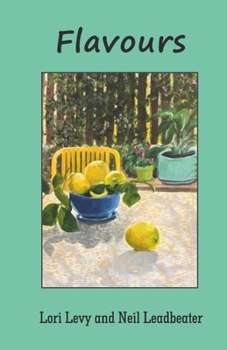
Books from the Pantry: Flavours by Lori Levy and Neil Leadbeater reviewed by Simon Fletcher

The cover suggests that ‘here be lemons’ and good company and a sunny clime. All well and good. A slice of Mediterranean life, perhaps. But there are two names on the cover. How is this going to work?

In fact it works very well and the two poets in question Lori Levy, Los Angeles-based but with a second home in Israel, and Neil Leadbeater, a West Midlander who lives in Edinburgh, combine to produce a delightful three-course meal.

Course one is from Lori whose work repays re-reading as I didn’t appreciate the scope or depth of her work on a first perusal. She writes about favourite foods, cookies, for instance, in ‘Mint Milano’:

chocolate mint Milano, a favourite in my family
for five generations. Each bite I take
is a journey back in time to Nana Ceil in New Jersey,
to her humor, her stories, the gold fillings in her teeth.

And then, she takes us forward in this land of familial passion:

They may laugh, but my youngest son heads to the kitchen
when he comes to visit – straight to the cabinet with the treasures,
for he, too, has inherited the mint Milano gene.

Lori writes inspiringly of ‘tilapia, fresh salads, shakshuka, kebabs’ while ‘At the Supermarket in Los Angeles’ and one feels this deep connection with family, over time and in many places. It’s the ‘flavour’ of the food that connects.

Neil Leadbeater is slightly less passionate, as one might expect, and considers, among other things, where food comes from and who grows it. He writes about the farmers, in ‘Grease-banding the Apple Trees’ his own family:

In the last days, we made our way to the trees-
disrobed them of their hay-bands, those coarse bits of
sackcloth that had caught the caterpillar codlin moths
and foxed them at their own game.

He also writes about one of England’s most celebrated cheeses in ‘The Double Gloucesters’, where, at the agricultural show:

Hard-pressed to declare
a winner, judges could not
praise enough their rich
nutty mellow flavours,
their apricot
Lady’s bedstraw yellow,
that mix of milk and cream.

The third course, ‘Dialogue Poems’, is no less rewarding with Lori speculating about what they might do:

If you bring a red-cheeked apple
from the Vale of Evesham,
I promise to come with a slice
of banana cake with pineapple cream.

Neil responds with an act of poetic theft, holding in mind William Carlos Williams’ glorious ‘This is Just to Say’:

I stole downstairs
in the middle of the night
and opened a line from
one of your poems…
took out the passion fruit
and ate it whole.

No forgiveness is required, Neil. It made me smile and it’s a fun and witty envoi to the whole collection. Here are two poets obviously and deliciously enjoying each other’s company. Their focus is ‘food’ and its complex histories but it’s all about the people, for food crosses borders and generations, with love, something we all hunger for at this time. Highly recommended.

Flavours by Lori Levy and Neil Leadbeater is published by Cyberwit.net

Simon Fletcher lives in the Oswestry Hills, Shropshire. He is a widely published and travelled poet who was short-listed for the Michael Marks Environmental Poet of the Year in 2022 and nominated for the Forward Prize (best single poem) in 2024. He’s performed his poetry across Britain, in Pakistan, Germany, Norway, and on BBC Radio. Simon runs poetry writing workshops in green spaces/places and MCs monthly live literature events. He’s also the manager of Offa’s Press. Simon’s pamphlet Wild Orchids, and the Offa’s Press books he has edited, are available at the Offa’s Press shop. Find out more about Simon at www.simonfletcherwriter.com

Books from the Pantry: The Whole Tangerine by David Bingham reviewed by Neil Leadbeater

Retired teacher/lecturer David Bingham has been writing haiku for more than 20 years and is frequently published in leading journals. During 2013-2014 he served as editor of Blithe Spirit, the journal of the British Haiku Society and from 2021-2022 as acting BHS president. In 2017 Bingham won the BHS Ken and Noragh Jones Haibun Award. He edited ‘Ripening Cherries’ (Offa’s Press, 2019), an anthology of haiku, tanka, and haibun, as well as ‘Stories under Every Rock’ (2020), an anthology of haibun. He is a leader of the Shropshire-based Green Wood Haiku group and regularly leads English-language haiku composition workshops and organizes readings at group meetings and literary festivals. His debut poetry collection ‘The Chatter of Crows’, was published by Offa’s Press in 2014. He resides in Ironbridge, Shropshire, U.K.

He has read his work in arts centres, pubs, theatres, on local radio and poetry and literature festivals. His most recent readings have been at City Voices in Wolverhampton and Country Voices in Shropshire. As part of the humorous poetry double act Bingham and Woodall, he is a frequent performer with John Woodall at the Wolverhampton Lit Fest and Comedy Festivals and at the Ironbridge Festival.

This attractive pamphlet of poems, with its striking cover design by Kuli Kohli, showcases some of Bingham’s different styles of writing with a particular focus on haiku, tanka, and prose poetry. His images are as vivid as the reddish-orange shade named after the fruit in the title. The joyful, sometimes surreal sense of humour that runs through this collection also lives up to the cultural symbolism of the tangerine which, in certain traditions, represents good luck, wealth and positive beginnings.

Bingham’s brand of humour is amply displayed in the collection of haiku called ‘Haiku 1’. Here are three examples:

a lifetime
overcoming gravity –
still, it gets me down

wondering
how long it’s been there…
the beetle in my hat

noisiest in the café…
retired librarians
out for lunch

The ‘Tanka’ sequence is, by contrast, more meditative and reflective:

on waking
I turn my dreams
inside out
letting the seams show
for the rest of the day

doors left
wide open revealing
an unlit space
nothing here to steal
but the darkness

In ‘Pips’, Bingham gives us his own brand of philosophy on life: rather than being distracted by the highs and lows, an accepting spirit of the overall picture is best of all:

The trick lies
in accepting that life
can’t be divided
into segments;
it’s either nothing
or the whole tangerine.

Whether he is writing about undergoing an eye test at the opticians, riding home from school in a thick Merseyside fog or taking tea in a Church Stretton tea shop, one of his many strengths is his ability to write about domestic episodes in common settings which everyone can identify with in an immediate and accessible way without making it sound tired or ordinary. This is partly achieved by keeping the writing spare through the adoption of a highly compressed writing style. A discipline which he has no doubt honed over the years through his engagement with Japanese forms. The directness of the writing also makes for good performance poetry.

One of my favourite poems in this collection is ‘Hi, Hedge’ where he addresses an overgrown hedge as if it were an encounter with a fellow human being: “So, what can I do? But don’t think you’re getting away with it.” Another favourite is ‘In and Out of Wolverhampton Art Gallery’. Like the previous poem I mentioned, there is something in the title that gives us the substance of what is to come. In the case of the latter, it is the way in which he takes the reader, stanza by stanza, further back from the picture altering our perspective on things. The ‘In and Out’ of the title becomes, like the poem that follows it, telescopic. The last two stanzas change direction completely in a very skilful and unexpected way:

But such trips leave little time
for a pastry and an Americano
in the newly revamped cafeteria;

a place, where the state
of the human condition is often
more apparent than
on the walls of the gallery.

A similar concept is adopted in ‘The Afternoon Train’ where each successive couplet takes the reader on ever-greater distances into what eventually becomes a totally surreal experience.

These keenly observed, thoughtful and joyful poems make a welcome addition to the growing catalogue of publications from Offa’s Press. Highly recommended.

David Bingham: The Whole Tangerine, Offa’s Press, £7.00

Poetry Drawer: Catafalque embroidery: Life on the High Cs: Topaz endeavours/ Buck / Rogers in / the 25th Century by Mark Young

Catafalque embroidery

(Baudelaire’s) collapse occurred as he was praising the elaborate
confessionals of the church, the interior of which he had
earlier described as a “terrible & delightful catafalque.”

Félicien Rops: Baudelaire & skeleton passions

Two rows of crowned kings & queens
are depicted on cloth of gold & yellow
silk on black velvet. These can be changed
to similar designs at no extra cost. The

coffin holder is made of sturdy solid wal-
nut. Two easels, one at each end, complete
the set. It’s perfect for any occasion, made
even more attractive by inlaid images of

skeletons that imitate those that are evoked
in Baudelaire’s Les Épaves, a book that in-
cluded several poems banned from Les
Fleurs du Mal
. Published in Brussels where

he had escaped to, even though he hated
Belgium, because his creditors could not
follow. Much alcohol, opium, poverty; &
then the stroke that presaged his death.

Life on the High Cs

When run through any English-
Icelandic translation app, the
atomic hypothesis & its concept
of cloud comes out resembling

a gothic horror screenplay. No
consideration for classical theory.
No sensitivity toward sociological
phenomena. Persons under the

age of twenty are included only
if they play in a Southern U.S.
university marching band or a
Marine Drum & Bugle Corps.

Topaz endeavours

It is a capricious, not auspicious,
beginning. I have forgotten how
to genuflect; & when I go to look
it up, I am greeted by “No inform-
ation is available for this page.” I
deliberately chose capricious as the
descriptor: in this time of kings, I
am afraid of what might happen

to me if I do not bend the knee to
the cabal that rules. So many acts
of baseless retribution in the air
one cannot help but smell them.
Or is it the scent of fear that swirls
around me, moving inside to out.

Buck / Rogers in / the 25th Century

Everybody in the coffee shop today
looks like someone else. The only
problem is that the people they
look like are all dead — relations,
mothers of friends, famous faces.
I am in a room full of ghosts who I
cannot see through. Then they speak
to me & I cannot hear their words.

The average age, I’m guessing, is
in the late 70s. Then I leave, & that
drops it below 70. They mutter to
themselves as I pass by, & I can
read the vibrations of their moving
lips. “Who was that masked man?”

Mark Young was born in Aotearoa / New Zealand but now lives in a small town in North Queensland in Australia. He has been publishing poetry for over sixty-five years, & is the author of around eighty books, primarily text poetry but also including speculative fiction, vispo, non-fiction, art history, & an artist’s book. Recent books are Balance, from Neo-Mimeo Editions, Nualláin House, Monte Rio, California & From the Cave’s jukebox, from Sandy Press, Santa Barbara, California. A new collection, synecdoche, came out from Sandy Press in mid-April.

You can find more of Mark’s work here on Ink Pantry.

Poetry Drawer: Clear Stones by John Swain

Lions fire from the ochre riverbed,
you stand in white among the sun trees,
you dress in linen sand,
burnt perfume and your red furs
linger on the river air,
you arise on a ladder of clear stones
to gather fragrant branches,
you silver thread the light on water.
I seek the dynasties of your silence,
a drop of my lamp oil falls
like a water bead on the shard of a mirror
resembling the cenotaph of a queen.

John Swain lives in Le Perreux-sur-Marne, France.  His most recent chapbook, The Daymark, was published by Origami Poems Project. 

You can find more of John’s work here on Ink Pantry.

Poetry Drawer: Back in Business: Like Father, Like Son: These Fine Children: Flowers for a Friend: Passerby: Someone in the Fog by John Grey

Back in Business

Time to sit on my porch,
read the newspaper.

The sun is well into
its spring U-turn,
sends warm rays of regret
for its winter absence.

A bee lands
on a breeze-tossed petal,
induces a golden butterfly
to join him.

Dogs no longer just walk
with their masters.
They seek out each other,
circling and sniffing.

A mockingbird
on a rooftop
advertises his wares
in borrowed song.

Windows open.
Chimneys are silent at last.

It’s the season
when my fancy demands
it be turned to something.
Not love, necessarily.
Lazing’s a good second choice.

Like Father, Like Son

A father, Frank
going straight after a long history
of drug offences –

and a son, Matt
out on bail
after a stash of cocaine
discovered in his car by cops –

that’s the family scene,
the one where Matt
sneaks in and out of the house

or stays up in his room,
eats his meals alone

and then,
when they do run into each other,
their tongues freeze up

but two pairs of hard angry eyes
make contact,

as they both look deep
into each other,
see the same festering hungers,
the same wretched desires,
the same pathetic appetites
that adulterate the family blood –

and they turn away in a shame
disguised as a superiority –

“he’s turning out
just like me,” thinks Frank –

“I’m turning out
just like him,” thinks Matt –

from the disgusted looks
on both their faces

you would never know
they just agreed on something.

These Fine Children

They are perfect,
middle of the night
sleeping,
middle of the day,
thumping volleyballs
across a net.
Their faces are
pure and lovely,
just like yours
at that age.
The photos
on your dresser
are a history
of how these
moments came to be:
your sly glance
through the
slightly ajar bedroom door,
your full face
at the parlour window.
God’s creation?
Maybe.
Your creation?
Is there any doubt.
At night,
alone at the kitchen table,
coffee and a cigarette,
a bottle of pain pills…
if only their father
were alive to see this.
For all their glory,
triumphs know
their place.

Flowers for a Friend

The river’s all dolled up,
with the sheen of skyscraper lights,
some stars sprinkled here and there –
the Hudson must be on its way
to someplace special.

Your face flashes out of all others
like a sudden appointment I’ve forgotten to miss,
and the sirens – God, the sirens –
it’s the sound of cops looking for something to do.

Someone (you?) says something.
It’s hard to tell in a crowd.
But I listen.
And I believe.

A woman’s selling flowers
that are so outrageously perfumed,
like they’ve been reading French novels
and wanted everyone to know.

I buy a bunch,
hand them to you.
You take them like you’re accepting
a bill you already know you can’t pay.
The river keeps going.
We don’t.
Not yet.

Passerby

You bring me pleasure.
Ironic that.
You could be a harpy,
a bigot, a child murderer,
for all I know.

You could be fool enough
to think that
a lovely face,
long straw-coloured hair,
a lithesome figure
in a fluttering blue cotton dress
is enough.
Let me tell you.
It is enough.

Yes, in my friends,
I want all the virtues.
But I look for beauty in my strangers.

Someone in the Fog

The fog is thick
but I can just make out a person
up ahead of me.
Not the features,
just the shape.
Not the way of living,
just the presence.
I see what must be a head
but not the knowledge.
And a torso
but no scars.
Limbs
but not what they bear up.
I’ve just reached an understanding
of who and what I am.
But with other people,
the fog rolls in.

John Grey is an Australian poet, US resident, recently published in Midnight Mind, Novus and Calliope. Latest books, “Bittersweet”, “Subject Matters” and “Between Two Fires” are available through Amazon. Work upcoming in Levitate, White Wall Review and Willow Review.

You can find more of John’s work here on Ink Pantry.

Poetry Drawer: My Ouija Board, Left on Read by Arshi Mortuza

I have spent years
warding off evil from my chest.
I’m convinced that my heart —
once plump, pulping,
and dramatically impaled
by Cupid’s bow —
has since flattened
into a planchette.

I drag my planchette heart
across ouija boards —
and spell out your name
though I’ve buried you
a thousand times.
More incantations:
“R u here?”
“I still <3 u.”
“Gimme a sign.”

Not that you answer.
I swallow the sting
of my séance
being seen-zoned.

Arshi Mortuza is a writer and educator residing in the Greater Toronto Area. She is the author of One Minute Past Midnight and Pressed Flower. Her work has been featured in numerous literary outlets worldwide.  

Flash in the Pantry: Bulletins of the Broken-Hearted by Ian C Smith

Minor characters from my past play walk-on roles in my dreams. Precise details: the huskiness of a woman’s voice, the neatness of a long-ago boss’s moustache, cameo appearances with those closer to me in life’s hurly-burly, my regulars, intrigue me. The only part of an early story by John Updike I remember was when the narrator described the past as a vast sheet of darkness where a few random moments, pinpricks of light, briefly shine. Reading Eligible, Curtis Sittenfeld’s witty modern take on Pride and Prejudice, reminds me how much art makes of misunderstood information, sexual and social tension, the giddiness of thin secrets, small things lit by hope or darkened with despair. Before mobile phones, noisily busy in an adjoining room, I once heard the staccato of a long message being left on my answering machine. When I had time to play it, optimistically expectant, to my utter horror it had vanished due to a connection fault. I never learned who believed I had received it without response. These missed instances transport me to student days and Angel’s letter under a rug in Hardy’s Tess of the d’Urbervilles.

My serendipitous discovery of Yeats’ early poem, He Wishes for the Cloths of Heaven, also before mobile phones, came about when, like a character in an old monochrome movie, I lifted an antimacassar on my club armchair, exposing a hidden letter. A nephew, my house-sitter during recent travels then, had a girlfriend, the letter’s addressee. Did she hear his approach, slip the letter from sight, then later forget it? Aswarm with voyeuristic conjecture, I read it, mind-chuckling about this connection to novelists’ formulae of letters found too late or never. Someone with a European name travelling by bus around northern Australia gazing on an endless panoramic heat shimmer covered a page describing this before getting to the point: his unrequited, perhaps ended, love for my nephew’s girlfriend. His heart’s slender hope bled all over the rest of the pages, awkward syntax charging its poignancy. Conscripting the young Yeats to illustrate his adoration, the poor guy reduced that effect by transcribing the gorgeous ‘Cloths’ as ‘Clothes’.

Now, my mind a maelstrom of memories, I wonder if that lovelorn swain recalls his paean to the girl he had lost to my nephew who, though no longer her partner, is still in touch with her. Do his thoughts return to the landscape between Broome and Darwin when he felt dizzy with desire for a girl who is now growing old and drinks too much? Do pangs of lost love, its accompanying dolour, linger? His added postscript: ‘No more beautiful words were ever written. Isn’t it you and me?’ followed Yeats’ poem. Perhaps with Maud Gonne on his ardent youthful mind, Yeats closed with: I have spread my dreams under your feet;/ Tread softly because you tread on my dreams. One thing that young man lonely on a bus achieved was his inadvertent introduction to me of what would become my favourite poem, so rich is its tapestry of swooning loveliness. I wish I could dance the tightrope of language with that broken-hearted scribe who heard the tyres moan, leaving all his dreams behind, as my reading life whizzed by.

Ian C Smith’s work has been published in BBC Radio 4 Sounds, Cable Street, The Dalhousie Review, Griffith Review, Honest Ulsterman, Offcourse, Stand, & Westerly. His seventh book is wonder sadness madness joy, Ginninderra (Port Adelaide). He writes in the Gippsland Lakes area of Victoria, and on Flinders Island.

You can find more of Ian’s work here on Ink Pantry.

Poetry Drawer: Without seeing, without waiting by Nikollë Loka

When the tomorrow
comes as a light at first,
and in the dark the darkness burns,
it explodes in flower loops
your soul.
Without seeing,
without waiting!
This autumn
shares fruit scent,
even though the type is pushing towards winter,
the leaves fall,
when the loops are ready to be born.
Without seeing,
without waiting!
I touch this autumn,
it burns my hand
and the day becomes sad.
When I smell
I feel a spring breeze.
Without seeing,
without waiting!


Nikollë Loka was born in Mirdita on March 25, 1960; graduated as a teacher at Luigj Gurakuqi University of Shkodra; master’s degree in pedagogy at the University of Tirana, doctorate in history of education at the University of Tirana. Author of ten poetic volumes in Albanian and three poetic volumes in Italian (two of which with co-authors); included in the anthology “La Poesie contemporaine albanaise”, “L’Hartmattan” publications, Paris 2024. In addition to Albanian, his poems have been published in Italian, English, French, German, Arabic, Romanian, Swedish and Macedonian. Winner of several literary awards in the country and abroad. Included in the Lexicon of Albanian writers 1501-2001, editions “Faik Konica”, Pristina 2003 and in the Encyclopedia of Italian language poets, “Aletti Editore” Rome 2021.

You can find more of Nikollë’s work here on Ink Pantry.

Poetry Drawer: The Squirrel: The Mouse: The Myth of Correspondence: Tuesday: Mouse Trap by Holly Day

The Squirrel

I thought the squirrel had died inside the tree so I poked at it
with a stick. It didn’t move, so I poked inside the hollow
I thought it was trapped in, poked it again. Something grabbed my stick
tugged it with teeth and tiny hands, and so I pulled
the stick back out. Weeks later

three tiny tails snaked out of the hole next to the first squirrel’s
twisted and wrapped around their mother’s tail as though
they had to cling to her even out here. I never saw
their little faces, never saw anything but the tails
growing thicker and redder and fluffier with each day.
The mother would only come out at night
to gather food for them, I never saw her leave her post.
I spread crackers with peanut butter for her in the kitchen
carefully placing them just below her nest as an offering
a plea for forgiveness.

One morning, all four tails were gone. The hollow
gaped at me, abandoned, from my old birch tree.
I put more crackers in the garden, put them in the branches
near the hollow, chased stray cats from my yard and
kept the dog inside, but I never got to see those little squirrel children
never got to see who had made their first home in my yard.

The Mouse

My husband calls me into the kitchen to show me the mouse
that has fallen into the sink during the night. “I think it’s dead,” he says
just as it begins paddling half-heartedly in the water once more
one last, futile effort to find some purchase on the slick porcelain basin
one impossible final effort. Its eyes are dull, flat, black
minutes from the end. I reach down into the water,
pull the little creature up by its tail
take it outside. “Make sure it’s dead,” calls my husband from the house

not wanting to be a part of whatever I have planned. The mouse
struggles feebly in my hand. Its eyes don’t see me. I have never
seen eyes like that before, half goggled, oblivious
like two dull nail heads jammed into its face.
I carefully set it down in the garden, place its feet on the dirt
let go of its tail. “Please don’t come back,” I whisper
as it struggles for life, for balance
before springing off into the undergrowth.

“Please don’t come back.”

The Myth of Correspondence

To fully understand the pictures I have sent you
first, fill a bathtub with water and ice
get into the tub with all of your clothes on.
Only then should you shake these photographs out
of this careful assemblage of paper.

This is the only way you’ll be able to understand
the shades of weather that separate us, the only way
to separate yourself from your envelope
of tropical breezes and permanent sunshine.
I will speak to you through the ice bruising your skin
a frigid wraith clinging to you from too far away.

Tuesday

On a perfect day, I would be able to open my back door
find nothing but jungle waiting for me, sunshine filtered in through the leaves
of trees I’d never seen before, the calls of unfamiliar birds coming at me from all angles.
On a perfect day, I would hear snakes in the undergrowth,
monsters rustling just out of sight
hear the low rumble of a tiger or a jaguar breathing a warning shot
close by, perhaps as close as the cooling shade beneath my back porch.

But this is not a perfect day, and I have not been transported
to a random scene from a Kipling novel, have not been transported back in time
to march with Herodotus or Alexander through lush jungles untouched by civil war
am not looking for new species of birds with Audubon
or stumbling into and through the ruins of Machu Picchu with Bingham.
I am just digging holes in my own back yard for tulips and daffodils
wishing I could be anyone but me.

Mouse Trap

The little mice watch me from their prison of tin and plexiglass
inside the live mouse trap I baited the night before. Four little mice
with pointed noses and trembling whiskers
eyes black and bulging against their dark brown fur.
I wonder how I must appear to them, this giant thing
that they spend their days avoiding, rushing from one dark corner
to another at the sound of my footsteps, and now
there’s nowhere left to go, they wandered into this baited box
and now I have them in my curious grasp.

I tap on the little plexiglass window and they
rush to the corners of the box,
cram themselves into the entrance chute, their thin black tails
twitching and curling, hanging out in the open. I imagine
what it would be like to keep them as pets, these stinky little mice
what it would be like to train these wild mice to live in a cage
to eat only when food is offered, and only what I alone offer them
if eventually, they would learn to anticipate my arrival
at the door of their cage with joy, or if
they would always be just as terrified of me as this?

Holly Day’s writing has recently appeared in Analog SF, Talking River, and New Plains Review, and her published books include Music Theory for Dummies and Music Composition for Dummies. She currently teaches classes at The Loft Literary Center in Minnesota, Hugo House in Washington, and the Indiana Writers Center.

You can find more of Holly’s work here on Ink Pantry.