Inky Interview Exclusive: Former Cheshire Poet Laureate Joy Winkler

You were appointed Cheshire Poet Laureate in 2005. That’s wonderful. Congratulations. What was the process of being appointed Laureate? What poems were you commissioned to write? How did you find the overall experience?

Thanks. The Cheshire Poet Laureate scheme was in operation when Cheshire was a unitary authority, not separate as now into East and West Cheshire. The person who thought up and implemented the scheme was the then Literature and Reading Development officer Liz Newall. There were only ever six poets who held the post. The process of being appointed involved an application and an interview at which I had to answer questions and read some of my poetry. The interviewers consisted of Liz Newall, the deputy leader of the council David Rowlands, and a representative from the Arts Council. I have to say it was just a little bit daunting. The intention of the scheme was to raise the profile of poetry within the county, and as such I was commissioned to write at least five poems relating to the Cheshire County Council year (I got paid for these – hooray, the first time I had been paid for writing a poem). Also, I was expected to instigate events and projects which would encourage people in the county to take part in poetry events. I invited well known poets from all over the country to visit our libraries and facilitate workshops and give public readings. I also gave personal readings in libraries and schools.

The commissioned poems were a great opportunity, as well as varied. They involved quite another way of writing than I was used to. The first one was to write a poem to be performed on Holocaust Memorial Day. I spent most of Christmas 2004 thinking about this which was both a salutary and sad experience. All the commissions were challenging and unusual. For example, one was to write a poem for Ellesmere Port Library as part of Ellesmere Port Civic Square redevelopment. The trouble was that they needed a one liner from the poet to etch into stone in the new square, they needed it fast, I had to come up with the one liner and then later write a poem around that. I came up with ‘set sail on the ocean of your imagination’ and of course it’s still there, cast in stone.

Another interesting and challenging commission was to write a poem to encourage people to vote in May 2005. The brief was for the poem to be short (so that it could be read on radio) and for it to encourage people to vote in both local and national elections. No pressure then. The most difficult thing about commissioned poems is that you are not quite writing as yourself, and that sometimes you have to disregard your own feelings in order to complete the brief. That is really hard for a poet.

The most enjoyable poem I wrote was commissioned to celebrate Adult Learners’ Week to be read at their North West Regional Awards ceremony. I used the idea of a villanelle, but then slotted in a rhyming couplet to each stanza to make it more cheerful.

From ‘Change your Life’

There’s a treasure chest of maths and reading schemes,
Learning is a river in full flow.
See what’s under a car bonnet,
Poke and tinker with a sonnet,
Change your life and realise your dreams.

One more notable commission was when I was asked to write about the Ploughing Match at Dunham Massey. I had never been to a ploughing match before. I was advised to go along before it started and stay all day. I did. It was a great experience to see it all take shape, the tractors old and new, the shire horses, the hedge layers and all the rest. When I read it out at their annual dinner there were tears. Of happiness I believe.

The overall experience of the laureateship was one of learning new skills, feeling more empowered, of being more self-assured, and of being at last convinced that I had earned the right to call myself a poet.

You were Writer in Residence at HMP Styal. You must have empowered many people during your seven years there. What did you learn from it yourself? Have you any memorable moments?

I learned such a lot during my residency at HMP Styal. I had never visited a prison before, knew nothing of the rules and protocols and yet, naively, I wasn’t worried about that. I was given a short induction, a set of keys and the rules about using them, and an office in the prison library. Then I was pretty much allowed to get on with setting up whatever projects and workshops I could think of. I suppose you could say I learned as I went along except for the sessions I had with a wonderful organization called Writers in Prison Network who supported lots of writers in residencies and who paid us, arranged to us to swap stories, advice, gripes and solutions. Prisons are not easy places to organize new projects in. I once had a visiting poet, Joolz Denby, visit us. She was expecting to read and perform to a room of about 40 women. That day the numbers didn’t add up after lunch so there was a lock down and she ended up reading to four of us. In situations like this the regime has the only say (quite rightly) but it can be frustrating. Thankfully, the Governor agreed to pay for her to do a repeat visit and all was well on that occasion.

I learned simply to be pro-active. I would go onto the Wing and sit at a table with my books and paper and pens and wait for women there to approach me. “Got some paper for me to write to my fella?” was a regular request but a bit of gentle persuasion, and they would sit with me and write a poem or a story, and others would come by and join in. I learned to be brave in the sense of not worrying if I got knocked back, and I learned a lot about prison life and the lives of the women who ended up there and how and why they ended up there. I learned a lot about life and people. I also learned how to enthuse people into writing and reading, activities which I know to be not only educational. but therapeutic as well. There is not space here to tell you all about my work in HMP Styal, maybe I should write a book. I’ll put that on the list.

A few memorable moments though. The day I took small sachets of herbs from my garden in to act as stimulants for ideas. Just as well I wasn’t searched on the way in even though they weren’t that kind of stimulant. The day a woman tried to steal the Christmas tree from the library for her cell. She hid it up her jumper. The librarian said it could have been worse as there were many other inventive places for hiding things. The day I arranged for a van load of drums to come in for a workshop and there were no officers around to accompany the van. I had to undo the huge gates and walk alongside the van which was supposed to drive slowly. I had to break into a jog and the women prisoners were shouting to the drive “Hey up mate, slow down. Can’t you see she can’t keep up?”.

We had visiting authors, visiting poets, drummers, Chinese ribbon dancers, circus skills artists, and so much more. It was a privilege to work there and I shall never forget it.

You are currently Writer in Residence at Tatton Park in Knutsford. Please tell us about the workshops you do. What are the future dates?

I have been facilitating workshops at Tatton Park for a few years now. There are generally around 6 or 7 a year for adults, and a couple for children. Next year’s workshops start in February and details can be found on my website www.joywinkler.co.uk, Tatton Park’s events page, or Eventbrite. This year though I am also there as Writer in Residence and plan not only to write poems inspired by the park and its attractions, but also to encourage members of the public and members of staff to put pen to paper about their experiences in this fantastic place. In the past I have written a lot of poetry inspired by flora and fauna and so this particular project is icing on my literary cake.

I would also like to get more written work out and about in the park. Some enterprising person has already made up a chalk board with stories of the fruit varieties on them. I am considering taking that idea a bit further. Watch this space, or rather the space in Tatton Park.

Can you please share with us a couple of your poems and walk us through the ideas behind them?

This poem was written when we were in the car travelling North. It struck me that it was a moment in time when people and birds were all moving in different directions and for different reasons. The prime inspiration was the glimpse of a magpie, the way it flies wings extended in a way that makes it look like a crucifix. Therefore, the bird theme led the poem; ‘seasonal plumage’, ‘peck at your foibles’ etc. The poem contains all things I actually saw in a very short space of time – I often think ideas are like a camera shot with our own eyes, the image lasts sometimes and it’s great to use that. This poem will be the title poem of my new collection.

Wings, Planes and Weather Vanes

Huddled in seasonal plumage
we move into the slipstream of slow traffic,
join the migration to lakes and frozen valleys.
I peck fretfully at your foibles,
you preen a little in the rear-view mirror.
The weather vane points North.

Some plane’s vapour maps a route
in the other direction to a warmer winter.
It’s all a matter of personal choice.
A magpie stiffens its wings,
marks the space between us,
makes like a crucifix or a blessing.

The next poem is an example of me writing about a person. People fascinate me and of course by people watching we can’t always know what their lives are like. Therefore, a sprinkling of poetic licence goes a long way. However, in this case I did know a lot about this person, a neighbour, and I was moved by her story and wanted to write about it. I was thinking one day about the disintegration in her life and circumstances and I happened to be jointing a chicken while I was thinking. The stages of the two things somehow joined together into this poem.

On Thursday

Jointing a chicken, breast from ribcage,
you think about her face, deflated skin, yellow eyes
clavicle like a wishbone. If you bend the legs back,
twist until they crack, your knife will find the place.

You think about blood around her mouth, how
the paramedic called her the wrong name, how
she used to carve her way up our street like a model.
On the slab, legs, breasts, wings in pairs

the rest in the pan keeping the tempo
of a rolling boil. Where she fell, a bottle
of gin, small jigsaw pieces in a knotted
plastic bag. I took her arm, we’d never

touched that much before, years of neighbourly
routine. She was bristling angry when her legs
gave way. The fat in the chicken stock floats,
small islands, the carcass rendered down.

Where is the best place we can get copies of your poetry collections, such as Morag’s Garden, and Stolen Rowan Berries?

I have a few collections but sadly two are out of print now. These are Morag’s Garden and Built to Last, my first two collections published by the National Poetry Foundation. I still have copies of On the Edge which was published at the end of the Laureate year and which has the commissioned poems included in it, and of Stolen Rowan Berries, which is my most recent collection. I am happy to supply copies of these on request. My email is joywinkler@sky.com. Stolen Rowan Berries is also for sale in the shop in Tatton Park.

Tell us about TOWN, your verse/drama.

I wrote TOWN after being inspired by two other pieces of writing. Katrina Porteous, a poet based in the North East, wrote a piece for radio called ‘Dunstanbrugh Castle, a secret as old as the stones’. What impressed me was the way it was produced using different voices and sound effects to tell a story. I then read Amanda Dalton’s sequence in her poetry collection, How to Disappear. She says she used a newspaper article to get the story, then wrote poetry involving each of the characters involved in that piece. I took that idea but made up my ‘article’ and used ‘girl finds her mother who has only ever lived a few streets away’. I wrote individual parts for six characters, one of which was curmudgeonly Town himself (i.e. Macclesfield). Each part was written in poetry, not as dialogue. The story was based on the town’s Barnaby Festival and I had Barnaby as a visiting stranger/magician/performer of art who turned the whole thing around. I performed the verse/drama myself with support from Andrew Rudd who composed and performed a music scape for it. Andrew was also a former Cheshire Poet Laureate – see how we progressed. We toured with it around 12 venues.

This was a really exciting project as it led me to think about using poetry in a different way, gave me permission, I suppose, to be more experimental with my work. I also learned a lot about bidding for Arts Council Grants, booking venues and performing in front of audiences.

Your play, Lightning Under Their Skirts, about growing up in 1960s Barnsley, was a huge successCan you give us a brief synopsis? Who else was involved in this production? How do you approach writing a play? What advice would you give?

Lightning Under Their Skirts is another example of giving myself permission to be experimental. I had the idea after TOWN to write something still using poetry but also including dialogue and having other performers as part of the whole.

It’s 1961 and we are in a small end of terrace where the mother rules the roost, the son gets away with anything, and the daughter is walked over by everyone. The father plays piano in a pub to earn extra money and apart from that, he doesn’t get a say in any of it. Gary, the son, gets his best friend’s girl pregnant. He gets into a fight with best friend at the local dance hall. He doesn’t take responsibility for the pregnancy. The best friend marries the girl. Back at home Sandy, the sister, tells her troubles to an agony aunt, finds out her own mother is seeing another man, is angry at all the secrets and lies in the family and eventually loses it with them all and leaves home.

I had lots of advice on the script from Kevin Dyer who acted as both dramaturg and director. I had worked previously with Kevin on TOWN and a couple of other performance projects. Also, there were two really brilliant young actors Josie Cerise and Harvey Robinson. I performed in the play as ‘POET’ and as ‘MOTHER’. This was a new challenge. I know nothing about acting but had to learn quickly and the two young people helped me along with great generosity and patience. We had a stage manager Alice Longson and a producer Laura Duncalf. Also, Harri Chambers composed original music and soundscape which played at various points in the play.

My first draft of the play was way out. I know now that I should get the arc of the narrative, build inside from that. I know that dialogue isn’t like ‘he said’ ‘she said’ but it’s short stabs and people cutting across each other. I know that even though a play might be based on a personal story, I have to leave ‘real’ people behind and discover the dramatic character who, after all, is who the audience is interested in.

I would advise reading scripts, watching live performances, and having a go. After all, you can’t work on something if there isn’t anything there to start with.

What advice would you give to budding poets?

Read lots of poetry of all kinds from every era. Don’t be put off if you don’t understand what the poet is saying at the first reading. Read it aloud even if you are alone – you will get it more easily. Go to readings of both published poets and of budding poets. Make up your own mind about styles that you are inspired by. You are allowed to be inspired by one style and yet write in a different one.

Join a writers’ group. If you don’t enjoy the first one you join, join another. They do vary.

When you feel comfortable with your writing, start to send some off to magazines. There are lots of magazines to choose from so do some research to see what kind of poetry each publishes. These can be very different. It’s never been easier to research these online, but it’s a good thing to subscribe to a couple also. It’s hard to keep these magazines going and they need our support. Don’t be dismayed by rejections. Use it to look again at your poem, can you change it, does it need changing? Never be satisfied but always look to improve a piece.

Find a mentor if you are not sure of your next move. You would be surprised at how helpful other writers can be, you just have to ask.

What are you reading at the moment?

I am beta reading a novel by a friend who attends our writers’ group. It’s a pleasure, it’s really good. Also I am reading poetry by Katrina Naomi ‘The Way the Crocodile Taught Me.’

Who inspires you?

That is a very difficult question to answer as inspiration comes from different quarters and changes all the time. I recently read a poetry collection by Cheryl Pearson. Cheryl won the Cheshire Prize for poetry a couple of years ago and her first collection is called ‘Oysterlight’ published by Pindrop Press. It has some really surprising and genuine imagery and ideas in it. I would recommend it.

What advice would you give to your younger self?

To be brave and have the courage to share my ideas. I was a quiet child and even now I question whether or not what I am writing is any good. Maybe this is a good thing as we should always strive to be better. However, I have noticed that people get on well by being proud of who they are and what they do. I wish my younger self had known that.

What is next for you? What plans have you got?

I have the draft of another collection ready to be printed and hopefully this will be out in February 2019. I will then work on poems inspired by Tatton Park and hopefully that will result in another collection towards the end of next year. I have a novel which needs my attention – it is written but I want to revisit it with the idea of including an element of poetry, myth, mystery. And I have written a second act to Lighting Under Their Skirts and at some point I would like to tour this but need funding first. And of course the workshops. They are ongoing and it is delightful to meet talented, like-minded people and to hear their work.

Inky Articles: Lemn Sissay at the Storyhouse, Chester: with Claire Faulkner

Having lived and worked in Manchester, I’m familiar with the work of Lemn Sissay. His poem ‘Rain’ is one of my all-time favourites, and I was lucky enough to see him perform his play, Something Dark, at Chester last year. So, I was thrilled to hear that he would be Artist in Residence at the Storyhouse as part of The Chester Literature Festival this year.

I particularly love the way in which the Storyhouse embraces poetry and introduces it to people. The building turns itself into a giant poetry book, and anyone who walks in to use the library or goes to the cinema becomes part of the experience.

This year Lemn’s poetry adorns the walls. It’s everywhere. The text is big and brave, covering walls and windows. But most importantly of all, the words are inspiring, positive and beautiful. You don’t have to be a poetry fan to appreciate work displayed like this. The overall effect and experience are stunning.

The works on display are from Lemn’s series of ‘Morning Tweets’. Poems written at dawn, which explore the themes of relationships and belonging, light and dark, sadness and hope, love and anger. I found that each one left me with an over whelming sense of comfort and peace.

The most inspirational was in the stair well…

If the phone won’t ring, make a call
If the mountain won’t move shift it
If the birds won’t sing, sing to them all
And if the sun won’t rise…lift it!

The poems are displayed in all corners of the building. Hidden away for you to find like buried treasure, and when you find one unexpectedly the messages have a deeper impact. Looking up from the first floor, I found this…

Let go of the pain
Let it be undefined
Let it rain let it rain
And then let it shine.

I was struck by the strength and hope in the line written across the balcony, “I am not defined by my scars, but my incredible ability to heal.” I stood for a while, looking up at it. Lots of people passed by, either collecting tickets or making their way to the theatre. Then one person, who I’d never met before stopped, glanced up and said to me. “It’s a good message. We should all remember that.”

Lemn Sissay MBE on Twitter

Poetry Drawer: A Dancer’s Day Off by Raine Geoghegan

A Dancer’s Day Off
Early September 1975
(For my fellow sisters/dancers, Bev and Elayne)

Being a dancer I have to endure
late nights, sore feet,
travelling in a stuffy van,
doing two or three shows a night
and not getting paid my worth.
I’m constantly on the move.

Sunday is my day off,
I lay in bed late,
eat a bowl of cornflakes,
a piece of toast,
wash my fishnets and G strings,
luxuriate in a long bubbly bath,
put a face pack on
and weather permitting
sit outside
which is where I am now
sitting on the doorstep
sipping English Breakfast tea while
my face hardens under the mask.
My mum whistles an Al Jolson song
as she peels vegetables for the Sunday roast.
The sun is shining,
the breeze fresh,
my fishnets rise then fall
on the line like a dancer’s legs
doing the can can.
My dance costumes, hung out to air.
swing graciously, the soft wind
bringing them to life.

I consider how my body slips into them
every night, Monday to Saturday,
how it takes at least twenty minutes to apply my make-up.
Pan stick, rouge, false eye-lashes, and red lipstick.
Then there’s the hairpiece which I curl every night with sponge rollers.
I fix it to the top of my head where it sits like a nest of curls.

Today I get to do whatever I want.
As the sun warms my legs and the smell of roast chicken prickles
my nostrils, I pour myself another cup of tea,
dip a dark chocolate digestive in, then
go back to watching my fishnets swinging on the line.

Raine’s Website

Poetry Drawer: There is a River by Raine Geoghegan

Poetry Drawer: The Last Day by Raine Geoghegan (for my father James Charles Hill)

Poetry Drawer: Sunday Mornings by Raine Geoghegan

Poetry Drawer: Four Poems by Jodi Adamson

Jodi Adamson received her BA from Huntingdon College and her pharmacy doctorate from Auburn University Pharmacy School. She works at a local retail pharmacy as a staff pharmacist. Along with her illustrator, Stacey Hopson, she has published an illustrated book entitled The Ten Commandments for Pharmacists, a humorous look at the world of pharmacy dos and don’ts.

Jodi was the Alabama State Poetry Society Poet of the Year 2015. Her poem “Lost Civilizations” won first place in the Alabama State Poetry Society Fall Contest. She also had her poetry reviewed by NewPages.com. New work has appeared, or is forthcoming in Amarillo Bay, Chantwood Magazine, Clackamas Literary Review, The Coachella Review, Crack the Spine, Diverse Voices Quarterly, Existere Journal, Forge, The Griffin, Juked, The Old Red Kimono, The Prelude, Rio Grande Review, riverSedge, Rubbertop Review, Schuylkill Valley Journal, Slab magazine, The Starry Night Review, and the anthologies Dreams of Steam III, It Was a Dark and Stormy Night, and New Dawn Unlimited.

AN APOSTROPHE: WILLIAM CARLOS WILLIAMS, THE ARTIST

Dr. Williams,

We have walked the same corridors,
both halls of poetry and the health profession.
Decades separate us, but you and me, we are alike.
Analytical imagination, duality of my personality,
caused a lot of consternation.
Can creativity breathe with such practicality?
Free thinking not be hampered by science?
Feeling be expressed through exact line spacing?

It was you, your calling, your regular wording,
shared your answers with the world.
Poetry, emotional wealth, not betrayed by compression,
extraordinary depth in precision.
Science, an inspiration,
not a limitation on the imagination.
Both allowed waltzes on prescription pads,
taking turns at the lead.

Pediatrician poet,
imitation, the highest form of flattery.
Please remember my parodies of your work were but
empathy and accolades
and you taken by surprise
was left speechless.
Clap, enjoy absurdity, this world, that bewilders us both without poetry.

MAILBOX ETHEREE

Poor
Mailbox
Standing there
Useless until
Communications come.
What does it do all day?
Shiver in the cold weather?
Bask in the warmth of the noon sun?
Perhaps, it picks a fight with the mailman.
That would explain its crippled black back.

MIGRAINE

I’m
Trying
To stop
The slow slide
Of my sanity as the
Throb in my head escalates
And life blurring and chilling as
I approach the slope of no return.

THE SHOWDOWN AT THE HARD ROCK CAFE

Waiting in the restaurant lobby, opposing fandoms
Sought sustenance and maybe alcoholic beverages.

To the left, Atlanta’s Labor Day weekend’s Chosen, the geeks
Their weapons peacebonded except the distinctive ire on their faces.
To the right, interlopers, confounded, frightened, football fanatics
Had fallen into the Twilight Zone with no clue how to proceed.

Jocks, stiff standing like their spiked hair, huddled while stone angels waited for them to blink.
A blond Slayer, her honey, readied their stakes; a tiny fairy spiraled pink curls round her finger.
The steamy couple surveyed the scene behind their brass goggles; a stilettoed, spandexed superhero smirked.
A corseted buccaneer changed her “arrg” to awkward, turned to her witchy friend,
“Remember they are more scared of us than we are of them.”

Flashing red dots, buzzing box interrupted, Princess Elsa waitress appeared, with icicles and snow flurries.

Let it go.

Hovering past memories of victimization faded.
After all, they all were fans, loyal and brave in their respective uniforms,
Who sought sustenance and maybe alcoholic beverages.

Inky Interview Special: Author Nicola Hulme

Tell us about your journey towards publishing your book, Portia The Pear. What inspired you to write for children? Who is the illustrator?

My journey started in infant school when I was encouraged to join a library, because I had read every book in the classroom. At the library, I was captivated by a myriad of authors including my favourites; Dr Zeuss, Enid Blyton and C.S. Lewis. Children’s books were my first love and the magic never left me.

As an adult, reading bedtime stories to my daughter, I looked at them more critically. Some of the books we read together were exceptional, but others were a little flat. Jessica actually tossed one book aside after reading it, unimpressed. I remember thinking ‘I’m sure I could write a bedtime story’. I didn’t act upon it then, but years later when my son was born, the idea came to me again. This time I was more convinced that there was a spectrum of books from the brilliant to the (without being rude) dull. I began to wonder if I could write something which at least fell along that spectrum. I didn’t need to be as talented as Julia Donaldson; I just needed to be as good as, or better than, the worst that had made it into print.

One Boxing Day morning, I sat up in bed and wrote a story from start to finish, the words just flowed. Of course, I knew nothing about publishing, so I did what everyone does to learn something new – I Googled. My search brought back many ‘How to’ guides and the following three points came up time after time:

1) Buy The Artists’ and Writers’ Year Book for a list of publishers accepting manuscripts, and read tips and advice from other authors, plus use the directory to narrow down your list of possible publishers for your genre.
2) Join local writing groups to have your work critiqued and learn from other budding writers.
3) Always read the publishers’ submission guidelines carefully, as each has their own preferences.

I sent off my manuscript to 5 publishers and received 5 pristine rejection letters as a result. Luckily, I had listened to advice from a guest author at one of the writing groups who had encouraged writers to celebrate their rejections as symbols of ‘trying’. I’d also read Stephen King’s On Writing in which he described pinning his rejections on a rusty nail in the wall. He received so many he had to find another nail. Unperturbed I carried on.

Fate then played a part in this story. My hairdresser handed me a leaflet she had picked up at Tatton Park, promoting a Writing Workshop called ‘Write like Roald Dahl’. It was held midweek on a work day, but something told me to book the day off and go along, which I did. It turned out to be a very good decision.

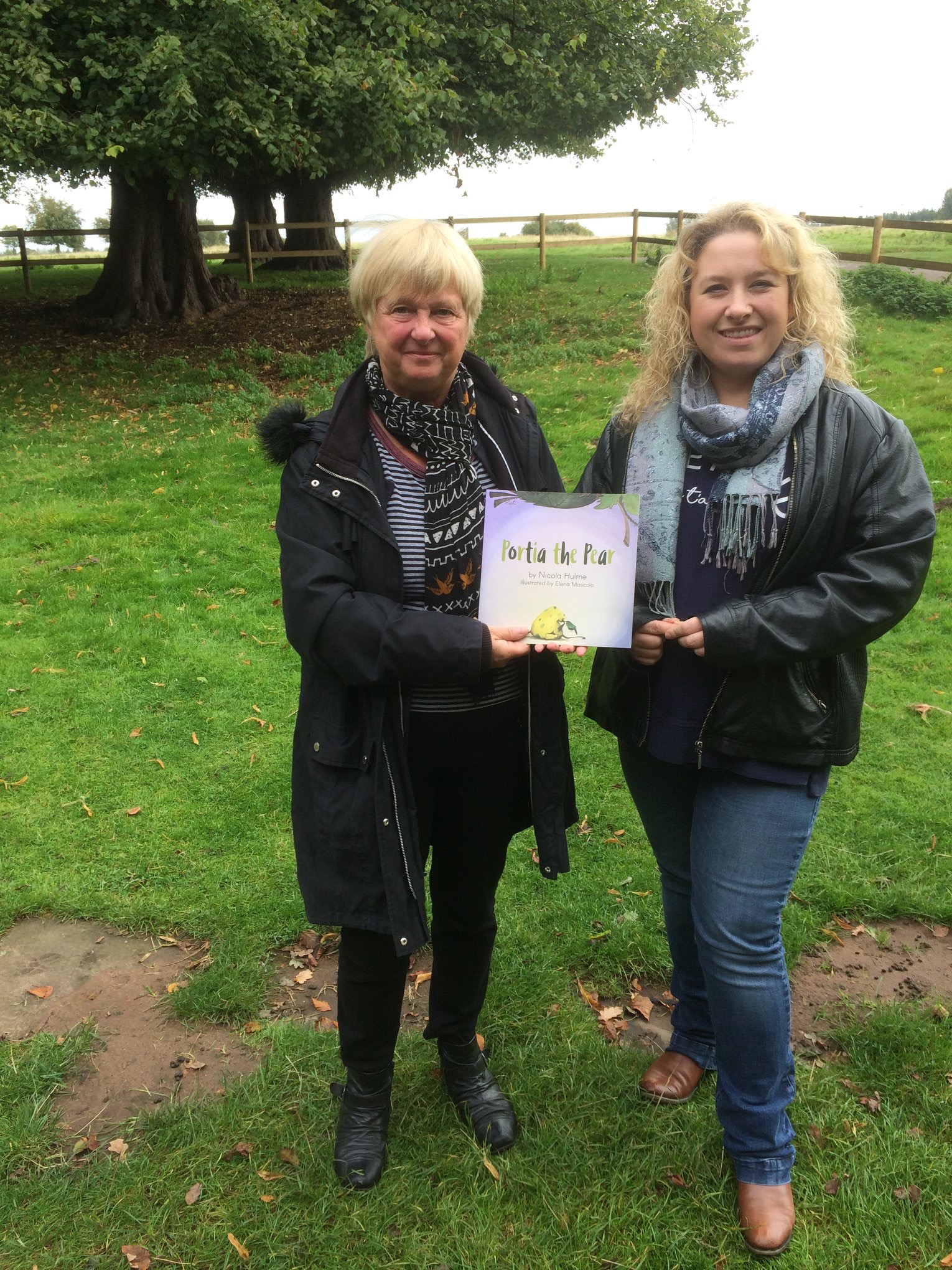
(Joy Winkler at Tatton Park)


Local poet Joy Winkler (Poet Laureate of Cheshire 2015) led the workshop which was truly inspirational. Joy fired up the passion in the room and gave sage advice on how to approach structuring a story for children. She then sent us out into Tatton’s Kitchen Gardens with the instruction to find a character and set the story in the grounds. There, I saw espaliers covered in the most beautiful pears. As I studied the fruit more closely, one knobbly, twisted pear stood out from the rest. It looked like it had a very sad face; the story of Portia the Pear was born. I received a fabulous reaction when I read it out and Joy suggested it was worthy of submission to a publisher. What happened next can only be described as serendipity..

The very next day I received an email saying a local children’s publisher would be visiting my writers’ group. I sent off Portia with the intention of asking them for feedback on how it may be improved. I received an email back asking me to call to their offices for a chat. A contract was offered and Portia the Pear was launched in September of the following year.

As a children’s picture book, the illustrations for Portia were pivotal. The clever chaps at Tiny Tree Children’s Books sent my text to the extremely talented Italian Illustrator Elena Mascolo and asked her to submit a concept piece. When I opened up the file, it was love at first sight. The colours jumped off the screen, the expressions on the pears’ faces were amazing, and the vibrancy of a very greedy caterpillar was fantastic. I knew the children would love them. Receiving illustrations for a story, which until that point has only existed in your head, is exhilarating. It is a truly magical gift. Elena lives and works in Italy and so we correspond online, and through our experience in producing the book together, we have become very good friends. Her work is so distinctive, I encourage anyone to look her up and see how unique her characters are. I was truly blessed to be able to work with her.

You are also a poet. Can you share with us a couple of your poems and walk us through the inspiration behind them?

I do enjoy poetry. I write mainly about my family, and of rural scenes, but I might write a rant, when I’m fired up about an issue, or a humorous piece when I observe quirks of human nature. I’m a member of Write Out Loud and we joke amongst ourselves about the depths of depression and solemnity we can reach in our collective writing, we do tend to stray into quite dark subjects. Poetry is an expression, so whatever feelings emerge are simply translated onto paper.

‘Nose-Blowing Days’ was written after an early morning school run. My little boy and I battled the wind and the rain which blew across the open school field. I was late for work, I had an important meeting scheduled, my hair and make-up was ruined, and I knew I would have to sit in awful traffic to get into the office. My stress levels were high. Half-way down the path, it dawned on me how much I would miss these days when Jack was grown. I smiled and relaxed and just enjoyed the moment, wiping his nose and holding his hand and splashing in puddles. At the time, I was taking part in the Napowrimo Challenge and the day’s prompt was to write a “Kay-Ryan-esque” poem using short, tight lines, rhymes interwoven throughout. Here is the result:

Nose-blowing Days

The walk to school
is sweet
‘tho puddles soak
our hasty feet.
Rain batters
‘brollies’ tatter
perfect make-up
runs and streaks,
but then I see
your innocent glee
finding a worm squirm
on the path.
The bird on highest
bough sounds
the roll call
as we scuttle past.
These hand-holding,
nose-blowing
days pass
too fast.

The following poem is reminiscent of my childhood in the mill town of Accrington, Lancashire, where I lived in a corner shop with my beloved grandma. Washing Day actually spanned three days, washing, drying and ironing day, and made a lasting impression on my very young mind. I was extremely touched when a fellow poet asked me if she could read my poem to her mum who suffers with Alzheimers, she believed that she would enjoy the memories the imagery invokes.

The Washing Line

Down dark cobbled back streets, clothes lines stretched
across cohorts of back yards, on Washing Day.
Regiments of white bed sheets hoisted high
flapping like flags, in threatening skies
supported by proud,
immoveable clothes props.
Garments not daring to fly loose,
straddled by dolly pegs
forced down hard.

Above boiling bleach buckets,
malevolent steam swirled, silently seething,
polluting the air with pungent peroxide.
The back door was wedged open, windows wide,
but still its clammy fingers clung to high corners.

Seized shirts submerged in the twin tub
were dragged out of the simmering broth
by oversized wooden tongs, grinning
toothless crocodiles.

A solitary circular spinner flipped its lid
with brutal force, revealing a gaping hole
which gobbled up garments,
firing it’s jet engine at the press
of an oversized button.
A bright warning label spelled danger
but I was more afraid of grandma
I did as I was bid
and stayed two full steps back,
watching a steady stream of captives
being fed into the mangle rollers,
pulled out prostrate, straight jacketed,
lobotomised on the other side.

Winched up on a maiden, by rope and pulley
squealing like a stuck pig, screaming in protest;
corsets and bloomers were discreetly dried indoors.
Ponderous drops dripped
onto the oilcloth floor beneath
missing expectant open mouthed buckets.

Hugging the gas fire, a burdened clothes horse
promised more than it could deliver.
A metal mesh fireguard, kept long after toddler years,
lent its flat roof to dry despondent socks.

From picture rail gallows, lifeless forms hung
closing in on the living,
One by one they were gathered,
folded and locked away in the airing cupboard
guarded by a gurgling old boiler in his
pillar-box red padded jacket.

Paroled for ironing; creases were pressed out
then forcibly pressed in.
Under a hellish red hot iron
wet handkerchiefs hissed and spat.
The board creaked and groaned,
along with grandma as she held her back.
Finally, the ordeal was over.
Clothes were locked into looming tall boys
with the turn of a tiny brass key.

The line stretches through time
from dolly tub to auto scrub.
My laundry is gently taken
from a silent washer,
that soaks and spins on demand,
conditioned smooth and wrinkle free
without need of an army of machines,
lightly clipped by brightly coloured pegs.
Still, I discreetly throw my underwear
into the dryer and smile
“What would the neighbours say?”

Mine is an easy load.
My line marks the ages of my babies
as their clothes grow.
Our favourite t-shirts old and tired,
out of shape and faded,
hang comfortably together, blowing in the wind.
Billowing white sheets release
their bouquet of jasmine and lily.
The sun warms my face,
the breeze caresses my skin
like the palm of a hand against my cheek,
or a kiss on the forehead from grandma.

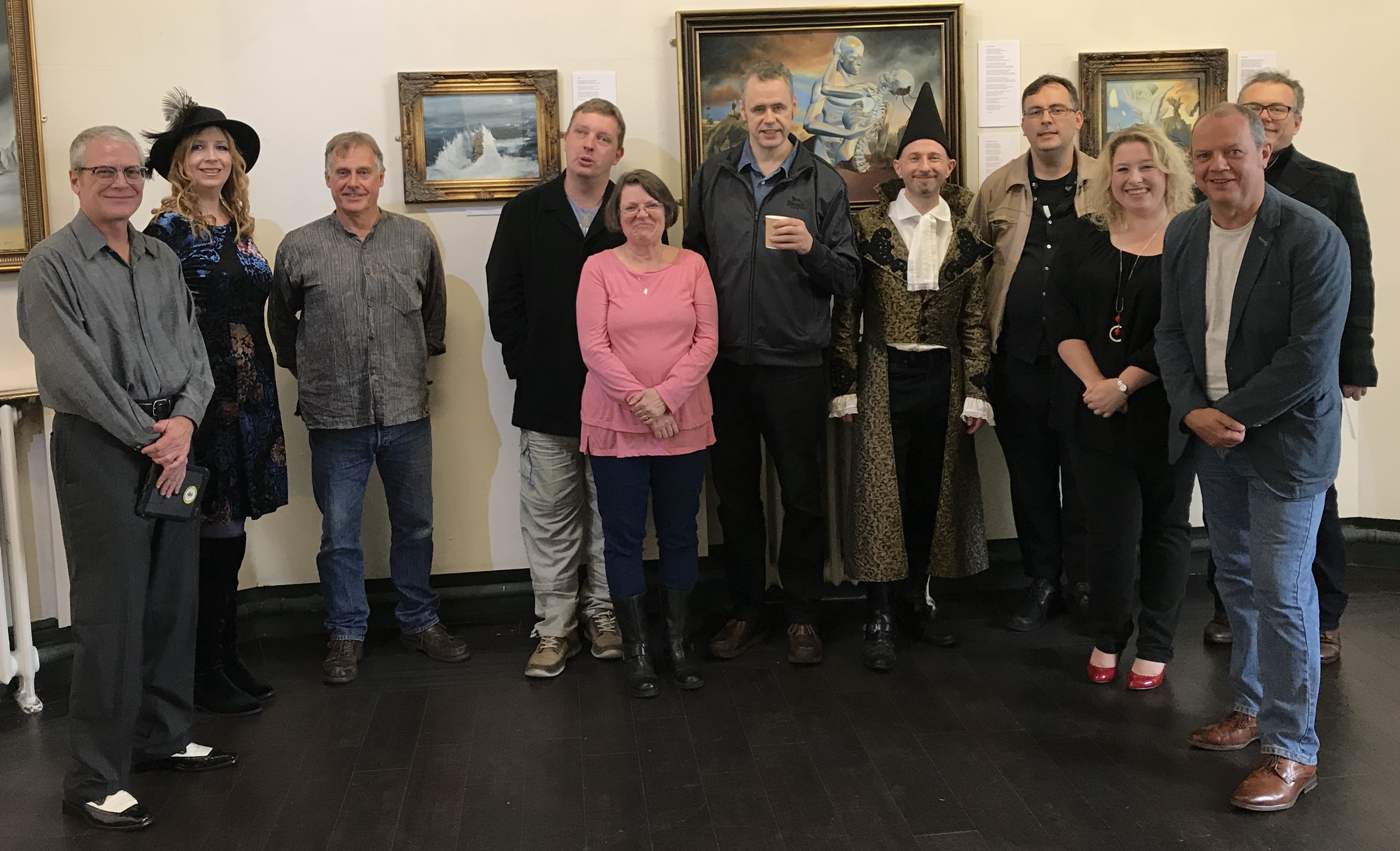
(Write Out Loud, Stockport, at Mark Sheeky’s 21st Century Surrealism Exhibition) 

As part of the Write Out Loud group, you have recently written poems for Mark Sheeky’s 21st Century Surrealism art exhibition at the Stockport War Memorial. Can you give us an insight into this event and tell us how you approached writing a poem about an artwork? Did inspiration strike quickly, or did you have to ponder on the visuals before the words appeared? Did your words match the original ideas behind the visual art? What did you learn about this experience?

It was a great privilege for the Write Out Loud poets to be invited to take part in Mark’s exhibition, and it certainly created a buzz. We meet each month at Stockport’s War Memorial Gallery and we are surrounded by art whilst we read out our work. As exhibitions change we are incredibly fortunate to preview the paintings. When we were offered the chance to create ekphrastic poems for Mark’s work we jumped at the chance.

Mark added another layer of intrigue in that we weren’t allowed to know the titles or the inspiration behind the works. He wanted to know our interpretations without bias or influence. Poems flooded in and as a result we had multiple poems for some of the paintings, but we embraced this and all poems were displayed next to their respective piece. During the month of the exhibition we performed an open mic event, reading our poems out for a very well-attended gallery. After each poem was read, Mark gave an explanation of what influences inspired him. It was really interesting to see how in the majority of cases both poet and artist had picked out the same themes.

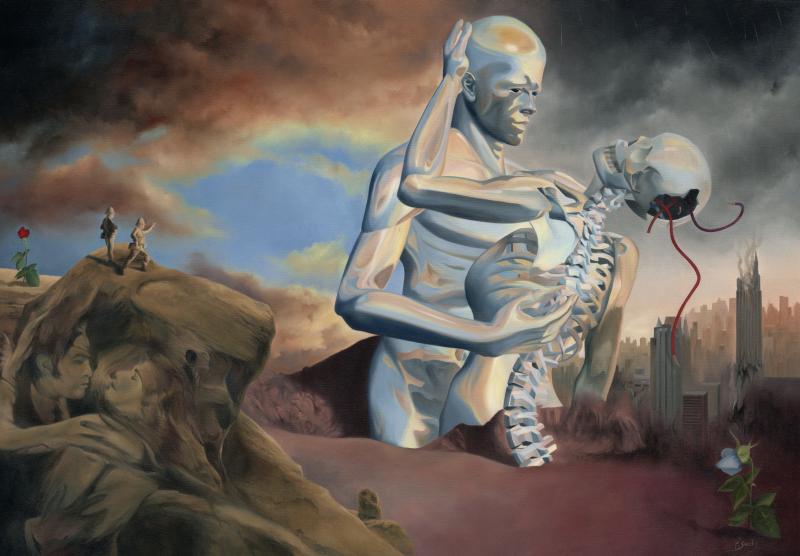
I loved the challenge of writing for Mark. I instantly picked out one of the most striking paintings which I now know to be ‘Triumph Of The Mechnauts’. It struck me immediately as a depiction of a dystopian scene. The central figures are two cyber robots, one male, one female, in an embrace. However there are many more images and symbols within the painting. I had to really study every inch to try to understand what story was being portrayed. Perhaps from my fictional writing, I like to understand the landscape, the characters, the mood etc., before beginning to write. I noted a city in ruin and an opposing rural scene with gentlemen walking over a hill beneath which there was another love scene reminiscent of Gone with the Wind. The skies were divided across the canvas, changing from bright blue to dark and stormy. In the detail there was a bright red rose and a contrasting drooping white rose. I took all of these images and created a poem which told a story which spanned time; from the old world of romance into a futuristic world of cyber dating, weaving in Shakespeare’s tragic Romeo and Juliet to illustrate doomed love. I did say we poets spiral down into dark places! I really enjoyed writing ‘City Of Promise‘. Once I had the concept, the words just flowed, and I had fun with it. Happily, Mark confirmed that he had intended the dystopian scene, but his inspiration had been simply the word ‘future’. What I learnt from the whole experience was how paintings can be a wonderful source of inspiration. It’s incredibly freeing to be given pieces of a puzzle, then letting the imagination carry you into creativity. I shall definitely use the ekphrastic technique again.

(‘Triumph of the Mechnauts’ by Mark Sheeky)


Have you tried any other genres of writing? Radio/plays etc?

My one and only venture into playwriting was a play I wrote aged 12 which was performed on stage at Moorhead High School. (I was actually a member of the same school drama club as Julie Hesmondhalgh who went on to play Hayley in Coronation Street).

I have recently written a short story, my first adult thriller. The main character is a disturbed teacher who, after learning her husband has cheated on her, reeks revenge on the male population. I really enjoyed the process, but gained a new respect for crime writers. I would wake in the early hours discovering problems with my plot, trying to figure out how a particular event could take place. I had to research poisons so I had my facts right, I questioned friends about their experiences commuting on public transport to ensure I was reflecting reality rather than just assuming facts. It was a lot more work than I had anticipated. The short story was created for a competition run by a University which added a degree of pressure to ensure my grammar, structure and punctuation was as polished as it could be. Compared to writing for children, the experience really stretched me, but that’s how we grow in our craft, so I will always opt for the uncomfortable over the familiar, for that purpose.

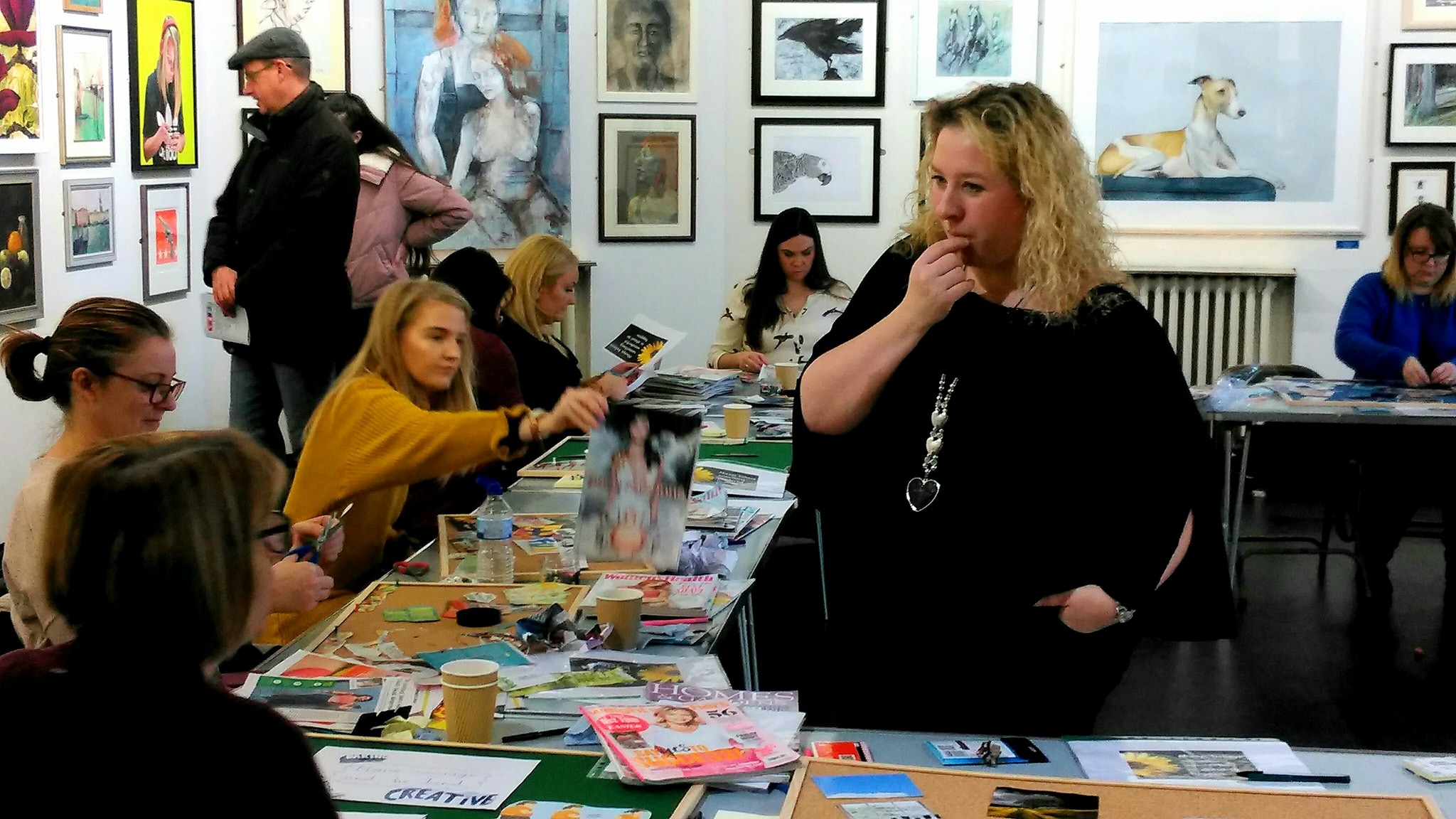
(Vision Board Workshop at Stockport War Memorial Art Gallery)

Who inspires you?

I was very fortunate to have been taught by an excellent English Literature Teacher who was passionate. if not zealous, about the subject. He introduced me to the Classics and the War Poets, and also to the theatre. I fell in love with Keats and marvelled at Shakespeare.

My late Father-In-Law took it upon himself to expand my literary knowledge. We would talk for hours on great poets and his favourite writers, Dickens, and Hardy. He also introduced me to classical music, something that never featured in my childhood. I’m extremely grateful for our time together.

I find inspiration everywhere and I have been inspired by a variety of sources over the years, however I’m beginning to realise that I’m largely influenced by pioneering women. It began with a passion for The Brontë Sisters, which opened my eyes to how female writers struggled to be heard. Maya Angelou and Oprah Winfrey are my heroines in challenging the status quo and breaking stereotypes. I respect anyone who stands up for a belief or challenges convention. I love Elizabeth Gilbert, who writes to encourage creatives to ‘write anyway’ and to ‘be stubborn about it’ (very similar to the message of Van Gogh: ‘by all means paint and that voice will be silent’. I have a fond spot for Jeanette Winterson, who was raised only a few streets away from my corner shop in Accrington. She opened a huge debate when she wrote Oranges Are Not the Only Fruit and continues to be a great ambassador for women’s rights.

What are you reading at the moment?

I’m having a cerebral holiday at present, reading a few bestsellers simply for the sheer pleasure of it. I have just read Eleanor Oliphant Is Completely Fine by Gail Honeyman and I can’t recommend it enough, a fabulous first novel from Gail. I’ve also just read The Keeper of Lost Things by Ruth Hogan, which was such a pleasure, it felt indulgent.
I’m currently re-reading a business classic in preparation for teaching a personal effectiveness course called ‘The 7 Habits of Highly Effective People’ by Stephen Covey. It was reading this book that gave me confidence to write, explore the craft, be proactive and keep the end in mind. I use Covey’s principles when I teach Vision Boarding at Stockport War Memorial Gallery. I have two workshops planned in for January 2018, when everyone is goal setting and thinking of long term plans. The combination of reading Covey and Elizabeth Gilbert, who I mentioned earlier, really sparked a fire within me to push myself out of my comfort zone to take on more challenges.

What’s next for you? What plans have you got?

I’m extremely excited to be working with Elena Mascolo again on our second children’s picture book. I cannot reveal any details yet other than tell you the story is the one I wrote on that fateful Boxing Day morning when I decide to write for children. It’s been fine-tuned and is now my next book (there may also be a third in the pipeline!)

I recently read my poetry at a Centenary Remembrance Day Service at St Matthew’s Church in Edgeley with the Write Out Loud Poets. We will also be performing a Christmas Open Mic Night on 12th December at The Samuel Oldknow, in Marple, which is always great fun and well received.

Into the New Year I’ll be Vision Boarding as I mentioned. I’ll be continuing to take Portia into bookshops, schools, book festivals and possibly Tatton Park at Easter and on Apple Day.

The new book will hopefully be launched mid 2019 so I’m looking forward to seeing that in print and holding a book launch.

I believe in constantly refreshing and learning new skills, so I’ll be studying under Joy Winkler at her workshops held at Tatton Park throughout 2019. Joy has now been named Writer in Residence, a title so well deserved.

Beyond that, I will be writing; children’s picture books, poetry and maybe, just maybe take on a novel that has been lurking at the back of my mind for some time. Time will tell.

Portia The Pear by Nicola Hulme

Nicola on Twitter

Pantry Prose: Trash Day by Orit Yeret


(Image by Orit Yeret, taken in NYC)

Orit Yeret has a Master’s degree in Comparative Literature and Creative Writing from the University of Haifa in Israel. She is a lecturer in Modern Hebrew and is currently employed at Yale University. In her spare time she enjoys photography, painting, and writing short prose and poetry in both English and Hebrew. Her work is forthcoming in Borfski Press and Drunk Monkeys.

Trash Day

Monday morning, 6:00 a.m.

The sound of a garbage truck backing up in the alley underneath Prince’s window.

Prince jumps out of bed in a panic. Without putting on shoes or pants, he storms out of his fourth-floor apartment window and climbs down the fire escape. As he makes his way down, he catches a glimpse of his own reflection—his hair is messy, his face unshaven, and there’s a fresh cut above his right eye that, for the moment, has stopped bleeding.

The city that never sleeps seems to be under some kind of spell—half-dazed, half-awake—much like Prince’s current situation, only he is on the move. Skipping the stairs, two at a time, he waves at the sanitation workers who have already started loading up the truck.

Wait! Wait!” he shouts, begging, as he makes his way down.

Please!” His pleas become louder as he approaches them.

The two workers stare at him, puzzled. They are wearing long, dark-green overalls with reflective lights. Prince is wearing a white T-shirt and pinstripe boxers. He is now in front of them, trying to catch his breath, crunched down, resting his palms on his knees.

Whew!” he exclaims as he inhales heavily.

That was quite a run,” says one of the sanitation workers.

What happened? Lose something?” the second worker says and starts to laugh.

As a matter of fact…” Prince begins to talk, slowly. “Yes! Did you happen to see an old bedside table…red wood…sort of vintage-looking…only has one drawer…” Prince looks around.

Haven’t seen it,” one of them says. “Anything inside, Marco?” he calls out to the other worker, who goes to check the truck.

Nope!” Marco replies.

Sorry, man,” the worker says, and starts rolling the trash bin toward the truck.

Hey!” Prince stops him. “Wait a minute…” He notices the worker’s nametag. “Luke.” Luke and Prince now stand on opposite sides of the trash bin.

Yo! What’s the holdup?” Marco yells from the truck.

You have to help me out, man.” Prince holds his head with both hands. “I don’t know what to do!” He stares at Luke with a desperate look in his eyes.

What’s the problem here?” Marco steps out of the truck and approaches them. He examines Prince from top to bottom and then turns to Luke. “Junkie?” Luke throws his hands in the air.

Prince is now pacing back and forth, barefoot, in the dirty alley. Marco signals Prince to calm down. “We’re not looking for any trouble here; just let us do our job.”

You don’t understand!” Prince says. “It was in there… It was in there and now it’s gone!”

Luke and Marco exchange a confused glance.

Sorry, man.” Marco then says, “Whatever it was, there’s nothing we can do.”

Luke and Marco start rolling the trash bin toward the truck again.

Please!” Prince cries out. “You have to help me!” He falls on his knees.

Oh, shit…” Marco says. “What the fuck, man?” He turns to Luke. “Get the fuck up, man!” he says to Prince, but Prince doesn’t move and keeps saying, “Please.”

Marco backs up and changes places with Luke.

Calm down, man,” Luke says to Prince in a soothing voice. “Get up. Come on.”

Prince listens to Luke and stands up.

What’s so important about that table?” Luke asks, taking off his gloves.

My dad’s watch… It was in there…” Prince stifles his tears.

And?” Marco intervenes.

Prince stares at the two of them for a moment.

This is a waste of time,” Marco says to Luke, but Luke continues to look at Prince without moving.

And…” Prince finally says, “He died a year ago, and that’s all I have of him…that watch.”

Pshh,” Marco makes a noise and averts his gaze.

Sorry to hear that, man,” Luke replies sympathetically.

So why would you throw the table away?” Marco jumps in again.

I didn’t!” Prince replies angrily. “My…” he hesitates, “…boyfriend did.”

Okay.” Marco holds his hands up. “To each their own, that’s what I always say.”

So why would he…?” Marco starts again, but Luke signals him to be quiet.

We sort of got into a fight last night.” Prince paces in place and rubs his forehead. He accidently touches the cut above his eye and makes a face as he feels the burn.

And that’s his handiwork?” Luke points at the bruise on Prince’s face.

Not intentionally,” Prince explains. “He threw a book at me—my book, actually—and it hit my head… Anyway, it’s all my fault.”

Oh, good…more to the story.” Marco taps on his wristwatch to indicate to Luke they need to get moving. “We’re on a schedule, you know,” he says to Luke.

What happened?” Luke asks Prince, curious.

I…cheated on him…during my latest book tour.” Prince looks away, embarrassed to meet their eyes. “It’s not like I planned it… It happened. He found out and…as you can see, all hell broke loose.” Prince points at the trash bins, which Marco and Luke notice are filled with clothes, broken dishes, and a shattered mirror.

Marco fishes out the pieced mirror from the bin. “Seven years of bad luck,” he mumbles. Luke nudges his arm as a sign to keep silent.

Prince comes closer to the bins. “What a mess…” he sighs. “Truth is, I don’t care about all of this,” he points at the bins, “but the watch—it’s all I have…all I had. He knew I kept it there.” He begins talking to himself angrily. “He knew it, and that’s why he did it…to hurt me.”

Like you hurt him,” Luke says all of a sudden. Surprised the words came out of his mouth, Marco and Prince stare at him.

What?”

Luke mumbles, “I can deduce things too.”

Hey, buddy.” Marco turns to Luke with a smile. “No one said you can’t.” Marco tosses the broken pieces into the bin and comes closer to Prince.

Like I said,” Marco puts his right hand over his heart, “there’s nothing we can do… It’s Monday morning, after the weekend…” Marco wipes off his forehead. “There’s lots of trash, lots of trucks around town… Sometimes we do three, four rounds before noon.” Marco turns to look at Luke, who nods at him in approval.

But you have to,” Prince begs again and, in a desperate move, clutches Marco’s overalls. Marco removes his hand with a swift move.

Like I said, sir,” Marco continues, “there’s nothing we can do. Start loading up,” he says to Luke, turns his back to Prince, and walks away in the direction of the driver’s seat.

Please,” Prince tries to appeal to Luke, who is now wheeling the trash bin.

You shouldn’t have done that,” Luke says to Prince.

I know,” Prince scratches his head. “I didn’t mean to…” Prince points to Marco’s direction.

Not that,” Luke explains, “your boyfriend—you shouldn’t have hurt him like you did.”

Prince looks at him, shocked. “You’re right, I was an asshole. Shit, I am an asshole.” Prince paces back and forth, just now realizing his feet are cold and wet.

Luke stops wheeling the bin and lifts his head to locate Marco. “This watch,” he then turns to Prince, “why is it so important to you?”

I told you, it was my dad’s…” Prince explains.

And he passed away, yeah, yeah,” Luke intervenes, “but it’s not just that, is it?” Luke comes closer to Prince. “See, if it were just that, you wouldn’t be running down the street in your underwear at 6:00 a.m., probably suffering from a concussion, by the look of this bruise, digging your feet in yesterday’s trash, now, would you?”

Prince’s face tightens. “What on earth do you mean? It’s the memory, of course.”

Luke stares at him severely.

All right.” Prince finally breaks down. “You got me. It’s worth a lot of money, like a lot, a lot…the only good thing I got out of that man. You know he disowned me when I told him I wanted to be a writer? Yeah…and when I came out? He told me I was not his son anymore.” Prince pounds his chest.

That damn watch,” Prince continues, “worth a couple of grand…enough to get me by for a while…I need it!” Prince recites with fire in his eyes.

Now, now,” Luke steps away with a satisfied grin. He attaches the trash bin to the truck’s metal arms. There is a loud noise as the bin is mounted and the trash piles on the truck. There are sounds of glass and china being further reduced and crunched together into tiny pieces.

So, what do you say?” Prince shouts over the noise toward Luke. “Will you help me? I’ll split the profits with you, promise.”

Luke smiles at Prince as he lowers the empty trash bin.

You know, people look down on us…because of what we do…” Luke wheels the bin back to its location. “But what they don’t realize…is that we know all their secrets.”

Luke winks at Prince and walks over to the truck. He grabs hold of the metal arm and jumps up; he taps the back of the truck twice.

You have a good day now, sir.” Luke salutes Prince as the truck pulls away from the alley and into the city street.

More Than Words: Orit Yeret

Poetry Drawer: The Blossom and the Withered One by Saikat Gupta Majumdar

The Blossom and the Withered One

In the corner of a street
A flower shop facing the road
Displays the lovely, charming ones
From the common roses to unknown
With variety of each kind
In bunches, single or garlands.

The people of the town
Step in out of urgency or eagerness
In their ups & downs during the day
From the children to couples
And aged old fellows
For passion, grim or gay.

One day, while a kid stood in
Before the sight of flowers
Exploring each one in wonder
Suddenly, noticed an old fellow
Thin and feeble with bearded cheeks
Stared at him from a distance.

Smiled slowly as he looked back
And then came in weak steps
‘You are loveliest of all indeed,’
‘And you,?’ the kid asked back
Smiling again the man fingering at a board
The flowers that have withered are in no need

Inky Interview Special: Poet John Keane


Tell us about your journey towards becoming a poet.

Childhood alienation and ill-health gave me an early passion for the written word as a vehicle of escape. Being the most elevated form of literary expression, poetry consequently became prominent in my life from an early age. Although I never studied literature beyond A Level, Robert Fagles’ translation of The Illiad is always with me, as are the complete works of Larkin, Yeats, Shakespeare, Brooke and Thomas plus several anthologies of the finest English verse. Since I know many of these masterworks by heart, I like to think they infiltrate my own humble works by some process of unconscious osmosis. Embedding the finest poetry in one’s memory engenders reflexive familiarity with the classic verse forms, metres and techniques, promotes eloquence and generally naturalises excellence. Not that my writing is in any sense excellent; but that is the goal, at least.

In recent years I have begun to experiment with hexameters and alternative verse forms; but metrical form of some type is always maintained as a bulwark against creative chaos. Traditional poetic structures and methods have proved effective across many centuries, so why try to reinvent the wheel every time you write? Engineers or architects don’t dismiss the accumulated wisdom of millennia, so why should poets or artists?

You have published several books, one of which is called The Drunken Bag Lady’s Arcadia. Interesting title! What are your other collections, and where can we get hold of these?

The title is a parody of Sir Philip Sidney’s The Countess of Pembroke’s Arcadia, published in 1580. Instead of a courtly countess, I dedicate my poems to a drunken bag lady; after all, a man’s got to know his limitations. I have two other poetry collections. Cremation, Please is a series of nihilistic meditations in the despairing spirit of Shakespeare’s sonnet 66 (‘tired with all these, for restful death I cry’). The Two Cultures was inspired by C P Snow’s belief that art and science are increasingly opposed realms; these poems humbly try to build bridges between the two (instead of wilfully ignoring science, like most contemporary literature).

The Drunken Bag Lady’s Arcadia

Cremation, Please

The Two Cultures

Can you share with us a couple of your poems and walk us through the ideas behind them?

Ten Years Missing (In Memory of Andrew Gosden)

A blizzard of spindrift erratic decisions
A jigsaw jumble, half-clues and vanished traces
Erased footage, unclaimed tickets of no return
Discarded uniforms and journeys leading nowhere

A man lurks in glass, his grainy, grey reflection
Sunk deep in these waiting years. Forever he stands,
Something or nothing, his face in taunting shadow,
A thousand fates or none. Perhaps he is waiting

For a girlish youth lost in wide-eyed spectacles
Lank-haired head full of Playstations, numbers and Muse,
His feet unsteady on the bright rim of desire
Drawn by the city to dreams of another life

And maybe he found whoever he came to meet
Or found another or another fate, who knows?
A razor sharp blue light pervading everything
Ensures no closure here, the case forever closed.

‘Ten Years Missing’ was written in 2017 to commemorate the tenth anniversary of Andrew Gosden’s disappearance. He went missing after taking a train from Doncaster to King’s Cross in 2007 at the age of 14. Nothing about the case fits together properly – for example, video footage of King’s Cross and the surrounding area was ignored by the police until the trail had gone cold. Andrew was highly intelligent and a gifted mathematician. It is one of those cases where the more you know, the less you know. A CCTV image possibly shows the reflection of someone waiting for him outside King’s Cross (‘a man lurks in glass’). A year later someone entered Leominster police station in the West Midlands saying he knew what had happened to Andrew, but it was never followed up (‘no closure here’). Despite the extensive police investigation (‘sharp blue light’) the case may remain unsolved (‘the case forever closed’).

My second poem is called ‘Go Missing’ and owes much to my right-wing libertarian perspective. The values you were raised with have no claim on you, especially if they were abusive or dysfunctional. The same is true of people or places. Your sole responsibility is to your rational self-interest and nothing more. You can make the decision to start a new life at any age, old or young. Once the decision is made, it must be absolute; never look back. The use of iambic hexameter is intended to convey a sense of wandering grandeur, as is the line from The Tempest concluding the first stanza:

Go Missing

Write not a goodbye note, depart without a word;
Resolve to leave your life and never once return.
New shoes await your feet, new clothes your back, new sights
Your eyes; new languages are eager for your tongue,
New lands your journeys. You must go missing, then;
And like a vanished dream, leave not a wrack behind.

Give everything away: you will not need such things.
Your life was nothing but a harness of regret,
A coat of faded threads and patches long outworn.
This tapestry is made, and fair its finery;
But little thread endures, and still the Fates spin on.
Now go: and make a better life of what remains.

You are part of the Write Out Loud group. Can you tell us about it? As part of the group, you recently wrote poetry inspired by Mark Sheeky‘s 21st Century Surrealism exhibition at the Stockport War Memorial Art Gallery. Can you give us a glimpse into the event?

Write Out Loud is an online resource and community dedicated to the promotion of poetry at a grassroots level. Although its primary stronghold is the north of England, it is forging links with the international poetry community.

It was a great privilege to be part of Mark’s exhibition. The idea of the different art forms in cultural conversation is one dear to my heart. I haven’t much talent for the visual or musical arts (or the literary ones, for that matter) but I greatly admire those who do. I had already seen a few of Mark’s paintings and figured his daring and original imagery might inspire some vivid Ekphrastic poems (poems inspired by works of art), adding depth and texture to his exhibition. In the event, every painting inspired one or more poems, many of which offered completely different perspectives on the same visual referent. The ideal response would be some counter-Ekphrastic paintings inspired by the poems, of course.

Do you prefer poetry or prose? Have you written in any other genre?

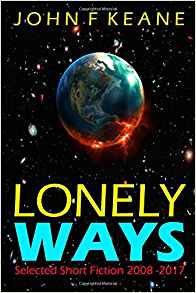
I think good prose can have poetic elements, and often does. However, poetry has to create a more immediate impact on the reader, due to its generally shorter length. Meanwhile, prose has much greater potential for extenuated argumentation than poetry: poetry that sets out to argue the case for or against something is usually bad poetry. Perhaps we could say that poetry is a stream while prose is a river: though they cross the same terrain, they do so in very different ways. Speaking of prose, I have a collection of short speculative fiction entitled Lonely Ways available on Amazon. Some of these pieces are written in a poetic prose style (what Ayn Rand termed ‘romantic realism’).

Lonely Ways is available here:

What advice would you give your younger self?

Become a plumber. Also, remember that a youth without sex is a wasted youth.

What are you reading at the moment?

I’m trying to read Forever Amber by Kathleen Winsor. An incredible novel stuffed with fascinating period detail but a sore strain on my feeble eyes and brain.

What advice would you give to budding poets?

Enjoy it as a hobby and vehicle of self-expression but don’t plan to earn a living from it. In fact, don’t plan to earn a living from anything creative unless you are incredibly talented, lucky or well-connected (preferably all three). Rich writers and artists are fallacies of significance. Many notable poets studied practical subjects, anyway (William Carlos Williams was a doctor; Wallace Stevens an insurance lawyer; and Thomas Hardy an architect). So study a remunerative subject and write as a hobby; if it happens, it happens. If it doesn’t (and it probably won’t), let it go. At least you’ll have a career and a half-decent life, at the end of the day.

Who inspires you and why?

My primary inspiration is probably the American novelist, Ayn Rand. The Fountainhead (1943) is generally felt to be her greatest work. In this libertarian tale of achievement and self-transcendence, Rand demonstrated that we don’t have to put up with anything that retards our rational self-interest and self-actualisation. Dysfunctional subcultures such as proletarian collectivism and Roman Catholicism have no claim on the individual and can be summarily dismissed. Everyone deserves the best life they can possibly attain.

The American writer Robert Greene is also a great inspiration. His classic 48 Laws of Power has been a huge influence on American rap music and its libertarian philosophy of striving and self-transcendence. Armed with Greene’s unique insights, the determined individual can overcome structural obstacles like poverty, racism and social ostracism to enjoy a successful life.

What’s next for you? What plans have you got?

I’m working on an alternative history novel entitled A Curious Development. This is built on the conceit that photography existed in the ancient world. It contains ten linked stories exploring various aspects of the theme across the centuries. One of these stories was published in the distinguished sci fi webzine, Daily Science Fiction while two more have been published in AHF magazine.

Daily Science Fiction

AHF

AHF #2


John Keane on Twitter