She finally moved from Fukushima fled its failed, toxic nuclear plant I wasn’t close to her, don’t want to be close to her
I get nervous when she moves toward me, arms wide with a smile unnaturally bright like the ladies who painted radium on watch dials and licked their brushes to keep them pointy
I don’t want to love her don’t want to be inside her No means no
Mitchell Krockmalnik Grabois has had over fourteen-hundred of his poems and fictions appear in literary magazines in the U.S. and abroad. He has been nominated for numerous prizes, and was awarded the 2017 Booranga Writers’ Centre (Australia) Prize for Fiction. His novel, Two-Headed Dog, is based on his work as a clinical psychologist in a state hospital, is available for Kindle and Nook, or as a print edition. His new poetry collection was published in 2019, The Arrest of Mr Kissy Face. He lives in Denver, Colorado, USA.
More work from Mitch, including his Inky Interview here.
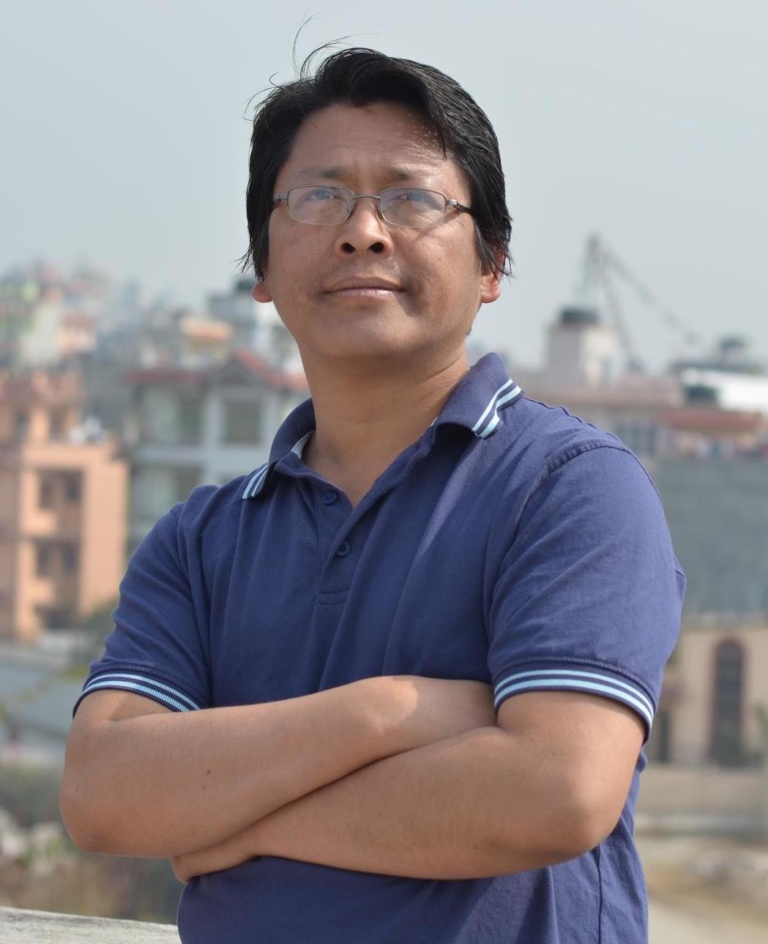
Chandra Gurung, who comes from the Himalayan country of Nepal, but is currently based in Bahrain, writes poetry in the Nepali language and translates poems from Arabic, Hindi and English into Nepali. His first poetry collection was published in 2007. A second collection is now due from Rubric Publishing, New Delhi. He recently participated in the First Dhaka Translation Festival in Bangladesh. In this interview he speaks about his passion for poetry and translation and of the things that have motivated him to become a writer.
Chandra, let’s start at the beginning. Please tell me something about your background and how you first became inspired to write poetry.
I come from a small village that is nestled in the hills in the Gorkha district of Nepal. The world-famous Gurkha soldiers, who are well-known for their gallantry and warfare and now serve with bravery in many different parts of the world, were named after this very place. The king of Gorkha defeated the rulers of the various small states and, with the help of the Gorkha people, shaped modern-day Nepal.
As a youngster, I derived a lot of enjoyment from reading books. My first poem was a rhyming poem about a kite. I remember reciting it at the school’s farewell day. Sadly, there was a yawning gap after that. Despite a deep desire to write poetry, I failed to make time for writing because I was a college student cum full-time teacher in a private school during the heyday of my campus life.
My dormant passion for poetry was well and truly revived after moving to Saudi Arabia in 2003. A kind of home sickness haunted me which fuelled my emotions and helped me to start writing again.
What do you see as being the role of a poet and what does poetry mean to you?
To engage in poetry, whether reading it or writing it, is to practice an enriching attentiveness. To practice poetry is to pluck details from the surrounding world- to see things more clearly, to recognize the beauty inherent in our lives, to experience pain and happiness and to connect with others around us. Poetry operates on so many different levels of consciousness. Poetry gives meaning to our lives. As Marie Howe has said, poetry can help to remind us all that we are alive.
Poets observe closely the world around them. They offer insight and entertainment and help us to measure our lives at a deeper and more meaningful level. Through their writing, poets add a new dimension to our existence. The role of the poet is to master language in ways that inspire us to experience something transcendent, useful and meaningful in our lives.
What would you say are the main influences on your poetry and how do they manifest themselves in your work?
I was away from my mother and my motherland from an early age. My poems explore exile and family, the pain of separation and the joy of reconciliation. They reflect the changing scenario of the society that I belong to. Poetry can be utilized as a means to build empathy and to bridge gaps of understanding between people. Poetry is meant to be our companion throughout every stage of societal awareness.
In my poems, I narrate stories drawn from my own life experiences. My poems reflect upon the social, political and moral issues of our time. Choosing the subject matter is central to my writing. I first decide what my poem will be about. The vivid metaphors come later. In all my poems, I strive to leave the reader with a sense of fulfilled expectation.
What type / genre of poetry are you interested in the most and why does it appeal to you?
Since I became fascinated with poetry, I have been writing in free verse. This form of writing gives me a certain sense of freedom and allows me some headroom for experimentation.
Please tell me a little bit about your translation work and how you became interested in translation in the first place.
In the present context, translation has become essential for the support and perpetuation of poetry or any other form of literature. Reading poetry in translation helps to foster a wider understanding between cultures.
During 2012, a number of Indian poets / writers joined me on Facebook. Through their suggestion, I began to translate some Nepali poems into Hindi. Later on, I started to translate some Hindi poems into Nepali. Running in parallel with this development, I have been translating several poems from Arabic into other languages.
Are there other areas of writing that you are interested in pursuing apart from poetry?
Without doubt, poetry is my first love! However, one cannot make a living out of poetry, let alone earn any royalties. Aside from poetry, I have been writing a series of essays on the lives of migrant workers in the Gulf Corporation Council (GCC) countries*. Their pain and their sorrow has acted as a catalyst for my work.
Do you have a preferred place in which to write? If so, where is it?
Location matters a lot to me. The neighborhood and its environment affect my feelings, actions and thoughts and ultimately my writing process.
Generally, I prefer to write in a quiet place, somewhere that is well away from any kind of distraction or disturbance. Most of my ideas come to me when I am travelling or sitting alone.
What is the poetry scene like in Nepal? Are you optimistic about the future of poetry in Nepal?
The poetry scene in Nepal is flourishing. A lot of young people in Nepal are writing poetry. We need to channel their energy down the right paths in order to bring out the best in them. The editors of daily papers are receptive to poems and poetry reviews. Literary organizations are spreading their wings far and wide. New books are released regularly. Organisations that promote poetry competitions are also thriving. For all of these reasons I remain optimistic about the future of poetry in Nepal.
What is the poetry scene like in Bahrain? Are there any noticeable differences between the way poetry is received in Bahrain as opposed to Nepal?
Foreigners make up fifty-five per cent of the total population of Bahrain. Among them many like-minded writers have joined forces to form various literary groups. They have also organised a number of workshops and they network with each other on a regular basis. Regular annual literary symposiums take place. Local Bahraini writers also participate in a range of literary activities. Poets, writers and artists from different Arabic countries are frequently invited to participate in these events.
Literary circles in Bahrain are full of writers from diverse nations. Exchange of knowledge and experience occurs on regular basis. Arabic readers are irresistibly drawn towards poetry. Accomplished poets from the Arab countries have greatly enriched the world of poetry and much of their work has been translated into other languages. Translations and interactions are much less of a feature when it comes to Nepali poetry.
What collections have you had published to date and what are you working on at present?
As I mentioned earlier, I first started to write poetry seriously when I was in Saudi Arabia. Nostalgia for my homeland fuelled my emotions and acted as a spur for me to write. Thirty three of the poems that I wrote during this period were published in book form by Sathi Publications, (Kathmandu), after my return to Nepal in 2007.
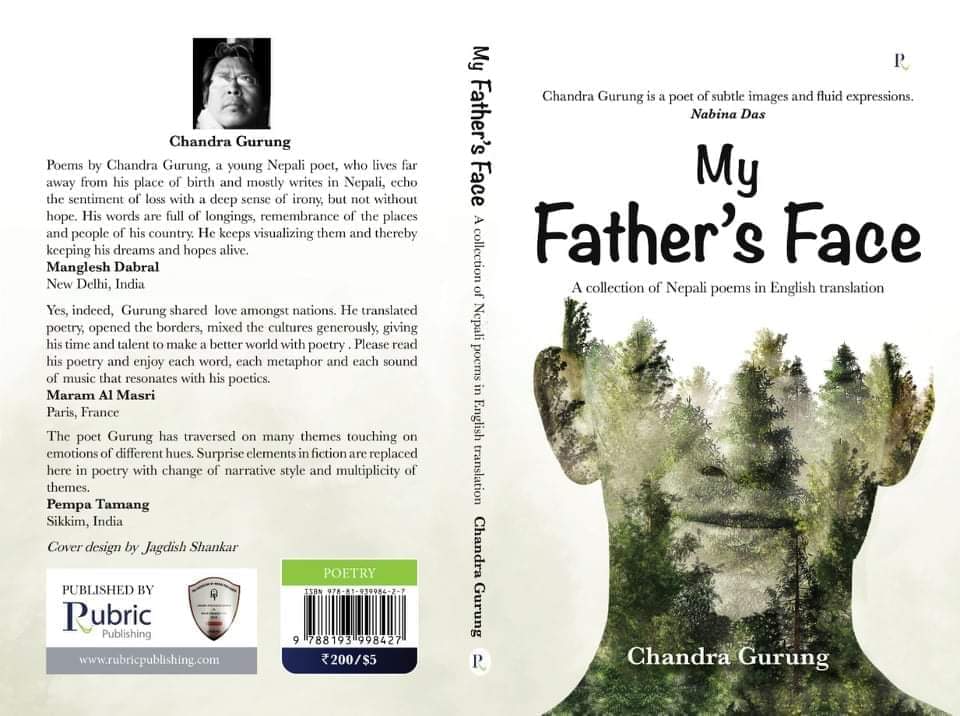
A second volume, My Father’s Face, is about to be published by Rubric Publishing, (New Delhi). This volume consists of English translations of 47 poems originally written in Nepali.
What lessons have you learnt from writing poetry? Do you have any pieces of advice to pass on to other aspiring poets?
If I have learnt anything it is that writing poetry is the best way for me to remain in touch with my emotions. It helps me to think creatively —to look at the things from a different perspective or through a different lens. Poetry helps me to navigate the world in a different way to the extent that, at times, it feels as if I am approaching it from a different dimension. Ultimately it widens my understanding of myself and of others and changes things for the better. Poetry has its uses in every aspect of our living. We must keep our hearts and minds open to its possibilities so that we can become receptive to it.
My advice to emerging poets would be to persevere and to be patient. The journey that poetry will take you on is a long one. A regular diet of reading and writing is essential. The sky is the limit for young, aspiring poets.
*Saudi Arabia, Kuwait, United Arab Emirates, Qatar, Bahrain and Oman.
Neil Leadbeateris an author, essayist, poet and critic living in Edinburgh, Scotland. His short stories, articles and poems have been published widely in anthologies and journals both at home and abroad. His publications include Librettos for the Black Madonna (White Adder Press, Scotland, 2011); The Worcester Fragments (Original Plus Press, England, 2013); The Loveliest Vein of Our Lives (Poetry Space, England, 2014), Sleeve Notes (Editura Pim, Iaşi, Romania, 2016) Finding the River Horse (Littoral Press, 2017) and Penn Fields (Littoral Press, 2019). His work has been translated into several languages including Dutch, French, Romanian, Spanish and Swedish.
Ancient stump with brown pine needles sprinkled on the forest floor. No sign of the trunk and canopy that was once rooted Through and by this humble stump. Further ahead, a hickory stands like granite. Around its crooked and askew trunk winds a vine, Embracing the hickory. The vine is splayed, its fingers fly out Like the digits of a child touching the air. To my left, a white pine, the monarch of trees, Massive and straight and soaring to untold and mythical heights. Directly in front of me, two trees, Soldered together like conjoint twins. Are they/is it one tree Or two? Do they nourish each other? Sprinkling the forest floor, White flowers as delicate as spiderwebs. Lazy in the sun that bleaches the air. The breeze is gentling, Touching my skin like a breath.
Christopher Johnson is a writer based in the Chicago area. He’s been a merchant seaman, a high school English teacher, a corporate communications writer, a textbook editor, an educational consultant, and a free-lance writer. He’s published short stories, articles, and essays in The Progressive, Snowy Egret, Earth Island Journal, Chicago Wilderness, American Forests, Chicago Life, Across the Margin, Adelaide Literary Magazine, Blue Lake Review, The Literary Yard, Scarlet Leaf Review, Spillwords Press, Fiction on the Web, Sweet Tree Review, and other journals and magazines. In 2006, the University of New Hampshire Press published his book, This Grand and Magnificent Place: The Wilderness Heritage of the White Mountains. His second book, which he co-authored with a prominent New Hampshire forester named David Govatski, was Forests for the People: The Story of America’s Eastern National Forests, published by Island Press in 2013.
Malevolent idle hearsay was received, functionally, without question, via email the following morning, from an unaccountable personage; an unspecified decision maker, or more likely an irritable opinion influencer. Either way, in respect to reliable, prospective contractual renewals, its source was deemed to be a mission critical figure: one wielding personal enmity with minimal concern for individual ramifications, consequently borne by any operative accused of displaying militancy. It probably was, Monty imagined, that stressed-out réceptionniste bloke, with his impressionistic, brilliantine black Barnet, who brusquely barked at him, unexpectedly, without explanation. Who in their right mind was enthusiastic about being screeched at, by total strangers, from point-blank range? Especially, when in the midst of heaving great, precarious weights on wheels, up slippery concrete steps, drenched by horizontal pissing rain? It was wrong on multiple levels. Monty wasn’t licensed to move an HGV (its driver dashing off for an eyelash) & so couldn’t have legally or safely re-parked it across Judd Street, even if he’d wanted to!
For experienced corporate liveried porters, west end deliveries were customarily simple enough, guiding fully-loaded sack-trucks straight down from pavement sited trap-doors, into pub cellars, by way of near vertical steps. An architectural wonder, east of Fitzrovia, the Renoir by contrast, sat pretty amidst a modernist, open concrete retail precinct, needed front-accessing. Poor porters schlepped sack-trucks laden with heavy, varying shaped boxes of booze, over sizable distances from a tight side street past dozy, meandering, haphazard middle-class shoppers, with nothing pressing, or schedule critical to complete within the ambit of their free time- entering the targeted bierkeller only after an irksome slalom, running a gauntlet, via the movie theatres grandiose interior. Uptight, stuck-up staff therein viewed grubby, disruptive labourers as necessary evils, forever warning them to be careful, not to scratch marble walls, leather sofas, damage BAFTA award-winning décor; blemish their hitherto compliant hygiene standards, or tourist quality environment (his chatty driver informed Monty, that some earnest punter wearing a silk paisley cravat, & working terribly hard on a laptop, pulled up a Polish agency porter as she pushed through the centres swanky wellbeing lounge, complaining about an ‘appalling reverberation’, & enquiring if lubricating oil could be found on her lorry, to quell a dreadfully annoying squeak, emanating from her sack-truck wheels). Aggrieved, Monty delivered as instructed, so he felt discriminated against, randomly, for a fault perceived in, & attributable to, a stationary vehicle. Today’s temporary worker was designedly without representation; fair game in a blame game, featuring irresponsible management, casting allegations devoid of substantiation. Zero hours contractors casually deleted: with plenty other mugs cheaply available, replenishing a neo-liberal firing line.
After work, Monty stood, radically disaffected, vengeful & scheming retaliatory scatological assaults- visceral dissension events assertively aimed at pointlessly debasing a cute, artistic, cultural whatchamacallit- Bloomsbury’s beloved Renior (opened in 1972 by the late Millie Miller, a creative space, a complex multi-purpose venue benefitting choice, cultivated audiences, absorbing discerningly selected films, & assimilating vibrant, mini-lifestyle festivals). Described by literati as a sumptuous haven for Flânerie; an opulent auditorium, wherein viewers, presented scrupulously crafted images of beauty & power, are cordially invited to comfortably confront, & cerebrally examine the scrumptious complexity of ‘absence’. Time Out magazine accorded it the legendary status of a trusted Delphic Oracle, an accessible focal point of third-party voyeurism situated upon Camden’s coveted multi-faceted map of aesthetic aspiration. Whetting his appetite for vandalism, & dishonourable disservice to brutal modernism, Monty incredulously read, & re-read, uncompromisingly fawning reviews of upcoming repertory, or independent films to be screened, posted inside the foyers plate-glass entrance: ‘Hamish McHamish’ caught his eye.
Bi-lingual, written by a sage St. Andrews based BBC producer (no doubt a chinless chattering-class wonder with a tiny jaw line & huge, easily bored brain) whittling her contemplative days away inventing impressionistic narratives. This tokenistic Art House instance being dotingly created in gentle collaboration with BBC Alba & the BFI, appropriates the legend of Hamish McHamish, an intensely earnest Gael, who stows away from the Isle of Skye’s rolling winds, shrieking like amputated voices of the damned, to escape excessive hardships meted out by supplanting C18 Lairds, enforcing brutal, authorised Highland Clearances, promoted by a United Kingdom for His Majesty’s Pleasure. Press-ganged & sent to sail seven seas as a cabin boy aboard a gay old lugger named HMS Petulant. Hamish runs ashore on those salaciously Friendly Isles, where lubricious local customs challenged visitors to nominate one of their gang to pleasure tribal maidens in a cooperative gesture of exogamous brotherhood. Being foolhardy, ginger, & savagely sunburned- got Hamish volunteered by sniggering shipmates. A brief, noisy preparatory ceremony sees him stripped, oiled, & bedecked by reeking giant petrel feathers, before being carried aloft to a Jiggy-Hut. A first hint of alarm occurs upon noticing disjecta membra from previous participants- what Hamish imagined as an idle shag-fest, momentary, & transient, was instead a deeply spiritual vaginal mission to render nubile virgins unconscious by way of deep-c multiple orgasm. Tribal custom decrees- succeed, & live a fêted existence attributive to a Chief, or fail & face public castration, followed by death-by-warthog.
Based entirely on academically verified, anecdotal eye-witness accounts, recounting how power evolves to compel folk to do its bidding via violence, remuneration, or blackmail, starring Mark Zuckerberg. This true-life Georgian adventure culminates in desperate attempts to escape mutilation in a requisitioned tribal canoe, & high life or death drama, fought out in blood curdling oar-to-oar combat, afloat upon a tranquil turquoise bay. Hailed by The Observer’s Lifestyle supplement as an intensely didactic cinematic triumph; a magically managed script sensitively parsed historical tensions between longings for a hereditary life lost, with a claim to profound personal enrichment as part of an Empire, from a challenging perspective held by a dispossessed, itinerant subject, from the margins of late-Enlightenment, Hanoverian Britain (an inventive sequel, seeing the protagonist return to Skye, serving his community as a native vanguard of colonial civilisation, shock & awe, minus any trace of reservation or remorse, is in the pipeline, awaiting Arts Council funding).
Evan Hay exists in Britain & rather than follow spurious leaders- over the years he’s intermittently found it therapeutic to write out various thoughts, feelings & ideas as short stories to be examined, considered, & interpreted by clinical practitioners who may be able to offer him professional psychological assistance.
Our children, Who art of future generations, May your lives be blessed, Your dreams fulfilled, Your hearts content for now and ever after. Forgive us our socio-political mistakes and the work it will require of you, As we must forgive our own parents and previous generations. Do not be led into the temptations of hatred and hypocrisy, But deliver yourselves from the paths of injustice and inequity. For your children’s kingdom Depends upon what you leave to them.
Revealing
The life I thought I’d have, But wasn’t it at all, Became as much a surprise to me As tulips in the fall,
That odd expectancy Of unanticipated pregnancy. Or, life bled from a story As from humanity’s great vein.
A blanket was unfolded To find, instead, a tapestry. And, I didn’t so much unfold it, As stop preventing it being opened.
Torn Photo Legacies
Towards the end, You were tearing up photos When we came to visit you, Bring you chicken from your favourite restaurant, Brew you coffee in the machine We gave you for Christmas.
We asked you why you tore them. You had a guilty look, but a realistic reply. “No one wants them. I don’t have anyone left.” It was true. What were we to you? Family, yes, in a sense – but not relatives. We don’t know anyone Who knew who you once knew.
But, then again, Breaking bread with you Alongside our children Was always more important Than whomever you once Broke bread with.
Mourning the Future
Children cry for many reasons That adults ponder for many seasons As they cry too To understand The tears of babes, The punishments of man.
Freshly birthed, departed From all that’s known, unaware of all that’s started The healthiest Newborn cries, As mournfully as a parent Who sees their grown child die.
Parents and children are separated Because of politicians who have long loved to hate The poor, Vulnerable, and innocent, While inculcating Policies of ignorance.
Yet crying fails us. Or does it? It may not solve what ails us. But it expresses A need, For acknowledgment, Making demands for a future we must heed.
Samantha Terrell is an American poet whose work emphasizes social justice and emotional integrity. Her poetry has been published in a variety of chapbooks and journals, including: Algebra of Owls, Dissident Voice, Dove Tales by Writing for Peace, the Ebola chapbook by West Chester University (PA), Knot Magazine, Lucky Jefferson, Peeking Cat Poetry, Poetry Quarterly and others. Raised in the American Midwest, Samantha and her family now reside in Upstate New York.
True, back then, he was a foolish fellow – mind lost in mazes, avant garde for fame. The dawn he heard those warblers singing in the willow wood ended his foppish ways.
He let his lyrics amble, breathed the songs within the trees, came to the river bank. The pipes of Pan unstrung his childhood pages. He saw Ratty and timorous Mole rowing.
He waved to them. Badger, Badger, they called. Badger he became. A life of black and white.
The Fencers
His habits build a fence with hammer and nail, unplugged rhythms gives pulse to purpose. He pins the wood as if it were untamed. a greening thirst rooted in earth. His son thinks him daft, hungers for things electric. Time is money, he mutters to himself, scoffing the bara brith his mum had made. Cake defeats him. Binds the beat of his heart.
Matins
The stoop of cloud broods a hunchbacked cumulus. Work beckons.
Slowly drying she switches on another humming light
and mumbles along flowery margins tying curtains that thread
to rituals of waking with tea and toast and thick cut marmalade.
Repeating and rehearsing and repeating will map the muddle of intentions
but she swims the waves with mermaids long after the breakfast hour.
Phil Wood studied English Literature at Aberystwyth University. He has worked in statistics, shipping, and a biscuit factory. His writing can be found in various publications, most recently in: Fly on the Wall Press (Issue 6), Ink Sweat and Tears, Poetry in Public, Poetry Shed, Allegro.
Laura Potts is a writer from West Yorkshire. A recipient of the Foyle Young Poets Award, her work has been published by Aesthetica, The Moth and The Poetry Business. Having worked at The Dylan Thomas Birthplace in Swansea, Laura became one of the BBC’s New Voices in 2017. She received a commendation from The Poetry Society in 2018 and was shortlisted for The Edward Thomas Fellowship in 2020.
How long have you been writing poetry?
The precise age is unremembered, but I was fairly young. Six or seven perhaps. That’s fifteen years ago now. It’s helped that I’ve always been a reader – I love to feel the gravity of a book in my hand – and my writing has grown quite naturally from that. One fed the other, and that’s still the case today. I suppose I was lucky as a child. I benefited from having grandparents who were already in their eighties when I was born. Their idea of a good time was settling down in the armchair with a good book, and I’ve inherited that.
My grandmother lurched from illness to illness and had endless time for me. She taught me to read and write. She would take me on her knee and read to me, often for hours into the evening, until I fell asleep. She loved ‘the greats’ – Tennyson, Keats, Chaucer, Walter Scott. Her voice had been broken by smoke in the war, and she could read with fabulous gravity. It was gorgeous and gravelly. I learnt to love poetry then, all because of the way she would read it. It’s the only voice which has ever done justice to verse for me.
What got you into sharing/performing your poetry?
I had joined a local writing group by the age of fifteen. We would meet once a month in the upstairs room of a musty pub in Wakefield. Old men dribbled verse into their pints and bemoaned the state of the nation. It was a bright, good time.
I was encouraged to share my work for the first time by two local writers who went to these meetings. With gentle advice, John Irving Clarke and Jimmy Andrex taught me the value of reading to a room on my own terms. They helped me realise that confidence and poise would come with time, and that I don’t have to shout to be heard. In that sense, I’ve always rejected performance. I read my poetry. It isn’t an act or a drama, and it isn’t memorised or scripted. I read it. That’s all. There’s pleasure enough in that.
How did you feel before and after your first performance?
Nervous! My first reading was at The Red Shed in Wakefield. I’d been asked to support Ian McMillan. I was fifteen, starstruck after meeting Helen Mort in the train station with her whippets the day before. It was winter, and I remember thinking that this Ian guy must be a big deal because people had travelled all the way from Harrogate in the snow to listen to him. I also remember having learnt my poems by heart and worrying about forgetting them. This is something I’ve since dropped. A book is part of a writer’s oeuvre and should play its own part in the performance.
Afterwards, I felt a small sense of achievement. I had stood in a dark room of strangers and read my little poems to them. What was more, Ian was there. And that was a big deal.
What kind of things are you writing about at the moment? Have the subjects of your poetry changed over time?
I’m doing the dreaming on a few poems about Anthony Burgess at the moment. It’s my way of making a small homage to one of my favourite writers. At times like this – when I’m not on commission – I tend to write in response to whatever I’m reading. Sometimes it’s a conscious response and sometimes it isn’t. This time it is.
But at other times, when I read my work, I’ll hear the faint ghosts of writers I’d been reading at the time. There might be a scrap of Plath here or a scrap of Ted there. Their presence was unintended at the time of writing. These are, unconsciously, the voices I write back to.
I’d say the subjects have changed over time. I’ve learnt to write with discipline – in the sense that I let myself write whatever I want to these days. There was a time when I used to write prescriptively. I’d read a love poem and decide to write one too. I’d read a verse about sex and set out on a mission to write my own. I suppose it works for some, but in the end I knew that I was writing myself into feelings which were forced rather than organic. It was like standing outside on a winter’s night, looking into a scene I wished I were part of.
And if I continued like that, I’d only ever be a dark watcher.
Do you think living in West Yorkshire shapes the type of poems you write?
Yes, of course. My place is as present as my politics, my ethics and my class. Every poem I write – every word I write- is a product of my place in the world. How can it be different?
I’ve read many papers which argue that creativity is inherent, is separate, is ‘disinterested’ (to quote Matthew Arnold). It supposedly exists in some alternate reality, untouched by the vagaries of everyday sexism, racism, the political climate, the calamity of war and human suffering. It’s a divine stream which we channel to escape our bleak realities. It’s manna from heaven. It’s crap.
I live in West Yorkshire and I always have. I think about this every day. My poems are the result of the books I’ve read, from The Tale of Mrs Tiggy-Winkle to The History Boys; the songs I’ve heard and the films I’ve watched; the marks that are made on voting cards; the (diminishing) forest on the distant moor; my grandfather’s medals which hang in the hall; the closing of Kellingley Colliery; Sylvia Plath Hughes at Heptonstall; my mother’s accent and my father’s lack of it; my single-sex education; the Miner’s Strike (yes, families are still not speaking to each other about that one here) and the endless endless endless endless endless endless news. There’s more, but we’ll leave it at that.
Who inspires your writing and why? Do you have any favourite poets or writers?
I’d have to say Dylan, but most people know that already. It’s his music that gets me. I love him on the page and on the ear. His intonation – that faux-Homeric bass voice – was just made to read poetry. And I like Sylvia Plath too. Mostly because she teaches me new vocabulary, and that’s always a good thing. My copy of Ariel is full of footnotes and definitions I’ve scribbled in the margins. But I’ve found that she stays with me for a long time after I’ve finished reading. Rather like a haunting.
The best collection I’ve read belongs to Peter Riley. Hushings, published by Calder Valley Poetry. I’d go so far as to say it’s the best book I’ve ever read. My copy has been on various ventures and was briefly lost for a frantic hour on Table Mountain in Cape Town when the wind blew it out of my hands.
In terms of music (because why can’t songs be poems too?), I like Leonard Cohen and The Cranberries. Dolores O’Riordan and her broken throat – the way her note will always break at the height of emotion – hurts a little every time I hear it. In a good way. Like Sylvia Plath all over again.
What is next for you? What are your plans?
I’m going to be taking a short break soon. Every now and then, the world’s white noise grows too loud and I can’t hear my own voice above the crowd. That’s when I know it’s time for a break. My first collection is almost finished, and I’d like to spend some time reading and writing before it goes out to the world. I’ll still be around – I’ve just finished a commission for The International Anthony Burgess Foundation in Manchester, and that’s still ongoing this year. And there’s another announcement to come, but I’ll have to wait a while for that one.
Really, I’d like to promote that attitude in itself. It’s alright to be selfish sometimes. Read some good books, read some bad books, watch movies you love but know you shouldn’t. It’s okay to take some time off sometimes. Writing is hard. And it’s even harder when you have bills to pay and a reality to live in. Be kind to yourself. That’s my only secret. Your best work will come when you take your time.
Nobody knew how it started. Nobody was entirely sure when it started, either, but it wasn’t long until everyone knew.
And by then, of course, it was too late.
People don’t think about the little numbers. They dream about big numbers – a lottery win, or a rich old uncle dying and leaving them with a huge inheritance – but that isn’t how most people become rich. It happens a bit at a time, often before you notice.
The same is true with a plague. One or two deaths don’t grab the headlines (unless the people who die are famous, of course). It takes thousands, millions of deaths to get people’s attention – and by then, of course, it’s already too late to prevent disaster.
And so it was with us.
—
There are 26 letters in the English alphabet. We all know that. Every child knew that. And it was a child who first noticed what we hadn’t – one of them had gone missing. I know, that sounds insane. How can a letter go missing? But it had. We all remembered there were 26, but however we tried to count them, there were only 25.
What letter was missing? I can’t tell you. I mean it – I really can’t. I don’t know what it was, I can’t even tell you any words that contained it. The spelling of those words has changed, you see – in every book, on every computer. Oh, yes, the computers. Touch typists everywhere started making mistakes. Lots of them. Statisticians studied those mistakes and concluded that the missing letter was on the bottom row, somewhere between the Z and the C keys. But they couldn’t eksplain what the missing letter might have been.
—
It happened again, a month later.
The world had just started to settle down again. There was a popular concept on the internet: the “Mandela Effect”. So many people remembered Nelson Mandela dying in prison, despite his emerging very much alive to lead his country, that they suggested reality itself had changed. They were remembering the true past, in some parallel dimension, and they’d somehow ended up in the wrong version of events.
The rational version was far simpler – a lot of people just remembered it wrong.
And so it was here. The idea of 26 letters in the alphabet was a Mandela Effect – people were remembering a false history. There had only ever been 25 letters. You simply had to count them…
Oh dear.
No matter how anyone tried, the count came out as 24. Another letter had kwietly disappeared from the alphabet. There were no clues this time. Touch typists, still adapting to the lower half of their keyboard, seldom did anything more than accidentally add a tab in the middle of a word, and that rarely.
But it was hard to convince the world that there really were only 24 letters in the alphabet when you’d spent the last month convincing the world there were 25.
—
Another month has passed, and people are getting scared. Now there are onli 23 letters in the alphabet. Some enterprising ioung chap had the bright idea of carving all the letters in stone, siks feet high, on the plinth in Trafalgar Skware. And now there are onli 23. I counted them maiself.
There’s no gap, no sign. It’s like he onli carved 23 letters in the first place.
It’s impossible. It’s insane.
Mani people are turning to religion, praeing to any gods they can think of. English professors have suggested several new letters to replace the missing ones, but thei argue over what these should be, what thei sound like and where thei should be used.
Have we all gone collectively mad? Is this the result of some foreign power, brainwashing us?
I’m scared.
The worst thing is, it could happen again nekst month. Or even todae. How would we efen know? Our lifes could change efen as I tipe these words…
—
Things are worse, but there has been a breakthrough of sorts. Researchers haf found a recording of a children’s nursery rime that teaches them the alphabet – while it doesn’t include the missing letters, we can at least identifi where in the alphabet thei belonged.
Of the original 26 letters, we haf now lost numbers 10, 16, 22, 24 and 25.
We chust don’t know what they are.
But does it realli matter? We seem to be able to conferse happili enough with chust 21 letters.
A funni thing, though – people are digging out their old Scrabble sets from their attics and cupboards, and thei all seem to have a lot more blank tiles now. I’fe found mine – there should only be two blank tiles, according to the box, but I seem to haf… sefen blanks.
Wait, no. I haf eight.
Whi did I put that one blanc tile before the Ls?
—
19 letters nao.
Eferione gnos there are fief faoels in the alphabet, and that is still true. A E I O U are all still present and correct. It might be ferri hard to rite uithout them. But somehao I find it harder to read than I used to. The missing letters are gone, but ue still ecspect to see them.
I leaf the Scrabble set out all the time nao. It helps me to no huen another letter fanishes from our collectif consciousness. So far, thei haf all been small letters, onli one or too of each in the bocs nao replaced with blancs. But huat if one of the bigger letters is necst?
And uai is this happening at all??
—
The second roe of mai Scraggle poard has nao turned planc.
Planc? Uai does that sound rong to me?
All these uerds sound rong lateli. Too much empti space on mai ceepoard. Reading gifs me a headache after chust a feu minutes.
Huen uill it end??
—
I heard the neuz today. Oh boi…
There iz a roe of four planc tilez on mai Zcraggle poard tonight. One of our more important letterz haz nao disappeared. Zomehao I thought there might be more of an impact, iuet oue maic do uith other letterz.
Efen zo, thiz iz cauzing great panic in poth the gofernment and the uniferzitiez.
At leazt our faoelz are all ztill here.
—
A E I U. A E I U.
4 faelz. Unly 4! Un ef aur faelz haz gun!!
8 planc tilez nau falleu the P tilez en mai poard…
Nuthing iz zafe!!
—
Te affapet nau ztands at 13 etterz. Unly aff ef uat it uaz.
Ue zeem tu mizz anutter efery dae nau.
Dicteneriez are fat uit ennpti pagez.
Ennpti? Uai duz tat zaund ueird to nne?
I can’t ztand it ani maur!
—
I tried te zcreenn, putt I couldn’t. Te zeund iz tere; I iezt cn’t rite it dun.
Unni 3 fe… fu… zpezu ietterz nu.
Zun peepz 4re uzing “4” 4z 4 zt4nd-in. It lucz gud, liec it fitz.
Un te0ri 12 t4t nun 0f t12 12 ree’. Ue 4re 1n 4 21nnu’4t10n.
1n te NN4tr1c2.
1 d0n’t n0 u4t te2e 24pe2 nneen n40 put te uurd 12:
GLITCHES
—
Ee eee eeeeeee eeeeeeee. (It has finally happened.)
Eee eee eeeeeee eee eeee eee eee. (All the letters are gone bar one.)
Eeee eee eeeeeee eee eeee. (Even the numbers are gone.)
E eeeee eeeee eeeee eee eeee E eeeeee eeee eeee eee. (I write these words but even I cannot read them now.)
Ee eee eee eeee, eeeeeee eee eee eee. (We are all lost, waiting for the end.)
—
I read back over these notes now and they seem like the ravings of a lunatic. The later entries are particularly hard to read – it look me weeks to decode the final entry, in which the position and angle of the single letter indicated what it actually was. What madness possessed me?
But I gather it wasn’t just me. Similar diaries, most far less detailed, have surfaced in other places. There may be more, their owners too ashamed to reveal them. They are the only works like this – all our books, all our keyboards, all are normal.
The Mandela Effect brigade are suggesting that our world, the simulation we live in, has been rebooted and all our memories reset. That sounds absurd to me. We are not in the Matriks, and there are still twenty siks letters in the alphabet.
ABCDEFGHIJKLMNOPQRSTUVWYZ.
See? Twenty… five…
Andrew D Williams writes psychological thrillers with a streak of dark humour. His stories question the nature of reality and those beliefs we hold most dear – who we are, what we think is true, whether we can trust our own minds – and combine elements of science fiction with philosophical questions. When he isn’t writing, Andrew’s time is split between swearing at computers, the occasional run and serving as one of the cat’s human slaves. Check out Andrew’s website.
She stood naked at the hotel window God stuck to the roof of her mouth the dying bury the dead while Stukas dive-bomb overhead remembering mid-morning along the banks of the Rhine Hunnish maidens sleep-dancing while Czechoslovakia re-disappears I told you- there’s no point in waiting for me- & you, you had red eyes like a Japanese sunrise Tanks stuck in the snow
It used to be that when the phone rang, it was you and if it didn’t ring, well, I knew it wasn’t you at all
Sharing oilcakes in Sarajevo- Elenita, aren’t you a little bit drunk? tiny angels swirling- how many close calls can one soul have? (I was hoping you would know) Chewing on coffee grounds- nothing goes to waste out here seems like the world was just going through the motions I love you when you sing that song it lets me pretend it really hasn’t been that long
Yelena, years ago I should have known you You are an exception even to the exception I’m sorry, she whispered again, one thousand summers I’ll wait ”Well, DON’T!!!,” I yelled “I have always loved you,” she reminded me, “Baby, you’re white like snow, I’m white like a cloud …..I will never stop smiling on you.”
Count to One
Don’t wanna walk past your house because you might just be home maybe I send my drone, just to check things out- I can tell when you’re not in town and it makes this city sadder your songs have become my songs can’t un-ring the bell, can’t send ‘em back you got me like an angel coming down like hell it’s been so long since I’ve lost touch One of these days, I’m going to take your picture down You know your love is a morning glory at midnight
Watching the rain glow I’m all brokenhearted since the day we started making eyes I’m so broke down, mixed up since the day we met up meeting eyes And it starts all over again tomorrow everything that was already over yesterday The nights get so strange when memories rearrange I’m gonna tear down all the stars for reminding me- So slow & suddenly
Getting time for a new star well, as long as I’m staring off into space- bouncing and balancing between Satellites Jumping off the deep ends of ships all headed further East, upward and onward unto Tibet to settle a debt with my old mind fly out to Berlin with a new kind A strange day started in a strange way Now I know the next time I live a life every-time I close my eyes I’m gonna see the light and everyday you know We lovers of the soul
Past Perfect
And for the first time makes me wish I had a soul to pray for- must have been that wine at 5 this morning- must have been because I knew you were leaving for the coast this evening- Catching a train to a star, I know you are
but all men unfaithful and all children ungrateful
I’m thinking you’ll make out alright in your new life you’re just past…you’re just past perfect makes me for the first time wish I had a soul to pray with- So then I could pray for your safe return
Edge of Never
Starting at the beginning will ever do any good lemme tell ya, honey we were spending too much time insane but just not doing it together cuts and bruises and chipped teeth to boot, I fired you off a letter from the Maricopa Station and it showed in the dream I had of you in Phoenix I had to move down in-to the country just to try to shake you off that morning, I woke up with a letter from you on my bed your letters always smell like the beach I mean, not the beach, but the sand in the wind when it’s in your hair, on the beach-
your handwriting burned on me like a gloomy humid sun I replied in Cheyenne on my way drifting North I found the Continental Divide a proper description of us- why, I had to leave the country just to try to shake you off a bit Vancouver nights by the Pacific had me wondering & wandering again so I slid back down the coast and with all my great timing, I missed my connection and did not get to see you So the arc took me back out to the desert once again this time, your letter was waiting for me and me, I was absolutely beaming
I slept with the photo you sent me I lit tiny fires in my afternoon room and I spent a mighty long time in that haze all the lights went foggy and then one early evening the very moment I began to miss you less- you called “I’m sorry for being sad…I’m feeling better now…”
I been back & forth, across this galaxy oh, that very very first night we met…. I really found my new love… I guess that was our naïveté but I still like to think about it sometimes oh, and my, how from time to time I wish I hadn’t burned all your letters, yknow well, not all of them…I still have the first note still sandy breeze mademoiselle, even to this day.
Stars Burnt
Stars burnt too close to the sun clouds looking to raise a little dust the snow in summer has no place to fall just like when you’ve no words & I’m the number you call you’re like a full moon at high noon I spent the whole season swimming in your room… a ghost looking for a little action, I know the feeling I’m not begging, but I’m certainly kneeling
Steal me some roses from a neighbour’s side-yard I don’t mind the thorns, baby when I’m crushing so hard
Stars so dirty, they turn straight to ice clouds act so innocent when their lightning strike twice and all their sleet, just can’t wait for fall you’ve no more colours, only my number to call must have been some kind of eclipse when you brushed passed my lips
So go steal me some roses I don’t care whose yard no, I can’t push you back when you come on so hard
Christian Garduno lives and writes along the South Texas coast, balancing between Forensic Files and Moscow Mules.
Humidity floods this after- noon—cicadas’ fiery clicks flash against ribs—rise
& dissolve in heat lost among trees. Crook- necked squash listen to
this siren call. Thorny-leafed, too pale to be touched; yet, I slide my hand under its shade
that cradles a drowsy bee. Ripple of air sighs over- head as if I could drown
in the wish of swimming above water that’s both tranquil & turbulent like
my temper in this incessant heat— this impossible nature clinging to
my mind’s capacity to dispel a season of quarantine.
Second Chance
Scooping handfuls of beans, glossy and freckled, makes us feel richer than our neighbours. As if we have the knowledge of the Dark Ages quickening inside beans that are impelled to split overnight into sturdy stem and ladder of leaves that spiral up, and up, and up in air, like Jack’s foolish dream, we dream of beans becoming our winter currency—our desire to hoard mason jars: full—like grace, if we share without in- tention—still, we resist thinking twice in our garden’s revival, we know empathy’s fickle yet immutable, surviving among glacier stones unearthed every year, like markers trying to chart a map of losses, like our sudden sadness, seeing a bean sprout backwards to give us our second chance.
Obscurity
Standing beneath a clear night sky, the dark that surrounds you, swallows you, making
you nearly invisible as you look up to see so many stars flashing their faint light
through phantoms of space, searching for you sinking in the yard’s soft grass, with-
out certainty that you are there, waiting— everywhere— at once.
Fair Weather
Freshly turned earth crumbles beneath my fingertips, I start again, imagining what these new rows will become . . . First seeds, no bigger than dark specks, sown in trays that hold the promise of what will sprout like little green fires, flickering in daylight growing second by second— seeds not missing a breath, now aching to straddle this new ground, where I settle them in- to raised beds; and, as I plant my good intentions, I smell what these seedlings are before they reveal their plain selves, whole and upright; and I dream I will make it to the end of summer to wash them under a rain barrel’s spigot and bring them inside to prepare a meal we will savour together— if you are my fair weather— and still here with me.
M.J. Iuppa is the Director of the Visual and Performing Arts Minor Program and Lecturer in Creative Writing at St. John Fisher College; and since 2000 to present, is a part time lecturer in Creative Writing at The College at Brockport. Since 1986, she has been a teaching artist, working with students, K-12, in Rochester, NY, and surrounding area. Most recently, she was awarded the New York State Chancellor’s Award for Excellence in Adjunct Teaching, 2017. She has four full length poetry collections, This Thirst (Kelsay Books, 2017), Small Worlds Floating (2016) as well as Within Reach (2010) both from Cherry Grove Collections; Night Traveler (Foothills Publishing, 2003); and 5 chapbooks. She lives on a small farm in Hamlin NY.