
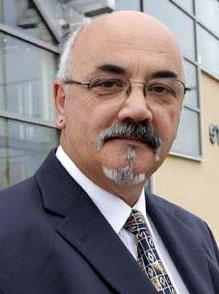
Hello Jim. Many thanks for agreeing to this interview. I’m sure that our readers will benefit greatly from your extensive experiences within poetry and creative writing. Can I start by asking you about the earliest foundations of your writing? Were English & English Literature subjects that came naturally to you at school, and who were your very first creative & literary inspirations?
I was adopted by a working class Liverpool family that had no educational expectations for me. I managed to live up to that by abandoning school from the age of eleven. I seldom went and when I did it was in the front door and out of a window. I hated school because I was bullied mercilessly by pupils and teachers but I loved learning and had discovered what I wanted to do at about the age of seven, when I read a book of poetry. I went to my dad and told him that I wanted to be a writer. He thought about it seriously and instead of dismissing it suggested that the way to be a writer was to first read, and that is what I did, and still do. He gave me a notebook and suggested I wrote down things that I thought were well written; this included words I had not come across before and phrases that I thought were very descriptive. So in all respects, my dad provided the seed of my first creative development. I tried to read everything that came to hand. I still do that, and these days average about forty novels each year, 200+ books of poetry and as many poetry journals that come my way. I often wonder how he had thought to give that advice as he had left school at thirteen to work as a tea boy on the docks in Liverpool and hardly read a book in his life, but his insight helped me lay the foundations for my writing. Although I like to recognise quality in what I am reading, I probably learn more from weak writing. That first book of poetry I had read was by John Betjeman, and his publication a few years later of Summoned by Bells kept him very high on my reading list until I discovered Beat and the New York School and moved away from traditional poetry.
In my ’60s & ’70s school days, I remember poetry being largely devoted to the works of Shakespeare and Tennyson. When I heard a poem by the Liverpool poet, Roger McGough, aged eleven, it blew my mind open as it felt like he was talking directly to me. Could you share some words on what it was like to be a part of the massive Liverpool creative scene in the 1960s, and to be writing/performing poetry with a very distinctive, ground-breaking style at such an early age?
For me, the Liverpool style in the early 1960s was much diffused, but became more focused after the arrival of Allen Ginsberg in 1965. I was thirteen when he came to Liverpool on a reading tour, and stayed there for a short time. I had started going to readings in O’Connor’s and other places, long before I was old enough to do so, taking the floor with my early poems – a couple of which have hung around. Roger and Adrian Henri were often there, but they were just part of a much larger scene I was involved with, including music, poetry and spilling over into all aspects of performing and visual arts. So when Allen Ginsberg said that Liverpool was ‘the centre of the creative universe’, there were not many who would have disagreed with him at that time, certainly not me. His visit was during one of my long absences from school, so I was able to hang out and listen to the dark conversations related to Beat; what it meant, how to capture it, bottle it, smoke it, etc. When Allen left Liverpool, he took a lot of people with him to attend the first big Albert Hall poetry event in London. As I was so under age at the time, I was not able to go. It was this event, captured in Peter Whitehead’s documentary ‘Wholly Communion’ that changed the perception of poetry in the UK and began the process of redefining poetry and its relevance.
As for myself, I performed in many of the open mic events around Liverpool and was invited to read in featured spots at some. I was also involved in the folk scene and went to many of the folk nights, still prolific due to the British Folk revival, which again Liverpool had taken to its heart. The other thing to be remembered is that ‘performance poetry’ was ridiculed by many in the poetry world and thought to be trivial, or of little value. Even the Liverpool Poets who had been included in two major anthologies that helped them break through (McGough, Henri and Patten) had a struggle to be taken seriously, and the word ‘popular’ was often applied in an arch way as a put-down.
Even back then I was experimenting with delivery styles and I had a vision of the spoken word as akin to a song without music. I saw poetry as part of the folk scene, a way to engage with an audience with words, and even today I still think about it like that and it continues to inform the way I perform my poems. I sometimes get told that I deliver too slow, or too fast, or exaggerate a pause, but in fact I am delivering the words to an internal melody that I think goes along with it. I can also point detractors to the fact that I have won numerous slams and awards for performance.
Could you share some thought with our readers about the processes involved in the construction of your poetry, Jim?
Most poems start with the germ of an idea, something seen, heard, remembered, and I collect those together. But then I have to decide what the theme of the poem is to be and how the elements I want to write about will approach the theme. Just as an aside, this is the root of ‘show don’t tell’, as the various elements of the poem need to be informed by the theme. Quite often the theme will not appear in the poem at all although taken as a whole that is actually what the poem will be ‘about’. I look for juxtaposed elements that will bring something new to the idea or illustrate it in a different, unusual or surprising way. I then over-write the poem getting the general feel for it, when I believe that it is approaching the ideas I want to engage then I start to reduce it. This process continues until I have the raw structure of the poem. At that point I start to consider the final form it will take. I have, of course, simplified the process here, but generally some aspects of this process are involved with every poem I write.
The exception to this are commissions; poems written to order or for a specific purpose come from the root idea provided in the commission. I enjoy commissions and see them as a challenge. I also enjoy working with other poets and I often work on collaborations with a friend who is a very fine poet. When I am conducting courses, I feel it is only fair that when I set a task for students I should do the same. So I do have a lot of stimuli and write a fair bit.
Are you a spontaneous writer, whereby inspirational thoughts have to be completed while you are creatively ‘in the zone’, or are you a writer who likes to mull and ponder over ideas, editing and refining them over time?
Well, both at different times, is the only truthful answer. At one time, back in the late 70s, I morphed into a punk poet, and for a while MC’d at Eric’s Punk Club in Liverpool. At that time, I would spontaneously generate poetry improvised from words shouted up by the audience. I carried on doing it in performance for years, and sometimes the results were better than others but it was always entertaining. The results were awful but, thankfully, the nightmares they left behind are fading now. To give a flavour of this, I did it at a reading a year ago. I was challenged (by my son) to see if I could still do it, and it was recorded. And this is it, written down exactly as said with the addition of breaking it into lines and stanza. No further alterations have been made. It has lots of faults, but I was interested in the subtext that in some ways must inform a lot of what I write. So here it is warts and all.
I started writing this on the day I was born
language came and books read
sixty years of sunsets and smiling at strangers
walking maps and dreaming
as I watched my children play this poem grew
and the words settled somewhere
with images of life like protein photographs
of all the people in my life that mattered to me
and the places that I lived and the ebbs and flows
that brought me to this place to write some words
that come in an instant and let me say this is poem
dedicated to everyone who helped me make my way
you are there between the lines with all my life
with everything I came to be
whoever you are perhaps you will know
these are the spontaneous
thought as I touch the cave paintings of my childhood
and the hieroglyphs of adolescence
the monuments of my later years
before they crumble into dust
I have never developed this further but may do so at some point. At the moment it stands with its flaws. This was created in the moments that it took to say it, and the ideas it generates touch on all my writing I think.
More generally I prefer to craft a poem. Develop it and take it through generations to a final product. Poetry is and has always been a way to explain how life works, the big themes, and this is as true today as it was when Donne was writing. The ethos of teaching literature has changed and the available texts have also expanded. Fifty years ago, Hughes and Heaney, although alive and writing at the time, had not broken through into the public consciousness. We have also seen the cross pollination of culture through multiculturalism, so this has also broadened the available texts. For me, though there is still a problem with some aspects of teaching poetry, I think more care should be shown in the selection of texts as popular does not necessarily relate to exemplar.
Can I ask for your personal thoughts on how poetry has changed within the last fifty years? Do you feel that the breadth and range of poetry taught to students has expanded during this time, especially compared to the poetry and literature that children/students were exposed to in the first half of the twentieth century?
The teaching of poetry in the first half of the 20th century was also supported with a grounding in classics, which made the poetry more relevant to the curriculum. Later, as teaching became modernised and moved away from the traditional method, poetry had less relevance to both teachers and pupils. For me, poetry becomes relevant when the teachers encourage the students to question it in different ways. A poem is a map to an unknown land; what the poet intended is mainly irrelevant, and the students should be encouraged to find their own path to what it means to them. Approached in this way, a poem is an adventure and an expression of creativity by both the poet and the reader.
University courses are a little different. Courses in creative writing and poetry have become very popular in recent years. Many focus on the students’ self-analysis and the production of a portfolio, with the emphasis on some courses being towards the linguistically innovative. In my courses I tend to steer towards the Black Mountain Poets, New York Poets, Imagism and, of course, Beat, together with the Modern British Movement. Many of the online courses I offer through the Poetry Kit (www.poetrykit.org) attract poets of all standards, from beginners wanting to see if there is anything in poetry for them to experience and well known poets who want to give their writing a boost. My starting point with all courses is to find great poems that the student has not read before.
But back to your original question, the start of it asked how poetry has changed in the past 50 years, and for me the main change has been the internet. This has allowed many more poets to find a medium for sharing their poetry; the result has been an explosion of outlets for poetry, and as long as you never expect to be paid for it or for it to be read by anyone, then the world is your bivalve mollusc saltwater clam. If you just want to be published and call yourself a poet then you can, someone somewhere will publish you, or if not you can do it yourself.
Wider development of poetry is also evident in popularity of open floor events, which give much wider opportunities for poets to find an audience.
Poetry in the centuries up to and including the early 20th Century basically followed trends and styles, so you had Romanticism, Symbolism, Imagist, and Modernism. But once you get to the mid and later part of the 20th Century, the proliferation of styles broadens so that there is no real dominant style. Elements of all of those previous styles persist together with Post-Modernism (a catch all for many different styles of linguistically innovative poetry), Confessional Poetry; the list goes on and on. In many respects that makes it a very diverse and interesting time to be writing poetry.
As a teacher of Creative Writing, what are the most important lessons that you seek to get across to young, enthusiastic writers, Jim?
This is very difficult to answer because there are as many answers as there are people. If someone is taking a course then their enthusiasm for the subject should be taken for granted, though it will express itself differently for everyone. The big problem is to try and guide without blunting that enthusiasm. I suppose the things I find myself saying mostly relate to craft, which is a distinct part of the writing process. Bringing the ideas together that help create the poem or other text is only a small part of the overall creative process. This is the point at which many people stop, thinking that the piece is done but really what should follow is the hard work that enables the writing to reach its potential and its audience, and this means possibly rewriting, revision, editing, tweaking.
I believe that attention should be paid to the tools we use, the most important of which are words. So reading is as important as writing; explore how people use words and find the best word for the job in hand. Listening to the rhythms of speech and how one word sits with others. This does not mean using the most obscure word; for me, the simplest most direct way of saying something is the best, but knowing a variety of possible ways to present what you want to say allows you to explore the possibilities available to you. Having a limited vocabulary limits the way you can express yourself.
I also ask writers to work within limitations of form so that they can learn about how the right words can be used to achieve an effect, so sonnets, villanelles, pantoums all have a place in the development of a writer who is serious about their craft. Doing these as challenges and bringing in some fun elements without being too serious about the outcome seems the best approach. Many poets who work only with free form try to dismiss fixed form as no longer relevant to them, but really there is so much to learn from using fixed forms. It is a bit like an artist painting in oils using a limited pallet, not through choice, but because they do not know about the missing colours. Using a similar analogy, an artist like Picasso first learned to paint in very traditional forms before setting his creativity free; the same is true of Van Gough and many others. So for a poet, even if they intend to write exclusively in free form, learning to manipulate lines through the use of fixed forms can help to develop skills in word selection and use, phase and line to best effect.
Another important aspect is reading good poetry by great poets. There are many to choose from but the ones I always recommend are Bob Dylan, Billy Collins, Charles Bukowski, Frank O’Hara, Allen Ginsberg, Emily Dickinson, Gertrude Stein, Robert Frost, Ezra Pound, Wendy Cope, Liz Lochhead, William Carlos Williams, Elizabeth Bishop… (the list changes depending on the needs of the students and the course.)
From reading a selection of your poems, Jim, I’m immediately struck by the wealth of detailed, mental images that start flowing into my mind. For me, your words have a powerful ability to make this happen. Are you artistic or creative in other areas, such as art and music, and/or do you take pleasure & inspiration from other creative arts?
I do write songs and have done since I started. In fact, the very first thing I ever wrote was a song. Visual art, film, plays are all part of the input that helps me relate to the world. I have written many ekphrastic poems and poems with intertextual relationships to a broad cultural base. If you live in the world and have an interest in hard and soft culture, it is difficult to get away from those influences, and I don’t think I would want to.
I would also add in science, the natural world, and perhaps the fundamental aspects of cosmology, understanding time and our relationship with it. Philosophy and psychology are areas I have studied, and I see the influences of those in my poetry, although I must say that I do not proselytise or try to foist any philosophical viewpoints as that is not the purpose of what I do.
When it comes to writing, do you have a specific location where your creative inspiration feels happiest. Also, are you a writer who feels happiest typing on a computer, or someone who utilises a variety of notebook and pens?
The simple answer is no, I keep to a writing schedule and write wherever I am. I do not have much truck with ‘waiting for inspiration’. For me, that is an excuse for a day off. My problem is forcing myself to stop writing. There are clear and easy techniques to ensure that I am ready to write, and I keep to those. I keep a PUKA PAD notebook with me at all times together with a small pen and this is used to jot down odd ideas, words, conversations, things seen, anything really that takes my fancy. I also collect things, postcards, odd things that pique my interest.
I usually write for several hours each morning, and later in the day deal with correspondence. Most writing starts as notes in my notebook, and it is when ideas start to coalesce that I use a computer.
Poems such as ‘Radio Days’ and ‘It was November’ create a wonderful pathway back to your past memories which, as a writing student, fascinates me by the glorious ease in which you make the words come to life. Is there an aspect of writing that you find positive and therapeutic, Jim, and is this a ‘spark’ that compels you to keep maintaining the creation process?
Thank you for your kind words, but the answer is no, there is no therapy in writing for me. I am not even sure what that really means. Poetry described as therapy or ‘heartfelt’ is usually a turn off for me. I made a career choice to be a poet and that is what I did and continue to do and I have never really done anything else. All my life experiences, and that includes direct experience and those things assimilated through reading, watching and listening, are all just grist to the mill of my output. I wonder, having written that if it is true or not, but consciously that is how I think it is. I do find it satisfying to be able to earn a living at something I would do anyway and I love being involved with the facilitating of courses. Since 1997, I have been involved with the Poetry Kit website (www.poetrykit.org) and that explores new poetry through the Caught in the Net series, and keeps me in touch with competitions, awards and new magazines.
I’d like to thank you again for sharing your thoughts with our readers, Jim. It’s been a personal joy to read some of your work and to learn from it. In conclusion, could you share some thoughts on what has been inspiring you to write during 2016 and are there any major writing plans for 2017?
I finish between six and twelve poems each month, sometimes more, sometimes less, then after I have the basic poem, I leave it for a while then return to it after a few months and see it to completion, so I hope to continue to do that. I have a suggestion for a pamphlet from a publisher, and I am working on an edition of selected poems for US publication in 2017. I enter competitions and submit to journals each month so I hope to carry on in the same vein. I also enjoy readings and although I do not often turn up at open floor events, I am happy to get invitations and try to accommodate them when I can.


