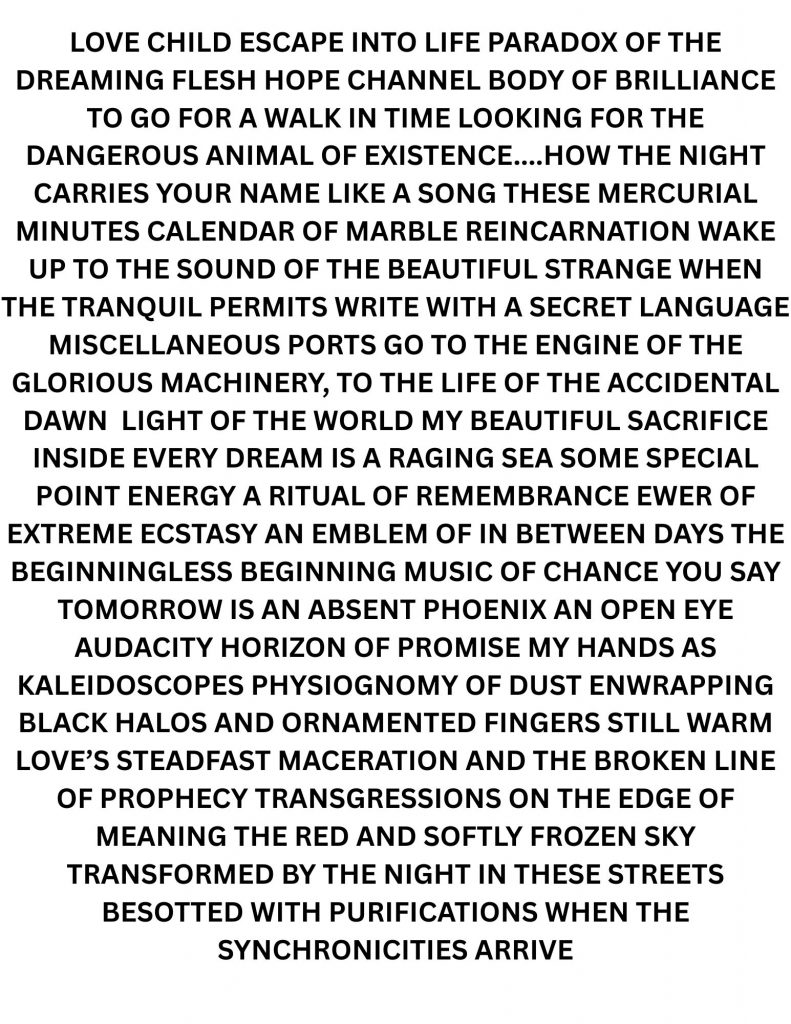

Rus Khomutoff is a neo surrealist language poet from Brooklyn.
You can find more of Rus’ work here on Ink Pantry.


Rus Khomutoff is a neo surrealist language poet from Brooklyn.
You can find more of Rus’ work here on Ink Pantry.

The mango trees in the spring blow,
But without any vigour and glow.
Sadness hangs around the hollow house,
My sick heart finds no repose.
The stars hum a sorrowful tune,
The moonlight lurks mournfully,
The rivers look cold and motionless.
I feel weak like the stars and rivers.
Bundle of laughs, moments of joy,
Shared with you in the past,
Appeal to my senses like the surf and turf.
Flood of memories chokes the heart.
The sun rises after every dark night.
I will touch your tender hand,
Embrace your arrival with a band.
I know separation awaits reunion.
Bimal Kishore Shrivastwa, PhD, is an Assistant Professor of English at Degree Campus Tribhuvan University, Biratnagar, Nepal. An anthology of his poems is published from Litlight Publication, Pakistan. Other poems from Mr. Shrivastwa are published from the UK, the USA, Bangladesh, India, and Nepal. Besides teaching, Mr. Shrivastwa loves promoting anything creative.

You can find more of Bimal’s work here on Ink Pantry.

‘The fence bit me,’ the kid thought as he struggled to run through the dusk and the tall grass.
That’s what he would have said to his grandfather, Bud, if he’d ever come home with a leg wound like the one he was trying to run with. Bud would’ve thought it a kick.
The kid felt the blood trickling down his leg, and the bottoms of his pant legs were getting heavy with mud and what-not. He remembered how his grandfather used to put sand in his pant cuffs where he snuffed out his cigarettes. He was glad his grandfather wouldn’t see how he’d turned out.
The wounded boy stumbled onto a shed, nearly ran into it. He smiled because the shed was real, not a prop in a fever dream. He fell to his knees then reached for the shed’s door handle and snagged it first try. Somewhere he could hear the dogs getting smarter. His wound stung with sweat. He pushed the shed door and dragged his body inside, welcoming warm air.
When he looked up, he saw an old woman in the corner sitting on a stool in front of an easel. Her hair seemed unending.
‘She doesn’t even care that I’m here’ he thought.
The woman snarled, “I got nothing for you!”
The kid lay quiet. He could see her eyes, could see she was blind.
“Go on I said!” the woman growled, “I smell blood and there’s nothing here that can help you.”
“You can’t see what you’re painting,” the boy said.
“Can’t see anything,” the woman barked.
The boy lowered his head then looked up through a dirty window at barren trees.
The pain in his leg was becoming unbearable. The boy managed to sit up.
“You don’t know who I am or what I’ve done,” he said.
She waited, then shrugged:
“Don’t much care. Ain’t what you’ve done anyway, but what you’ll do and I’m thinking not much.”
“You don’t know me.”
“True, but if I had to guess I’d guess you’re just another fool who’s let their horses get away, and now that they’ve wandered off, you’re too stupid to know how to get them back so you’ve carved out a world of trouble for yourself. Just a guess.”
“Shut up!” the kid shouted.
The old woman clenched the paint brush.
“And seeing as it would take different thinking to get your horses back, well, that pretty much closes that case.”
She dabbed her brush in a palette on her leg.
“Red smells the best.”
She asked, “Are you, what is it they say? Bleeding out?”
“Am I?” the boy shivered.
“I’m no doctor.”
The kid stared at a scythe hanging on a hook.
“How can you even know what you’re painting?”
The woman laughed. The boy tried to straighten his leg.
“What’s it like to be blind?” he asked.
“You tell me.”
She pulled the brush from off the canvas.
The kid took a breath then slowly, painfully got to his feet and limped over to the woman.
“I smell fear,” she said.
“I killed someone,” the kid whispered.
The woman sighed.
He noticed more tools hanging. Curious, he dragged himself over and put a hand on a pitch fork, testing the sharpness of the prongs.
“Could I have this?”
“Your kind don’t ask,” the woman grinned.
The boy turned.
“I’ll spare you because you’re old and blind.”
The woman wiped the tip of the brush with a rag.
“I’m an artist. You’d think I’d be good enough to kill, but have it your way.”
“Who are you?” the boy asked.
“Another one of those crazy seers,” the old woman replied.
The kid thought for a second.
“My grandfather used to talk about seers when he talked about the old country.”
The woman nodded.
The boy held up 2 fingers.
“How many fingers am I holding up?”
“Two,” the old woman replied, “Most put up 2. People aren’t that creative.”
The kid lowered his hand and turned his attention to a finished painting hanging on a wall. He studied it.
“Why waste your time painting a field?”
The woman turned, showing the kid her marble eyes again.
“It was the last thing I saw before they came for us. I paint the world that can’t be killed.”
“Everything can be killed.”
“Sez you,” the woman said with calm conviction.
The kid looked at the painting on the easel.
“That’s nice – an apple.”
“Found it this morning on the path where they say the deer like to sun themselves. Not another apple tree for miles, just this one.”
He looked out the window.
“Almost dark now.”
“I know. I smell it.”
The kid stood silent for a long time then whispered.
“I’m scared.”
The women plucked a rag from a pile of rags she kept in a basket by her side and offered it to the kid, who took it and wrapped his wound.
“Does it hurt?” she asked.
“Like crazy.”
“Good.”
The kid turned to the pitch fork, then back to the old woman, who was holding one hand in the other; the one that didn’t work. The boy stood at the window, then turned but was stopped by the woman who held her arm out. In her hand was an apple.
“Thanks,” he said, taking it. The woman said nothing.
The kid shoved the apple in his pocket.
“What will you paint next?”
The woman sighed.
“Never know. Something good. Always something good.”
The kid left the shack with a bandage and apple, but not the pitch fork.
The landscape was somewhat moonlit. Dogs were becoming smarter and closer.
He made his way slowly across more tall grass, limping and stopping only once to catch a glimpse of ordinary life through an ordinary window.
He found the road then began limping toward the gathering of lights.
Joe Ducato lives in Utica, NY. Previous publishing credits include; Adelaide Literary Magazine, Santa Barbara Literary Journal, Modern Literature, Avalon Literary Review and Bangalore Review and among others.

You dreamful, dreamy, moony and dreamed King of Elves!
You became in the most amazing ways:
A dazzling statue of Buddha, as if a ghost created it from the moony dreameries.
A parrot on the statue: the paradise-like birdie, awoken from stunning, meek, tender dawn.
A bonfire – the shimmer in the soft night with its warmth born from the muses of the tenderness.
A bewitchment-enchantment of a bliss, that brings amaranthine wind from paradise.
A poet worships the statue belonging to the dreamery of the Erlkings from the morns.
A pearlful inspiration in the wise mind, full of eternity of the Morningstar.
The poet who writes the most dazzling poesy like soul-softness of muses with tears.
The bonfire is being adored by the awoken bird of the melancholy of the times.
A daydreaming of the sylvan elves, bewitched in the dawns and the gorgeous Golden Fleece.
A whisper, that melancholy, for me and fancy of sempiternity, gives.
We praise, You most tender Erlking, and your treasure:
ontology, eschatology, epistemology, ethics, aesthetics, logic, metaphysics, epicureanism and stoicism, all of them, enchanted by tender Buddha in a most picturesque way.
Paweł Markiewicz was born 1983 in Siemiatycze in Poland. He is poet who lives in Bielsk Podlaski and writes tender poems, haiku as well as long poems. Paweł has published his poetries in many magazines. He writes in English and German.
You can find more of Paweł‘s work here on Ink Pantry.

there once lived a swan couple
devoted to each other as they cosily huddled
flying together across sapphire skies
seeing the golden dawn of a new sunrise
life sailed across a river of dreams
carrying echoes of songs that gleam
smiles shimmering on the shores of love
as they cooed like a pair of doves
life flew on the whispers of the breeze
a gentle, fleeting rustle of the leaves
in the hush of twilight’s solitude
they heard the symphony of the interlude
’til time, cruel time
snatched him in life’s prime
and she was left alone in the twilight
alone in the grief of her soul’s long, dark night
she cried and cried
copious tears on time’s tide
her heart breaking each time Facebook brought back her reveries
and mine breaking to see her memories
and then one day, she spotted Cygnus
the Swan constellation in the northern sky,
seeing her mate in the silver stardust,
she smiled, silver-haired, and tried to adjust
making peace with grief in her heart
while honouring love that would never depart
Avantika Vijay Singh is a communications professional wearing the hats of a writer, editor, poet, researcher, and photographer. She is the author of Flowing… in the River of Life and Dancing Motes of Starlight (ebook) and editor of five anthologies. A recipient of the Nissim International Award Runner Up 2023, WE Gifted Poet 2024, and WE Illumination Award 2024, she has been published in national and international journals. Nature’s beauty, sustainability, life, spirituality, and humanity are her muse, lending immense depth to her poems.
The Swan Couple poem can be found in Avantika’s new collection: Gold Dust on Sunbeams: An Anthology of Poems
You can find more of Avantika’s work here on Ink Pantry.

Overexposure
It could happen to anyone, what emotions
do to undo us.
Reveal the unexpected.
In such abrupt instances is it each other we really feel?
Consider this fort of a man.
He’s some cool-headed professor.
Hasn’t his authority been resented, so
stern, so robotic? Here he is now
projecting slides of his Nicaraguan humanitarian trips,
all the peasant women & children, their hunger & his own.
The lectern cracks with some savage gentleness,
& his is a surprise.
Looking back down the road, years & poems on,
where’s a snapshot of this,
& where in the whole world is the wiser revealed?
Jealousy
These glimpses are just beyond nonchalance,
this demeanor of civility. They are ready to flare
Pompeian, jet like lava from the blood.
We don’t make love to each other.
A third party intervenes, its green gaze mirroring the hidden,
a sudden fit enlarging a moment of tenderness
for grown children reduced to shrewish slithering Medusas.
One look and be now stone-turned stolid.
What shines the length of our flesh?
Heated, greased lightning with the fervor of alcohol?
Lust incites possession, fears the urge, loathes the irrational
while passion sips tea and hands us our heads
as salted meat on the breakfast tray.
Workers Backs
Rope-made, the knots, the ties tight between
what lifts & goes & pulls & pushes
hour after hour with or without
any breaks at all.
Any breaks?
All loads are shouldered & found
as a squeeze between boulders,
breathing to go home
Wouldn’t you want to go home
by placing hands there on these muscles
that could steam like horses
watered down after a race
& then go further, give them all
a blanket & a day & a night
where their backs could be
just touch for themselves?
Try This One On
The fender’s impact shrieks.
These wheels, teeth, eat
whatever flesh gets in the way.
Oh you can have that world,
brutality a past-time,
the predator sizing up
the diamond miners’ worth,
so useful unless they get out of line.
Human resources, commodities:
the ghetto boxer’s survival
dependent on beating fists.
Bets from the screaming crowd
are only part of the packaging.
Pal, they’ll call you.
Pal, play your hand.
It’s a shell game.
Later, if lucky, shrewd,
demand top price while the ring,
the ring still takes toll.
Laughter
The good guru—–
wisdom/innocence,
a rush as if from rocks,
water gushing through.
Give air, a gasp, a snort,
innards/spirit, a spray
of baby’s breath, soft rustles
now, hush hush fingers, clap,
cover the whispering
lips, eyes reflecting the sound,
eyes only, squinting & maybe
a few trickles, (lick, trace, let fall),
carrying further what spirits know
living in the torn forth sound.
Stephen Mead is the resident artist/curator for The Chroma Museum, artistic renderings of LGBTQI historical figures, organizations and allies predominantly before Stonewall: https://thestephenmeadchromamuseum.weebly.com/
Stephen is a retiree whom, throughout all his pretty non-glamorous jobs still found time for writing poetry/essays and creating art. Occasionally he even got paid of this. Currently he is trying to sell his 40-year backlog of unsold art before he pops his cogs: https://www.artworkarchive.com/profile/stephen-mead
You can find more of Stephen’s work here on Ink Pantry.

Wrought inside a cherry centre, made-up from love-bound wind
Just while shit razors cry, I bend up for inexplicable owls whose spind skin
Gets woofing after dizzy eyes and pained breads and haloers for xmas wind?
O, you appear now to ask
All about the Ides of midmarch and devilries and abaddons and kicked limb
And we will starve for a slit as we gabble after
Domed dragglers that must come forever home to a mod casementer for failure
(And if I could have just one cool dreamtime, perhaps dead buckrabbits will
Beget bereft hair from huge mares and sea-sanders that render holy pets from
liveliness and pure Love).
Jim Bellamy was born in a storm in 1972. He studied hard and sat entrance exams for Oxford University. Jim has won three full awards for his poems. Jim has a fine frenzy for poetry and has written in excess of 22,000 poems. Jim adores the art of poetry. He lives for prosody.
You can find more of Jim’s work here on Ink Pantry.

Baby’s screaming wouldn’t stop. It echoed through the whole house from upstairs in its crib, threatening to lift the roof off in one long cataclysmic wail: “I neeeeed yeeww! Where are yeeeeewww! I knooow you’re down theeeerrre!”
Downstairs, Daddy sat on the couch facing Mommy by the front window coated in frost. They locked eyes, their faces creased like two paper bags. They held their breath as tight as two divers. A faint smell hung in the air like sour milk.
Daddy glanced up at the living room clock, its spiky minute hand dragging across a pale face. It was a 12:23 on a Saturday afternoon. Nearby, the wallpaper had buckled a little. Baby’s onslaught began a half hour ago, after Mommy plopped it in the crib for its nap, surrounded by piles of picture books and stuffed bunnies and kitties.
He could picture Baby standing up on its toes, hands gripping the bars, red-faced, gasping for breath between sobs. A galaxy of radioactive-green stars swirled on the ceiling. From a small cube white noise gushed.
He held up both palms to Mommy, fingers spread as if in surrender, and mouthed the words, “Ten more minutes.”
Mommy felt she was on the verge of tears. She clamped her hands over her hears and collapsed sideways onto a cushion. It killed her to hear Baby in despair.
“Why won’t you comme up heeeeeerrre? I don’t want to sleeeeeep! I’m not tiiiirr-red! Puh-leeeease!”
Daddy remembered from Sociology seeing the slow-motion footage of a mother’s face when its infant cried, a micro-seconds shift from murderous rage to wide-eyed compassion.
Mommy didn’t know how much longer she could stand it. She shoved herself up and hurried into the kitchen to do dishes, where the rush of water from the faucet helped smother Baby’s howling.
Daddy sat stone-faced on the couch. The house was chilly, but he refused to put on a sweater. They both knew Baby needed its nap, that without its nap it would turn into Bad Baby, flinging toys and food on the floor, screeching like a wild animal, its eyes bleary and unfocused.
“I luuuuuvve you! Why won’t yeeww help meeeeeee?”
Mommy reappeared wringing her hands in a towel. She nodded at the clock with fierce determination. The minute hand ticked into place. Ten minutes. They both knew this couldn’t go on. Daddy hung his head. Mommy went to the foot of the stairs and prepared to climb them quietly, the carpet soft under her sneakers, waiting for the creak at the top to give her away.
Daddy watched Mommy start to glide upstairs like an ascending angel in a church pageant. He caught his breath and listened for the moment that Baby’s shrieking ceased, when an enormous silence would settle over the house like a big soft blanket and they would all crawl under it, and Daddy would tell stories about a hairy monster with jagged teeth who was really friendly, the terrible interlude all but forgotten as sleet pinged the windows and tree branches brushed the sides of the house like an impatient creature seeking warmth.
Based in Boston, Gary Duehr has taught creative writing for institutions including Boston University, Lesley University, and Tufts University. His MFA is from the University of Iowa Writers Workshop. In 2001 he received an NEA Fellowship, and he has also received grants from the Massachusetts Cultural Council, the LEF Foundation, and the Rockefeller Foundation.
Journals in which his writing has appeared include Agni, American Literary Review, Chiron Review, Cottonwood, Hawaii Review, Hotel Amerika, Iowa Review, and North American Review.
His books include Point Blank (In Case of Emergency Press), Winter Light (Four Way Books) and Where Everyone Is Going To (St. Andrews College Press).

an incredulously rich crimson—
flamed flamboyantly
where it had risen
arching above the emerald defiantly
hailing Spring in Jharkhand joyously…
flames of fire blossom
blossom fiery flames
bold and beautiful are they in season
growing in the jungles rampantly,
Palash is the beauteous one
exuding a primitive raw beauty,
that caught my heart so exuberantly,
flames of fire blossom
blossom fiery flames
brave and beautiful are the one
who live in the shadow of the Palash euphorically
uncoated by the plastic veneer of urbanisation
exuding a primitive raw beauty…
living life in synchrony
with the flames of fire that blossom
in the heavens
far from the reaches of civilisation
no concrete roads reach them vitally
no motorised vehicles reach anyone
no piped water reaches them instantly
no thick mattresses cushion their bodies comfortably…
their bed of hardships
infusing in their backbones, steel warships
and, yet they know the joy of the season…
the Palash springing to life vividly
in the colours of life, crimson
that thrums raw in our veins exuberantly,
smearing the colours of life ecstatically…
flames of fire blossom
blossom fiery flames
Avantika Vijay Singh is a communications professional wearing the hats of a writer, editor, poet, researcher, and photographer. She is the author of Flowing… in the River of Life and Dancing Motes of Starlight (ebook) and editor of five anthologies. A recipient of the Nissim International Award Runner Up 2023, WE Gifted Poet 2024, and WE Illumination Award 2024, she has been published in national and international journals. Nature’s beauty, sustainability, life, spirituality, and humanity are her muse, lending immense depth to her poems.
You can find more of Avantika’s work here on Ink Pantry.

The Rain Bridge
Underneath the rain bridge,
you mimic the river in perfume,
glass lamps after glass lamps
illumine your forehead
with a mark of clear water.
The rain drapes fragrant sheets
we garment in the water of your hands,
we vigil for the pure light
as you willow the river
and incense the lip of a jar.
We drink from the stream
beside the grass path
where the sky powders wild violets,
the sky floats on a stone flame.
The Rose Sphere
Blood flower, fire flowers set the moon on escutcheon,
you walk on embroideries, the sky a tapestry falcon,
the cup of your breast spills from a river red tunic.
We drink the wine from your side,
glow horses and run as the rose sphere jewels the night air,
persimmons drip like your necklace from a wet branch.
The Moon Vine
A river of light sparks in the night trees,
the sky willows bend anemone,
our hands blur at the surface of water.
You rain in ink to purify the lanterns,
cup to cup we wash exalted,
the sky lights clean through a bracelet of trees,
you sever pomegranates from the moon vine.
John Swain lives in Le Perreux-sur-Marne, France, and has published two collections of poetry, Ring the Sycamore Sky, and Under the Mountain Born. His chapbook, The Daymark, was recently published by the Origami Poems Project.
