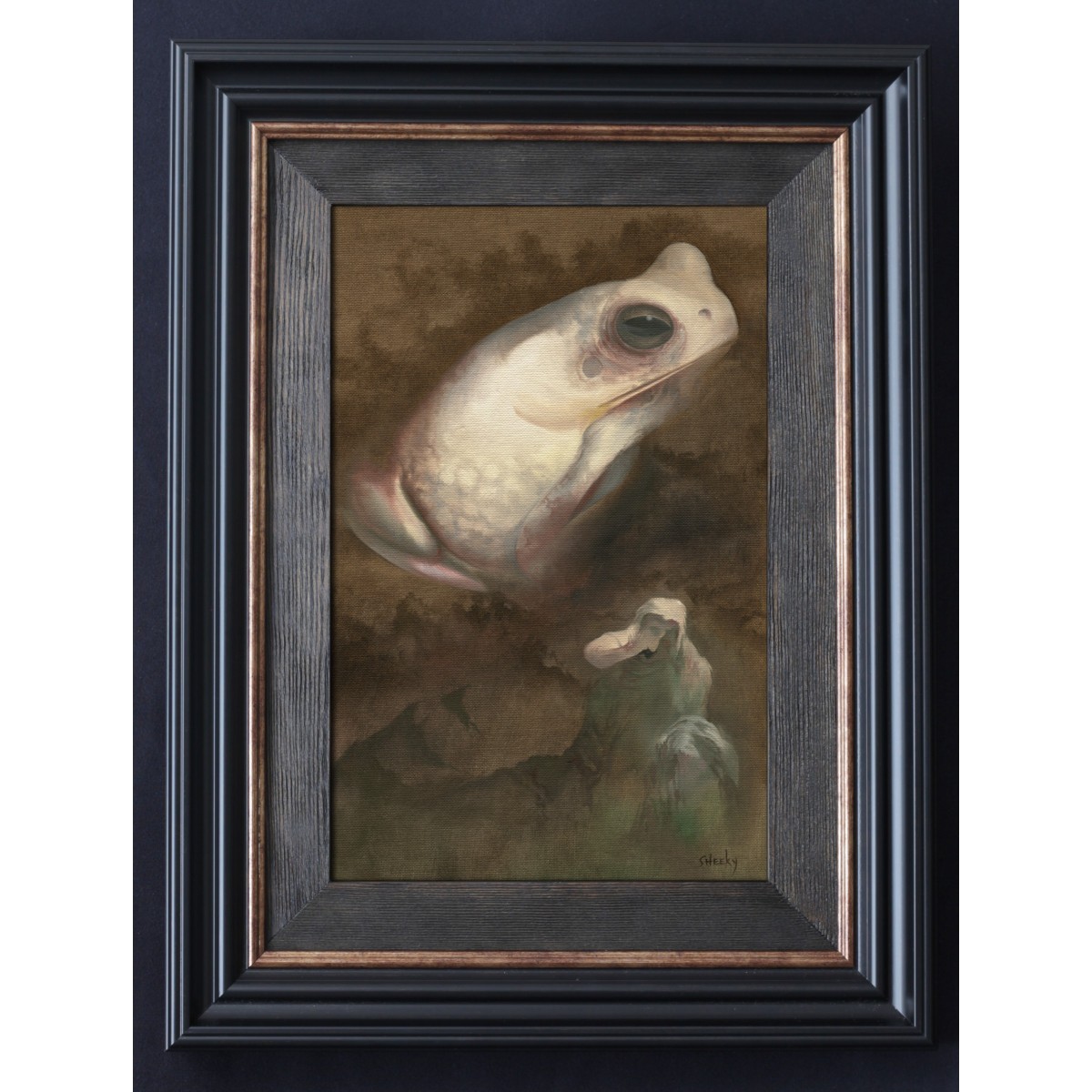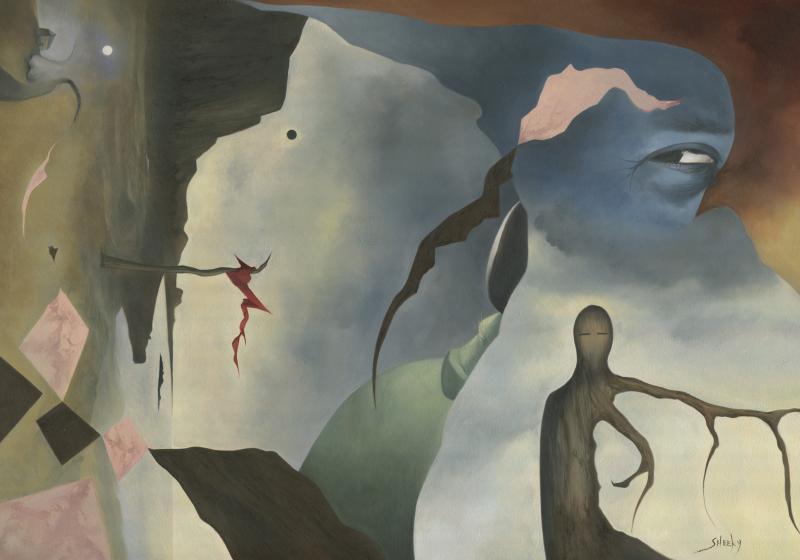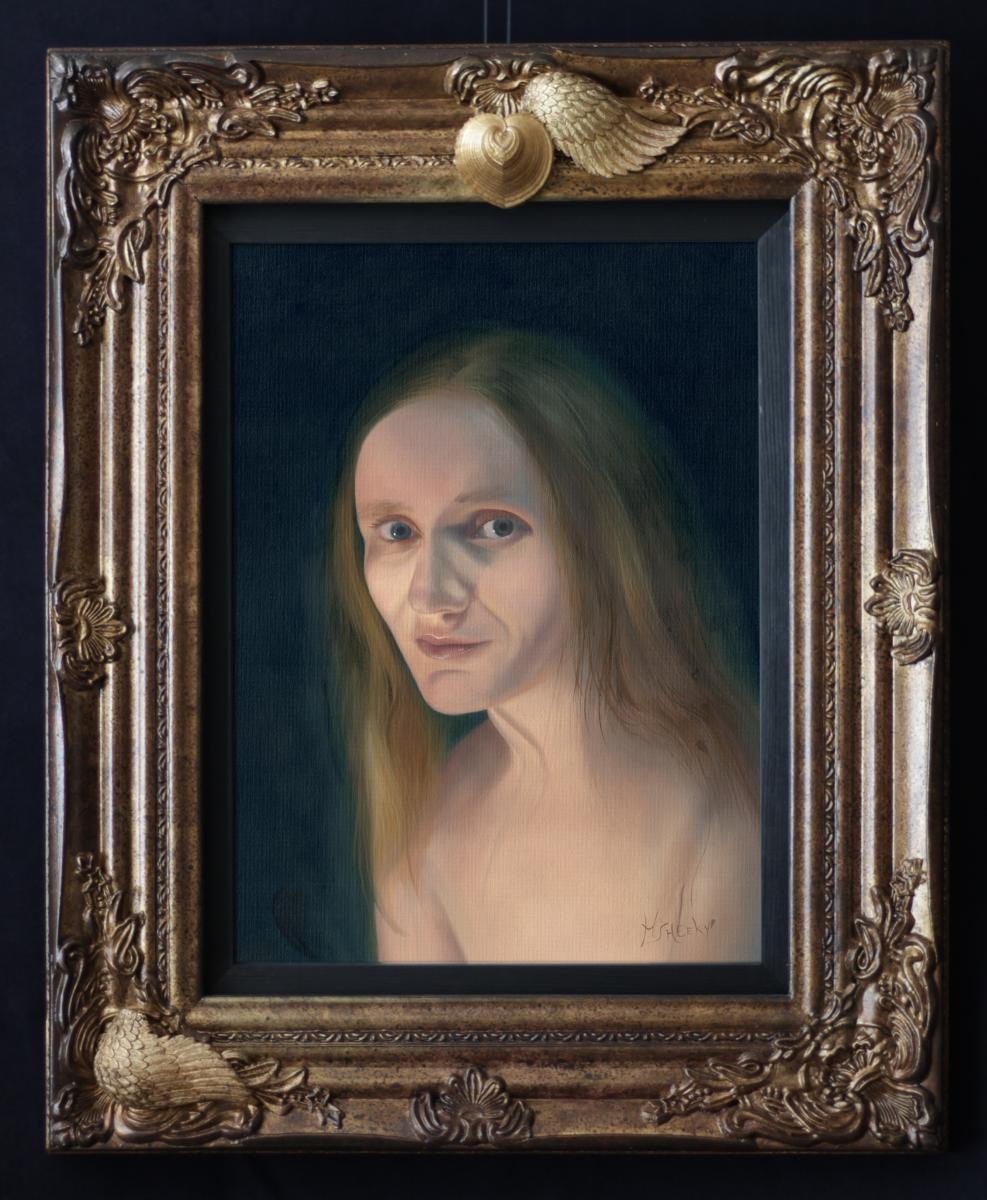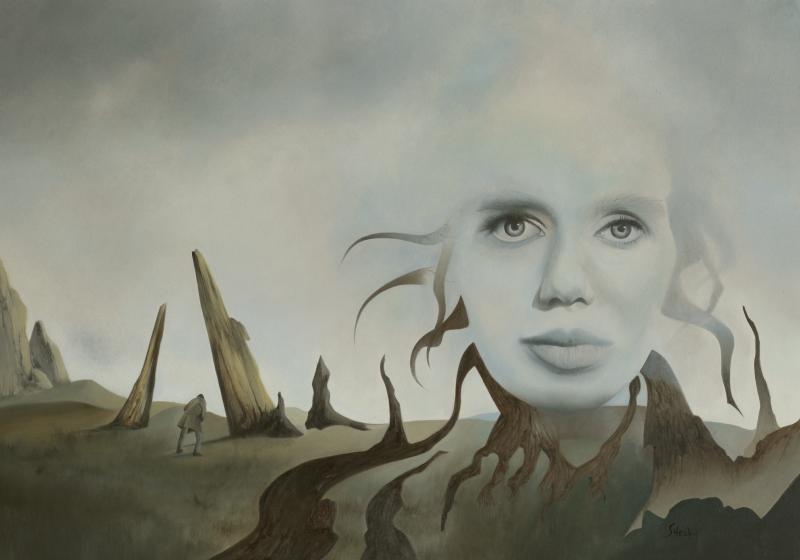
Inkphrastica: The Passion Of Anna: Ken Pobo (Words) & Mark Sheeky (Oil Painting): Part 2 of an Ingmar Bergman Triptych

My face, gone.
I stumbled around since
I had no eyes, hoped it would return
like the dog I lost in fifth grade.
I made coffee and even drove to work.
No one said anything. Perhaps
my face had been erased for years,
maybe since I was born,
only I kept picturing it there.
Is this common? Without a face,
I couldn’t see others. Had I ever?

The sky, I presume, still appeared,
a stale gray the same as my good suit.
I used to say my,
what a pretty world this is,
cornflowers blue as my grandmother’s
church hat, asters poking red swords
in a bloated breeze. I may dream
a whole new self tonight–

it’s happened before. Selves
form and melt, ice on a puddle.

The Passion of Anna: Artwork for sale by Mark Sheeky

Inky Interview Special: Poet Ken Pobo From Pennsylvania

Inky Exclusive: Interview with multi talented artist Mark Sheeky

Inky Interview Special: Kevin Casey

Describe your journey towards becoming a poet.

As far as writing goes, I think my childhood was fairly typical: greeting card verse in grammar school, bad, overwrought poetry in high school. Even worse poetry followed in college. I tried to get some fiction published after grad school, but–especially since this was before you could submit work online–I couldn’t bear the waiting, so I gave up. In the spring of 2014, though, a friend and I were complaining about the state of contemporary writing, especially poetry. It occurred to me then that I didn’t have the right to whine from the sidelines, so I tried my hand at poetry, and here we are.

Tell us about a typical day in your life.

Up early (about 4am). Write if the mood strikes me, but usually not. An hour’s commute to work (often spent mulling over some poetry topic), and then work (English Professor turned administrator). An hour back home (more mulling), and then a few hours for family, and at least some time reading/writing. Most serious reading/writing takes place on weekend mornings, with their large, uninterrupted blocks of time…

Who inspires you and why?

I’m inspired by other poets, both famous and unknown. Or, more specifically, I’m inspired by their work. Usually without warning, the form or content of a poem will seem to force me to respond. The resulting poem will be my own version of theirs, or will be a type of rebuttal, or might even be hardly related to theirs at all, in the end. Once inspired, though, the poem will always happen. It’s a question of how, instead of if.

What advice would you give to your younger self?

I still regret the decade-long writing hiatus I took, though I remind myself that the world wasn’t terribly anxious about this break. The advice would be not to underestimate how quickly time passes.

Tell us a story in five words.

In remission, his pettiness returned.

This strikes me as a great example of why I enjoy poetry. As a story, these five words are similar to Flannery O’Connor’s A Good Man is Hard to Find in which The Misfit murders the grandmother, saying she would have been a good woman if there had been someone to shoot her every minute of her life, i.e. that sometimes we need a life-altering crisis to become decent and virtuous. But whereas O’Connor’s narrative involves the journey of a whole family through this twisted landscape and a dramatic, violent conclusion, a wee poem can approach a similar topic in a quicker, less sensational, though perhaps a more nuanced way.

Have you been on a literary pilgrimage?

A pilgrimage suggests sacrifice, or at least the minor hassle of planning, and I’ve never done that, per se. However, back in college, I lived fairly close to the home and gravesite of Emily Dickinson, and I would visit these places regularly, placing pennies on her headstone, etc.

Why do you think poetry is important?

On a bad day, I’m not certain it is. On a good day, though, I think that poetry is the quintessential human art form, that creating and sharing meaning in this almost ritualistic, ancient way is such a part of our species, as well as being (potentially) so accessible to both writers and readers. Poets may not be “legislators of the world,” but anyone with a degree of proficiency in their language should be able to make and understand poetry.

Do you have any advice for other writers?

Only to recommend the old dictum that you not let a day go by without at least writing a line. No poet of whom I’m aware makes their living solely through writing, so the discipline imposed by needing to earn a paycheck simply isn’t there. It’s usually important, therefore, that we force ourselves to write, to write better, and to try to get these poems out into the larger world.

What are you reading at the moment?

I make time to read any and all poetry I can get my hands on: collections from established writers, brand new web journals, etc. I’m also reading Braided Creek: A Conversation in Poetry by Ted Kooser and Jim Harrison.

What is next for you? What plans have you got?

I’ve got a new collection coming out this summer from Glass Lyre Press, and it looks like I’ve written enough poems to pull together another manuscript, so working on that will take me into the fall.

Poetry Drawer: Quotidian by Kevin Casey

Kevin’s Blog

Poetry Drawer: No tertium quid by Sofia Kioroglou

In search of a morally uni-vocal answer
There is either right or wrong,
No tertium quid, no equivocity

Seek for the truth,
and meet with scandals and horrors
in multivocal clamor

You do not need bombs and bullets
to hush people’s gums and blur the truth
Terror can be masqueraded as substantive laws

Superpowerism as a promotion
of global movement for democracy
A regression of freedom into monarchical dictatorship.

If plongeurs thought at all,
they would long ago have gone on strike
Eric Arthur Blair mutters over his Chardonnay

The truth is diluted like wine
the sheeple are thrown into a quagmire
“Liberty is telling people what they do not want to hear”

Inky Articles: A Spotlight on Miltos Sachtouris: by Sofia Kioroglou

Poetry Drawer: Three Poems by Karen Wolf

Cathy Across the Table

My best friend scoots
into the restaurant bundled
against cold spring air. We search
the chalk board and waitin’ line. We
should get a cupcake to
mark the occasion, she says, about
to move 300 miles south
of the Arctic Circle. We toast
our friendship with bowls
of lentil soup, her eyes
sparkle with girlhood
surprise at our window table when I hand
her an afghan I crocheted to warm
Alaskan nights. April showers
pound the glass calling
up our sunlit kayak trip that ended
rain-swamped and overturned. We laugh
and slurp our memories. I want
to make this last and sidestep
good-byes. Tomorrow, Cathy
will leave and despite
promises, our connection will
cease in a relationship
void of commitment.

Lesson Learned

Below a window-framed parking
lot, beside a cushioned time-out
chair, a gray bucket hosts
rock weapons. Six-year olds,
desperate for food, fresh air, try
to stare the classroom clock
into warp

speed. Ms Thompson
hoists the rock bucket
onto her desk, holds
forth active shooter defense strategy. Suzy

reaches for the teddy
bear hidden in her desk, while Jeremy
sucks his thumb and Nicholas imagines finger
painting his rock, before Jane says, My
Mommy won’t let me throw rocks. The lunch bell rings.

Jeremy grabs the newly
vacant swing, as an older boy
pushes him aside, to climb
skyward. Jeremy
fires a rock at the blonde
airborne head.

Decency

In a cobwebbed corner of my mind, it hides before
stepping out in top hat and tails
for a carriage ride across the city, proceeds
to the homeless,
documented
on the Society Page, it

dons a pink
tee-shirt, race number, raising
cash for breast cancer, finishing
time splashed
across Facebook. It

donates to a wildlife society, covets
polar bear gift socks under
my slippers. In

the forefront of my mind, it
sometimes dances, in silent satisfaction
helping a neighbour with
trash, listening to
a co-worker, making
an afghan for a homeless woman.

Inky Interview Special: Poet Karen Wolf from Bowling Green, Ohio

Poetry Drawer: Who She is Not by Karen Wolf

Poetry Drawer: Claustrophobia by Karen Wolf

Flash In The Pantry: Still Wet by Mitchell Krockmalnik Grabois

1.

My masterpiece is still wet. It will not burn.

2.

She is Sri Lankan. She keeps telling me I’m a great writer, which annoys me, but she insists. I say: If I’m a great writer, why aren’t I rich and famous?

3.

I have a while to wait until it is burnable.

4.

She says: Until the giant sleeps, the dwarfs play everywhere. That is both folksy and elegant but, in the context, doesn’t make sense. I lose my patience and say: Well, don’t call me great anymore. Truth be told, I’m one of the dwarfs.  Besides, calling me great stimulates egotism and, as a Buddhist, you know that’s not desirable.

5.

I have thus far left no trace of myself, of my “talent.” I have not given in to ego. I have thus not contributed to genocide or war.

6.

Okay, I’m sorry. I won’t call you great anymore. She goes walking around the lake. When she returns she says: You know what I think of when I see cranes? I think of tying their long necks together. They have lovely long necks with tiny soft feathers. So white. So white.

Flash In The Pantry: Serotonin Reuptake by Mitchell Krockmalnik Grabois

Flash In The Pantry: Mandela Warp: A Moment in History by Mitchell Krockmalnik Grabois

Flash In The Pantry: Cooking Shows by Mitchell Krockmalnik Grabois

Inky Interview: Author Mitchell Krockmalnik Grabois from Denver, Colorado

Poetry Drawer: Quotidian by Kevin Casey

Tumbling south, swifts and swallows blur the sky
with their numbers; geese wedge their sonorous way
toward longer days before the first frost falls,
each driven or led by a urge sensed
and accepted beyond our comprehension.
But the heron overhead, alone except
for the patch of dawn it carries on its back,
decides each day which pond or beaver bog,
which river bank to haunt–a compass rose
of courses to choose from with each sunrise,
and no flock to follow, or shift in seasons
to shoulder this daily decision we share–
necessity’s mundane miracle
of industry and resolution.

Poetry Drawer: Flight by Laura Minning

Dreams
are meant to be fulfilled,
and dreams
are meant to be shared.

That’s what he thought.
That’s what he
always wanted.

He was so full of life.
His soul was free,
but his body
was weighted
with illness.

His heart grew heavy
with each passing day,
but he never gave up,
and he never lost sight
of his dreams.

I respected him for that.
I respected him
for who he was,
and I was grateful for
for the time
that we did have.

And every time
I think of him,
I will smile
because I know
that he
would have
wanted it that way.

Inky Interview: Author and Visual Artist Laura Minning

Poetry Drawer: Home by Shannon Donaghy

I know better than to leave a place
And expect to find it
Exactly where I left it
This time, I return home a foreigner
I’m not sure I ever really belonged here
Forever the pre-trembling of this half-broken house
Always on the verge of collapse
Foundation rotting, eaten away
I fit here like a baby tooth already lost
Nothing grew in my place
I don’t complete this empty face
Not lost, just out of place
I teeter on the edge
And disappear without a trace

Inky Interview: Shannon Donaghy from Montclair State University, New Jersey

Poetry Drawer: Occupied by Shannon Donaghy

Poetry Corner: Four Poems by Robert Beveridge

Cabin

There is a place in Maine,
near Belfast, where the oaks
trundle up to the oceanside,
fifty feet of shattered rock
separating soil from surf.

The cabin sits behind
that rock, the clearing hewn
some years ago, the house
built, then, two rooms
and shed, then added
onto later.

This place. This
is where I want you.

Let me carry you inside, show you
wood and varnish walls, oaken floors
worm smooth with centuries
of footsteps. The desk, the bed
walnut carved
within this house and never moved.

Through the door, the kitchen
cast iron and wood stove
two chairs, an ashtray
made of stone. When the house
was built, there was no shower;
the builder’s wife, waist-length hair
bunned up, stood naked
in the washtub as he poured
lukewarm water over her
washed her back with hands
calloused from carving.

Now building codes have intervened,
a bathroom added, papered
and electric, running water.
Some things, though, never change.
Undress, expose your body
by the flicker of the lantern
step into the tub
and close your eyes.
Let me wash you
in the water we have heated
touch your back
with calloused, trembling hands.

Cold

The motel room this morning
I woke up
and all traces of you were gone

I kissed the sheets
where your musk scented them
took a tape
you’d left on the TV
and looked for you
shivering
in February morning air

your apartment was empty
your scent absent

your favourite stores
the bus stop
our corner booth at Tiffany’s
all were air-conditioned
in the chill
and you were in none

I left another message
pulled the blankets close
sat down to wait
for your call

Phillipe Soupault Wouldn’t Have Done This

I wish
I could smoke
in these grey
academic cages

or that this crowd
of harried housewives
and eager idealists
practicing Art
could meet in a bar
biweekly

instead of being outcasts
like the great wretches we read
who go to Cabaret Voltaire
and drink absinthe in the rain
pass folded papers
and scrawl drunken notes

we sit in our cells
and watch the war
in the Persian Gulf
write dry lyrics
to dead times
stroke old wounds
on new battlefields
comfortable and dry

I want to go
to the dream
of white-eyed
engineers and
headache pills
who talk.

Come with me
walk through the rain
to a little restaurant
on the corner
of 13th and Pine
we can eat
and talk
and write

bars down the street
to drink in
cheap hotels
for quick liaisons
when the pen
is sapped of ideas
and the air!

Dark, smoky,
filled with falafel
and feta cheese
perfect place
to write and talk.

Illicit lovers tryst
by the window
read each other’s
poems palms
and psalms to sex

in the corner
a skinny artist
with rimless glasses
looks up, looks down,
sporadic scribbles
intertwined with bites
of falafel sandwich
watches the lovers

(yes, even Starving
Artists can afford it)

who are engaged
in nothing but themselves
first exchange
of poems takes
all their concentration

they look up
and laugh
and kiss

Phillippe and friends
wouldn’t have hated it,
I think, not like
this antiseptic room

pen strokes paper
pulls purrs
of lust and moonlight
from the fibers
lovers wrestle in between
and tigers roar
rivers run
the moon dies
its nightly death.

Shrove Tuesday

Lost and running, searching for you,
I am crushed by mountains.

Seeing you is pain,
A pain of too much honey tinged with blood.

Goddess, I cannot look at you
over rivers, or sunlit lakes. I cannot
demand your presence, no more than I could
see your face by staring at your hands.
Even kiss me once, my goddess,
let me feel your lips on mine, your perfect
Lips of honey tinged with blood.

Inky Interview Special: Poet (& Noise Maker) Robert Beveridge, from Akron, Ohio

Poetry Drawer: A Lesson in Composition by Robert Beveridge

Poetry Drawer: The Drowned City by Robert Beveridge

Poetry Drawer: To Be or Not to Be by Robert Beveridge

Poetry Drawer: Two Poems by John Grey

In At The Kill

Pigeons on the rooftops,
a body of prey,
hawk claws grip telephone pole,
take a hundred different forms,
a picture perfect pose
the right way to measure –
look up, a symbol,
changing at the blink of an eye.

If I ever had the strength
to peek through that book
of concentration camp horrors,
difficult words, unconscionable phrases
would compete with one another
for a better grasp of evil’s history
though for how long
could the mind still claim to be master?

I could trace iniquity, back and forth,
from the unborn to the living
to the relief of never having brought
a child into the world,
the darkness repeating itself,
maintaining both depth and surface,
in bodies draped across each other,
bald heads, dead eyes, that depart
from what I know of people,
then the ashes of the ovens,
the Nazi Auto-da-fe,
the acts that overstep even
the worst that I can imagine,
ordinary people
taking on this ghastly form of reality,
owed an impossible apology
to go with the sorry plots and crosses.

Pigeons on the rooftops
do not hone the mind’s values,
can never be noble,
like the hawk
that eyes the fattest of them,
is about to swoop,
satisfy its hunger.
I am fine with it.
I have learned that each kill is different.
Some must always be remembered.
Some grant the witness license
to go home and hug his loved ones.

Sorry But

Regarding making your home,
partly my home,
I’m afraid the furniture
is too ugly for my tastes,
likewise the colour of the drapes
and, most of all,
your expectations.

I find I work best
as a solitary man
who interacts with others of his kind occasionally
but finds that overdoing it
can lead to changes in dress sense,
in habits, clean or otherwise,
and strange food in the refrigerator.

So I find I must refuse
your kind offer –
same for your disagreeable demand.

Poetry Drawer: An Awkward Meeting in a Coffee House by John Grey

Inky Interview Special: John Grey, Australian Poet, USA resident