once he gripped it from this conflagration of the concordant horizon which arranges itself and is tossed and merges with the fist which would grip it as one who threatens destiny and the winds deep inside weighs the shadow hidden in the yawning depth that surges over the submissive graveyard with faded finger
Jonathan Hine’s work has recently appeared in Dissident Voice, Academy of the Heart and Mind, Under the Bleachers, Duane’s PoeTree and Horror Sleaze Trash. He has forthcoming poetry in Cajun Mutt Press and North of Oxford.
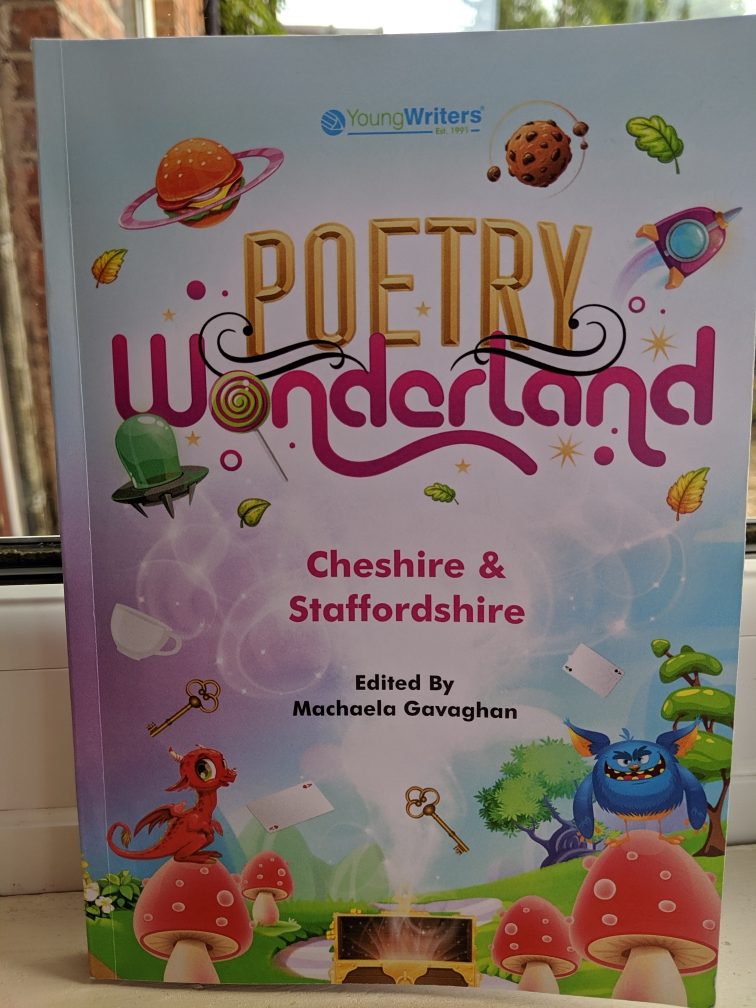
Knowing that I enjoy reading poetry my Mum mentioned a book of poems written by children from schools in the local area. ‘Would you like to read it?’ she said, ‘I can get you a copy.’ I agreed, and a few weeks later, as I was leaving my parent’s house following Sunday dinner, Mum handed me the book. ‘It’s very good’ she said, I’ve enjoyed reading it.’
Poetry Wonderland is an anthology edited by Machaela Gavaghan. The book was published and organised by Young Writers, a group who run competitions and work with schools up and down the country.
For this competition and publication, Poetry Wonderland invited primary schools from Cheshire and Staffordshire to create wild and wonderful poems on any topic they liked, the only limit was the limit of their imagination.
In an age where funding of the arts in schools is decreasing it’s a real joy to see children in primary schools being encouraged to use their imagination and enjoy the experience of writing poetry.
On a personal level, I find that there’s something very honest in poetry written by children. It’s expressive, truthful and open, Poetry Wonderland had some great example of this. There is a full range of poems in this book, a mixture of styles and structures, some rhyming and some following a set pattern.
If I Had Hope is by Lily-Mai Jackson aged 9 from Wistaston Academy in Crewe and describes hope through each of the senses. It opens with:
If I had hope I would touch the falling hearts that are far away and fill them with magical tears…
This beautifully written poem finishes on a dream:
…If I had hope
I would dream of smiles and perfume for
Christmas
The freedom of imagination in these poems also makes me smile. The Picnic On The Moon by Millar Anderson aged 11, from The Ryleys School in Alderley Edge, is just brilliant in its approach and explains what might go wrong if you decide to go to the moon:
The picnic on the moon, It was a nightmare…
The tea was cold, The drinks floated off, The aliens ate all the sandwiches…
Determination and positivity also come through in many of the poems. One example of this is, I’m Walking On A Rainbow by Poppy-Jane Powell aged 8 from Burton Manor Primary School in Stafford:
Imagine if you could walk on a rainbow, Who said you can’t? W is for walk A is for another rainbow L is for learn to walk on the rainbow…
Creative writing also gives a platform for freedom of expression, and I think we can all relate to Tired by Grace Ivell, aged 9 from Broadbent Fold Primary School in Dunkinfield:
My neighbours alarm clock is loud…
…they need to get a new one
A bit quieter, I think.
To me, anthologies like this show how important it is to develop interest in the arts for younger children. Hopefully all those involved in this project will have had fun and this will encourage them to read and write more poetry in the future.
My Mum was right. I have enjoyed reading this book. It’s reminded me to have fun with my own creative writing, be more open with ideas and to read more children’s poetry. For more information on Young Writers and Twitter
A new metaphor is as useful in the climate fight as a new solar panel design. We need poets engaged in this battle, and this volume is proof that in fact they’re in the vanguard!
Bill McKibben, Schumann Distinguished Scholar at Middlebury College and leader of the anti-carbon campaign group 350.org.
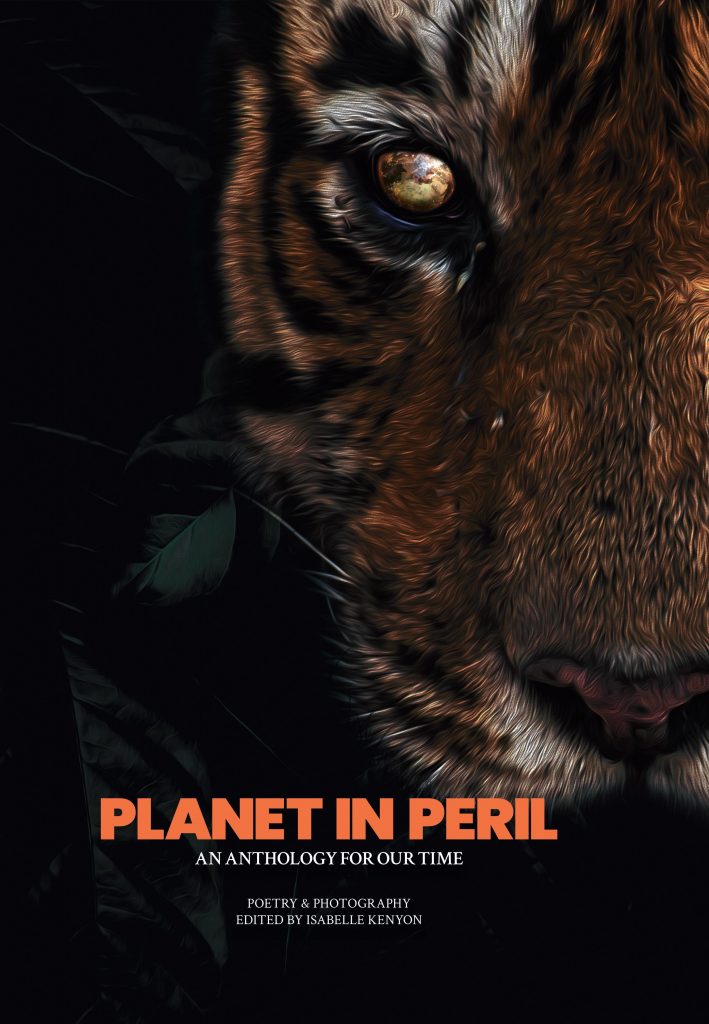
Editor Isabelle Kenyon speaks about brand-new anthology of eco-poetry, photography and art: Planet in Peril.
“Fly on
the Wall as a Press aims to talk about the most pressing issues of
our time, and I knew that there is possibly nothing more urgent than
our current fight against the rising temperature of our planet.
Anthology “Planet in Peril” is founded upon the belief that words
have the power to change and I have been extremely heartened and
emboldened by the passion and heart of the creatives featured, aged 8
to 80. I believe that no book can ever come close to describing the
devastation which climate change is currently causing and will
continue to cause to many ecosystems. However, in my humble opinion,
this anthology certainly comes close. Divided into sections of vital
ecosystems and continents, the artists weave the world as they see
it: the beauty, the intricacy, the devastation and the vulnerability.
Some imagine a dystopian future, or perhaps what is now becoming a
reality, for our future generations.
For this
project we will be fundraising for WWF and The Climate Coalition. Dr
Michelle Cain (Oxford University), has kindly written a foreword
which really brings home what this book aims to do: interweave
scientific research with artistic disciplines. The former Derbyshire
Poet Laureate, Helen Mort, and Brazilian based wildlife photographer,
Emily Gellard have been commissioned and really bring a sparkle to
the book.
This project will extend beyond print media, however. Our children and our children’s children will have to live with the potentially irreversible effects of climate change. Consequently, I have decided to run several initiatives intended to involve and educate children of all ages in this project. First, the anthology showcases a section for twenty poems submitted by writers under the age of 18. Two poetry workshops have taken place and so far, three school visit are planned, designed to engage them in poetry writing and art inspired by the book and its themes.”
Further details can be found at Fly On The Wall Press. Enquiries should be addressed to IsabelleKenyon@hotmail.co.uk
Pre-order your copy of Planet in Peril. Special discount code to Inksters: INKPANTRY10 (valid until the 4th of August 2019).
Extract from Kittiwakes by Sue Proffit
Bursting from the cliff-face in an urgency of light, catherine wheel of wings flinging its spirals seawards
over glittering water, they pocket the cliff in hairs-breadth nests where chicks stick, smudge-eyed –
the growing silence is sucking them out of rock, water, rapturous air, leaves me bereft –
so few of you left.
Extract from ‘where she once danced’ by Anne Casey
she is drowning in a sea awash with cobalt deadly metals fill the channels where she breathes
her lovely limbs are shackled down with plastics her lungs are laced with deadly manganese a crown of thorns to pierce her pretty head a bed of sludge to lull her in her dreams
Once She asked how powder was made and he replied from the eyes of goldfish.
Another time they played fictional characters. He was Stanley Kowalski
In one of those paper thin moments that psychologists journalise, she asked him ‘Will you ever love me?’ He told her, ‘The Big Dipper held the answer.’
Today her home contains an aquarium, the complete works of Tennessee Williams and a skylight in the bedroom.
The man that she married doesn’t understand why she looks out the skylight when they make love.
R. Gerry Fabian is a retired English instructor. He has been publishing poetry since 1972 in various poetry magazines. He is the editor of Raw Dog Press. He has published two poetry books, Parallels and Coming Out Of The Atlantic. His novels, Memphis Masquerade, Getting Lucky (The Story) and Seventh Sense are available from Amazon, Apple Books, Barnes and Noble. He is currently working on his fourth novel, Ghost Girl.
I
was lucky enough to be gifted a copy of Issue 11 of Butcher’s Dog
Magazine recently, and what a wonderful present it was. Butcher’s
Dog publishes two magazines a year, each issue has an original art
cover and features up to 25 exceptional poems. Issue 11 was edited by
Dr Jo Clement, Will Barrett and Ali Lewis.
As
a magazine, it’s beautifully made. The cover piece by Qi Fang is
awash with soft blues, purples and pinks. It feels lovely to read.
The poems flow and work together, supporting each other but still
have their own identity and voice.
The
thrill of getting publications like this is the introduction to new
poets you might not have read or discovered before, and there are
some outstanding poems in this issue.
I
have read my copy several times now, it has accompanied me on train
journeys up and down the country. Each time I found a new favourite,
a new meaning or a new interpretation of one of the poems. Which
makes this a difficult review to write. The poems I mention in this
review are the ones which captured me somehow, or which stayed with
me long after my train journeys were over.
Even
the dedication of this issue captured my soul and made me wonder
about Buckley. I can picture the joyful dog at the beach with his
“…golden tail held high, / face to face with the ocean’s
spray.”
Sheep
in flood by Iain Twiddy is a beautiful piece of writing centred
around nature, memory and loss. There’s an urgency in the
structure and language used, which to me emphasises the strength and
struggle in both life and death.
“…You
pulled it in, your ninety-year-old forearms and shoulders and
spine, dragged at that boulder, slippy as rock moss, heaved it,
gripping, up through the mud, then gasped back into the
bank, panting in the mist, your heart a shudder thumped again
when it instantly upped onto its stump-black legs and ran off…”
Armistice
Day by Victor Buehring captures the moment of a two-minute silence
with vivid clarity, but could also be questioning the readers
perception of peace within society today.
Your daughter is looking for you in the library by Claire Collison, completely entered my imagination. I enjoyed the structure of the poem, and how imagery was used to search for someone within items and documents. There’s a haunting quality to this piece, and by the end I could see into that microscope.
“…Your daughter couldn’t work out your brass microscope
root tip of hyacinth
so we can’t see what you saw
blood smear
in slides the size of sticking plasters –
pike scales
all that you gave up,
Spiracle (side) Dytiscus
under glass.”
Two elephants in a
room by Tom Sastry struck me the moment I read it. It’s both
beautiful and dark at the same time.
“…I
did see a mirror. I saw what a mirror makes me feel. I didn’t
understand it. I had no use for it…”
Is
this poem about seeing the truth, self-identity or survival? It’s
a striking piece of writing, with a well-deserved place in a strong
and inspiring magazine.
I could go on and on about this issue of Butcher’s Dog Magazine, instead I recommend that you seek a copy out for yourself, dive in headfirst and see what gems you find for yourself. You can find out more information on Butcher’s Dog or Twitter
You started it by wearing the slinky tigress outfit the one that snaked over your hips to lay bare your tawny body beneath liquid cellophane. I have no idea why I did not have enough sense to leave you where I found you – in the contortionist’s cage on Times Square where you always humped your best in front of an audience to the beat of a long line of mule-eyed protagonists. “Their numbers are as the stars in the sky.”
She had the emotional presence of a toothpick, the personality of a comatose eel…
A woman I desired read Antigone which she encouraged me to do, so I did. When I came upon ‘Teiresias’ I said, “I can’t spell that,” she said, “Look it up.” Somewhere.
She became that woman you wouldn’t expect – out of proportion to everything else.
When she moved her body slid – of a piece – which caused a problem. The ground upon which she walked swayed and swelled people running, different directions up and down the boulevard while the other women – kinder, nobler, gentler with foreign accents showed themselves open, not nearly as dubious – yet this one stuck hardened to her molten core – sad – yet oh so beautiful in a glittering sort of way
beckoning, surreal, blue tourmaline eyes that rolled back into her head as she spoke incomprehensible and inhuman things – enticements thick with ice, this sorry sophist and enigmatic soul you couldn’t poke through though I tried many times.
The skin is thick and deep with grey pleading for a little joy in shades of pink the soul is blank and hollow in darkness asking for a little warmth in tones of stars the heart is silent and still rainbow monochrome begging for a life-giving little jolt of blue the bones are frozen, attached in ice clear aching aloud for a reprieve of flesh of warm red a mind hovers inside in fiery lament wanting only for a bit of hours to exist yet it is only a grunt unheard of the colourful ones in the prison of the lone, the sentence is eternal the death remains of nauseating flavours the living will once again keep safe distance.
Old Fools
The bus will be late again this Sunday under the century mist on a cold winter bench old fools must wait, their gaze upon a gate to a paradise invisible to the passers-by.
The city sleeps still in a shroud of oblivion lives have slipped into their temporary tomb worn to pieces by the inferno of infinite routines while last trees cry dying leaves upon the icy pavement.
The two might sleep for a little while he holding tight onto the shiny tank she dragging on a greyish cloud of ash ancient as the traditions graved on monuments.
Unseen, living in the wrinkly bubble of their age they seek the hesitant gaze of the other memories built upon the fresh bones of infants a smile shy as a fleeting moment escapes the universe.
They laugh no more to the keen eye of the observer the flesh has fallen off the crackling frames leaving senseless messages of passed lives upon the pavement welcoming to their shameless survival.
The decades have built fortresses around their secrets shriveled breasts kindly placed onto an altar still beat with the passion of a single score carrying too many years to count, they love for all times.
Scent of the Ancient Ball
There is a dim ray of a future behind the cracks of the ramparts sounds emanate from the twirling shapes of silken whites while the stone burns with the icy flames of the prison.
To be part of this strange ball but a dream in the depths inhaling fumes of a past reverie poison or elixir aiming to taste what remains of the ghostly dance.
The heavy oaken gate persists in its temerity its lock rusted melts into torrents of a bloody paste no drawbridge will again annihilate the cruel moat.
It is a tower of ivory, mother of pearl, diamond and silver treasure for the hungry to be consumed perhaps too late where she is surrounded by the death-defying maidens.
Centuries go by, she continues in her light genuflection hands joined in a prayer searching only communion one with all, pure of soul as once of body.
Signature
The presence is signed on the old photograph hanging there on the left wall, by the window built of trusted hands, while outside the tree wants attention.
He too can write on the pane of the ancient glass.
Finger prints on the side of the redwood desk, tend to the forgotten elbow, never fully able to rest on the worn-out couch, trampoline for young charm.
It hoped its future would be of leather; but not so.
The room screams with memories it alone keeps safe; the air is filled with sparring souls attempting an accord; freckles of dust, sparks of their little power inflamed.
Wishing they had landed on the feature of a Mona Lisa.
Unwilling to shine, the lamp, secure under her banged shade, would like to jump at them and empower their dying light, while planted on the thinning carpet, they remain quiet.
Waiting for another moment, another time, to become.
Song of the grave
The stone is barren it was once broken slate now it awaits.
Cold it may seem yet warm in truth smooth and perfect it shines as many stars.
The rock draws like a magnet light rains as so many tears.
Let fall come and a palette of colours in oils and pastels it will glow in the fog.
Winter snow flakes glitter and blind forever lasting chagrin a wonder smooth as granite.
The river runs near singing it melody murmur of hope in eternity renewed.
The sun returns lighting its fire life is reborn on a single tomb.
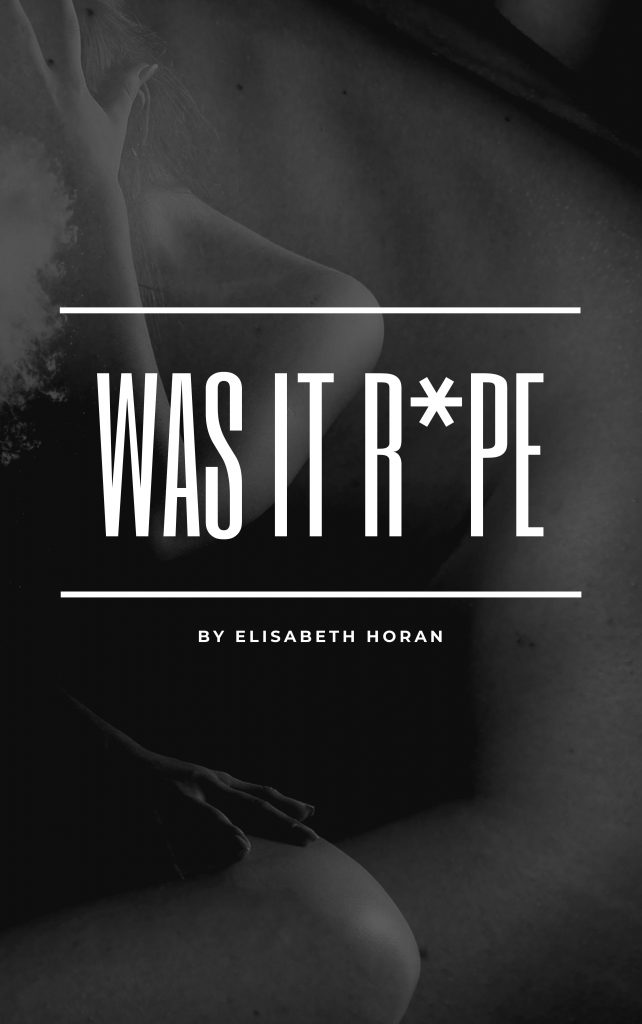
Isabelle Kenyon (Freelance Editor, Book Marketing Consultant, and Managing Director of Fly On The Wall Press) interviews Elisabeth Horan on her new book, Was It R*pe (Rhythm and Bones Press)
How do you brand yourself as an author?
Experimental, feminist. I write about women for women. I would say I am an advocate for mental health and I’m brave in my writing – I say things to the world that I’ve never been able to say without my pen and paper. I write to increase awareness – for example, my debut collection, Bad Mommy Stay Mommy, with Fly on the Wall Press, increases awareness of postpartum depression. I feel like I am a loving and caring poet and that when I write it is a gift, I want the poems to do a job and make a difference. They express my identity as a mom and the mistakes I have made in my life are part of who I am.
What drove you to write Was It Rape?
I started writing it
during the week Christine Blasey Ford was giving her testimonial to
the court. It brought back memories of when I was 16 and was a victim
of sexual assault. It was hard to hear – the pain of watching led
me to an intense period of writing. I realised if she was brave
enough to stand up in court and give that testimony that I could
write a book about my experiences.
Do you think your
poetry stands alone or is it essential to know something of your back
story?
I think it can stand
alone. But if you know personally, it becomes more intense – If you
know my vulnerability the experience digs deeper. Often I have
friends who find it too painful to read my work. But I have to write
my truth. I like to think the message I try to share with others – to
hold on keep hope alive, and that sense of solidarity is universal
and can stand alone.
Do you think it is
important to speak publicly about personal traumas?
It’s important to write
so that readers know they are not alone in their experiences. So much
of my life I allowed to be dictated by my past trauma. I’m not a
person who deals with trauma well – it’s not a choice – it’s
led by my sensitive nature. I see the beauty, but life is interwoven
with pain. This comes out in my writing. It’s just who I am. It’s
what I know about and feel the most.
Which writers and
artists influence you and why?
I have always admired Frida Kahlo since I became aware of her in college. I studied in Mexico for a time and connected with her deeply. I endured a miscarriage, and ensuing hysterectomy and equally, Frida survived so much pain but continued creating art. I just have huge admiration, respect, love and care for her. I have undertaken to write ekphrastic poems about her art and her life as a tribute to her.
Inpatient
I think my room was No. 14 one time my pastor came
I think his name was Mark he came to visit I suppose to bless me and the nurses, they asked me
May he come in
And I didn’t know what to do so I said no he cannot but I have wondered all these 24 years since
Might I have succumbed to Jesus; might I have been reborn, maybe even saved on the life raft that religion has the propensity to relay
I would’ve saved all that disgusting food the hangovers –
All that wasted energy from trying to kill myself so stupidly, so slowly.
Mark, the pastor came to visit and in fear of Man/God’s eye on my – body
Our ayatollah looks at me with contempt He put me in charge of stoning an adulteress
I found a good wall to set her against but I’d forgotten to see to the stones Someone had come and taken them to repair the wall that surrounds his olive grove
So there we were all ready to execute her and no stones
The ayatollah looked like he wanted to beat me to death with his bare fists but he was old and frail
Instead he exiled me and the harlot too The villagers took hold of our arms and legs and tossed us out the village gate slammed it shut behind us
We looked out at the desert turned and looked at each other