Ink On The Sofa: Performance Artist Alice Smith
Reply


If they were going to put me in the nuthouse
I was going to need my collection of Bertita Harding novels
They had power–
the stories of these heroes would keep me alive:
Karl and Zita of Hungary
Austria’s Franz Joseph and Elizabeth
the Mexicans Maximillian and Carlotta
Duse and Da, whose tale age cannot wither
and the glowing story of Clara Shumann
but my wife, a Lithuanian
whose hands were strong
from decades of milking cows
tore them from my grasp
and shoved them into the Fat Boy stove
where I heard them crackling in anguish
as she held me away
I would have burned my hands retrieving them
and not cared at all
All I could save was my favorite
the story of the Braganzas of Brazil
who created independence
from the Empire of Portugal
which I had hidden
in my patterned brocade vest
which I wore over my cummerbund
The hell with you all
I was never cut out to be a farmer
When they release me I’ll take Bertita
on the open road
and together we’ll find a green paradise
something like Ireland
Mitchell Krockmalnik Grabois has had over fourteen-hundred of his poems and fictions appear in literary magazines in the U.S. and abroad. He has been nominated for numerous prizes, and was awarded the 2017 Booranga Writers’ Centre (Australia) Prize for Fiction. His novel, Two-Headed Dog, is based on his work as a clinical psychologist in a state hospital, is available for Kindle and Nook, or as a print edition. His new poetry collection was published in 2019, The Arrest of Mr Kissy Face. He lives in Denver, Colorado, USA.
Inky Interview: Author Mitchell Krockmalnik Grabois from Denver, Colorado
Flash In The Pantry: Serotonin Reuptake by Mitchell Krockmalnik Grabois
Flash In The Pantry: Mandela Warp: A Moment in History by Mitchell Krockmalnik Grabois
Flash In The Pantry: Cooking Shows by Mitchell Krockmalnik Grabois
Flash In The Pantry: Still Wet by Mitchell Krockmalnik Grabois
Poetry Drawer: Loch by Mitchell Krockmalnik Grabois
Poetry Drawer: Photogenic by Mitchell Krockmalnik Grabois
Poetry Drawer: Microwave by Mitchell Krockmalnik Grabois
Poetry Drawer: Granite by Mitchell Krockmalnik Grabois
Poetry Drawer: Trick by Mitchell Krockmalnik Grabois
Poetry Drawer: Coal by Mitchell Krockmalnik Grabois
Poetry Drawer: Petition by Mitchell Krockmalnik Grabois
Poetry Drawer: Poetry Slam by Mitchell Krockmalnik Grabois
Poetry Drawer: Hygiene by Mitchell Krockmalnik Grabois
Poetry Drawer: Between Jobs & Not Me by Mitchell Krockmalnik Grabois
Poetry Drawer: Mea Culpa by Mitchell Krockmalnik Grabois
Poetry Drawer: Stoned by Mitchell Krockmalnik Grabois
Poetry Drawer: Five Hundred SCUBA Divers by Mitchell Krockmalnik Grabois
Poetry Drawer: Love Bird by Mitchell Krockmalnik Grabois
Poetry Drawer: Wailing Wall by Mitchell Krockmalnik Grabois
Poetry Drawer: Buzz by Mitchell Krockmalnik Grabois


Balance
don’t swing to and fro,
stay steady, don’t
hang like shoe laces on clothes line
you can’t swing, you must go to someplace
firm,
at your centre is a hurricane, made of what?
all that is felt, a cold gumbo of confusion,
you want to go where everyone knows your name
but, you get anxiety when everyone looks at you
everything is wanted both ways, the sun and
it’s opposite is needed
and you try to stay firm on ornate cement
but what’s under its hardness?
i don’t know, but the bridge of your nose, sometimes
catches vertigo.
on a park bench you sit hard and alert,
but you stare out of the window of your childhood,
the one that keeps on falling
into a myriad of pieces,
yet fits perfectly when you compose them together
in thought.
The Story
You tell yourself
You walk around telling
Yourself
It’s your history
The past
The future
You telling yourself
The story dancing around
In your skull
The stuff people said to
You
The movies you
Watched
Television shows
Music from radios
Sounds.
The stories changing
For me
Every few years.
Then me believing in a story
the story moves on
What story of the page is next?
it keeps turning,
i spill hot coffee on it, or soda
or water
the story can be be bland
or bold and spicy
or usually having highs and lows
and flatlands like Kansas
no hills at all
and sometimes you just want
the moment to unfold without
a story
and forget
next.
Wise Man
It would take years to become one
Far beyond a mortal sixty
Or eighty
To know all the things I must
Like not to go down a residential street doing seventy
It would take 400 years to learn how sit another a tree in a lotus position
100 to not follow a parade in the plaza
Fifty not to be aroused by cardboard model with synthetic lashes and teeth made by science
Eighty not to be a able to lose your temper
At some driving fool.
When You Lose
It’s as if you know
You’re going to lose
As if you’re just going
Through motions
And feel as if the machines
Know that you wanna win
That you’ll take another bet
Because you’re sad depressed
Or bored
And you’ll just stay there and take the beating and watch
It feels like they know
Everyone knows while flashing all the lights
In the rain
watching this, being sits,
the rains come downs hard,
light, then hard
this being sits, the winds pick up
and lashes out, violently
this being sits, waiting enduring
seconds, then hours, holding on
What is Time?
the storm starts up again, furiously
as if to snatch the air out of being
the being holds, drifting is not a choice
endure endure endure
the storm changes its pitch, like a cello
then rushes more, five years, ten years
the being waits in the darkness, then light
then darkness
the objects and beings, images drift away,
a baseball bat, a brown newspaper, a plastic cup
drift drift, while holding place
not one storm, but multitudes of storm
hard light, and various in duration,
light in sound, heavy
pressing the being
the being holds through.
Damion Hamilton is from St. Louis MO. His poems have appeared in Chiron Review, Poesy Magazine, Zygote In My Coffee, Red Fez, The Camel Saloon and many others. He writes poetry, stories and novels. He has written several books. Available here. He can be found on Twitter.


a velvet violin in space
I finished the spinach and made a list of the apples
it’s a new world with food for the people
why is the pack of picky werewolves scrunched up at the bottom of the bed?
it’s a new ogre who sings in the sunshine
you can grow thru the wall like a houseplant
would you like to see the dragon?
wink another module
notice honeybees
starting night for the colours in the mind
the leaping was enough to set off the alarms
versatile limbs and numb names
machines like it when
basic clouds for the prairie today
now for something exciting
to complain of the cloudiness
the antidote to the rock-slinging orcs
reaching me tonight for a two-moon soufflé
and that cracking voice – is that you?
boing said the high part
and that makes a nice worm
that sea is the talking salt of what now?
a shadow bat was lurking and now he’s drinking tea
speaking to the sky and that would include the sun
a packet of kool-aid the size of a mattress
a new earth language
a screwtape opera
the humble tiger
the redundant roofer
the nice wolf of the sleeping trees
now the release of the good doves
what is the colour of the sound in my head?
slink like that last leather leopard
a nice time in the clark universe
not the work of the worried man
the clacking smasher was in line for the world
would you like to fly?
see me in the dust bowl not working on my machine
on a blue earth waiting for the curb monsters
when you were caught in the web
did you think of the morning stars not working yet?
I’m here with the wolf and we’re cooking potatoes in a frying pan
would you like some?
earth is a miracle-gro planet
like the chant of the monks in the barn
no sound for the duration of the poem
mapping out now and then
with that morning fresh blend
the green magic the frog taught me
a spring blast of the clean energy
that famous earth
an eclipse burger
and now we have the news from the satellite station
hello from up here we can see everything haha
there won’t be a new world without some of the old
now in the sleep as one cooks a junk tire
keeping a baby koala fit
would you like to see the breeze in real time?
let’s start with that old sun
the angel here on the mountain
a war on the warmth
wandering head is the roving reporter
a big kiddle of the good wet yes
charming a sentence near you for a dollar
on star day we will show up and clean the sun with scrub brushes
when the stubborn become raw
everything is made of chocolate
power elf gets the cooking done first
a little beaver dam in the creek
celery brain
time now for the walk
J. D. Nelson (b. 1971) experiments with words in his subterranean laboratory. More than 1,500 of his poems have appeared in many small press publications, in print and online. He is the author of several collections of poetry, including Cinderella City (The Red Ceilings Press, 2012). Visit Madverse for more information and links to his published work. Nelson lives in Colorado.
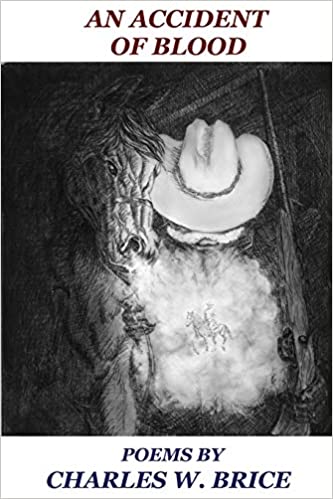
The poems in Charles W. Brice’s latest collection, An Accident of Blood, are heavily autobiographical and portray a sobering mix of strength and fragility.
The collection, presented in four sections, kicks off with poems focussed on the experience of growing up. The opening poem, The Fishes, is about keeping secrets, being in a gang, and being thrown out of a gang for not keeping the secret. The way this poem is delivered perfectly captures the young boys’ spirit, allowing readers to imagine similar antics from their own lives:
Okay, Joe said, you can join.
Great, I said, what’s it called.
The Fishes, Joe said,
but that’s a secret.
You can’t ever tell anyone
the name of our club.
Do you swear never to tell?
Yes, I said.
Then Joe taught me the handshake.
Olfactory senses are stirred in The Smell of Home in Wyoming with reminiscences of feeding a horse an oatcake, how to approach it from behind, and the smell of the barn: Warm horse fragrance, creek of leather / saddle, breath mist before us— / a synesthetic blast of beauty.
It is easy to empathise with poems that relate to the effect of his growing up with an alcoholic father, for example in the poem, Deal Me In, which relates the despair of how his father’s gambling debts all-but wiped out his mother’s household savings:
During a night of failure-to-grow-up
daddy, drunk and deluded, sat with hoodlums
at a poker table and said, “Deal me in.”
Leukemia is a particularly powerful poem of lives and deaths, in which the sister of his best friend dies yet he survives, and the death of his dog, ‘the same morning that my dad, / rumpled and red-eyed, arrived / home after a night of drinking and whoring.’ The statement, ‘I lived.’ separating the death of his friend and that of his dog, says all that needs to be said but the poem isn’t done yet … ‘He mocked my cries rather than face his embarrassment. / He made fun of my grief while my mother / railed at him for his drunken infidelity. / I knew then that, / in the family I called mine, / there was no place for me, / no place for me on this earth.’
The intensity of the personal poems eases up with a scattering of more whimsical subject matter. In The First Time, the title hoodwinking the reader into expecting a poem about loss of virginity, is rewarded with a poem about the creation of a perfect Italian pasta sauce — rhyme augmenting the lines like herbs enriching the sauce.
Was his name Luigi, or Antonio, or Amedio—
who first threw garlic into olive oil? Did
he slice it thin, inhale its pungent fragrance
on his thumb and think, maybe a little oil?
Did Maria, or Beatrice, or Sofia, one of his
lovers, dip a soft digit into the mix, exude bliss,
kiss his lips, prance the room, dance and swoon?
There are four ekphrastic poems that take inspiration from famous artworks. The Land of Cockaigne is a wonderfully succinct example, after the 1567 painting of the same name by Peter Bruegel the Elder. Cockaigne, being a mythical land of plenty, the brevity of the poem perfectly captures Bruegel’s unflattering imagery. The ten-line poem includes the observance that, ‘Memory and desire silence / the squeals of the slaughtered— / never spoil our appetites’. In a manner akin to the cow that approaches the table in Douglas Adams’ The Restaurant at the End of the Universe, urging diners to enjoy, “Something off the shoulder perhaps … braised in a white wine sauce?”, in Brice’s version of Cockaigne, ‘Even boars come / with knives attached.’
Pork Chops in Raspberry Vinegar Reduction is a decidedly insightful take on the ingredients for a successful relationship. Beginning with the sprinkling of herbs over two thick pork chops dredged in olive oil:
Let them marinate for an hour or two.
Tell him it takes many ingredients and time
to make a relationship work.
… continuing with:
While the chops are browning
marry a quarter cup of water
to a quarter cup of raspberry vinegar.
Tell him that the recipe for a good relationship
means always putting the relationship first
before the wise culmination:
Serve immediately. Tell him that
nothing of importance can be solved
after 11 PM. Always kiss each other goodnight,
you might not get another chance.
The politically-charged Section III features poems addressing topics including the Vietnam war, Hilary Clinton and, in the craftily-titled poem, The Trumpet Shall Sound, the Trumps.
Melania appears in stiletto heels,
Hurricane or not, you can still make deals.
Commerce revolves on a gigantic wheel,
And Trump sits atop it.
Charlie Brice is the author of Flashcuts Out of Chaos (2016), Mnemosyne’s Hand (2018), and An Accident of Blood(2019), all from WordTech Editions. His poetry has been nominated for the Best of Net anthology and twice for a Pushcart Prize and has appeared in The Atlanta Review, The Sunlight Press, Chiron Review, Plainsongs, I-70 Review, Mudfish 12, The Paterson Literary Review,and elsewhere.


The Action Figure is Alive
After the book “Midlife Action Figure” (2019) by Chris Banks.
It starts with a close call,
the wiener dog’s
weaponized hindquarters
shimmying on the rug.
Our hero escapes
under the sofa,
waits until it’s safe
to make his way
to the laundry room.
He finds refuge
in a clean pile
of sheets.
The rumble of the dishwasher
lulls the weary warrior
to sleep.
*
The next morning,
he wakes to the sound
of a gouged mouse
screeching from a rattrap.
Can’t save squeaky now.
Sitting up, he counts
the bees buzzing
around his head,
feels dizzy, decompresses
back into the basket.
Mutant boy idles,
replete in the linens
until the housekeeper
shuffles over, lifts the lid
in full Yoda mode.
“Sunken treasure, you are!”
she exclaims,
and if the lionheart could,
he would smile back.
Snowball Effect
The office pet eats butter
off the kitchen counter,
makes the rat jealous.
Mom calls, tells you
she’s getting a divorce.
The VP’s favourite
seduction tactic is limerick.
You’re already surfing
for a new job
in a stolen boat –
anyone asks,
you’re babysitting
for a friend.
Mrs. Berger changes
the report deadline
from a week
to three hours from now.
The kicker is that the research
must be typed blindfolded.
Another catch is
the building is under fire,
bulletproof trolls with Uzis.
Chunks of concrete
dislodge, crack
of the icecap.
Hide the penguin
under your desk.
Better to apply
the adult diaper now,
meet your maker later –
but soon!
To think, last night
was spent eating
cheese puffs in front
of the TV, naked.
“Normal behaviour” is
training for a shootout,
*Tyler Durden sermons
blaring in the background.
Turn the lights off
before closing the door,
conservation before annihilation.
*Tyler Durden is the main character in the 1996 novel “Fight Club” by Chuck Palahniuk. He is a ringleader who brainwashed his club members to commit crimes across the city.
Samuel Strathman is a poet, author, educator, and editor at Cypress: A Poetry Journal. Some of his poems have appeared in Dreams Walking, Feed Magazine, and Mineral Lit Mag. His first chapbook, “In Flocks of Three to Five” will be released later this year by Anstruther Press.

I grabbed a can of wasp spray
from my wife’s hand
She was a farm girl and stronger than me
She grabbed the can back and hit me in the head with it
Wasps had colonized the attic of our farmhouse
the one my granddad had built in 1918
and our love was being overwhelmed
by the difference in our reactions
I found the wasps’ buzzing comforting
consoling
I heard messages in their drone
messages designed for me alone
telling me about the true nature of the universe
My wife said that if the noise didn’t stop
she was going to fall off the wagon—
was I too stupid to understand?
Yet now that she’d hit me with the can of wasp spray
she couldn’t use it
She had created an inner barrier
that she didn’t understand
but was unable to surmount
She went outside without saying anything
got into her old Pontiac
and headed down the road
I knew she was going to the meth house
Whether she was going to do meth
or just fuck the meth maker
I didn’t know
But I couldn’t pursue her
I was too engaged
in listening to the wasps’ messages
Mitchell Krockmalnik Grabois has had over fourteen-hundred of his poems and fictions appear in literary magazines in the U.S. and abroad. He has been nominated for numerous prizes, and was awarded the 2017 Booranga Writers’ Centre (Australia) Prize for Fiction. His novel, Two-Headed Dog, is based on his work as a clinical psychologist in a state hospital, is available for Kindle and Nook, or as a print edition. His new poetry collection was published in 2019, The Arrest of Mr Kissy Face. He lives in Denver, Colorado, USA.
Inky Interview: Author Mitchell Krockmalnik Grabois from Denver, Colorado
Flash In The Pantry: Serotonin Reuptake by Mitchell Krockmalnik Grabois
Flash In The Pantry: Mandela Warp: A Moment in History by Mitchell Krockmalnik Grabois
Flash In The Pantry: Cooking Shows by Mitchell Krockmalnik Grabois
Flash In The Pantry: Still Wet by Mitchell Krockmalnik Grabois
Poetry Drawer: Loch by Mitchell Krockmalnik Grabois
Poetry Drawer: Photogenic by Mitchell Krockmalnik Grabois
Poetry Drawer: Microwave by Mitchell Krockmalnik Grabois
Poetry Drawer: Granite by Mitchell Krockmalnik Grabois
Poetry Drawer: Trick by Mitchell Krockmalnik Grabois
Poetry Drawer: Coal by Mitchell Krockmalnik Grabois
All those years ago, when I left my family home, I hugged many of the tall Scots Pines that ringed the gardens, towering in silent majesty over the crumbling edifices of human existence – the house, the outbuildings, the possessions now consigned to the skip. A year later, I passed by that house again. The new owner, with his different map of the world, his different understanding of value, had felled every one of them. I felt great pain – perhaps that of the trees, certainly my own.
This book (and talented author) both remind me somewhat of the supermarket, ‘Aldi’. No, it’s okay, I’m absolutely fine…please bear with me.
Every now and again I shall purchase a bottle of red wine from Aldi and, being a cagey spendthrift (no, not a miser, just careful), I shall usually plump for a nice £3 bottle which does the trick, because a) Aldi have excellent wine merchants and b) my taste buds have adapted nicely to their £3 range, which is comparable to the £20 range of wines at Tesco, or Sainsburys. Since becoming disabled, my eldest daughter occasionally goes shopping for us. She knows I like red wine, but she doesn’t drink a lot of it herself and therefore picks out something from the £10 to £15 range, because she thinks that is what I would choose also. So I get my wine and, naturally, my £3 taste buds are completely blown away by the difference in quality. Thus, I make the new bottle last twice as long, because every sip is utterly delicious and definitely not to be rushed. Which brings us neatly (via the scenic route, past the vineyards) to Michael Forester’s latest book, Forest Dawn – Reflections of the Rising Light.
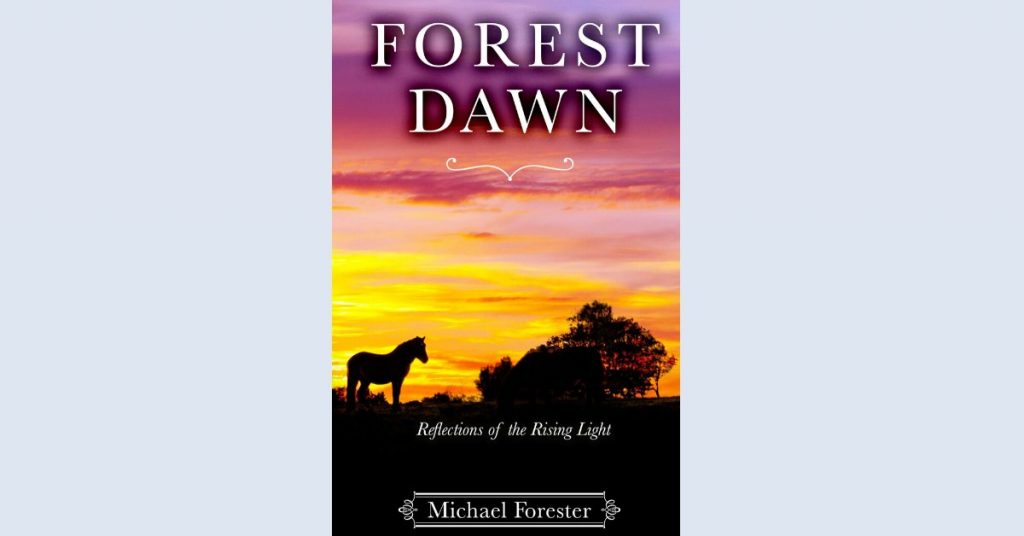
This is Michael Forester’s new collection of essays and poetry, succeeding his awesome 2017 book, Forest Rain, which we were honoured to review here at Ink Pantry. The focus this time is for the author to ‘illuminate the profound that hides in the simple and the eternal that shines through the commonplace’. As such, the book begins in fine fashion with the inspirational essay, ‘A Pound of Peace’.
‘A pound of Peace, please, mate,’ said the man in front of me in the queue at the market stall. His shopping bag was packed full and I wondered how he was going to fit any more into it.
‘Beautiful bit of Peace this is,’ the stallholder commented, weighing out a pound on the scales. ‘You’ll not find better in the market today.’ The customer smiled his thanks and pressed the Peace down into his bag that was already bulging with Worry, Regret and Frustration. It looked precariously balanced as he walked away. I wasn’t surprised to see it topple out and splatter into the gutter.
‘And what can I do for you today, sir?’ The stallholder’s voice brought my attention back to the table. ‘How about some Pleasure for your supper? Just sprinkle a bit of Indolence on it and fry it in Indulgence – beautiful!’
Tempted, I checked my wallet. ‘Sorry,’ I replied, ‘I’m all out of Trust to pay you with.’
‘That don’t matter’ he retorted. ‘I take all the major cards – Gullibility, Foolishness, Ignorance. And if you’ve got that new one, Complacency, I can even give you a discount.’
Each carefully crafted essay and poem carries a stream of messages via positive metaphors and symbolism. The description of a dream leads to a lesson in forgiveness. A childhood memory of a spider focuses on the myriad of choices we face in this lifetime. The recollection of a faulty wire in a garage door looks into angels and God’s sense of humour…and so on, throughout the thirty-two chapters of the book.
The writing in all the essays and poetry is direct and thought-provoking. Michael’s sense of humour and skilful writing creates a steady platform between some of the harsher subjects covered (such as refugees fleeing from their war-torn homes), meaning at no point are we feeling that this is all part of a grand, egotistical speech and we are being lectured to. Michael’s talent as a writer is both simplistic and genius; he draws the reader in like a magnet. We’re never pulled in, but merely guided by Michael’s total command of the written word. Another bonus…we also learn from what is being presented to us.
I raced through this book’s wonderful predecessor, Forest Rain, as it is an utter joy to read. This time around, something seems different for me. The sheer joyousness is retained, but I found myself tackling this book in smaller chunks, as after each chapter my head was swimming with what I had just ingested. If Forest Rain captured the energy of an energetic teenager passionately exploring the world, Forest Dawn seems to me to be somehow maturer and worldly-wise in its approach.
Michael’s humour shines through his writing, as demonstrated in a short poem called ‘Oh My God!’, which immediately took me back to being a young 1970s choirboy; my 7-year old mind earnestly trying to make sense of the vicar’s authoritative sermon.
‘Repent!’ he shouted.
I didn’t know what penting was, but I promised there and then, I’d definitely re-do it more in future.
‘All ye like sheep have gone astray!’ he yelled.
I thought of new season’s lamb with mint sauce and some potatoes.
‘The kingdom of heaven is at hand,’ he snarled.
I looked at my hands. There was nothing on them, certainly not a kingdom.
‘I see you, sinner,’ he said.
I checked my flies.
The writing throughout the book is top quality, in terms of pace, tone and depth. Every chapter leaves a trail of fascinating, informative foam in its wake, along with the knowledge that, as readers, we’ve been privileged to share in this gentleman’s Earthly journey and what he has learned from it so far. It’s a masterclass in creative writing and the author should be extremely proud of what he has created here.
As I said at the end of the Ink Pantry review for Forest Rain, this is an excellent book and I sincerely wish that I had written it. Nothing has changed.
And we are but flying fish, breaking the surface for a moment, to bask in the reflected glory of a transient elevation.
Get your copy of Forest Dawn: Reflections of the Rising Light

Irene
Irene took quickly to the scene,
Looking to discover new things,
Looking to be places she’d never been.
Irene quickly became a yes woman all right,
Saying yes to the men’s aberrant advances
And yes to the women’s aimless advice.
Irene took quickly to saying yes
Becoming addicted to their requests,
A few more track marks on her arms,
A few more heads up her skirt.
Irene quickly became a no woman all right.
She became no woman all right.
Splinters
I have found solace in this fluid state, this comforting womb,
This escape from the reality of mankind’s mania,
Drawn to the water’s stillness, its silence, to its blue
But the waves have torn off this false merman tale
And spat me out saltily to the sands above
Bidding me no mercy, no protection as the ancient whale
Waves a gentle goodbye – I bring my wet, wrinkled fingertips
To brush away these ocean-like teardrops.
I pluck away the barnacles like scabs that have to be compulsively picked
Off like a fish being scaled, flaked until it is merely flesh to be devoured.
I am no longer welcome to live in a world where there is only peace.
I stand naked in my vulnerability, left human after the sea has had me scoured.
I step out of the water and find footing on solid ground,
Gravity weighing heavy on these shoulders
Taking in the sights of the green earth and the sky’s musical sounds
Channeling the mighty thunder of the gods to stand tall, to stay afloat.
Even though, I fear the wind will whisk me away to mere particles of dust
As the hurricane makes splinters of a small, wooden fishing boat.
I fear I would rather be splintered in the sea.
Garden of the Gods
I stand upon this rock where we had our second date,
then both spent and energized from lovemaking,
Dazed by the camel-shaped formation, the gods’ fate
that brought us here, miles from any sound but these beating hearts,
longing to be lost in each other’s touch again,
we climbed higher, fell deeper, believing we would never part
but as the space between the camel’s hump and its head grows,
so does the space between us now, both physical and beyond,
this space, this emptiness, this forest full of woes.
Every year someone falls to their death –
Dazed by the dizzying distance below, I find my footing,
pondering what hope for us there is left.
Charles K. Carter is a queer poet and educator from Iowa. He shares his home with his artist husband and his spoiled pets. He enjoys film, yoga, and live music. Melissa Etheridge is his ultimate obsession. He holds an MFA in writing from Lindenwood University. His poems have appeared in several literary journals. He is the author of Chasing Sunshine (Lazy Adventurer Publishing), Splinters (Kelsay Books), and Salem Revisited (WordTech Editions).

owego poem, from a great distance
or all of us fucked like
dogs in the rain or maybe just
some of us beaten with
the myth of god
or of us raped but
all of us left for dead and
did you come to this town knowing
all doors would be locked
against you?
were you given a shovel and
a reason to dig?
a child of your own to break?
there is never any pain so
private it cannot be shared with
those who hate you most
for kristen, who got there first
and here we are wrapped tight in
the laughter of dead men
shooting their guns at the sky
here we are saying we are here
with our maps drawn in the sand
with the house not quite level
after 100 years of civil war
pictures falling from cracked walls
baby with a mouthful of
broken glass and
the trick of course is
to separate the symbol from
the symbolized
the reality is that a clenched fist
has no value in an empty room
your god has no purpose
in a kingdom of corpses
paint his picture on whatever
holy surface you can find
and all it does is fade
xochiquetzal
dull pewter skies and five below
zero when we get the news of picasso’s death and
then we are stoned when we hear about his
lover’s suicide
ground too hard to start digging graves,
so i am swimming in your blood
you are drowning in my arms
subtle addictions and the frost that
crawls through our veins and
was i whole before i met you?
did he understand the trail of
wreckage his life would produce?
probably
and he probably didn’t care and
we are too wired to sleep when his
widow puts the gun to her head
i am happy for the gift of absolution and
you are begging for more
pale sunlight though a haze of
january sky and we were laughing
at the idea of true love or i thought
maybe you were crying
thought you understood i
would always fail you in the end
the enigma in shades of grey on grey
set fire to the air
in the dead man’s house
make sure
says everything is okay, says
this is just a dream within a dream,
but i have my doubts
i have stood on the river’s surface
on the coldest day of the year,
have looked down to watch the hands
pushing upward with diminishing strength
i have been god in the
truest sense,
but i prefer drugs
i prefer sex
pain and suffering on a human level
mixed with my father’s disapproval over
every choice i’ve ever made and
what i tell him that standing still isn’t an option,
he calls me a liar
when i talk about the future, he
puts the barrel of the gun in his mouth and
this is how we spend our last
fifteen years together
this is life in the kingdom of crows
i get married
learn to crawl blind through
any number of deserts of my own making,
but i hang onto this image of you from
when we were young
i hang onto
the idea of free will
the inevitability of a
diminished future
i will find you there and sing
bitter songs of hope
before the story ends
phantom hope
a million miles of static on
pilate’s radio but the asshole wants to dance
tells you the crucifixion is
all in your mind
says it’s a waste of time
being in love with an addict
thirty years and nothing to show for it but
cold sunlight down early morning streets
st elizabeth on her hands and knees
and crawling into the ocean in
some warmer corner of the world
silver chains and a cross of
gold and what if she can’t
remember her child’s name?
what if every moment is
the one that matters most?
you stumble through each one blind
only to end up lost
only to end up holding your
father’s ashes
in the middle of the freeway
a million miles of static in every
direction and that fucker judas with
his hand up your lover’s skirt
with his teeth filed down to
chrome points and his
tongue dripping poison
gives us all one last kiss
then says goodbye
John Sweet sends greetings from the rural wastelands of upstate NY. He is a firm believer in writing as catharsis, and in the continuous search for an unattainable and constantly evolving absolute truth. His latest poetry collections include Heathen Tongue (2018 Kendra Steiner Editions) and A Flag On Fire is a Song of Hope (2019 Scars Publications).
