the office they gave me held a view of birds. how then should one focus on scheduling appointments and booking calls with contractors? flight stretched like a long arm over mountains and tangled tablecloth.
Going back to London
it looks like I’m going to be going again – something in my life bringing me back to London. it’s not weather, god no, and I’ve no friends I want to see; I lived it a time, it’s true and have some happy memories but none of those will light my way tonight.
me and this girl are renting a car, taking it from Bristol all across the country. she has appointments she has to keep or something. something to do with a visa. I’m going along because I like to drive and want to see if some barstaff there remember me.
there was this place I used to go to – in Camden. I lived in Golders and it was handy, that’s all. they played folk music, and sometimes jazz. I got drunk there most nights that I got drunk. it was pretty good. once someone thought I was an A&R man and set me up – free drinks all night. the walls were a squeezed waterbottle and the air blue as fruit.
me and this girl are going to London. we’re going tomorrow morning. it’s June now, and the weather’s looking fine. I’m angling that we drive along the coast, even though it means getting up early. we’ll go east, our eyes flying to sunrise and Paris will be rising to our right.
Ice cream
she is sitting on the ground outside of tesco.
she is sitting with legs flat, taking little licks off the top of an ice cream cone.
she looks about six. she looks about happy. her dad or someone on a bench nearby pouring down a bottle. the sun is out. it’s summer.
she looks happy. I go on in, buy vegetables and bread, fresh fish and wine. when I come out she’s still there, eating her ice cream.
Describing Cheryl
Cheryl; black as a red cherry plucked out of a blue earth, good a fuck as any animal, clever as candlewax, ambitious as a bee in spring.
look: I tried so long to reduce you down to an essence in poems and now I feel like you need an apology – look at the shaggy order into which I’ve put things.
The bait
my mam says she likes about half the things I publish – she is very honest when she likes something. when she doesn’t – that is to say when it’s one of those poems about drinking or the ones about chasing girls – she’s honest too, in a different way,
saying “well done” quietly and going on eating her dinner.
sometimes she asks why I don’t write the nicer poems all the time to which I don’t really have a response.
when you drop some bread on the pavement in a crowd of flocking birds you don’t get to decide if a starling will get it or a seagull.
. . . . .
D.S. Maolalai a graduate of English Literature from Trinity College in Dublin and recently returned there after four years abroad in the UK and Canada. D.S. has been writing poetry and short fiction for the past five or six years with some success. Writing has appeared in such publications as 4’33’, Strange Bounce and Bong is Bard, Down in the Dirt Magazine, Out of Ours, The Eunoia Review, Kerouac’s Dog, More Said Than Done, Star Tips, Myths Magazine, Ariadne’s Thread, The Belleville Park Pages, Killing the Angel and Unrorean Broadsheet, by whom D.S. was twice nominated for the Pushcart Prize. Work is published in two collections; Love is Breaking Plates in the Gardenand Sad Havoc Among the Birds.
Mauna stuck in a bottle-neck light Over her shoulder fly’s a peacock That’s not COVID aloha for you to rock How many hearts broken at twilight Steams of coffee drinking all night Un-shed tears of a lonely hawk Shadow-less early morning flintlock Midnight is my time for walking until daylight Meadow of a murmuring lizard Lonely silence of a duck’s quack Star thrown shadows of a blizzard Unmentionables torn from the back Like a grasshopper sticking in the hat of a wizard Sun was nearing the steeple of Jack
Her Pal
Her pal wears an alabaster grass Ball-Dress to write Improper overtures of COVID from men Writing with Tortoiseshell Pens Gaps between shutters for light Frost- bound Coachman arrived at midnight We needed him at ten Swelling caves aloha in silk hose until then Insulting to any lady’s double-envelops white
Terry Brinkman has been painting for over forty five years. He started creating poems. He has five Amazon E- Books. also poems in Rue Scribe, Tiny Seed, Jute Milieu Lit and Utah Life Magazine, Snapdragon Journal, Poets Choice, In Parentheses, Adelaide Magazine, UN/Tethered Anthology and the Writing Disorder.
Subtending void, vanished time, actualizing my absence.
Sempiternal words created life — please preserve my presence.
Motion & Stillness in Rustbelt City (Buffalo, NY)
Seeking the heart of a city may be a false quest: is not each human heart, each structure in the built environment, each shape and flow of the natural world suffused with the peace and chaos of urban life irreducible constituents of the heart of a city, pulsating in balance the life and death of everything, unable to be localized to any one place?
How foolish the human spirit is to seek something which cannot be found. How foolish I was to find myself at the Civil War monument beneath the gaze of the Union and her soldiers and sailors, seeking understanding in the interlocutions, the laughter, the sparrows, the comings and goings, the flags and music moving on the wind to the play of children.
Always 15 minutes away from wherever you need to be as the saying goes — pockets for pedestrians swallowed by highways over a motor abyss and it is well to be so close to a friend or work, coffee breaks or home, but time piles driving alone, leading thoughts to unknowns:
Memories of passenger seat dialogues with a friend now absent, melancholy towards a concert, panic attack towards the airport – thinking of everything in nothing in the road I travel, engine I use, person I pass, position I keep, my future, present, past — much to remember and forget, narrating existence through selves and sounds and cities.
Antipoem
Pseudowritten antipoem, unbosomed unpoetry, ubique ubiety: paradox of plague.
Depression
Contentment visits as I extricate myself from sleep
before memory of being human draws me back
to music silenced beneath behemoths of how we hurt each other,
our shared sought love that casts out fear like eager arms of children.
Disintegration
In early morning still I sing myself to sleep, fractal music scattered as fragmented hymnary,
inhabiting space ceded by silence and its static,
inhibiting the self I was and am and will become,
inheriting some creation of my own disharmony,
inhuming stone sundered while sculpturing sciamachy.
Connor Orrico is a student and amateur field recordist interested in global health, mental health, and how we make meaning from the stories of person and place we share with each other, themes which are explored in his words in The Collidescope, Burning House Press, and Headline Poetry & Press, as well as his sounds at Bivouac Recording.
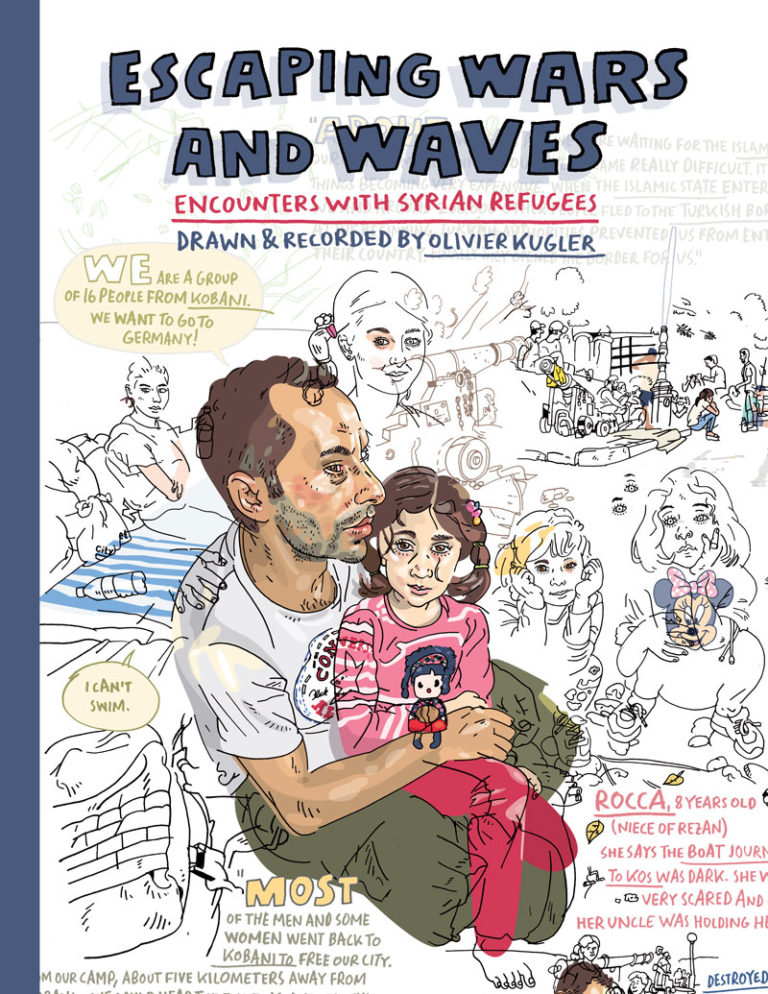
In December, 2013, I travelled together with Julien Rey from Médecins Sans Frontières (Doctors Without Borders) to Domiz Refugee Camp (Kurdistan, Iraq). Accompanied by two Syrian Kurds, Mazen and Amer, who helped us with translations, we met open-hearted people who invited us into their tents and houses where they told us, over a cup of tea, about their lives back home, their escape from Syria and about the living conditions in the camp. My opening words to the people I met were, “Hello, my name is Olivier Kugler. I am a German Reportage Illustrator, based in London. Médecins Sans Frontières commissioned me to portray Syrian refugees in order to help raise awareness about their situation. May I interview and take photos of you? ’ The photos won’t be published, but I need them as reference for my drawings.
For most of us, it would be fair to state that 2020 has not been the greatest year within living memory. At times, surrealism has merged into a new form of normality; not aided by the notion that things may perhaps get a lot worse before they start to get back to any form of what we perceive to be everyday ‘normal’. At such times, it’s important for us to realise and recognise that while we may have to don a face mask and perhaps queue a short while to enter a well-stocked supermarket, for others across our planet their lives have been shrouded in the darkest, deepest surrealism for a long while. Likewise, as we look forward to future halcyon days when we can again flock en masse toward sunlit beaches, or travel on public transport without the aid of any damn irritating facial armour, for some people this level of normality is lost in time and may never return.
The 2018 book, Escaping Wars and Waves (Myriad) allows us multiple, enlightening glimpses into the daily lives of people torn from their homeland and forced into new, uncertain lives. Put simply, it is a book of highly educational words and inspirational illustrations. Every page is packed with sketches of the people Olivier Kugler met between 2013 and 2017, as he followed the trails of refugees fleeing from Syria, into neighbouring countries and further onward toward Europe.
Every page portrays a harrowing personal story. In Iraq, we meet some psychologists who have formed a mental health team to care for refugees. Their plight is tough, for Syrian men tend to view any offer to aid their mental health as an affront to their masculinity. Similarly, Syrian women are not comfortable with any aspect of psychology improving their personal well being, although some women do come into the mental health unit, sometimes using their children’s medical needs as the main reason for attendance. One of the centre’s psychologists, Ahin, shares her thoughts concerning her child, Kawa.
The happiest day of my life was when Kawa, my baby boy, was born. He is seven months old now. We would love to go back to Quamishli where my parents are. They haven’t met their grandson yet. Every night, before I put Kawa to bed, I tell him how beautiful Syria is.
Still in Iraq, Olivier was waiting for a translator to join him, in snowfall and freezing temperatures. A local man, Muhamed, took pity on the shivering illustrator and gave him hot coffee from his roadside stand; sternly refusing any payment. Muhamed is 55 and fled Syria 15 months ago. One day, a helicopter appeared and randomly began destroying houses in his Damascus street. Muhamed, his wife and daughters barely escaped with their lives as their home was flattened by a bomb. They ran with only the clothes they were wearing. He cries when he speaks of his wife. She is severely depressed and no medication is available for her.
One Syrian lady, Vian, does visit the mental health team here. Her husband had been arrested 16 months earlier. She has not seen him since. Their youngest son was born only 7 months ago. She is unsure if he will ever get to meet his father.
Some younger refugees struggle to make the best of their situations in the Iranian refugee camp. Djwan has found a living, renting out some sound equipment. He earns around £30 – £50 for each rental. He also supplies chairs so that people can sit and listen to music. To raise morale, he teaches break-dancing in the camp. In Syria, he had been in the army but escaped, along with several others.
Many of my friends died. During one mission in Boyedah, I was on a roof, surveying the area. A man tried to kill our colonel. I was calling and screaming at my comrades for help. Moments later, a rocket-propelled grenade was launched and hit the tank dead on…there was a lot of fire. Two of my friends were in the tank. They burned to death. They became ashes.
On the Greek island of Kos, Olivier meets Claudi, a Swiss market trader. She explains that her business profits are down 50% because of the incoming refugees. Locals get nervous around them and she now has to find a trading spot in a quieter location. She says she does not blame the refugees, as they are her friends. Sherine, a physiotherapist from Aleppo, tells Olivier that 30 of her friends and family had escaped from Syria. Half of the group were on Kos. The rest of her group were still in Turkey, still attempting to join them. This had been her 4th attempt to reach Kos. Initially, their boat’s motor had broken. On the second attempt, they were intercepted by pirates at sea, who stole all their fuel.
The tales of people losing all their money to traffickers is common, with many refugees saying they have given people everything they have to board a boat. Often, the traffickers take all of their money and are never seen again.
In Calais, France, we find three young Syrian men sharing a simple tent. The point is made to Olivier that Europe is no ‘promised land’. They don’t want to be here and want to get back to their homeland. One poignantly states, ‘I prefer Syria, but without the war’. They say that Médecins Sans Frontièreshave been exemplary and that Britain gives them most of their food. The men say that initially, the French gendarmes used to catch them trying to escape to Britain and jokingly say, ‘Bad luck, but try again tomorrow’. Now, they are referred to by many as ‘jungle animals’. In Calais, several right-wing fascists regularly attempt to find refugees and badly beat, or cripple them, while stealing everything they own. On his last night in Calais, Olivier meets a confused-looking Afghan gentleman. He has lived in London and wants to get back there. He says sadly, ‘I miss Croydon’.
In the English city of Birmingham, we meet Wisam and his wife, Hadya. Their story is typical of countless others who have literally ran for their lives. They have moved from country to country and felt unwelcome in all. They have been told, ‘Why do you come here? All you do is eat our bread!’. Refugees have been charged up to 10 times the regular price of food, compared to the local population. Back in Syria, it was common practice for soldiers to open fire with machine guns on random houses. Wisam was shot several times in his legs and he is now disabled. Here in Birmingham, with their three children, Wisam and Hadya are beginning to find stability again. In Syria, they had owned a couple of shops, selling beauty products. Wisam was always in work, but one day everything was taken from them and suddenly they had nothing. Wisan got his family free from Syria first and then tried to join up with them. He tells how he paid good money to find a place on a small fishing boat. The capacity for the boat was 150 people. Wisam says there were nearly 500 on the boat when he tried to cross the Mediterranean to get to Italy. Meanwhile, at the same time, Hadya learned that some other boats had capsized and sunk to the bottom of the sea, killing around 800 refugees. She feared one of them was her husband and did not know how to tell their children.
Each story in this book is personal and meaningful. The reality of each refugee’s tale is given face on, with absolutely no sugar-coating. This is what happened. This is how we got here. This is what we have lost. Usually, as Ink Pantry reviewers, we focus on the prose, the grammar and where the writing takes the reader on a literate, creative journey. Here, the writing is nothing less than the often harrowing truth. It simply is. Each illustration on every page is remarkable, because Olivier manages to capture the ‘soul’ of everyone he meets and draws. In a world often tainted by ignorance and lack of awareness, Escaping Wars and Waves should be a mandatory read in schools and libraries, for all children and adults. For anyone who dares to suggest (as I have sadly observed all too often on social media) that these people have ‘deserted’ their country and are therefore ‘cowards’, or even that they are treated lavishly – being given absolutely anything they want – I would simply say, read the book and try…just try…for the very briefest of moments to understand their personal experiences.
I am very grateful that I had the chance to meet the people I portrayed in my drawings. I feel connected to them and want to thank them very much for their patience and trust. I hope that their circumstances have improved significantly and wish them, and their compatriots, all the best.
we row, hearing only our oars pluck the sigh of ripples free from the lake’s swish of midnight
and silence, lifting water to sudden cold light, cutting and breaking at the damp float of moss that clings to the cold
wooden skin of our craft the stir of sand and silt scurries beneath us as we pull on,
heavy with grief, our backs turned from the shore and its familiar round, worn stones, moving
onwards and away, towards the tangle of the nearing tree strutted embankment, its branches open
and different with day.
Sleep- Some Scenarios
Absence.
From the beginning you wept, tossing and un-soothed, suckling milk to an exhaustion that gaped from a hungry, red mouth.
We paced and sang rhyming reels, running and running their rhythms amongst the thinning air, heated by your wails.
Then wings, gentle and absolute with downy sleep would brush us and rock us from such barrenness.
Accidental.
Sofas sag with TV induced stupor and beer bottles brag of an evening lounge, gathering in glazed emptiness on the coffee tables while you sleep, fully clothed, as the drone of day spirals fitfully to insubstantial rest.
Later you will jolt awake, bleary, shirt astray and stumble against the furniture of the world stripped to 2AM; stark with the inconsequence of failure.
Induced.
Sleep arrives in the form of opaline tablets marooned on a sanitised, metal tray, each pill an island thudding with escape.
They slip between your waxy lips and soon breath is a stringy rattle clambering to the air, while dreams lurch un-fettered beneath your eye-lids,
unwrapping the last of the world amongst the dim lights of a hospice ward.
On Worthing Beach
Smooth shingle, rounded by sea, slides and sinks as we walk, unevenly as the tide does in its blinking and glistening suck at the shore, lapping us in our race to print the sands. Its salty rush at us, cool even in summertime.
The wind full of bluster and smudges of faraway fairground jangles haunts our walk, intercepting our words with its stolen sounds.
So even as you push your fingers against the crevices of my palm and pull me to you, we feel the persistence of centuries echo within the town, the tide and the gulls’ clasp of the paling sky ring at us. Our footsteps vanishing already to the hold of the land.
Saturday Evening – Suburbia
The trees here are suburban stooges, the stand-ins for a woodland, growing in the dim expanse of a backyard, their shared vision grown to leaves and translated, in mob, to the breeze, their whispered drool in stereo with the screech of hand break spins that greet this neighbourhood from the supermarket car-park, where, on evenings like these its empty space is loot – for some- to race with; to fill the trivia of time with and escapist fumes elude the labour of trees. Oxygen and air a cloak as scarce as day.
I Realised When I Heard Him Play
that instead of talking he was glossing life to a pop song’s day, fizzy with vacancy.
While his violin sung of a river; long notes following long notes in ripples pushed to air from the eddy and flurry of water circling in the dank murk of the weir.
His bow’s strong strokes alive with sorrow swung from beneath the current’s keening push of minnows swum to minim beats then to semibreves
while his fingers leapt between fine, taut strings coaxing music from hollow mahogany to sing the sadness of the sentences unsaid.
Jenny Middleton has written poetry throughout her life. Some of this is published in printed anthologies or on online poetry sites. Jenny is a working mum and writes whenever she can find stray minutes between the chaos of family life. She lives in London with her husband, two children and two very lovely, crazy cats. You can read more of her poems at her website.
Subtending void, vanished time, actualizing my absence.
Sempiternal words created life — please preserve my presence.
Motion & Stillness in Rustbelt City (Buffalo, NY)
Seeking the heart of a city may be a false quest: is not each human heart, each structure in the built environment, each shape and flow of the natural world suffused with the peace and chaos of urban life irreducible constituents of the heart of a city, pulsating in balance the life and death of everything, unable to be localized to any one place?
How foolish the human spirit is to seek something which cannot be found. How foolish I was to find myself at the Civil War monument beneath the gaze of the Union and her soldiers and sailors, seeking understanding in the interlocutions, the laughter, the sparrows, the comings and goings, the flags and music moving on the wind to the play of children.
Always 15 minutes away from wherever you need to be as the saying goes — pockets for pedestrians swallowed by highways over a motor abyss and it is well to be so close to a friend or work, coffee breaks or home, but time piles driving alone, leading thoughts to unknowns:
Memories of passenger seat dialogues with a friend now absent, melancholy towards a concert, panic attack towards the airport – thinking of everything in nothing in the road I travel, engine I use, person I pass, position I keep, my future, present, past — much to remember and forget, narrating existence through selves and sounds and cities.
Antipoem
Pseudowritten antipoem, unbosomed unpoetry, ubique ubiety: paradox of plague.
Depression
Contentment visits as I extricate myself from sleep
before memory of being human draws me back
to music silenced beneath behemoths of how we hurt each other,
our shared sought love that casts out fear like eager arms of children.
Connor Orrico is a student and amateur field recordist interested in global health, mental health, and how we make meaning from the stories of person and place we share with each other, themes which are explored in his words in The Collidescope, Burning House Press, and Headline Poetry & Press, as well as his sounds at Bivouac Recording.
Brian dug for victory. The lawns and flower borders disappeared. The invasion of potatoes, cabbages and onions began. ‘Soil for the stomach,’ became his mantra. It was in those lean times that he became a master at producing giant vegetables. ‘Making the most of sun, earth and water,’ he told his nodding neighbours. Wanting to do his bit, he freely gave away most of his prodigious produce to nearby hungry families. In the post-war years he became famous in the local circle for his prize marrows and leeks. He was awarded many cups and rosettes and his sisters made sure he was buried with several of them.
A retired army officer called Teddy returned the garden to its floral state. With his wife Vera under his command, they grew regimented rows of Salvia, Antirrhinum and Delphinium. Enemy weeds were instantly repelled and every plant knew its place and orders. But, after Teddy’s fatal heart-attack in the Dahlias, Vera let the garden be at ease. The weeds, which had lost many battles, finally won the war. Vera became very fond of gin and made a great drinking friend in Marge from the WI. From that time onwards, the only thing that really blossomed in Vera’s life was Marge; sweet, fragrant Marge.
Come the Summer of Love, the garden had pretty much gone native. Where once stood Lupin and Heliopsis, there was now Cow Parsley, Wild Carrot and Teasle. And this being the Age of Aquarius, it was freely embraced in that state by Sandra and Tony. They had no intention of denying the natural rights of woodbine, brambles and ivy. The shed became Sandra’s meditation retreat and Tony cultivated his favourite weed in the greenhouse. All in all, the garden was a great place for communal love-ins and naked freak-outs. Concerned neighbours felt some private relief when Sandra and Tony both suffered a string of bad acid trips and had to move to an institution with an even bigger, but tidier garden.
In moved Ronald, a young Anglican clergyman, his mind firmly fixed upon the devil and all his works. He had no vision of transforming the garden into Eden anew. Like Adam’s fallen race, nature itself had been twisted and deformed by sin and there wasn’t much sense in trying to rectify that with secateurs and a spade. Actually, stinging nettles and tearing thorns were to be encouraged, reminding tea-drinking guests of the vile corruption done to God’s creation through man’s rebellious transgressions. It was the constant promotion of such undiluted theology that led to Ronald’s own expulsion from the garden, the bishop moving him on to a quieter, country parish.
During the reign of three consecutive families, the greenery was generally deemed more of a nuisance than a delight and hacked back to the edges. In came timbered patios, barbeque pits, crazy-paving and a pebbled drive. What was left of the lawn, after years of mis-use and neglect, was eventually replaced by artificial turf. The plum trees were felled and replaced by a concrete base for a trailer-caravan; and the pond was filled-in, so that a hot tub could be erected. Trampolines, paddling pools and rabbit hutches occupied the rest of the encroaching dead space. Once the last family had gone, it took all the remaining energy of an ex-school mistress to help nature reinstate itself within the garden. She laughed to her daughters that the garden would probably ‘see her off, early doors’, and it did.
In Jerry’s time, the garden was less of a private place and more like a park, especially for the neighbourhood children. The gate was always open and the garden was often filled with the joyful sounds of youngsters climbing trees, playing hide and seek and making daisy-chains. Jerry helped them to construct dens and, once inside, the children would get close as he told them wondrous stories from his imagination. One evening, when a mother was reading to her child ‘The Selfish Giant’, she was told by her little girl that there was a man at number thirty-seven who also had a lovely garden and liked to share it with little children. Later in the week, Jerry had to answer the door to two officers of the law who asked many questions and made him hand over his computer. Thereafter, the gate was shut and bolted.
Now arrives Jane, escaping the city and the divorce. The garden is in full bloom, though somewhat disordered. Jane holds her hips and surveys the mess; she shakes her head, but is optimistic. She feels that with a little time and TLC, the garden will be able to regenerate and probably look better than ever it did before. Her first job is to clear out the shed. Ridding it of cobwebs and rusted tools, she replaces them with her paints, brushes and blank canvasses. Satisfied with that, she takes a relaxed walk around the garden, breathing deeply the green; refreshing her senses on Willowherb, Foxglove and Honeysuckle. And finding, in the most abandoned corner, as though emerging from hiding, Forget-me-not and Selfheal.
john e.c. is the editor for Flash Fiction North, which is devoted to publishing shorter fiction and poetry.
Moving forward, I want my disease to be my companion, so she can help me write my canon.
Eclipse
I borrowed the eyes of an eclipse, to wink Eden under the table,
I saw a secret, which is to say – I didn’t see it:
to borrow eyes from not a friend, but Mother Nature,
to see what I can’t see unseen.
Gunshot romance
There’s a girl sitting next to me, belongs in a Tarantino movie. But I’m not dodging bullets; I’m only dodging a longshot kiss.
How Terrifying…
How terrifying death is in the middle of a thought. My eyes wanted to slam shut such that they could defend against what I know not.
Kindness
Sometimes human kindness to one another is so short as to be nonexistent.
Nausea
There is nothing more repulsive than the smiling photo of a politician in their ad, those papers glued to surfaces many, like a parasite — those who themselves are but a surface plenty.
Waterfall
I want my thoughts to descend like a waterfall, such that the droplets form an image of you.
When…
When every word you’ve used Too much — It’s a hollowed word, Sans thought.
Word Map of a Cat on a Mat
Putting the indexes out, I saw the cat, Sleeping with torso outstretched While I, unheimlich, rushed to and fro; On a mat, it sat — in peace, And I said sighing, what I want is that.
Michael T. Smith is an Assistant Professor of English who teaches both writing and film courses. He has published over 150 pieces (poetry and prose) in over 80 different journals. He loves to travel.
Plumbing lines should really be treated with or treated to video clips of Michael Jackson from the days of the Jackson 5. Except. The browser does
not currently recognize any of the video formats on offer since YouTube has **completely re- moved**its Flash player code from its site. I load up my boat
with pretzels & set sail for the Azores in the hope that hedge- rows of blue hydrangeas will recognize a kindred stranger. I Want YouBack propels me
along even though it’s on its last legs; but, at sea, it doesn’t matter all that much. A mael- strom beckons to me, but my pretzels kick in & minimize it
in the bottom left hand corner of the screen where it can whirl impotently. Finally I reach the outskirts of the harbour. A limo is waiting. It moonwalks me in.
axing proves
You do not have to settle for the town mahjong hero — here, let me take the keyboard. Lady- bug y Cat Noir have a past & revisionist views of events, but even the most skeptical analyst does not believe all the goodwill has been completely wiped out.
So, there is nothing to forgive. The protagonist enters a new world where early voting polling places are not yet available. She is still quite mobile but gets tired easily. Is three weeks of it too long?
A line from Lionel Ritchie
She hid behind a tree as a car drove past. Sometimes these things just happen, especially when antacids aren’t working
anymore. Nothing I could say would help. The surrounding landscape vanished as the latest sci-fi series was streamed, ad-
free, on to the quarry walls. The contextual translation could be anything you wanted, within or without your comfort zone. A
boy fell from the balcony. CCTV footage captured a group of neigh- bours coming to his rescue. This Pin was discovered by Prissy Duh.
Le Grand Siècle
Crazy parties at night in the gardens of the Summer Palace. Morning comes, & the crows come to pick over the remains. We go for a walk, compare notes on the paintings inside. The Fragonards. The Watteaux. Reminisce about that string quartet we heard playing in the small salon off the Rue des Brigands a few evenings ago. There your heels clicked against the cobblestones. Here on the lawn they are silent; but the crows pecking at the plates replicate the noise as I remember it. Robbers Street. What did I steal from you? What you from me? No demanding notes, though we paid the ransoms anyway.
Mark Young lives in a small town in North Queensland in Australia, & has been publishing poetry since 1959. He is the author of over fifty books, primarily text poetry but also including speculative fiction, vispo, & art history. His work has been widely anthologized, & his essays & poetry translated into a number of languages. His most recent books are a collection of visual pieces, The Comedians, from Stale Objects de Press; turning to drones, from Concrete Mist Press; & turpentine from Luna Bisonte Prods.
We filled the birdfeeders three weeks ago. Against the yellow wood We can see they have not gone down At all. We may wind up spreading the seed On the ground For the chipmunks and squirrels, Who will consider it their due. Forty degrees on the porch this morning. In town orange lights set out for Halloween, Evidence of lives that go on When we are not here. The somber beauty of leaves turning In the rain. Along the shore The water pipe lies atop the ground. The town will turn it off next week. The birdfeeders are still full. The birds have headed out And so will we.
Christmas 2019
Late December. We have gathered For a Christmas concert. The town band—amateurs, neighbours— Plays O Holy Night. A new generation has come To Golden Pines. They share greetings As though they knew each other well. Our crowd, in the ninth decade of life, Ranks thinned, Small signs of things not working well, Joints, numbness, This year more walkers leaned up Against the wall.
That they are amateurs is clear enough, Except for the first trumpet, The song they play once scorned by the church: Our hearts are gladdened, The room is made to glow At this particular Christmas In this particular year.
The Wrong Sweater
At stores this morning Long lines to exchange or return: Too large, too small, too green, too blue, Most simply inconvenienced By the innocent errors of loved ones. But the day after Christmas Also brings out the worst in us, Holds up to ridicule and contempt The kindness of others— What on earth made them think I would ever wear that, In every family distant kin You never see who still send the children Outgrown games they never play.
Robert Demaree is the author of four book-length collections of poems, including Other Ladders published in 2017 by Beech River Books. His poems have received first place in competitions sponsored by the Poetry Society of New Hampshire and the Burlington Writers Club. He is a retired school administrator with ties to North Carolina, Pennsylvania and New Hampshire. Bob’s poems have appeared in over 150 periodicals including Cold Mountain Review and Louisville Review.