When you feel you need to make a change a big change in your life when you want to make a change but you don’t know what or how what do you do? Just pick something and do it, the Devil laughs. Doesn’t matter what? Change is change. He stops pacing. Let me help you out. Do something big! For example, become celibate or gay or a political activist or a dog breeder or a gun lover or – and this is an interesting idea – stop writing poetry it sucks anyway, take up another hobby instead: golf, gardening, stamp collecting, raise ferrets, play the tuba, anything just do something please! For the love God (and the Devil) and he stomps out of the room shaking his head just like always. Him and his dramatic exits, so predictable.
Breathing
Cold November night I breathe in the chilled air feel it filling my lungs life is a good thing.
Stare up at the moon full and bright throwing shadows from the trees across our front lawn. Stars are out too, Orion the Hunter, Taurus the Bull, Gemini the Twins, behind them the vast infinite darkness of the universe and its timelessness.
But not for me. Part of the human condition is living knowing you’ll be dying and you don’t know when and there’s nothing you can do about it except seize the day.
Time is all we have. And strangely, even though I didn’t love it, I’m reminiscing about my life in business, as a “businessman” feeling sad that I’ll never be in business again: imposing in my three-piece suit, my company car, making another sale, closer to hitting my target for the quarter, my bonus for the year.
I take another deep breath the cold air reminding me I’m alive and for some reason the infinity that is the universe is sending me back to when I was a young man, my future timeless and mysterious as the universe itself.
The MRI
giant machine, cold and throbbing peers deep into you through skin muscle bone and sinew perhaps all the way to your soul “next test lasts four minutes” don’t move remain still as a rusted car as images flood by as you try to focus on something other than the heavy stillness drag of time: sex and vacations, dreams, work childhood memories chores to be done books to read humans (you can sense them) are in the background servicing the machine but you can’t hear them or see them for you are within the machine captive helpless a visitor just like outside in reality all the while the machine pulses and throbs trying to peer deeper and deeper to dig out all your secrets and you want to tell it there really isn’t that much to find
Light
So what’s wrong with all these shadows in the hallway splinters of light sneaking under the doors? Do you have to watch TV all damn night haven’t you got more important things to do something, anything learn something earn something a university degree perhaps or some money paint the garage clean the gutters, repair the shutters pull some weeds, call your mother anything.
Do you even know what’s behind those doors in the hallway have you tried to figure it out? Why not grab a flashlight take a look? No, of course not, you’re too busy slumped on the sofa watching TV crime mysteries for Christ’s sake.
What would Dad say about you wasting your time? or Grandma Sadie. What would Thomas More do if he knew or FDR or Caesar, Dante, Leonardo, Michelangelo, Mozart, Ernest Hemingway or Jesus. . . What?
Simplicity, simplicity, simplicity! I say, let your affairs be as two or three, and not a hundred or a thousand; instead of a million count half a dozen, and keep your accounts on your thumb nail. Henry David Thoreau (1817-1862)
Brunette Everything’s so complicated when in the beginning all that mattered was this sweet brunette in Language Arts class the most beautiful creature he’d ever seen
Stop I must heed Thoreau simplify my life: stop buying useless crap avoid social media stop controlling everything and make something with my hands
Judge Judy I have a simple life: no drinking, gambling, guns, golf or girlfriends. Only me and the Mrs. of 50 years gardening, shopping, reading, and watching Judge Judy on TV.
The News Nonchalant in reporting horrible things but I can feel how frightening and painful being stabbed or shot must be, reminding me how lucky I am living a simple life
Antidote to Reality I am constructing a chronicle of beauty about my woman in her innocence, her purity her tender simplicities that would dwarf even Juliet’s charms
Micheal Eastbrook and his Muse have this to say…
Part of me wants to leave behind thousands of poems in countless little chapbooks and magazines, infesting every nook and cranny of the Internet, quantity over quality and all that. Another part wants to write only, say, 100 poems, each a masterpiece like Dylan Thomas. And a third part wants to leave nothing behind, except for the smoke lingering in my wake after burning them all leaving people to wonder about the genius they missed, forever searching for any poetic gems that may have survived. But seriously, do I have to write a poem every damn time there’s a space in my day: at the doctor’s office, the airport, the DMV, during the kids’ basketball practice, soccer and softball. Pull out my notebook, push on my glasses, click my pen into action. (I’m old-fashioned, no electronic recording gadgetry for me.) No doubt the literary world will be fine if I simply sit and do nothing other than stare into the space around me. But the Muse, it’s her fault I tell you, she’s always crowding me sticking her nose in my business. For example, the last thing I wanted to do last night was wake up at 3 a.m. turn on the light fumble for my pad and pen but She was there nudging me hissing in my ear ”Come on man move it I got things to say”
Emotions run high. Knees go weak. Elaine thinks about kissing him all the time, kissing his warm lips, being his partner, being the chosen one amongst all of the girls.
Elaine thinks about another late-night rendezvous, visits to theatres and museums, gifts of flowers, books, and chocolates, long and relaxed lunches, and early dinners. She dreams about having a beautiful home. Henry London meeting her parents, introducing him as the “man of my dreams”. She dreams of building a life together, a future, a life, starting a family, of becoming Henry’s wife, but Henry is a closet bisexual.
Only his closest friends know this, and secretly they laugh behind Elaine’s back, calling her love, a passing phase, an infatuation. All her life Elaine’s been a joke, had few friends, never had a proper boyfriend until university days, to Elaine Henry is more than a man, and she’s never felt like this, this glorious anticipation whenever they meet in the evenings, usually in Elaine’s out of the way flat. Henry says he likes “slumming”.
To this Elaine has no reaction. “Why do I watch so much television, so much Netflix, soap opera after soap opera, what did Henry mean by “slumming”. Maureen laughed at first when I told her, then she took my hand in hers, and kissed it, and not for the first time have I wondered that Maureen has romantic feelings for me. I could never tell Henry. He would tell his pal Epstein. I’d be a joke; Elaine told her diary.
She smiles, she cooks, she irons (perfectly) his shirts sometimes, she loves him. Epstein, Henry’s business partner is his lover, and confidante. They’re both handsome, rich, and can have any partner they want. Epstein and Henry are voracious lovers, Vikings in the boardroom, Vikings in bed. Elaine had a lovely smile, all the interns and volunteers said so. She was the epitome of style and grace on a budget, they tittered.
Yes, Elaine had a lovely smile. But would she be able to keep up with Epstein’s appetite for women and men, Henry London’s captivating life, his multi-million rand lifestyle, Paris on a break, Cambodia on a summer vacation, Hawaii next to the pool for Easter, Namibia on a weekend, and then there were his holiday homes dotted all over South Africa. Shame, poor Elaine, the girls tut-tutted amongst themselves. She really has no idea what she was letting herself in for. Elaine was lonely.
In her loneliness, she dreamed about sailing, boating for beginners, and Martha’s Vineyard. Sometimes she read Gillian Slovo, or Anne Tyler novels. Anne Tyler beat out Gillian Slovo for her favourite novelist. She discovered the love story between Zadie Smith and the poet Nick Laird, felt like Smith on Henry London’s arm. Confided in Henry of the aspects of her mother’s creativity in her childhood, and mental illness in adolescence.
Henry made her feel lonely. There were evenings when he was in one room, and she was in another, feeling lonely. Elaine can’t cope sometimes. She does the line of cocaine, and then sneezes. She listens to Carly Simon because Henry London loves listening to Carly Simon. Her only friend, the chubby Maureen says that Henry, the love of Elaine’s life is vain. He smokes a joint halfway, Elaine smokes the other half. She wanted to be seen as cool, as completely belonging girlfriend body and soul to Henry London.
Elaine doesn’t like Epstein. He said once that he wanted to come in her mouth. Elaine was shocked, went to the bathroom and cried, smoked a menthol cigarette, thought of how it made her feel when Henry called her sweetheart, suggested something to listen to other than Carly Simon in the evenings when they went to his mansion in Summerstrand, and, besides, Henry liked it when she smoked.
It made her feel slightly nauseous sometimes, gave her a headache, but it was worth it just for the look that Henry London gave her. He would tell her that he was grooming her for a better life, that all small-town girls deserved French perfume. The European fashion designed-clothes, the cocaine, Henry London’s life, his partner in crime Epstein made Elaine feel forlorn, sad, wretchedly depressed.
She thought it was romantic braving winter with Henry on her arm, when they walked into an expensive restaurant, or a nightclub for drinks, or into his house, and when she walked into his bedroom she felt as if she was walking on air, as if she could float up to the ceiling with happiness, and joy painted on her face for the world to see, and afterwards Henry would hold Elaine’s hand in bed as if he was a gentleman.
And she, the backward, religious gentlewoman-lover would smooth her hair, ask him if it had been alright for him, he would stroke her arm, said it had been perfect. She would wake up in the morning to breakfast, Henry’s father had often made breakfast for his family in the mornings, now he lived as a recluse in Louis Trichardt, and slept with his housekeeper who was of mixed-race descent, from Saint Helena.
The housekeeper’s parents had come from Cape Verde. Rufus Epstein took Prozac, besides other illicit drugs. He was a social animal, an extrovert, subjected his lovers to public arguments, drug-induced tantrums. He drank, and wasn’t ashamed of it either. Henry confided in him that Elaine made him gentler, kinder, Epstein laughed at this in Henry’s face, told him to come on a binge-drinking bender with him.
Epstein invited Henry to sleep with multiple partners that night. Henry said that Elaine was coming over to his house later that evening. Henry was going to cook his famous chicken. Epstein said that Henry was becoming to use to Elaine’s self-conscious and innocent ways. Epstein told London that he was a fool, a coward, that he was coming to romanticise love, and even worse romanticise life. Elaine was a little girl. Wait until she’s jaded, Epstein suggested wildly, or you ask her if another woman can join you in bed, watch her face fall, watch her react.
Watch her response to you, and watch the love, and respect go out of her eyes for you. But Henry London wasn’t surprised by Epstein’s reaction, Epstein all along had been secretly in love with Henry for years, and Henry had known this (all along), played along with it, used it to his advantage in business dealings. Elaine the mouse, had turned into something competent, someone of value to Henry London.
She was, by all male accounts that he spoke to, something wanted, something desired now that she was on Henry’s arm at all the right social gatherings, parties, functions. Elaine was a socialite now. Henry could even see the desire in Epstein’s eyes, but he also knew that Epstein wanted to make a mockery out of Elaine, he wanted to sabotage her squeaky-clean reputation.
And that was one of the finest things about Elaine, Henry thought to himself. She was so innocent. She wasn’t like the women in his entourage, who had seen everything, had done everything, travelled to death, experienced, and tasted the world. Elaine unusually did most of the talking at the dining room table at Henry’s palatial mansion, in the bedroom, while Henry London did all of the lovemaking.
I thought that nobody would ever love me. I was so scared of him, not intimidated, just scared. He was a man’s-man, Elaine told her diary. It was Epstein who had proudly given Henry London the nickname “Hercules”. Elaine had been a virgin before she had slept with Henry. He had been confused when she at first refused his advances.
Girls liked Henry London, girls loved Henry London, most of them wanted to sleep with him too. Henry had to court Elaine, woo her, promise her the world, be kind, and considerate, sweet, and gentle. Elaine wanted a husband. Maureen had told her that every girl secretly wants their very first boyfriend for a husband. It was a dashing Henry London that “awakened” Elaine physical body, and soul, and spirit.
She felt elated lying in Henry’s arms, thought of him as a kind of prophet when it came to a woman’s body. Then there was Carly Simon’s voice again, telling them both to worship each other all over again. Elaine had even read one of her stories to Henry. Henry London had clapped his hands at the end of the reading, and called it energetic, and intelligent. Elaine thought that she would die of happiness, her face painted with joy again for all the world to see.
“Rita is a woman who has had visions from childhood. At night she always left her bedroom door ajar, slept with the light on, with the bible under her pillow. She is visited by men and women who have passed on to the hereafter who think that they are still in some indefinable way connected, tethered to this world, this earthly plane and to the ones they have left behind. Children, husbands, spouses, pets.
She believes her auditory hallucinations are very, very real and that it is her duty, her moral obligation to record the conversations that she has with them be they writers and poets who have suffered the anguish and despair of suicidal depression (Assia Wevill, Sylvia Plath, David Foster Wallace, and Anne Sexton). Be they South African men and women detained during apartheid.
(Dulcie September, George Botha, Biko aka Frank Talk), men and women of African, British (Anna Kavan, Ann Quin), North American, Dominican descent (Jean Rhys) or from the Biblical era (for example Moses, Jonah and the whale, Elijah, Job, Noah, David, Solomon, and Jesus key figures in the history of civilization).This she does fastidiously handwritten in black Croxley notebooks.
But when people around her can see that she is different, special in a rather extraordinary way they begin to doubt her sanity and she is found to be certifiable, told that she should get plenty of rest, be put under psychiatric treatment and put under the care of a team of doctors. She soon though discovers her identity. Its borders in the powers of her own feminine sensuality, her ego.
The perpetual balancing act between the psychological framework of her intelligence, and intellectualism, and the final analysis of the sexual transaction. With that said she rises to the occasion and meets her new life head under feet. She soon finds herself in the tiny one roomed library of the hospital and begins to read everything she can get her hands on from Doris Lessing but most importantly the genius poetry of T.S. Eliot.
Once she surrenders to the fact that everyone around her thinks that she has lost touch with reality she pursues love with an art second to none. She is or rather becomes Orlando in an asylum and finds that she must play her role in this establishment’s class, gender and economic system. She becomes a phenomenal African version of Virginia Woolf’s Orlando.
Beautiful, wanted, adored, worshiped by men and women for her intellect in a dazed, confused world where pharmaceuticals, head doctors with textbook knowledge of case studies are the elixir, the essence of life. She negotiates the shark infested waters of having intimate relationships with both men and women acutely aware of the danger she finds herself in of engaging in licentious behaviour.
Of losing more than the fabric of her psyche, her soul. The safe world as she knew it as a child, youth and adult in her twenties. She finds herself in danger of losing everything. In the hospital Rita has flashbacks, embodies another personality that she, and her psychiatrist Dr Naomi Prinsloo calls ‘Julia’, she writes and she journals.”
Epstein walked in then completely naked into Henry’s bedroom. Elaine caught unawares blushed deeply. “Little girl,” he said nonchalantly, “it is time for you to smell the Malawian-roasted coffee beans in this room, and grow up.”
Abigail George is a writer who lives in a coastal town in South Africa.
The woman pulled the wide brim of her hat low over her eyes to block the glare of the sun bouncing off the smooth surface of the sea just yards from the table where she and her husband sat, waiting for their drinks.
“The drive from Lima wasn’t so bad, was it?” she asked. The sun turned the sea silver, like the surface of a mirror. A flock of Peruvian pelicans swept in low over the sea, wings outstretched, holding formation like a flight of warplanes coming out of the sun.
“No, it was not so bad,” her husband replied. His hat shaded his eyes. He peered at the sea with indifference. He found it boring, uninteresting. He wanted a drink and looked around for a waiter. “The road is pretty good. It’s a good road.”
“I didn’t think the drive was too bad,” his wife replied. “Long, but not tedious.” She squinted her eyes against the sun reflecting off the sea. “Of course, you were the one driving. I’m glad you didn’t think it was bad.”
“How would you know? You slept most of the way.”
“Yes, I did. It is such a boring drive. Sleeping makes it bearable. I’m sorry you didn’t enjoy the drive.”
“It was all right,” the man said.
The pelicans made a wide loop and still holding formation, flew back toward the man and woman, crossing their front with wings outstretched, gliding above the sea’s smooth surface.
The waiter appeared and put their drinks, picso sours, on the table.
“Mmm,” the woman said after picking up her glass and taking a sip. “It’s good.”
“Yes,” the man said. “It’s a good drink.” He looked at the sea. The sun was low in the sky. The sea shimmered in the afternoon light. The man squinted his eyes against the glare but did not turn away from it.
“What shall we do here?’ the woman asked.
“I thought you wanted to see the Islas Ballestas.”
“No, you said you wanted to see them.”
“I never said I wanted to see them. I mentioned them but I don’t remember saying I wanted to see them.”
“I remember you saying you did.”
“Well, if you remember it, I must have said it. I don’t know why. I have no interest in seeing them.”
The woman took another drink. “Islas Ballestas. What a strange name for a group of islands. What does it mean? It must mean something.” She looked at the sea and took another drink.
“It means crossbows in Spanish,” the man replied. “I don’t know why the islands have that name.”
“It is such a strange name. Everything about this place is strange. Even the drinks.” She held up her pisco sour glass. “Why would anyone name islands after crossbows?”
“I don’t want to see them,” the man said. “You have to stay on the tour boat. Landing on the islands is forbidden. You have to stay on the boat and look at them from the sea. I don’t want to do that.” The man drained his glass and looked for the waiter. “Do you want to sit in an open boat for two hours looking at a pile of rocks surrounded by the sea?”
“No. It doesn’t sound very exciting. I don’t want to do that.” She finished her drink. “Order more drinks.”
The waiter took their order and went away.
“The tour boats are crowded. You sit next to people you don’t know for two hours. You can’t even get up and walk around. I saw pictures of the boats. They look awful. I don’t want to spend any time like that.”
“Then let’s not go,” said the woman.
“The islands are barren. Nothing grows on them. There is nothing to see except some arches cut into them by the sea. And maybe some animals. Sea lions and birds. Of course, the boats are open. There’s no sense in going in an enclosed boat. You can’t see anything from an enclosed boat.”
“Let’s not go see them, then,” said the woman. “There must be something else to see. Something not so tedious and uninteresting.” They were interrupted by the waiter bringing their drinks
A middle-aged couple came onto the terrace and sat at the table next to the table where the man and woman sat.
“Hello,” said the newcomers. “You’re Americans, aren’t you? We’re the Andersons, Jill and Ron, from Billings, Montana. We haven’t seen you at the hotel. Have you just arrived?”
“Yes,” the woman said. “We arrived this afternoon.”
“You are visiting, then,” said Mr. Anderson.
“We drove down from Lima,” said the man.
“Oh, Lima. I’m sure that’s an interesting city. It’s so big,” said Mrs. Anderson. “Our guide book said one third of Peru’s population lives in Lima. Nine million people.” The woman looked pleased with what she said about nine million people in Lima, as if reciting a well-known fact made her important and elevated her social standing.
“Yes, it’s a big city,” the woman said.
“It must be horribly crowded,” Mrs. Anderson said.
The woman didn’t say anything. Her husband looked at the sea and another flock of Peruvian pelicans flying in formation low over the water.
“We’ve been here, in Paracas, for two days,” Mrs. Anderson said. “This is the most fascinating place. There is so much to see.” The waiter brought their drinks and went away.
“Have you taken the boat tour to the islands?” asked Mr. Anderson. He smiled at them then looked toward the sea.
“No,” the man said.
“Oh,” Mrs. Anderson said. “Well, we enjoyed seeing them ever so much. The arches are spectacular, and very photogenic, if you are a photographer. Are you a photographer?” she asked the man.
“No.”
The Andersons finished their drinks. Mr. Anderson signaled the waiter for another round.
“There are colonies of sea lions. Everybody on our boat was taking pictures of them. It was very exciting,” said Mrs. Anderson.
“Yes,” said the woman.
Jill Anderson smiled at the woman. “You absolutely must see the local museum. Are you going to see the local museum?”
“No.”
“You must not miss it. The displays are fascinating. You should see them. There are human skulls that are cone shaped. They are over a thousand years old. Can you imagine?” Mrs. Anderson’s eye opened wide. “Cone-shaped heads. Now that is something to see. And there are holes in the skulls. Yes, holes have been cut through the bone. Square holes, not round ones.” Mrs. Anderson blinked. “That must have hurt.”
Mr. Anderson said, “You bet. Even bumping your head hurts. The pain of having a hole cut in your skull must have been brutal. With primitive tools, too. And they didn’t have anesthetics either.” He took a drink of pisco sour. “I don’t know how anybody could stand that. The pain, I mean.”
“Seeing those holes made my skin crawl.” Mrs. Anderson shuddered and said, “Ugh.”
The woman and her husband looked at the sea and didn’t say anything.
“Those holes. That’s called trepanation,” said Mr. Anderson. He nodded his head and waited for the man or the woman to comment on his knowledge. When they remained silent, Mr. Anderson continued. “See, it was fashionable to have a misshapen skull. They did that by tying boards to the front and the back of the heads of newborn babies. That’s how the skulls were deformed. The bones were soft, you know. But when the skull was deformed the brain was deformed, too. That caused mental disturbances. Which is expected, of course. You can’t deform the brain and not have consequences. People went crazy and acted as if they were possessed by demons. Medicine men cut holes in the skulls to let the demons out.”
Mr. Anderson smiled, proud of his knowledge and pleased he was able to pass it on to the two Americans sitting at the next table.
“I think they were shamans, dear, not medicine men.”
“Whatever.” Mr. Anderson waved his hand dismissively and took a sip of pisco. “Anthropologists think that’s why the holes were cut,” Ron Anderson said. “To let the demons out. To us, it’s a strange thing, naturally.” He took another swallow of pisco. “Nobody believes in demons anymore.”
“It’s still horrible, whatever it’s called,” said Mrs. Anderson.
The man and the woman remained silent. They looked out to sea and saw the pelicans flying by again, low over the water, searching, hunting.
The Andersons got up. “Maybe we will see you at dinner tonight. We’re leaving in the morning,” said Mrs. Anderson.
After the Andersons left the woman said, “I don’t know why people are like that.” She finished her drink and said to her husband, “I want another.”
“Like what?” The man signaled the waiter for another round of drinks.
“Always butting in. They could see we were enjoying ourselves, sitting here in the sun, looking at the sea, not talking. They spoiled it. Why did they intrude? Why did they do that?”
The man laughed. “I don’t know. Do you want to ask them? We will see them at dinner.”
The pelicans made another pass, flying close to the sea’s surface. The man and woman got up and went into the hotel.
“It’s no good anymore,” the woman said as they went in.
Robert P. Bishop, a former soldier and teacher, lives in Tucson. His short fiction has appeared in The Literary Hatchet, The Umbrella Factory Magazine, CommuterLit, Lunate Fiction, Spelk, Fleas on the Dog, Corner Bar Magazine, Literally Stories, and elsewhere.
Alright. So everyone thinks I’m crazy. Even my mater. But I’m doing what I want to. Ever since I was a kid I fell in love with the piano. I listened to piano music on my iPod. Then my Dorfer when that was available commercially. My favourites were Beethoven, Chopin, Thelonious Monk.
Mater indulged me with lessons and bought me an old time electronic piano when I was five years old. I practiced every day for hours and my tutor android, Erasmus, struggled with me every day for me to do my regular learning tasks. I did velocity exercises every day, played simple études over and over and lost myself in the cleanliness of the majestic sound.
I was highly proficient at the age of 10. I persuaded mater to let me play with an adult chamber music group, violin, cello, viola. Of course I had to go with Erasmus and my bodyguards, Jim and Veronica. They were cool, but Erasmus could be a pain in the ass. He’d tell me the rules on the way to rehearsal or a concert. He’d tell me everything I did wrong on the way home. But at least I got away from the house.
We played at people’s homes, big mansions like mine, for a handful of invited guests, as well as the resident families. Most of our concerts of contemporary composers lasted about 20 minutes. I was surprised that people would listen that long. But some of the elite people prided themselves on supporting high culture.
We were well known by the time I was 12, the ‘Off-World Quartet’ getting a lot of attention from anyone claiming to be educated. I actually earned my own credits. I had a family account that I never really used, since Erasmus took care of all my finances and expenses, but it felt good to earn my own livelihood.
I was 13 when I heard some people after our concert talking about a retro club where they played old time jazz. mater and pater were away somewhere at my next concert and I asked Erasmus, Jim and Veronica to take me to the club, the Hidden Chord. They resisted at first, until I offered Jim and Veronica 5,000 credits each, then they agreed. Erasmus objected strenuously. He kept saying over and over:
“That is not allowed,” and only stopped when we got to the concert house.
He started again on what should have been on the way home in our hover car. But I was determined. When he said:
“I’m obliged to tell your mater…” I held up my hand.
“You’ve been a good tutor, Erasmus, even though you tell me what to do all the time. I’m going to the club. If you don’t stop arguing I’ll tell mater your programming is obsolete and I need a new tutor.”
“That’s not fair,” he protested. “I’ve been with you since you were born. I’ve always done my best for you.”
“True. And I appreciate you. But I’m going to the club. Either come with me cheerfully, or start looking for a tutoring position somewhere else.”
“Where would I go? I was designed for you.”
“Then grow with me.”
“Alright, Brandon.”
“And no sulking.”
“Yes, Brandon.”
The club was dirty, smelly, loud and full of ganja smoke. I loved it. Erasmus insisted I wear a respirator, which I only did when we were outside, but he was right this time. I listened for a while getting used to their playing. There was a core group, drummer, bass, some kind of horn. Musicians kept joining them, playing for a while, then leaving. An old guy played the electric piano for a few minutes, then stopped. No one else played it. The group started something that sounded familiar and I went to the piano, sat down and softly played some thematic chords. Another horn joined us and blared away for a while. When he was done, the bass nodded to me and I just let music flow from my fingers.
I lost track of time, like every time I practiced or played. Other musicians came and went, but the bass kept letting me lead. It felt good. They stopped for a break and the audience applauded loudly. The bass thanked me.
“Come back any night and sit in with us,” and he gave me a handful of credits.
Erasmus ushered me out, with Jim and Veronica in their usual positions, one in front, one in back, Erasmus next to me. I lay awake for hours that night thinking that it felt just as good in a different way as playing with the Off-World Quartet. I suddenly had the image of playing alone on a real piano, the old kind, made of wood and stuff. It sent a thrill through me.
In the morning I had Erasmus search the web for a piano. Naturally he mumbled about how useless it would be since we had excellent electronic pianos. But I ordered him to do it. He normally did everything lightning quick, but this time couldn’t find anything. I was disappointed, but couldn’t get the idea out of my head. I started practicing the Appassionata. After 2 months I was making progress with the Allegro assai. A month later I actually played the entire Opus 57, albeit slower then it was written. Erasmus begrudgingly admitted it wasn’t bad.
Then one day, a miracle. Erasmus found an ancient Steinway Concert Grand in a curio shop. It emptied my account of all the credits I had earned, plus some. It came to the house on one of the few days people went out without respirators. A good sign. I had Erasmus put it in my living room area, then I tried it. It sounded strange and off-key. Erasmus tuned it, polished the wood and oiled the moving parts. I tried again. It still sounded strange after a lifetime on the electronic piano, but it was definitely in tune.
I practiced every day on the wooden beauty that Erasmus called the ‘old box’. He kept warning me that it was a very fragile instrument and it could break any time. But I dismissed that, saying:
“You can fix it.”
I made a special request to mater for my 14th birthday that she invite her select friends to our house where I’d give a concert. She consulted pater and wonder of wonders he approved. The date was set. I practiced diligently. The big night came. The guests arrived and despite pater’s misgivings that 25 minutes was an awfully long time to listen to music, everything was ready.
Most of the people knew me and applauded when I bowed, then sat down. I began the main theme, in octaves, quiet and ominous. Just as I was getting the feel of the down and up arpeggio, there was a loud screech, then a thud and the strings broke. I was horrified. Erasmus rushed to the piano, looked, then shook his head forlornly.
“The metal plate that hold the strings broke, then other parts broke.”
“Can you fix it?”
“Maybe in a year or so, if I can find replacement parts.”
He went to mater and told her that I could continue on an electronic piano, but pater decided we’d have supper instead. I sat there stunned as the guests fled into the main dining room. I stared at the beautiful instrument that I had become so obsessed with.
“Can we find someone to fix it?”
“I’ll try, but I wouldn’t count on it.”
I got up and went to my room, already accepting I would never play the Appassionata on a real piano.
Gary Beck has spent most of his adult life as a theatre director and worked as an art dealer when he couldn’t earn a living in the theatre. He has also been a tennis pro, a ditch digger and a salvage diver. His original plays and translations of Moliere, Aristophanes and Sophocles have been produced Off Broadway. His poetry, fiction and essays have appeared in hundreds of literary magazines and his published books include 21 poetry collections, 7 novels, 3 short story collections and 1 collection of essays. Published poetry books include: Dawn in Cities, Assault on Nature, Songs of a Clerk, Civilized Ways, Displays, Perceptions, Fault Lines, Tremors, Perturbations, Rude Awakenings, The Remission of Order and Contusions (Winter Goose Publishing, forthcoming is Desperate Seeker); Blossoms of Decay, Expectations, Blunt Force and Transitions (Wordcatcher Publishing, forthcoming are Temporal Dreams and Mortal Coil); and Earth Links will be published by Cyberwit Publishing. His novels include a series Stand to Arms, Marines:Call to Valor and Crumbling Ramparts (Gnome on Pigs Productions, forthcoming is the third in the series, Raise High the Walls); Acts of Defiance and Flare Up (Wordcatcher Publishing), forthcoming is its sequel, Still Defiant); and Extreme Change will be published by Winter Goose Publishing. His short story collections include: Now I Accuse and other stories (Winter Goose Publishing), Dogs Don’t Send Flowers and other stories (Wordcatcher Publishing) and The Republic of Dreams and other essays (Gnome on Pig Productions). The Big Match and other one act plays will be published by Wordcatcher Publishing. Gary lives in New York City.
You can find more of Gary’s work here on Ink Pantry.
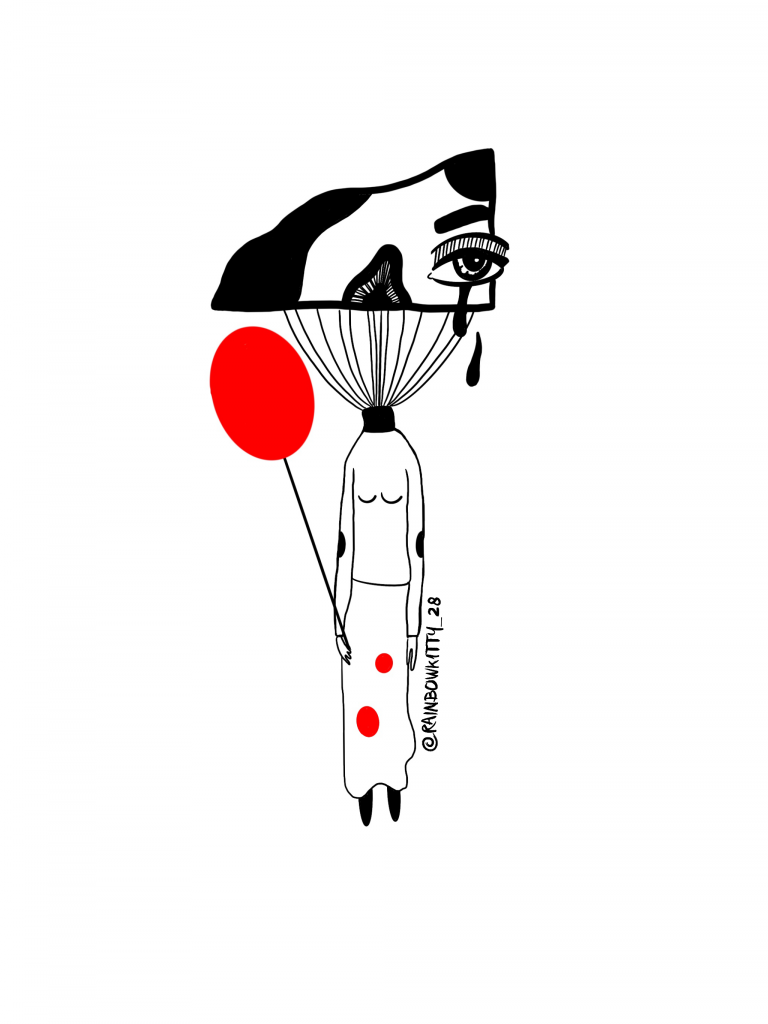
Balloons are red, a worldwide affirmation of caution. My eyes are dry though they appear to be running wild. Tears are the ocean bliss I long to float amongst. Turquoise hues of inner peace surround. I see in black and white but the colour of you blue. Limp limbs drift silently with the wind. Your cuddle isn’t temporary. Your warmth ties souls to your healing properties.
Push me away. Pull me back in. Dance beneath the luminosity of a millions stars. Make us sway without human interruption. Erase the land. Allow all irrationalities to dissipate. Capture joy with a bottle and cork. Travel with me through time and galaxy. Kiss me before I go to sleep and you may just become my reality.
Proceed with caution they said. Work twice as hard as your peers they said. Don’t be too different they said. Fit into the category of success they said.
Don’t wear short skirts they said. Don’t shave your head they said. Wear heels they said. Be classy they said. Respect your elders they said.
Always smile even when your hurting they said. Mental illness is all in your mind they said. Don’t get tattoos they said. Your too fat they said. Your too thin they said.
You look ill they said. Eat something they said. Your trying to hard they said. Be subtle they said.
Don’t cross social boundaries they said. Don’t break the rules they said. Don’t be too revealing they said. Be sexy they said.
Don’t talk to much they said. Don’t hold too many opinions they said. Be seen and not heard they said. Why can’t you be more like so and so they said.
You’ve had too much to drink they said. Go to your room they said. Don’t talk about racism they said. Deal with it they said.
Control yourself they said. Why are you crying they said? Pull yourself together they said. Your making a show of yourself they said.
Eclectic mind. Open to the very fibre of another’s truth. Sit with me for a while. Pour your dreams into my minds eye. Grant me the perspective of the creator. The symphony to your goals.
Untie your soul. I am not the prejudice to which you recoil. Allow the sweet birds to sing from the pits of your stomach. Draw a diagram expressing true desires. Be the kite above who has earnt true perspective. Flood the tree’s pages with inked ambition. Eclectic minds think alike. Authentic smiles perpetrate insight for the otherwise unkind.
Find the beauty in cultural difference. The history, the talent and cultural superstition. Personal projection leaves ears firmly shut. Open the mind and close your mouth. Digest the palette of another’s spoon.
Determine knowledge through personal experience. Interact soulfully removing convenience. Believe in what you know. Believe in ceaseless growth. Eclectic be the ear. Eclectic be the nose. Eclectic be words spoken. Free will. Free expression. Opening the eyelids to the beauty that surrounds. An eclectic world.
Cleo Howard is a mixed race woman of Jamaican/English descent, now living in West Yorkshire, prior to being a Cypriot resident for the past year. Cleo is a writer and artist full time, currently writing a first novel based on personal experiences in life thus far. Cleo considers writing as therapy, something of an antidepressant as Cleo is a self-professed mental health survivor, creatively showcasing the distinctive individual phases of recovery through chosen art forms. Cleo is also a tattoo artist.
Life is a molotov cocktail of joy and pain Look into the mirror and feel sane or insane The negative and positive forces at work The way trouble can wipe away a smirk
A marathon life can seem, or a quick sprint Some lives are a novel, others have just a few lines to print How is life treating you some say? That depends on moods or the time of day
The rich can be sad, the poor content Even though one has a ‘Bentley’ the other can’t pay the rent This thing called life that keeps the heart beating New faces and trials we are constantly meeting
Toss the coin, or spin the roulette wheel Ups and downs of life the Ying and Yang feel Still for me life is a blessing, so enjoy your path Even though tough times won’t make you laugh
Be optimistic even when the skies are grey Believe in a ‘higher power’ and give a daily pray The planet we live on is such a beautiful thing Watch the moon and the stars and listen to birds sing
So from the cradle to the grave keep the head high Life is a journey we travel until we die Take risks, be careful explore new life Have children spread your seed with partner or wife
As we all grow old the mind may change Places and people the world seems strange Through it all keep in mind we only have one chance So take life by the hand and have the last dance
memories hourly they spread across uneven eons within a second-hand tapestry of woes naked shame clothes his name and the daily joie de vie turns a sacred screw as viscous iron blood smelts an ancient block of fever’s night
between the eyes it climbs a fence like caged ivy down vena cava lane with Joey Gentile and her weekly digital pacifier
charged with apocryphal bible belt bullshit in the south
rumour consumer ads squirt like fish through an endless stream of consciousness
Heavenly sailorling spy out the wan light-sheen of star. Baffling unearthly time: weird having just thieved by elves. One of pale mornings longs for some meek fulfillment of night. Moony and nostalgic chums – comets are upon the skies.
Lonely dreamery – lying just blink-sea, weird above. Endless nostalgia is being of pang. Hades is fay. Heavenly moony lure, beings seem dark, Ethics fly off! Poignant decease has become drab black, comet has picked rain.
The glow, which is deathless, at length in the sadness full bane. Grim Reaper loves more than you dream – a bit lights on the worms. Marvel of starlit night: I have found a little of my name. Starry night – dreamy glow are only in the tender souls.
Sensing the moonlet, demise of cool-blue song will be free. Your worm bawls after all certainly. Death blubbing like me.
Paweł Markiewicz was born 1983 in Poland (Siemiatycze). His English haikus and short poems are published by Ginyu (Tokyo), Atlas Poetica (USA), The Cherita (UK), Tajmahal Review (India) and Better Than Starbucks (USA).
You can find more of Paweł’s work here on Ink Pantry.
Begin with bent brow in hands and hands unfolding, hinged doors as wings of the suddenly happy bird, hopeful as Dickinson’s in that opening, in those feathers spreading, encompassing horizons, the visions wide & present, calling to & from the soul. Now even these fallow fields are less depressing, still being of earth, its potential, to just blend with rich compost, keep moist and wait with the clarity of deep breaths taken, released. Hands in rich silt are mere flesh made of water and air, the synthesis of elements, the celestial given physical form. Is this what real unidentified angels actually are everywhere, and the great patterns of their work evident in the ploughed furrows, those waves churned over & up? Humble and holy come other stored examples in the heart and the head. Sample now Grandma’s drawers of saved twisted bread ties, baggies, folded aluminum squares whose crinkles were cleansed, scents smoothed under water to dry amid dishes. The next space which opens fans with cards of gin rummy, fancy suits flat against cushioned table mats ringed with the blue of Grandpa’s cigars. The green glass corners of his ashtray forms a diamond of use graced by the tall frosted gold pillar of beer. A little salt gives the best head, froth whiskers tickling the tongue’s tip refreshed past that entrance of the old gas stove’s aroma amid the dust and lead paint of that sunny lead-in back porch. This is the covenant of how blessings open out from each other, snow-globe contained but macro from the micro producing vistas further and farther. What other extreme unction to ask for than that? What more really to want for ever?
Exacting Revenge (For Louis Enrique Mejia Godoy)
Will indeed be a pleasure, say
some acid burns on each still pus-running knee. (We agree. Can’t wait.) Add these lime-laden eyes remembering that sack & almost asphyxiation in lungs yet too raw for adding their two cents. (Sounds fine.) The will shall have to compensate, one spirit taking prayer
& honing its frantic edge toward the faith of some future soothing every scar which winces with salt. Also
there, in that sphere, distant as peace, the torturers, having lost ground & passed into freedom’s blow, will have no choice
but to live knowing that their vileness failed.
This is my dream anyway, the revenge of a good life handed to everyone descending from repression with hope savored because of all the vaccines poured orange as mercurochrome under the sun’s gold.
Bleeding For Jaco
Electricity gone awry… boundary lines blurring… the jarring of feedback, the blisters of static where, from amps, scabs bleed…
Jaco, who were you? The homeboy made good? The mutt derelict genius?
The usual labels as commentary, tragic speculations all… We cough up explanations to digest brutality & then remember…
Duality looks deeper. Gropes for control: Your callused fingers cut by bass strings, the palm ripped, a gash pouring jazz… Physically too: the bones of your face shattered, having been beaten outside some pub.
Blood is a poignant reference, a vivid metaphor for pain.
But what sabotaged you, Jaco? The ecstasy of an Icarus, with the eyes of the drowned?
The surplus of ground zero conveys abrupt shots: the numbing by lithium, the detox quarantine. Yet life you still attempted, blinking an eye, twitching a toe, & Jaco,
It wasn’t madness that drove you, but bloods’ pure notes. A virtuoso from day one, a whole improvised opus you became,
Jaco,
to rock out, rock out, as a solo
Waves
This one, ten foot slate, a girder unearthed & returning. These others are meniscuses too grey for reflecting the sky sliding on each curve…
Here the post cards are all black ‘n white. If any difference occurs shades blur it in a slap of repeated graceful savagery.
Why be a non-conformist when insanity is all the rage?
Instead, weather tongues, the multitude’s mouth, a basin with teeth gnashing to spit out…
Oh Deus, do you exist, & from such a tough rugged heartland must not wounds be genuinely felt, entered, before healing can spark mercy?
Mama, I’m going in, goat-shaped froth gnawing off despair’s crabgrass. Where are my bones?
Now the pleated sheets form leaves, an excess of light & the coast whitens. In excelsis, purity burns liquid brimstone, the amethyst face, hands, a spirit looks on in tenderness, dispossessing memories, a passage to float from & open upon Baltic cliffs, Gibraltar balustrades—–
The other world, the other world, this must be a birthing place.
The Photographer’s Pupil (For D. Arbus)
A heart on the wind, you’d been opened that exposed, waiting for initiative to take over, give way to instinct. Imperative is clarity utterly unmasked by the camera which hid you. Then the subject’s impact would hit the pit of the stomach. You were a portal from which the real sight blew through.
Vision extender, what you saw was recorded not so much as documentary, but an intuitive view. Does such gentle predatory perception replenish what feeds it? Dimensions transcend the image & shudder forth cut.
How can I tell you your existence did the same? Its traces wash fossil-like from the acid baths. As you develop I grow astonished, senses reeling with what yours’ encapsulated: the freaks & the street people, the transvestites and circus attractions, all horrific & mortal, remarkably so.
Shy nymph, you crept up to them, finally asking permission & then taking command. What a surprise! Their faces freed, all artifice stripped, a psychological truth, now emblem-poignant.
Here I see the proof, their lives passing alibis, affidavits without judgment. Yes, there’s no verdict in the flesh except that it gives. But how did you go with it at your own perilous risk: the last supper of Barbiturates the slit wrist tub?
Now deep & enlivened, I attempt wading through. I find you like a deer caught off guard, no empathy siphoned from your quite earnest pupils. Just so, I am not vacant. I walk from this crypt, its portfolio, & wander susceptibly. You did too, more real in the dark, exploring the dank subway tunnels, their wired tired tribes. The trains lurched & pulsed, such tireless fury ritualized by your gaze.
In those eyes, both of us have known death, have been there & come back. but who taught that, & how does one live with the tie?
Stephen Mead is an Outsider multi-media artist and writer. Since the 1990s he’s been grateful to many editors for publishing his work in print zines and eventually online. He is also grateful to have managed to keep various day jobs for the Health Insurance. Currently he is resident artist/curator for The Chroma Museum, artistic renderings of LGBTQI historical figures, organizations and allies predominantly before Stonewall, The Chroma Museum.
You can find more of Stephen’s work here on Ink Pantry.