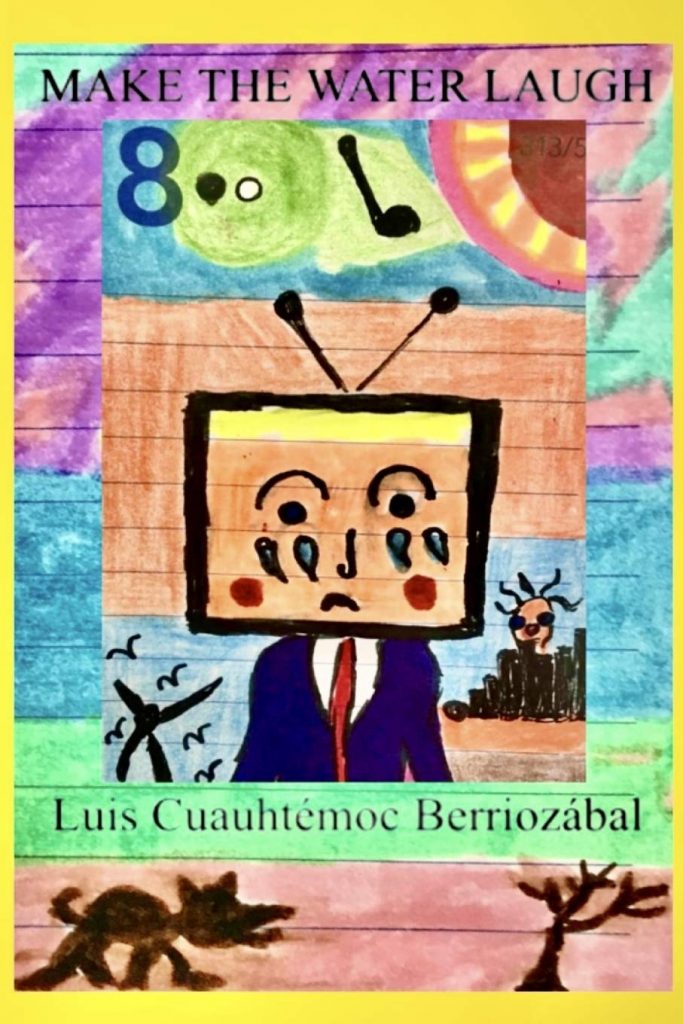
Poetry Drawer: Suffrage: Negation: Covid Winter: Christmas Lights: Letter Against Anger to the Daughters of George Hoshida by Brian Glaser

Suffrage

My grandmother was asked as a young woman
by her young son:

What do you want for Christmas
besides world peace?

The anecdote survived for decades in my family.

Tonight I realize it said more about her
than I had seen:

she was born just after the First World War,
her Cold War Catholic parenting

was unafraid of the Red menace—

she didn’t want to frighten her children
about the Communists,

she had been able to vote,
she had made something,

call it a difference.

Negation

     Twilight—
there are many brief
         hues to it—

Covid Winter

My grandmother would carefully select
Hallmark cards
with the appropriate words for the recipient and occasion.

I defended Hallmark for this reason—
without the detail that this was my grandmother,
she was a possible person in my comment—

I defended Hallmark to my literature teacher in college
and he said, with a laugh,

“If you have to rely on Hallmark, you’re in trouble.”

My son’s world history teacher showed his class
a Hallmark movie today at the end of the semester,

and she told them all that
she and her husband love to watch Hallmark movies together.

We laughed at them afterwards in my son’s room,
gentle, brief, slightly sad laughter.

And I walked in the cold darkness of December tonight
and prayer graced me

and language itself died like night at the dawn
and was reborn in the unspeakable pain of the dying.

Christmas Lights

      I am proud
                   of the dark houses,
            their hopefulness—

Letter against Anger to the Daughters of George Hoshida

Begin with the beauty of smallness:
on the evening of the convergence,
on the longest night of the year,
winter solstice, my children and wife looked for the bright planets
coming together, joining,
and they could not find them in the dark winter sky.

The vastness of the universe has for decades
seemed to me annihilating,
the dark everywhere around us—
so that meaning would become as if it never was
if I thought about that emptiness for too long.

But tonight I discovered how small I am,
my loves and worries,
and realized that it is, despite this, more than nothing, my life,
my family and my home, my being,
my human body and soul,
truly small though I am in the winter solstice of space.

Your father had every reason to be enraged,
imprisoned as he was simply for being Japanese in Hawaii—
losing his oldest daughter from whom he was separated—
and through it all
he kept drawing,

mostly human figures,
as he had been taught by correspondence school,
often three of them sharing a loose-leaf page—
maybe there was a rageful healing thoroughness there,
assembling families of separate figures again and again,
like laughter occupying each body
until its independence was complete.

Brian Glaser has published three books of poems and many essays on poetry and poetics.

Poetry Drawer: Applause of a Nightmare: Lips of Summer by Yuu Ikeda

Applause of a Nightmare

Applause of a nightmare
resounds in my room

I try to cover my ears
with floating images of you

But on the stage of boring energy,
I can’t escape from the applause

I don’t know what to sing
I don’t know how to dance

The applause never ceases

It looks as if
endless discord
dives into me

Lips of Summer

Lips of summer
kiss my eyelids fiercely

I feel the heat
I feel the beats

Waves of vehemence
and
ripples of softness
mix on my eyelids,
then,
I’m soaked in
a curtain like fire

Yuu Ikeda is a Japanese based poet. She loves writing, reading mystery novels, and drinking sugary coffee. She writes poetry on her website. Published poems are in Nymphs, Sad Girl Review, and JMWW.

Inky Wisdom: Sam Reese on Editing Short Stories

It feels slightly embarrassing to admit that I enjoy editing my short stories—like confessing to some long out-of-date taste. For many writers, especially early in their careers, editing can feel like a chore—or worse, a kind of punishment inflicted just when you want to be celebrating all the hard work it has taken to create a draft. But, like most of the important parts of being a writer, editing grows easier the more you practice—and the more you understand what kinds of editing techniques work for you. Someone once told me that there are two kinds of writers: those who make their writing better by adding to it, and those who improve by cutting away. While, like most writerly ‘rules,’ this misses a lot of the nuance that makes everybody’s own practice unique, it can be a useful place to start—particularly since I know that I tend to trim, rather than add.

I begin most stories by over-writing. My first draft is usually at least 25% longer than it will end up. In the most extreme examples, I have written stories four or five times the length that they really need to be. I like to think of this as a sculptor might—preparing a block of marble that I can refine down to the shape it needs to be. There are several things I look for in this paring back. Normally, I’ll edit out two thirds of my descriptions. These can make the story heavy, and distract the reader from those really crucial descriptions that carry the story’s weight. I also remove a lot of explanations that I needed for myself—characters’ motivations, details about their histories. In short fiction, you don’t want to give the reader more background than they absolutely need. And finally, I turn to shape.

By shape, I mean the trajectory the story follows—the way that it moves. This will differ from story to story, and sometimes it isn’t obvious exactly where the emphasis should be. But there are some rules of thumb that tend to hold true. Most stories rely on a short opening and conclusion—most of our attention should be on what happens in between. Normally, I find that I can edit down the three opening or closing paragraphs into a single one. To make the story’s movement clear, it helps to have something that connects these ends—a repeated image or motif, a phrase or scene or just a mood. But a story has to change, it has to take the reader somewhere new. So when I’m shaping, I am focused on the end. What shift do I want to show the reader, and what kind of feeling do I want this shift to have?

As I said though, there isn’t just a single rule for how to edit. There have been plenty of times when I have come to a draft and found that there is a missing piece, rather than too much. I tend to look for places where I can add another scene between two characters, so that I can build and complicate their relationship. You’ll often see discussions of ‘round’ and ‘flat’ characters, but I prefer Kazuo Ishiguro’s perspective: it is three dimensional relationships that make writing interesting. If I do want to add to a single character, I will look for ways to weave in memories. Fiction allows you the freedom to play with past and present in ways that usually seem awkward in visual media like film. In particular, it allows you to capture the way that our own memories disrupt or blend without experiences of the present in our everyday existence. Drifting between the present and a memory allows you to reveal something of that character’s outlook or experiences, or else to add resonance to something that occurs later in the tale.

Of course, that leaves the least glamorous part of editing for last: proofreading. You will find all sorts of tricks out there for catching minor errors (like reading your story from the last word to the first) but I prefer to use this as a chance to work on another component of my style at the same time—the rhythm of my sentences. My technique is pretty simple: I read my story aloud, really emphasising the cadence of each sentence. Not only does this help me catch any little problems, it also allows me to do something that I think is even more important: getting the rhythm of my story’s movement right. By controlling how your sentences speed up or slow down, you can exercise control over when your reader pays attention, and when they will rush on forwards, heading to a climax. Because rhythm matters just as much as content. It shapes feeling, and response. And it gives you something else. Style.

Hailing from Aotearoa, Sam Reese is an insatiable traveller and award-winning critic, short story writer, and teacher. His first collection of stories, Come the Tide, was published by Platypus Press in 2019. A widely respected literary and music critic, his study of The Short Story in Midcentury America won the 2018 Arthur Miller Centre First Book Prize. Currently a lecturer in Creative Writing at York St John University, Sam formerly taught at the University of Sydney, where his inspirational teaching was recognised with an Excellence award. His forthcoming collection, on a distant ridgeline, is published by Platypus Press.

With special thanks to Isabelle Kenyon from Fly on the Wall Press.

Poetry Drawer: We / feel cooler / in dry air: elephant cup cakes: A line from Billie Jean King: Hosomaki: A Paumanok Picture by Mark Young

We / feel cooler / in dry air

Parts of the morning collide
with the eventual winner

of the home & away series.
Not much is left. A few shards

cause craters in the eyes, a part-
pennant does pennance as it

wraps around the nearest set
of ankles. Then a dog sled ar-

rives, still moist with snow. We
welcome it with closed arms.

elephant cup cakes

           ‘ Pachyderms and pastry! I love it.’   Tom Beckett

That a pachyderm is highly comp-
etitive in the global pastry market
does not adequately capture the true
sense of how unlikely scenarios such
as this are. Those Instagram influencers
who talked this up were all probably
tickled by the ivory. Money may have
changed hands. But the natural attri-
butes of the animal are ideal for the
task — tusks, tail, trunk; all master
mixers — why be surprised? & those
feet! Pancakes galore. The perfect size
for carving out cheesecake casings.

A line from Billie Jean King

An exciting update is coming.
A chart’s been prepared to
illustrate the main points. Small
popups will appear that use

colour & typography to provoke
a psychological reaction. There’s
certainly a place for that, simple
or complex, since we are both

made up of energy & used to
the use of icons to represent
emotions. It won’t be that long
before you have command of

the update, can use all parts of
it intuitively. Savour the small win —
this victory is fleeting. Another
update is now only days away.

Hosomaki

The queue outside the sushi
bar melts into one another
as the bagpipes suddenly
arrive. Raw fish & rice is no
match for tartan, even one
only rarely worn. That’s the

problem with living in a
garrison city — too many con-
tradictions, too much bias.
Too few true conflicts. Which
is why the military make what
they can out of what’s available.

A Paumanok Picture

Later, when the road
had opened,

Walt Whitman
was allowed to pass.

Mark Young was born in New Zealand but now lives in a small town in North Queensland in Australia. He has been publishing poetry for over sixty years, & is the author of around sixty books, primarily text poetry but also including speculative fiction, vispo, creative non-fiction, & art history. His most recent book is The Sasquatch Walks Among Us, from sandy press, available through Amazon.

You can find more of Marks’ work here on Ink Pantry.

Books From The Pantry: Marples Must Go! by Greg Freeman reviewed by Neil Leadbeater

Greg Freeman is a former newspaper sub-editor, and now, news and reviews editor for the poetry website Write Out Loud. He co-comperes a monthly poetry open-mic night in Woking with Rodney Wood, and his debut poetry pamphlet Trainspotters was published by Indigo Dreams Press in 2015. Marples Must Go! is his first full-length collection.

The writing is on the wall. MARPLES MUST GO! So who was Marples before he was consigned to history? Being of the same era as Freeman, I remember the name well but, for the sake of the younger generation, I will add that Ernest Marples was a British Conservative politician who served as Postmaster General and then Minister of Transport in the late 50s and early 60s. Nothing unusual about that, you might think, but he was responsible for many things that we now take for granted such as the introduction of Premium Bonds, postcodes, the opening of the M1 motorway and the appointment of Richard Beeching whose drastic cuts abandoned more than 4,000 miles of railway track. Details of his later life were colourful resulting in him fleeing to Monaco at very short notice to avoid prosecution for tax fraud. Freeman delivers Marples’ life story in five stanzas touching upon every detail. Apart from anything else, it is a model of precision, honed no doubt after years spent in a career in journalism.

In this generous collection of 60 poems, Freeman draws inspiration from politics, popular culture, football and family. The earlier part of his collection is primarily about growing up in the post-war era and the swinging sixties. There are poems about iconic TV programmes such as Space Patrol and Juke Box Jury; popstars such as Dusty Springfield, Cilla Black, Chuck Berry and the Dave Clark Five and one about an influential, if somewhat unconventional, teacher whose readings from the Penguin Book of Contemporary Verse gave Freeman his first introduction to the world of poetry.

Freeman has a journalist’s eye for detail. He knows instinctively what makes for a good story. Out of all the stories recast as poems, the title poem must be at the top of the list. Other ‘scoops’ include an account of Margaret Thatcher’s visit to a girl’s school in Leamington Spa which sparked a large student demonstration (Dust-Up in Leamington) and the discovery of a huge cannabis farm on disused private land near Berrylands station (Berrylands). Freeman’s description of the station which I used to pass through on my daily commute into and out of London is spot on:

An apology for a station
on the way to Hampton Court,
the place where the fast
slowed down for Surbiton.
It overlooked a sewage farm
we’d cycle past, a short cut.
Lower Marsh Lane
more or less summed it up.

This extract is a good example of how Freeman condenses his words to their essence, omitting anything that is unnecessary while getting to the heart of the subject.

His years spent in newspaper journalism are celebrated in poems such as ‘The Overmatter’, ‘Classifieds’ and ‘The Local Rag’ where the ageing aroma of old newspapers brings to mind:

Crashing typewriters bashing
out wedding details, film previews,
match reports. Telephones
shrill with complaints, demands,
rare tip-offs.

In ‘Goodbye Farringdon Road’ Freeman records the historic moment when the Guardian newspaper relocated its London offices from Clerkenwell to King’s Cross and refocused its priorities from print to the internet. There is a telling line in the final stanza:

Print’s long goodbye, but at what cost?

A series of poems on the subject of football betray more than a passing interest in the sport. In one of them, (The Battle of Hastings as Summarised by Roy Keane), Freeman deftly combines his love of football with history. This is something he is particularly good at. Other poems that simultaneously work on more than one level include ‘Fine and Dandy’ which is an interesting cocktail of comic characters, politicians and history, ‘Clacton’, a clever fusion of pop song titles, film titles, place-names, politicians and Brexit, and ‘Return of the Daleks’ which uses a TV series as a hook on which to hang a poem about Brexit. In a further poem on the theme of Brexit, Freeman reminds us how times have changed with these telling lines:

Back then you couldn’t speak your mind;
now you can shout it out loud.

Freeman admits that he is very much a poet of place and this is reflected in his poetry, whether he is writing about places in his native Surrey or places further afield such as Marbella, Barcelona, the Stockholm Archipelago, the Loire Valley or Bruges. These references help to ground the poems, establishing a backdrop to the stories that he unfolds.

Towards the end of the book, there is a sequence of poems about four bronze statues in Woking town centre by Woking-born sculptor Sean Henry. These poems represent a series of back-stories for the figures, as Freeman saw them. These four statues are ‘Woman (Being Looked At)’ at the entrance to the Peacocks shopping centre, ‘Standing Man’ in Jubilee Square, ‘The Wanderer’ outside Woking railway station and ‘Seated Man’ inside the station on a seat on platform one. Freeman’s tribute to these works has received a nod of approval from the sculptor who told him he had accurately captured some of the thoughts that went into the works as well as bringing in ideas of his own which he felt were somehow right. These verbal descriptions of a visual work of art represent a new exciting departure for Freeman.

Poems closer to the present moment bear references to the pandemic (there is one about clapping for the NHS), Nigel Farage scanning the channel for migrants, the anniversary of V.E. Day and a retrospective on the singer-songwriter Amy Winehouse.

These engaging poems are more than one man’s memory of significant moments in his life. They are my memories too and they will resonate with many other readers. They are the kind of poems that work well in performance as well as on the printed page. The collection captures with wit and compassion ‘our time’. Fully recommended.

Marples Must Go! by Greg Freeman is published by Dempsey & Windle (2021).

Neil Leadbeater is an author, essayist, poet and critic living in Edinburgh, Scotland. His short stories, articles and poems have been published widely in anthologies and journals both at home and abroad. His publications include Librettos for the Black Madonna (White Adder Press, Scotland, 2011); The Worcester Fragments (Original Plus Press, England, 2013); The Loveliest Vein of Our Lives (Poetry Space, England, 2014), Sleeve Notes (Editura Pim, Iaşi, Romania, 2016) Finding the River Horse (Littoral Press, 2017) and Penn Fields (Littoral Press, 2019). His work has been translated into several languages including Dutch, French, Romanian, Spanish and Swedish.

Poetry Drawer: st elena: golgotha postcard: muted splendour: modigliani’s gun: first attempt at escape: westward by John Sweet

st elena speaks with the voice of a carrion bird

the almost and the
always and the never and then
everything in between

close yr eyes

do you see now?

let the map take you
from here to there

let the desert be your
starting point
and your destination

no walls and no water

no true purpose

you’ll live and you’ll die
just like the rest of us

you’ll be forgotten

maybe you
already are

golgotha postcard

pilate shot through the throat and
then the crows at his heart

the dogs drinking his tears

grow up fast or
not at all,
right?

a lifetime of dying played out in
the space of an hour and i
forget if i ever told you i loved you that summer

i forget if you were the one who
taught me how to bleed

was too busy making promises that
turned without effort into
such heartfelt lies

muted splendour

and then dali grows old
and then dali dies and
i am left in this room
with your sister

says she’s cold, but
she won’t get dressed

won’t get up off the floor

just tells me she hates
me while i kneel down
to kiss her feet

modigliani’s gun

barefoot on broken glass at the
end of november and maybe it feels as
good as a bullet through god’s filthy heart

maybe only children
will be killed in the war

each tiny death made into a movie and
all of them playing in another room while
we’re trying to sleep, and so how can you
claim to be famous if no one wants
to see you naked?

why would you keep on bleeding
all over the carpet when it’s
all you’ve been doing for the past 30 years?

there’s a got to be a better way
for you to waste the rest of your life

first attempt at escape

late winter snow from dull pewter skies,
driving west but never fast enough,
laughs & tells me he’s the one who took the
pennies from christ’s blind eyes

says he’s looking for a
girl named jennifer to fall in love with then
says the heater’s broke

tells me i look like shit

asks how long I’ve been
bleeding to death

turns the radio up way too loud while
i’m trying to think of an answer

westward

and then you and i and the
sleeping face of christ, all of us
radiant and each of us alone here in
the sudden warmth of november,
in the flickering shadows of falling leaves,
beneath the ominous web of powerlines,
blue sky reduced to meaningless
geometry, startled birds, endlessly
crashing planes and the children laughing,
screaming, running home across barren
fields or down haphazard sidewalks,
the memory of their motion, the way i
tell myself over and over again not to
forget this moment and then the
ease with which i forget it

the reasons i write these
meaningless poems

the idea that maybe even one
of them might find you

John Sweet sends greetings from the rural wastelands of upstate NY. He is a firm believer in writing as catharsis, and in the continuous search for an unattainable and constantly evolving absolute truth. His latest poetry collections include A FLAG ON FIRE IS A SONG OF HOPE (2019 Scars Publications) and A DEAD MAN, EITHER WAY (2020 Kung Fu Treachery Press).

You can find more of John’s work here on Ink Pantry.

Poetry Drawer: Improvisations: Unbearable Lightness: Somerset: False Advertising by Jenny Middleton

Improvisations

We have taken to living life
as if it were jazz
rouging wan days
with bright notes
born from barren weeks

hollow as the tin-can lanterns
recycled and strung up
in the spindly birch trees
by kids, next door.
Each cylinder’s dark interior
is pierced with geometric patterns
so they gleam with empty space
marking out the night
with absence, as death is cut
into our lives.

We philander from the garden
and let it straggle, feeding
on its own leaves, drunk
with fermenting sugars
set to sweeten autumn
without us.

Grief’s time-signature surges
days in eight bar riffs
dubbing evenings
to waves of past voices –
ghosts we drink to extinction –
and stand at last
in the darkness of a new street
awake and broken with dawn.

Unbearable Lightness

I lent Kundera’s novel,
and then separately,
a pair of daisy spotted culottes
(smart enough for an interview)
to friends
light enough not to return,
their words, ceiling trodden
and walked to air.

I find I still wonder where
the pages spore their print
in absence
from my shelf
as if they were
chilli pepper seeds –
papery and disk like
skimming ideas to flame
even after they are eaten
and gone.

And whether clothes
absorb memories
with their wear
to larger shapes,
stained and stretched
to age.

The rails of thrift shops
hung, heavy and spooling
sky, touched, scraped
with the beyond
of these days.

Somerset

The plough’s metal ribs are turned to the sky. Rust flakes in fingernails from the iron core of abandoned machinery amongst the unmown grass sprung with daisies and summery warmth. Flattened clouds rule the sky, pulled taut as clavichord strings that hum with a storm’s jigger at the afternoon and its wobble of espaliered peaches.
We run barefoot with the children, laughing, circuiting the field, drunk with exertion, feeling the rub of damp roots fleck with the music of first rain.

weather charts
blue sky to numbers
rain blurs us

False Advertising

Billboards feather boa the street
taxiing minds and high balling eyes
to palm tree spas kissed
with sangria and sunshine’s
strut in snakeskin thigh highs.

The adverts promise
the everything of lies
to anoraked pavements
apace with slow stepped lives
loitered with the fur
of Friday night zooms
and the lurch between
stops to and from home in buses
pelted in more soft sell.

the earth a dream mumbled in pentameter
curved, foetal and asleep
beneath a tarred city’s rumble

Jenny Middleton is a working mum and writes whenever she can  amid the fun and chaos of family life. She lives in London with her husband, two children, and two very lovely, crazy cats. 

Poetry Drawer: Definitions (On Naming Things) by Richard Helmling

That line, that grey smudge, in the sky—like a shadow of something moving out beyond the world
Was it a passing ship? A sail wide as limbo
The mind reels at the distances, knowing they can only be fiction, that only the self is real

Lost now (because a petrified forest is really just a field of rocks)
I sit down in the shadows of the palm fronds reaching over me with dagger fingers
What am I—but a sinking wetlands, methane-rich refuse rotting into usefulness?
Or really
I think I am the output of some formula—a reductive algorithm
Definitions slip through the cracks between their own words, eel-slick and mucosal
It’s June now, and this too must pass, this uncertainty
Things do, pass, always

 Richard Helmling is a teacher and writer living and working in El Paso, Texas.

Books From The Pantry: We Could Not See The Stars by Elizabeth Wong: Reviewed by Yang Ming

The tracing of one’s ancestry has gained some form of public interest in recent times. People go to great lengths to find out their ancestry by doing DNA tests such as 23nme or trawling through history records. The quest to seek out our ancestry, and even all the way back, clearly shows us our innate desire to discover our sense of belonging in human civilisation. So reading We Could Not See The Stars, (published by John Murray Press/Hachette UK), a debut novel by London based author, Elizabeth Wong, feels timely.

Set in fictitious Malaysia, the story opens with Han, a young man who goes on a fishing expedition with his supercilious and arrogant cousin, Chong Meng, in their sleepy fishing village, Kampung Seng. They seem to run out of luck under the sweltering heat as ‘the salty sea heat stuck to the pores of their skin.’ One day, Han encounters a mysterious man by the name of Mr Ng who arrives at the village, asking about his deceased mother, Swee. Why is he looking for his mother all of a sudden? The thing is, Han barely knows his mother since she died when he was five years old. Han’s grandmother describes her as one who doesn’t speak of her past, ‘as if she was not fully present in the net. As if her thread was a stray one, woven loosely with the other lines, threatening to unravel as life tugged on it.’ Mr Ng’s appearance unsettles Han. But Chong Meng is impressed by this man’s stories of his travels and the tales of his golden tower. Han’s life changes when his mother’s spade – the only thing that is left of her – goes missing. Han thinks Mr Ng has something to do with the disappearance, and sets out on a quest to retrieve his most precious possession. It is later at the Capital that Han finds out, on a faraway island, across the Peninsula, and across the sea, the forest of Suriyang is cursed.

Those who wander in and return will lose their memories. An expert in Naga Tua island, Professor Toh believes the forest is hiding something that does not wish to be discovered. Is there something sinister lurking in the forest that is causing people to lose their memories? Will Han ever find out who his mother is?

The novel is a blend of speculative fiction and human drama. It is split into 8 parts with each detailing the characters’ perspectives and their connection with the enigmatic forest of Suriyang. Wong skilfully crafts her narrative by setting up pivotal plot points in each chapter, and it grips you as the story unfolds. Right from the start, we are introduced to a host of characters – each with various motivations. The problem with writing this sort of ensemble is that writers often fail to accomplish what the characters set out to do. But in this case, Wong manages to pull all the threads together towards the end of the story as the characters’ lives collide with each other.

Wong is also a keen observer. Her on-the-ground research at a fishing village in Malaysia certainly pays off. Her lucid prose exudes authenticity and playfulness. It’s also filled with intricate details about the Hei-Sans archipelago of nine hundred islands, and the people who inhabit these islands. When Han travels on a train to Hei-Sans archipelago, she whisks us away to Western Range, a new mountain that is ‘hardened to become the spine of the Peninsula’. She further describes the structure of the mountain, ‘as the spine was being pulled apart by tectonic forces, some cracks, like the Spirited Pass, had grown until there was more crack than rock, and together they had formed a continuous, thin crack splitting the Western Range along its entire width.’ Her attention to such details stems from her training as a geologist.

Ultimately, We Could Not See The Stars is a profound meditation on continuity, identity and belonging. What happens when we do not know the people who have gone before us? What does that make us? Swee poignantly finds out:

Their full names were inscribed on the walls of the docks, a reminder of the people who had passed through the place. These were home-world names – names that existed only in song, and sung the history of their families and clans. How else would a person know their place in the broad sweep of time? If one did not have a home-world name, no one would know who they were, nor their forefathers, nor ancestral homes. A person was nothing without their home-world name, a speck written out of history.’

Despite the multiple storylines, the novel celebrates a mother’s sacrificial love and the longing to leave behind what’s important for the next generation. That’s powerful, yet at the same time, makes us question our existence in human civilisation.

We Could Not See The Stars is published by John Murray (Hachette UK). The novel is now available in major bookstores, including Waterstones, Amazon UK, Booktopia Australia and Book Depository.

Poetry Drawer: Dancing a Whirlwind: Golfo de Morrosquillo: Magdalena Sunset: Enter Iris and Luna, Stage Front: La Boca Summer Day by Lorraine Caputo

Dancing a Whirlwind

A morning shower
            barely has left a
                        print on dry earth

& now a bright breeze
            dances joropo
                        around us, around

Mónico playing mandolin
            his aged-mahogany face
                        wrinkled in a tranquil smile
Around cuatro & guitar
            caja drum & maracas

A bottle of cocuy passes ’round
            an anciana sings, her
                        cinnamon hands clapping
Women chat, adjusting costumes
            a child cries
                        & is comforted

Rosa the singer & Luis
            the spoon-player
                        begin to dance amidst us
Fine soil billows ’round
            their steps & twirls

joropo – traditional music & dance of Venezuela, originating in the llanos region
cuatro – a four-string instrument like a small guitar
caja – box
cocuy – an alcoholic brew of a cactus plant
anciana – old woman

Golfo de Morrosquillo
            (Tolú)

Full moon rises above
            tejas & thatch roofs
The gulf rolls evenly
            around the breakwaters
                        onto the grey sand
A crab flees from
            the rising tide

Families take a dip
            in the night-darkened waters
                        stroll on the seawall, the beach
Three boys play kickball
            with a plastic bottle

Along the malecón
            scented by grilled foods
                        people eat & drink
Bicycle taxis pass &
            horse-drawn carriages, the
                        clop of hooves lost to
Music blaring from
            restaurants & discos
Vendors spread their cloths
            with jewellery, incense
                        under streetlamps
Women yet corn-row
            hair with quick molasses-
                        coloured fingers
Sunglass salesmen walk
            café to bar

& the musicians still wander
            accordion ’round neck, caja
                        drum, guarachaca stick in hand

Magdalena Sunset

(Mompox, Colombia)

Waterlilies float swiftly by on the river’s current.
Bells clang for mass at Santa Bárbara church.

In front of a colonial house on the river walk
speakers blare music, Inside, amidst balloons
& streamers children sing a birthday.

Dressed in vivid paisley, shoulders stooped with
passed generations, doña Julia sits on the steps
to the río, talking to herself.

Two Scottie dogs laze in a window niche of their
ochre home trimmed melon & jade. One rests
his muzzle on the wrought-iron grill.

With a splash of water, a man jumps from the jetty.
Dulled light of almost-evening sheens on his tanned skin.

The boats have abandoned this narrow channel
of the Magdalena & this terminal stained white
concrete & brick flaking, vacant windows staring.

In the cool evening sung by gecko, toad & cricket, a boy
sends his kite aloft. Families chat outside in caned chairs,
a foursome plays Parcheesi on an iglesia patio.

The disappeared sun paints loud indigo & purple
reflecting in the swift water. Shadow-treed banks
reflecting waterlilies still floating by.

& some other church clangs its bells for mass.

Enter Iris and Luna, Stage Front

In a momento
       the town is plunged
              in inky darkness.

Scattered whistles & cheers
       echo down the streets,
              echo the groans
       of men, their TV soccer
              game disappeared
       before their eyes.

These lanes fill with
       families & couples
              who watch the

Stars emerge, now freed
       from the glare
              of streetlamps,
       sparse clouds
              brightened by the
       full moon.

A chubby-cheeked boy
       points at her,
              Look, la Luna has an Arco Iris!

Surrounding her,
       a moonbow paints
              this chill night,
       auguring rains
              to come
       before the dawn.

La Boca Summer Day

I. On the Caminito

Corrugated tin of ex-convetillos
is painted in a circus of colors.

Artisan stalls umbrellaed beneath
the clouded sun.

Tourists sip wine at café tables.

A couple is packing their jambox & CDs.
Slight wind flutters high split skirt, caresses
her legs, fishnet stockings.

II. Behind the Façade

Along the cobbled streets the tin of shacks is anemic.
Crumbled balconies, rickety steps, eaten bannisters.
Doors with missing slats open to the breeze off the
rotted Riachuelo. Glimpses of cramped rooms
beyond curtains.

Upon littered walks sit families at card tables,
bottles of beer & mates at hand.

In an empty niche of the Bombonera, a man
sleeps on a broken vinyl couch, zipper open
below his bloated paunch.
A caked glass set on a crooked table.

Across a high-weed lot, boys kick a soccer ball
& there yonder a group plays volleyball
over a frayed net.

On this humid summer day in La Boca … 

La  Boca – a working-class neighborhood of Buenos Aires; birthplace of the tango 

Caminito – “the little street,” name bestowed by a tango song; now a tourist hub, frequently portrayed in photos of Buenos Aires 

conventillos –  tenements with small, cell-like rooms in which late-19th / early-20th century immigrants lived 

mates – a mate is the container (often made from a gourd) from which yerba mate (Paraguayan tea) is sipped through a bombilla (a metal straw with a strainer) 

Bombonera – “the candy box,” the nickname of the home stadium of Bocas Juniors, the world-renowned soccer team of LaBoca 

Wandering troubadour Lorraine Caputo is a documentary poet, translator and travel writer. Her works appear in over 250 journals on six continents; and 18 collections of poetry – including On Galápagos Shores (dancing girl press, 2019) and Escape to the Sea (Origami Poems Project, 2021). She also authors travel narratives, articles and guidebooks. In March 2011, the Parliamentary Poet Laureate of Canada honored her verse. Caputo has done literary readings from Alaska to the Patagonia. She journeys through Latin America with her faithful travel companion, Rocinante (that is, her knapsack), listening to the voices of the pueblos and Earth.