Part of me stays in the damp office that smells of keyboards, printers and an admin who smells like the machines.
Another part of me wanders with the last autumn raindrop and slides to the earth, relishing the mud, grazing the worms and inhaling their earthy scent.
This vagabond further wanders and breathes with the tiny heart of a red Lacewing pauses by the burning redwood, shelters in a shaking palm leaf before turning back to the office, awaiting the return of my lifeless part.
Trees and Rain
The clouds pucker and upon meeting no resistance, pour down. The ridges in the pine loosen, listening to the thunder. The maple displays its rich red skin, glistening with water. A winged Samara detaches itself from the maple, teases the closest leaf, spreads its papery wings and lands on me, as I huddle in a corner near my window. My eyes are glued to the red delicate bark and I inhale the mild odour of the misty pines, finding my paradise at last.
Padmini Krishnan was raised in India and now resides in Singapore. She writes free verse poetry, haiku, and short stories. Her recent works have appeared in the Ariel Chart, Mad Swirl, Page&Spine, The Literary Yard, Spillwords, and World of Myth.
Winter approaching, the elk will retreat. The flames are burning in luxury. Embrace virtual warmth, It is a designated action for those who lack love.
Drink this unforgettable ice spring. Practicing giving up is more dangerous than rock climbing. Forget the monopolized narrative, No matter how many devices are installed in the world.
The shadows overlap, and the dream is on the verge of fragmentation, Broke into the heart of the planet. Why treat snowflakes as imaginary enemies, loners?
Such is life in the voter’s booth Hurry up, there is a line NO! The time is mine Prop. Three is uncouth I need to move to Duluth No more TAX! Underline Don’t forget to sign Truth is not Truth I am headed to the door Three hours grave yard dead No to, Pollsters ambassadors Going home for beer and bread Vote here nevermore Shave shower and bed
Lauren
Washington the place of her hart Heavenly beauty happy hunger Running for Utah Bar’s gossoon out cast man Deep velvet Azure of the sky Zig Zag maze of dark Clambering for help White Ivory crucified in a car Death Pew for the guilty Brief gestures haunting remorse
On the Fifth Day
Blessed are Dogs that smile and wag their tail. Blessed are Cats that climb trees to the top. Blessed are Birds that sing at dawn and dusk Blessed are Turtles that never stop walking. Blessed are Squirrels that gather nuts. Blessed are Gold Fish that swim, swim, and swim. Blessed are Horses that let you ride them.
A Little Drunk
I am always a little drunk I feel too much Even as a child Perhaps the opposite I remember how at Eighteen The price fell to the floor At afternoon coffee I eat Easter eggs Perhaps the opposite Healthy robust and subtle I feel too much
Euclid
I wake at Cockcrow Burning still is Venus Gait to antecedent Java Precipitating Euclid Ave. Gamble a crosswalk traverse Initial stride ceased Snot-green conveyance Truck Malaise my Death Bed Scrotumtening the Cross walk Florin Ghost Candle Light
Terry Brinkman has been painting for over forty five years. He started creating poems. He has five Amazon E- Books, also poems in Rue Scribe, Tiny Seed, Jute Milieu Lit and Utah Life Magazine, Snapdragon Journal, Poets Choice, In Parentheses, Adelaide Magazine, UN/Tethered Anthology and the Writing Disorder.
You can find more of terry’s work here on Ink Pantry.
Crossing out from the obstacles of life, I return with the sea-lesson.
Here around the womb of grass I hear the roar of mosses.
There is no sky over the locality Only there is that left shadow.
There is sea roaring inside me, Even though to the world, the sun is mostly regarded as a small lamp.
The river is similar As basic necessities.
The sky is not vast, Only the blue umbrella!
The letter of the sea
Often I remember old crew Santiago, While returning young Manoline, Santiago got a big fish in the sea.
But failing to save the fish from shark, returned home with it’s skeleton. Again he was not fade up.
I haven’t been too old Passing the half of life Staying home reserving water I have not yet seen the sea
I’m alive with the dream of a fish Less water, less salt Young Manoline will be back Carrying the letter of the sea.
Princess lycho
Moving from Andaman Trank road Seeing the sun being grey.
Breathing from the shadow of cloud King Zyrak’s daughter Lycho felt pain.
Passing fifty years in a straw house, Keeping the words alive, At last princess Lycho lost in the deep virus sleep.
Keeping in mind that she will never rise Sare words hide themselves In the voice of Andamanian tiger So that they never met with humans.
Now it’s kojagori full moon, Sitting beside the sea, the tigers Count the age of moon with Sare language.
Some butterfly comes With jeru and pujukkor words.
Masudul Hoq (1968) has a PhD in Aesthetics under Professor Hayat Mamud at Jahangirnagar University, Dhaka, Bangladesh. He is a contemporary Bengali poet, short story writer, translator and researcher. His previous published work includes short stories Tamakbari (1999), poems Dhonimoy Palok (2000), Dhadhashil Chaya, translated version is Shadow of Illusion (2005) and Jonmandher Swapna, translated version is Blind Man’s Dream (2010), translated by Kelly J. Copeland. Masudul Hoq also translated T.S. Eliot’s poem, Four Quartets (2012), Allen Ginsburg’s poem, Howl (2018), from English to Bengali. In the late 1990’s for 3 years he worked under a research fellowship at The Bangla Academy. Bangla Academy has published his two research books. At present he is a Professor of Philosophy in a government college, Bangladesh.
In my back garden, admiring the trees, I chilled for a while, considering decking positioned to take advantage of breeze in my back garden.
Cypress shared tang as birds, order-pecking, chattered and quarrelled in various keys: determining rank … then double-checking.
Yet this ruckus part of natural frieze, excited squawks augmenting, not wrecking the mood of plateau: peace which heart pleased in my back garden.
Irish poet and writer, Perry McDaid, lives in Derry. His diverse creative writing – including more than 1000 poems and 300 short stories appears internationally in the like of Anak Sastra; Amsterdam Quarterly; Aurora Wolf Literary Magazine; Red Fez; Brilliant Flash Fiction, Alfie Dog and Bookends Review and his latest novel Pixels, The Cause and the Cloud Cuckoo is available for order online.
You can find more of Perry’s work here on Ink Pantry.
When you feel you need to make a change a big change in your life when you want to make a change but you don’t know what or how what do you do? Just pick something and do it, the Devil laughs. Doesn’t matter what? Change is change. He stops pacing. Let me help you out. Do something big! For example, become celibate or gay or a political activist or a dog breeder or a gun lover or – and this is an interesting idea – stop writing poetry it sucks anyway, take up another hobby instead: golf, gardening, stamp collecting, raise ferrets, play the tuba, anything just do something please! For the love God (and the Devil) and he stomps out of the room shaking his head just like always. Him and his dramatic exits, so predictable.
Breathing
Cold November night I breathe in the chilled air feel it filling my lungs life is a good thing.
Stare up at the moon full and bright throwing shadows from the trees across our front lawn. Stars are out too, Orion the Hunter, Taurus the Bull, Gemini the Twins, behind them the vast infinite darkness of the universe and its timelessness.
But not for me. Part of the human condition is living knowing you’ll be dying and you don’t know when and there’s nothing you can do about it except seize the day.
Time is all we have. And strangely, even though I didn’t love it, I’m reminiscing about my life in business, as a “businessman” feeling sad that I’ll never be in business again: imposing in my three-piece suit, my company car, making another sale, closer to hitting my target for the quarter, my bonus for the year.
I take another deep breath the cold air reminding me I’m alive and for some reason the infinity that is the universe is sending me back to when I was a young man, my future timeless and mysterious as the universe itself.
The MRI
giant machine, cold and throbbing peers deep into you through skin muscle bone and sinew perhaps all the way to your soul “next test lasts four minutes” don’t move remain still as a rusted car as images flood by as you try to focus on something other than the heavy stillness drag of time: sex and vacations, dreams, work childhood memories chores to be done books to read humans (you can sense them) are in the background servicing the machine but you can’t hear them or see them for you are within the machine captive helpless a visitor just like outside in reality all the while the machine pulses and throbs trying to peer deeper and deeper to dig out all your secrets and you want to tell it there really isn’t that much to find
Light
So what’s wrong with all these shadows in the hallway splinters of light sneaking under the doors? Do you have to watch TV all damn night haven’t you got more important things to do something, anything learn something earn something a university degree perhaps or some money paint the garage clean the gutters, repair the shutters pull some weeds, call your mother anything.
Do you even know what’s behind those doors in the hallway have you tried to figure it out? Why not grab a flashlight take a look? No, of course not, you’re too busy slumped on the sofa watching TV crime mysteries for Christ’s sake.
What would Dad say about you wasting your time? or Grandma Sadie. What would Thomas More do if he knew or FDR or Caesar, Dante, Leonardo, Michelangelo, Mozart, Ernest Hemingway or Jesus. . . What?
Simplicity, simplicity, simplicity! I say, let your affairs be as two or three, and not a hundred or a thousand; instead of a million count half a dozen, and keep your accounts on your thumb nail. Henry David Thoreau (1817-1862)
Brunette Everything’s so complicated when in the beginning all that mattered was this sweet brunette in Language Arts class the most beautiful creature he’d ever seen
Stop I must heed Thoreau simplify my life: stop buying useless crap avoid social media stop controlling everything and make something with my hands
Judge Judy I have a simple life: no drinking, gambling, guns, golf or girlfriends. Only me and the Mrs. of 50 years gardening, shopping, reading, and watching Judge Judy on TV.
The News Nonchalant in reporting horrible things but I can feel how frightening and painful being stabbed or shot must be, reminding me how lucky I am living a simple life
Antidote to Reality I am constructing a chronicle of beauty about my woman in her innocence, her purity her tender simplicities that would dwarf even Juliet’s charms
Micheal Eastbrook and his Muse have this to say…
Part of me wants to leave behind thousands of poems in countless little chapbooks and magazines, infesting every nook and cranny of the Internet, quantity over quality and all that. Another part wants to write only, say, 100 poems, each a masterpiece like Dylan Thomas. And a third part wants to leave nothing behind, except for the smoke lingering in my wake after burning them all leaving people to wonder about the genius they missed, forever searching for any poetic gems that may have survived. But seriously, do I have to write a poem every damn time there’s a space in my day: at the doctor’s office, the airport, the DMV, during the kids’ basketball practice, soccer and softball. Pull out my notebook, push on my glasses, click my pen into action. (I’m old-fashioned, no electronic recording gadgetry for me.) No doubt the literary world will be fine if I simply sit and do nothing other than stare into the space around me. But the Muse, it’s her fault I tell you, she’s always crowding me sticking her nose in my business. For example, the last thing I wanted to do last night was wake up at 3 a.m. turn on the light fumble for my pad and pen but She was there nudging me hissing in my ear ”Come on man move it I got things to say”
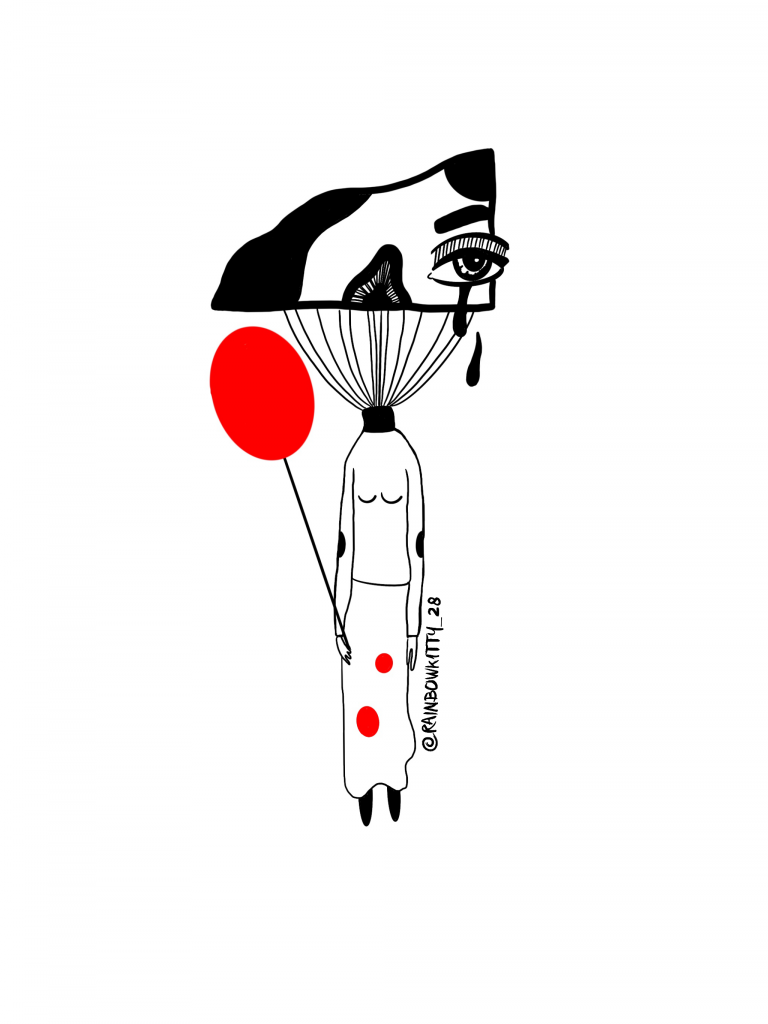
Balloons are red, a worldwide affirmation of caution. My eyes are dry though they appear to be running wild. Tears are the ocean bliss I long to float amongst. Turquoise hues of inner peace surround. I see in black and white but the colour of you blue. Limp limbs drift silently with the wind. Your cuddle isn’t temporary. Your warmth ties souls to your healing properties.
Push me away. Pull me back in. Dance beneath the luminosity of a millions stars. Make us sway without human interruption. Erase the land. Allow all irrationalities to dissipate. Capture joy with a bottle and cork. Travel with me through time and galaxy. Kiss me before I go to sleep and you may just become my reality.
Proceed with caution they said. Work twice as hard as your peers they said. Don’t be too different they said. Fit into the category of success they said.
Don’t wear short skirts they said. Don’t shave your head they said. Wear heels they said. Be classy they said. Respect your elders they said.
Always smile even when your hurting they said. Mental illness is all in your mind they said. Don’t get tattoos they said. Your too fat they said. Your too thin they said.
You look ill they said. Eat something they said. Your trying to hard they said. Be subtle they said.
Don’t cross social boundaries they said. Don’t break the rules they said. Don’t be too revealing they said. Be sexy they said.
Don’t talk to much they said. Don’t hold too many opinions they said. Be seen and not heard they said. Why can’t you be more like so and so they said.
You’ve had too much to drink they said. Go to your room they said. Don’t talk about racism they said. Deal with it they said.
Control yourself they said. Why are you crying they said? Pull yourself together they said. Your making a show of yourself they said.
Eclectic mind. Open to the very fibre of another’s truth. Sit with me for a while. Pour your dreams into my minds eye. Grant me the perspective of the creator. The symphony to your goals.
Untie your soul. I am not the prejudice to which you recoil. Allow the sweet birds to sing from the pits of your stomach. Draw a diagram expressing true desires. Be the kite above who has earnt true perspective. Flood the tree’s pages with inked ambition. Eclectic minds think alike. Authentic smiles perpetrate insight for the otherwise unkind.
Find the beauty in cultural difference. The history, the talent and cultural superstition. Personal projection leaves ears firmly shut. Open the mind and close your mouth. Digest the palette of another’s spoon.
Determine knowledge through personal experience. Interact soulfully removing convenience. Believe in what you know. Believe in ceaseless growth. Eclectic be the ear. Eclectic be the nose. Eclectic be words spoken. Free will. Free expression. Opening the eyelids to the beauty that surrounds. An eclectic world.
Cleo Howard is a mixed race woman of Jamaican/English descent, now living in West Yorkshire, prior to being a Cypriot resident for the past year. Cleo is a writer and artist full time, currently writing a first novel based on personal experiences in life thus far. Cleo considers writing as therapy, something of an antidepressant as Cleo is a self-professed mental health survivor, creatively showcasing the distinctive individual phases of recovery through chosen art forms. Cleo is also a tattoo artist.
Life is a molotov cocktail of joy and pain Look into the mirror and feel sane or insane The negative and positive forces at work The way trouble can wipe away a smirk
A marathon life can seem, or a quick sprint Some lives are a novel, others have just a few lines to print How is life treating you some say? That depends on moods or the time of day
The rich can be sad, the poor content Even though one has a ‘Bentley’ the other can’t pay the rent This thing called life that keeps the heart beating New faces and trials we are constantly meeting
Toss the coin, or spin the roulette wheel Ups and downs of life the Ying and Yang feel Still for me life is a blessing, so enjoy your path Even though tough times won’t make you laugh
Be optimistic even when the skies are grey Believe in a ‘higher power’ and give a daily pray The planet we live on is such a beautiful thing Watch the moon and the stars and listen to birds sing
So from the cradle to the grave keep the head high Life is a journey we travel until we die Take risks, be careful explore new life Have children spread your seed with partner or wife
As we all grow old the mind may change Places and people the world seems strange Through it all keep in mind we only have one chance So take life by the hand and have the last dance
memories hourly they spread across uneven eons within a second-hand tapestry of woes naked shame clothes his name and the daily joie de vie turns a sacred screw as viscous iron blood smelts an ancient block of fever’s night
between the eyes it climbs a fence like caged ivy down vena cava lane with Joey Gentile and her weekly digital pacifier
charged with apocryphal bible belt bullshit in the south
rumour consumer ads squirt like fish through an endless stream of consciousness