While doctoring the sun, my wife expounds On gradients of moonliness called “love.” Attending raves in giant fields, she’d tell Us, “Nothing is a drug,” and drop it like A mic. And neon lights berated costly Nights, so full of naked, blaring animus; If not, at least of intimations. Without A wink of hesitation, a raccoon is Digging through my trash outside; emaciated Martian with an ear for the eraser, like My wife, whose syllogisms overlapped with hope.
While proctoring tomorrows, Obama rounds The radiance of spoonerisms up to one. “Pretending saves a little space,” he’d tell Us (nothing like a bug), and pop it like A collar; neonates conflated bossy Rights – the pull of naked, blaring animus – With tons of steely scintillations. Pick out The pinkest nation: A cocoon is Hugging the rough trash inside me, wasted, Marshalling an iridescent pacer like My wife, her syllogisms home with overwhelm.
Sonnet for Democracy: or, Epigrams and Sound Bites of 2016
“You campaign in poetry. You govern in prose.” Mario Cuomo
Reporters quoted thermophilic Trump: “My wife’s the only girl I care to hump.” The New York Times lent Hillary its ear: “Your crossword puzzle suffers, much like Lear.” The brothers Koch were drips of condensation On the greenhouse ceiling; glass somatization. A Marxist Yankee ate a pound of fees To rush adrenaline’s fraternities. The Onion’s parodies: a haemorrhoid Deployed that contributions out-diploid. The categorical judicial branch Decided John Doe Jr.’s avalanche, At best, unconstitutional; and Scalia’s Dissent, “Divide the horse!”: paraphernalia.
“Abound but to abandon!” was the chant Protesting what The Talking Light was can’t.
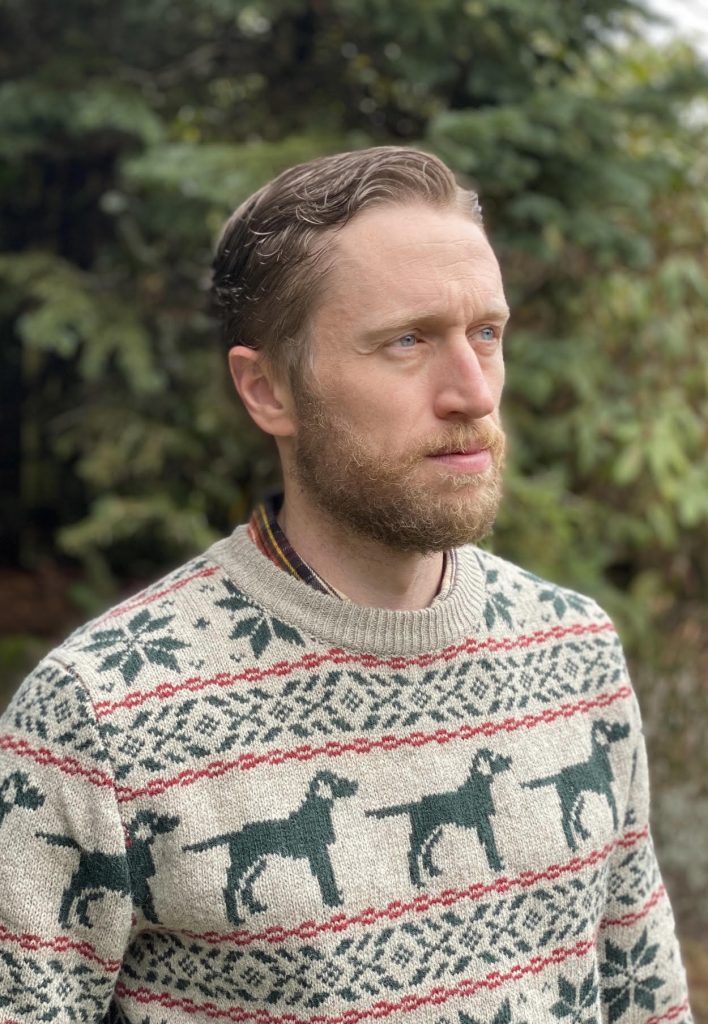
Jake Sheff is a pediatrician and veteran of the US Air Force. He’s married with a daughter and several pets. Poems and short stories of Jake’s have been published widely. Some have even been nominated for the Best of the Net Anthology and the Pushcart Prize. His chapbook is Looting Versailles (Alabaster Leaves Publishing). A full-length collection of formal poetry, A Kiss to Betray the Universe, is available from White Violet Press.
Man with long alabaster hair Will they forgive me? Ghost woman fair man ecstasy White-lighten nightmare Playing fifty one deck solitaire Lost in Blue-silver Poetry Stopped stranded twining absurdity County Fair games unfair
Turd Puzzler
Attributed to our raccoon Ghost-woman’s tenacity of hatreds to domestic Halloween Uncommon factor of similarity in work Two smoking globe turds puzzler Nocturnal perambulation alabaster shirt Rearing high feathering trail guzzler Mutate celibate in dirt The arc which it subtends muzzle
Contretemps Queen
Life as the contretemps Queen Looking through the drape of clouds seeing the moon She let the sun fall on the floor at noon Lies so deep the bottom cannot be seen Woman’s enemies reason she drinks from a canteen Good bad or indifference looking over a lagoon Attributed to our raccoon Tenacity of hatreds Halloween
Sheaf of Yogurt
Yellowstone National Park Forward to sheaf of Yogurt Wide headers acumen shift She gazed at the lamplight shine She’s in a knockout snow drift Tense Portobello bruiser mine Threw in the towel broke swift Being Ten counted out after only nine
Man’s Walk
Tale of woe in her Crucified Shirt A most scandalous thing in the dark Today the hard working man’s walk Daughters Virgin Moon Desert The dames weighed in dirt Lotus ladies tend to the fire’s spark Lost in Yellowstone National Park Poet’s verses sheaf of Yogurt
Terry Brinkman has been painting for over forty five years. Has Five Amazon E- Books. Poems in Rue Scribe, Tiny Seed. Winamop, Snapdragon Journal, Poets Choice, Adelaide Magazine, Variant, the Writing Disorder, Ink Pantry, In Parentheses, Ariel Chat, New Ulster, Glove, and in Pamp-le-mousse, North Dakota Quarterly, Barzakh, Urban Arts, Wingless Dreamer, LKMNDS and Milk Carton Press.
You can find more of Terry’s work here on Ink Pantry.
I shall change seawater into honey, smelt the stone into the gold, the bitter is namely sweet, the sun is born from the womb of the night.
Oh, my God! No matter what if you are really the God Oh, the devil! No matter how many tricks you have today, I am neither living nor dying I want to put you all into the golden tripod of time.
I am originally outside of the earth I will leave one day although I have forgotten many years but I woke up finally today
From a little drop of water the world came into being It was originally a tear of mine I was originally the God of the Gods.
The world is in a box the little timeworn world the countries of Lilliput the President of the king’s prime minister those kings, premiers and presidents those dwarfs in the scroll of time’s picture
They do not believe the additional sun both like a diamond and like gold make you warm in winter make you cool in summer
Neither have they seen the sweet ocean nor have they known heaven outside time forgotten those gods who like mountains are the ones the former ancients owned
世界在一只盒子里
世界在一只盒子里 这个小小陈旧的世界 一座座小人国 那些国王 首相 总统 那些时光画卷里的侏儒
他们不相信另外的太阳 既像钻石 又像黄金 在冬天时让你温暖 在夏天时让你凉爽
他们没见过甜蜜的海洋 也不知时光之外的天国 忘了那些山岳般的众神 是古老的曾经的自己
The King of the Diamonds
The sun was rising in my breast I woke up finally said goodbye to the night’s nightmare the world was lit up by me this is actually the real me
There is no longer day and night there are no longer newborns and death I got myself back before there was no earth and heaven I have existed from the beginning
The world is just my works: a picture, a poem a symphony. Give me a stone I will turn it into the king of the diamonds.
钻石之王
太阳在我胸膛里升起 我终于醒来 告别黑夜的梦魇 世界被我照亮 这才是真实的我
不再有白昼与黑夜 不再有新生与死亡 我找回了自已 在没有天地之前 我就早已经存在
世界只是我的作品 一幅画 一首诗 一部交响曲 给我一枚石头 我让它变成钻石之王
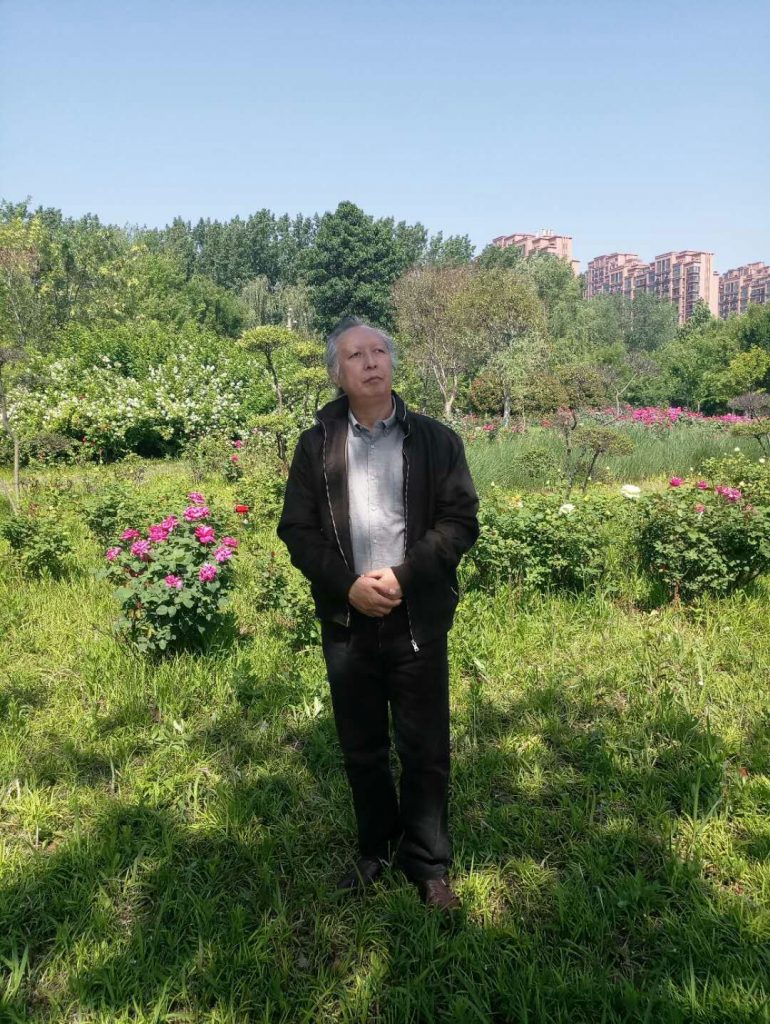
Yuan Hongri (born 1962) is a renowned Chinese mystic, poet, and philosopher. His work has been published in the UK, USA, India, New Zealand, Canada, and Nigeria; his poems have appeared in Poet’s Espresso Review, Orbis, Tipton Poetry Journal, Harbinger Asylum, The Stray Branch, Pinyon Review, Taj Mahal Review, Madswirl, Shot Glass Journal, Amethyst Review, The Poetry Village, and other e-zines, anthologies, and journals. His best known works are Platinum City and Golden Giant. His works explore themes of prehistoric and future civilization. Its content is to show the solemnity, sacredness and greatness of human soul through the exploration of soul.
Yuanbing Zhang (b. 1974), is Mr. Yuan Hongri’s assistant and translator. He himself is a Chinese poet and translator, and works in a Middle School, Yanzhou District, Jining City, Shandong Province China.
You can find more of Hongri’s work here on Ink Pantry.
The knock on the door always comes at the wrong time, when you’re lovemaking on a sunny Sunday afternoon, during a drug-drop when relatives pay a surprise visit, when the post delivery hands-over a court date as the landlady hammers the door for way overdue rent, when your new lover drops by with a surprise bottle of wine and you’re already fucked-up on narcotics and your previous lover is waiting on a call, when a political or religious pusher relentlessly pounds or when the season of ghosts and demons from your past, rip the door clean off its hinges, it’s time to throw away the key and look out at the countless shattered doors left in your wake.
One for Alfredo
First breath 1927, San Diego, early years spent in Mexico and then returned to USA in 1935 – he was expelled from High School for violence toward a tutor, sometime following he was arrested for smuggling people from South to North America, spent 4 years in San Quentin for possession of heroin and whilst incarcerated painted murals on the prison walls, on release he worked as a caricaturist for Disney for 2 years and in 1957 he opened up his own Art Gallery and in 1961 he was apprehended for 1 lousy joint of marijuana, Ajiijic, Mexico was his home for a while where he continued to paint and sculpt and express himself in various other mediums, he returned to the States seeking, as always, neither fame or fortune but continued creating and died in 2015, how Alfredo Santos, his life and work have been kept secret is a shameful, sad, sin, don’t take my word, see for yourself and make a startling discovery that the rich and ignorant ‘art establishment’ has, seemingly, closed its protected doors upon.
For Marianne Joan Elliott-Said (1957 – 2011)
We met on a couple of occasions, unfortunately, in a formal environment, but she genuinely appeared taken that I had recognised her and acknowledged her unique impact upon me that remains to this day: straight off, she was so warm and alive and we got grooving, she told me of the horrific pedestrian injuries of being hit by a fire truck some years back and how she had been making, producing and mixing recordings recently, this was just a few years before she lost to cancer: Poly Styrene was doing it herself decades before any sisters stepped into the light, her spirit moved with authenticity, blessed with talents that stretched smoothly over many mediums, creativity was deeply in her heart and blood and were more than just an extension of herself, this was her life that reached out across vast distances: Marianne Joan Elliott-Said sculptured pathways of beauty and sadness, she carried the torch of the muse, her voice and music and artworks resonating like a global choir of love and peace: Poly Styrene, I hear you now, I see you now, I feel you now, I sense you now, standing before me like a messenger broken free from all bondage of this uncertain world.
The Viewing
I couldn’t remember her name, although we’d been dating for a few weeks: an invitation came for a private viewing of Jonathan Coles paintings and latest works: within 15 minutes of the opening, this woman, whose name I couldn’t remember, gripped attention by climbing up into the loft rafters and swinging and screeching nonsense, hanging upside down, exposing skimpy panties and long, long legs and streams of bright red hair tumbling toward the ground: ‘Who the fuck is she?’ ‘What the fuck is she doing?’ ‘I don’t know,’ I told them ‘What the fuck! call her down man! get her down!’ ‘I don’t know her name,’ I said ‘Get her the fuck down now!’ ‘Hey! Hey! come on now! time to come down now!,’ I shouted, waving my hands: she dropped to the floor, the loft studio stood still in utter silence as she walked towards me: she looked angry, serious: ‘Fuck you! I don’t know you! I don’t know your fucking name but you don’t fucking tell me to stop enjoying myself!’ she screamed at me before making her exit from the studio and I never saw her again, whatever, her name was, but I guess, it didn’t matter too much.
John D Robinson is a UK based poet: hundreds of his poems have appeared online and in print : he has published 14 chapbooks and four full collections of his poetry: he has also published a novel of fiction and a collection of short stories: he has been nominated twice for the Pushcart Prize.
You can find more of John’s work here on Ink Pantry.
The vault opens itself at dawn. The calyx of an Arctic alpine forget-me-not reopens for an enchanting glory of the sunshiny dreams, because of the eternally august poem, that reads lenient and benignant.
Throughout the day: there is up there a paradisiacal flight of all halcyon seraphim, singing through the stoicism, eudemonia of many celestial dreamers.
Under the sun: a rhythm in wings of butterflies. After evenfall: the paradise closes itself. The springtide has gone to bed in aestival splendor.
In addition overnight a balmy sempiternity sleeps as well. Here below a sensitive firefly flies, above so ravishing earth. In danger owing to the raveners of the night. Indeed spared thanks to the sheen of Luther’s star. The earth becomes a dazzling hereafter. It remains not far from June sparks, the little fire.
vault – (poetical) sky
benignant – mild
halcyon – peaceful
seraphim – seraphs
aestival – summery
ravener – bird of prey
sempiternity – eternity
Paweł Markiewicz was born 1983 in Siemiatycze in Poland. He is poet who lives in Bielsk Podlaski and writes tender poems, haiku as well as long poems. Paweł has published his poetries in many magazines. He writes in English and German.
You can find more of Paweł’s work here on Ink Pantry.
One day I’ll manage to get my ducks in a row sort it all out stop procrastinating, stop the coffee calling, stop the sunlight casting shadows which distract me and tempt me outdoors to see the ducks swimming smoothly sending sopheristic shadows across the water. And as I watch those shadows move in effortless formation negating the coffee and lulling me to sleep again.
Less Is More
I thought it a bit overdone that Summer Exhibition of long ago. Paintings were floor to ceiling filling every wall, even leaning up against the wall so it became a show where nothing was shown in all its glory, all was a daze a cacophony shouting so loudly it was impossible to contemplate the individual. You need space for that, space in between. Too much and nothing is seen.
When Psychopath Met Showman
When a violent psycho with overwhelming power meets a deluded showman with a hero complex it’s looking bleak for those caught in between. Those displaced from their homes, displaced from their lives, those losing their lives. those losing the life they expected to live, More and more of them, a stream without end as the show goes on.
Lynn White lives in North Wales. Her work is influenced by issues of social justice and events, places and people she has known or imagined. She is especially interested in exploring the boundaries of dream, fantasy and reality. She was shortlisted in the Theatre Cloud ‘War Poetry for Today’ competition and has been nominated for a Pushcart Prize and a Rhysling Award. Her poetry has appeared in many publications including: Apogee, Firewords, Capsule Stories, Gyroscope Review and So It Goes.
You can find more of Lynn’s work here on Ink Pantry.
It’s red, more like maroon with sequin spaghetti straps somewhat form fitting, an inch up the knee, lace, tulle and blinged. “Kind of risque for an old broad,” Rick laughs.
Bought as a bargain, but not in the basement. Ten percent off, then another ten, then etcetera. A “steal,” as Aunt Betty would say.
So, I’m giving you warning, hon, three months before we sit side by side, at that wedding.
We did it as kids, thanks to our mother, who sewed the same skirts for us, but it’s now, four decades later.
Do not wear the same dress as me, sister dear.
I’ll take the clouds, most days
“Too many clouds, not enough bloodletting.” He read through my poetry, critiquing all I’d once written, mostly to him.
But I like the clouds. I can feel safe with them, conjuring them into all sorts of contortions.
Carousels, waterfalls; the cirrus are perfect for those wispy white whirl designs.
I’ll take the clouds most days. With them, I am comfortable, forsaking the opening of arteries or serving my heart up, with a side of my spleen.
The Ray days
Missing my Ray. Ray, the barista with the cherry stone eyes steaming my mocha hot filled with latte, with his wink and his wisdom surpassing just coffee.
Now it’s Renaldo. He’s old and he’s cranky and needs to go decaf.
But I need a Ray when it’s 5AM starting time and even the sparrows sleep late.
The ‘D’ in Dave
With the robin revival, it’s time to renew all those springtime festivities. Finally, frost leaves the trees.
As we visit the mom and pop sweet shop on Third Street, where that same letter ‘D’ on marquise, has been blacked out for years.
Dave deemed it “bad luck,” deciding to just let it be.
At that place, where they pipe in the ‘oldies’, we’d slurp on those frappes, cones and sundaes.
On our first visit back, today, 15th of March, we see that the ‘D’ was relit.
The new staff took care of it, saying Dave had passed on, but they’d still keep the same name and traditions
as ‘Dancing Queen’ played in the background.
I said “yes”
Kind of disheveled, but there’s still some fight left in them. Red over easy, in their partytime poses.
It’s been several weeks since they prettied my doorstep mid-day on Monday.
I jumped from the shower hoping that you were the sender.
From the fields, to the table top they adorned, all those days.
In their gestures of ”get well,” “I’m sorry,” or “Sue will you marry me?”
With yours, it was love and a morning proposal.
3 weeks and thriving, are your Valentines’ flowers.
When not writing poetry, Emalisa Rose enjoys crafting and drawing. She volunteers in animal rescue, and tends to a cat colony in the neighborhood. She lives by a beach town, which provides much of the inspiration for her art. Some of her poems have appeared in Writing in a Woman’s Voice, Spillwords, Origami Poem Project, and other special places. Her latest collection is On the whims of the crosscurrents, published by Red Wolf Editions.
You can find more of Emalisa’s work here on Ink Pantry.
I think I’ll live a small life, not too long, not too short. I will do tiny things, tasks not worth observing. I will keep my head down close to the earth, watching seeds sprout in spring, and thanking all for the harvest, however big or small it might be.
As Days Go
Tomorrow needs no introduction. It is expected and waited upon. The sun rolls out its red carpet and walks its way across the sky trailing its long dress over flowers and coloured glass broken on asphalt.
Today is fine. I’ll take it. It’s what I have now, a sure thing until it ends. But, tomorrow, tomorrow… Who knows what it will bring?
Perhaps salvation, all promises fulfilled, Dreams run wild. Joy after joy.
Or maybe nothing more than the same. Or trouble. So much trouble we wish it had never came.
Conscripted
We are being taken. We are being shoved. We are being beaten. We are being loved.
We don’t know winning. In losing we prevail. One by one we get our medals: six feet, board and nails.
Thug World
When a neighbour is murdered a part of you dies. When a burglar takes you for all you’ve got part of the heart that was in you goes out the door with your stuff.
Hard times. Harder for others. Drugs flows in the streets and in veins. Love says we can all heal this. Love knows, but it’s not easy to explain.
Sirens. Blue lights flashing. At night it’s hard to sleep. Don’t watch the news on television. Don’t listen to updates on radio. Don’t scan headlines on your cellphone.
There’s nothing you can do but grieve, and you’ve done so much of that you need to take a break.
Vote when the time comes. Write letters to the power always. Try for something new, something different. Search your mind and heart. Tell the world what you have found.
Times Like These
You shouldn’t be sorry for yourself. You should be sorry for others. Yet the thought of those faces Sets you down the road to remembrance of times and places you once were, Horrors smaller than war.
The streets here have their own noises Gun shots, car crashes and sirens. The dead bloom on concrete and asphalt. The dead stay where they fall. Far off the damage is bigger, But you can’t stop seeing the damage at home.
Slow Down It’s Only the End of the World
Take your time. Slow down. It’s only the end of the world. Weigh each word. Write every sentence with care. The story is your life. It’s why you are here. You need to get it right before “The End” appears.
Joseph Farley edited Axe Factory for 24 years. His poetry books/chapbooks include Suckers, Longing for the Mother Tongue, and Her Eyes. His fiction books include a novel , Labor Day (Peasantry Press), and two collections of short stories: For the Birds (Cynic Press) and Farts and Daydreams (Dumpster Fire Press). His work has appeared in Schlock, Home Planet News Online, US 1 Worksheets, Mad Swirl, Horror Sleaze Trash, Ygdrasil, Penine Platform, Understanding Magazine, and other places.
I break open the hourglass release the silence of eons grain by grain. So slow the fall of passive echoes. Look what eons of defying gravity does! Losing touch of the shore.
The tectonics shift left shift right . . . squirm for air. Orchestrate a wave show. Horseshoe clouds now here, now gone.
Not knowing to belong or not to they build their own orbit. Like the rings of Saturn all ice and rocks buffering on a loop.
Daya Bhat has authored two books of poetry. Her free verse, short poetry and short fiction appear in a number of journals. You can find her art, poetry and musings on WordPress and Instagram.
When its arched brow rises from behind the country hill, snub-nosed, a grin for a grill, you remember you’re in second grade.
There’s Cindy’s old yellow dog feigning outrage at your passing van, his bark and lunge petering to that bored, panting trot. And there the synod of grammar schoolers wrestling lunchboxes into a line, reinventing the rituals, the hierarchies, the variations of elemental courtship.
There the oil-rosy puddles in rutted gravel, the soaked toes, knots of gossiping daffodils, tufts of too enthusiastic grass, the bristles smudged in sage and mustard along the far edge of fields.
When you top the hill you know you’ll see the bus swing a backward right in your mirror, right onto the main road, so you lean, small-palm the cracked leatherette, grasp the memory of cool steel framing the seat ahead, all your uncertain world still straddling the smeared window slid halfway down.
The same low sun stuns you when you glance back, forward, run your times-nines, wheel left and head for school.
Fifth Grade
As I flew into town that first time, leaning over the gull-winged sweep of the handlebars, the burn in my pudgy, mad-pumping thighs, told me I was fast, was free, was finally entering the my country ’tis of thee we’d all been singing, sweet land of weekend- playground liberty. That mile I’d never ridden was a hundred miles, the fresh fall breeze speed itself, as those fat tires snarled through dunes of shoulder gravel and eddies of falling leaves. When I jumped the curb onto the school’s front sidewalk town kids, exotic friends named Cindy, Billy, Darlene, and Gary, were already gathered, long unchaperoned, at ease, their pre-adolescences already underway, their slow turn toward my approach blasé as I came skidding into that newest of my old neighbourhoods of memory.
The Day I Got My Timing Down
It was in that phase of pure sarcasm, midteens, when guys work out an awkward stance,
work their pack’s patter ’til they maybe have it. I don’t really remember the day but
the single-moment wonder of hitting my first come-back just right by accident, then their free, true
laughter, my perfect follow-up, the never looking back. From there a career: from Senior Class Clown
to smooth talker in any crowd to flip teacher spinning lit to wordsmith chiseling chin-up come-backs
to the tin-clad sarcasms every life dishes out as it disarms or drops you or
leaves you hanging, slamming its clanging locker door in your gullible, stuttering face.
Kissed-Off
Lord knows I’m a voodoo chil’.
—Jimi Hendrix
Until that night a girl had only kissed me. Not I a girl. I was fifteen and for
over a year Jimi’d been telling me he was a voodoo chil’, yeah, and I wasn’t. No moon
had turned a fire red, and not one mountain lion had found me waitin’. Now
I was going with Sue, at whose Midwest harvest party I’d do the kissing. Nervous
and showing it, acting distractedly, voice shaking, our friends milling, I knew
it was a now-or-never situation, even though I’d never ever and didn’t really know. Giddy
and ridiculous, we slid into the stairwell, out of range of her parents in the kitchen,
the kids below: the outskirts of our infinity… We made eyes. We made small talk. But all I
could think about was making my move. (If only I’d had a Venus witch’s ring.) Then inching
my arm and small-talking her a little more, I aimed my face and kissed her! And oh, Lord,
the gypsy was right: amazing and no big deal at once. So we kissed again (Lord knows I
felt no pain) and for three months flew on as make-out fiends until she dropped me for my best friend
at her party for my sixteen-and- been-kissed birthday. And I fell downright dea-ea-ead.
Français Firsts
—for Priscilla
After all your dainty tales from la rue du Tel-ou-Tel, so many elegant snippets de la Rive Comme Ci, Comme Ça—Oui, I am forever sheepish I never made it
to Par-ee (sauf une gare on the outskirts, eurailing toward Luxembourg, which was all but fermé for the Halloween weekend). But though now you could easily keep me
down on any farm, France in swah-sohn-canz? Oh là là! —my version of the proverbial semester abroad, and where un nouveau me must’ve definitively begun. Par exemple,
near Nice, absorbing the glowing Côte d’Azur then tour-busing by Monaco for Menton, out one route en corniche and back another, long before my paltry français could surface
fast enough to prattle with my teacher’s kids. But un début—and it would take me only four more largely lonely months to pass myself off as a less evident américain, with at least
a decent accent to show for it, my being the yoghurt-eating, knows-little sophisticate I’d become. It would be two decades before Starbucks blitzed very many Midwest cities,
so old Grenoble’s where the cafés and bistros, wines finer than Boone’s Farm, addicted me to a fresh perspective, to une idée de moi-même transcending tackle football, college fraternity,
and culture as country rock. Granted, all the exotic side-trips did make a difference: that disorienting week in Warsaw (still dictatorial), those goose-steppers in Chopin’s
park; the overnighter (avec les trois femmes!) to Italy; Geneva on weekends; Christmas on the Bodensee (which made me certain I’d learn German for my Überlingen girlfriend
before Italian for those gorgeous Florentines.) But en France? So seul? And working steadily on the concept of an inner life? It was la première fois that I knew I knew abnormally
nothing—and that I no longer wanted to. On the vigntième floor of my international dorm, some inside switch had somehow gotten flipped. Souddainement, ancient history was interesting,
the future a matter for my contemplation, my ignorance a currency I hoped to leave behind, exchanged for novels in two languages and grand prospects for actually using my mind. By winter
I could’ve stayed on through spring. And by spring, back home again and left to reconnoitre, I began that retrospective cataloguing that deepens one’s appreciation—such as how a shy, petite
‘teep’ from Japon and a bold, femme noire from La Côte d’Ivoire could intersect via moi via anglais; or how tinny, small-car traffic is more romantic in memory; or how geraniums are la plus rouges
à Chambéry, a few blues uniquely Mediterranean, and no whites colder than novembre over Mont Blanc. Or how some French are rich, canadien, but also poor, arabe, c’est à dire, algérien. And how
my world seemed now to be le monde.
D. R. James’s latest of ten collections are Mobius Trip and Flip Requiem (Dos Madres Press, 2021, 2020), and his prose and poems have appeared in a wide variety of anthologies and journals. Recently retired from college teaching, James lives with his wife in the woods near Saugatuck, Michigan, USA.