Tell us about your journey towards publishing your book, Portia The Pear. What inspired you to write for children? Who is the illustrator?
My journey started in infant school when I was encouraged to join a library, because I had read every book in the classroom. At the library, I was captivated by a myriad of authors including my favourites; Dr Zeuss, Enid Blyton and C.S. Lewis. Children’s books were my first love and the magic never left me.
As an adult, reading bedtime stories to my daughter, I looked at them more critically. Some of the books we read together were exceptional, but others were a little flat. Jessica actually tossed one book aside after reading it, unimpressed. I remember thinking ‘I’m sure I could write a bedtime story’. I didn’t act upon it then, but years later when my son was born, the idea came to me again. This time I was more convinced that there was a spectrum of books from the brilliant to the (without being rude) dull. I began to wonder if I could write something which at least fell along that spectrum. I didn’t need to be as talented as Julia Donaldson; I just needed to be as good as, or better than, the worst that had made it into print.
One Boxing Day morning, I sat up in bed and wrote a story from start to finish, the words just flowed. Of course, I knew nothing about publishing, so I did what everyone does to learn something new – I Googled. My search brought back many ‘How to’ guides and the following three points came up time after time:
1) Buy The Artists’ and Writers’ Year Book for a list of publishers accepting manuscripts, and read tips and advice from other authors, plus use the directory to narrow down your list of possible publishers for your genre.
2) Join local writing groups to have your work critiqued and learn from other budding writers.
3) Always read the publishers’ submission guidelines carefully, as each has their own preferences.
I sent off my manuscript to 5 publishers and received 5 pristine rejection letters as a result. Luckily, I had listened to advice from a guest author at one of the writing groups who had encouraged writers to celebrate their rejections as symbols of ‘trying’. I’d also read Stephen King’s On Writing in which he described pinning his rejections on a rusty nail in the wall. He received so many he had to find another nail. Unperturbed I carried on.
Fate then played a part in this story. My hairdresser handed me a leaflet she had picked up at Tatton Park, promoting a Writing Workshop called ‘Write like Roald Dahl’. It was held midweek on a work day, but something told me to book the day off and go along, which I did. It turned out to be a very good decision.
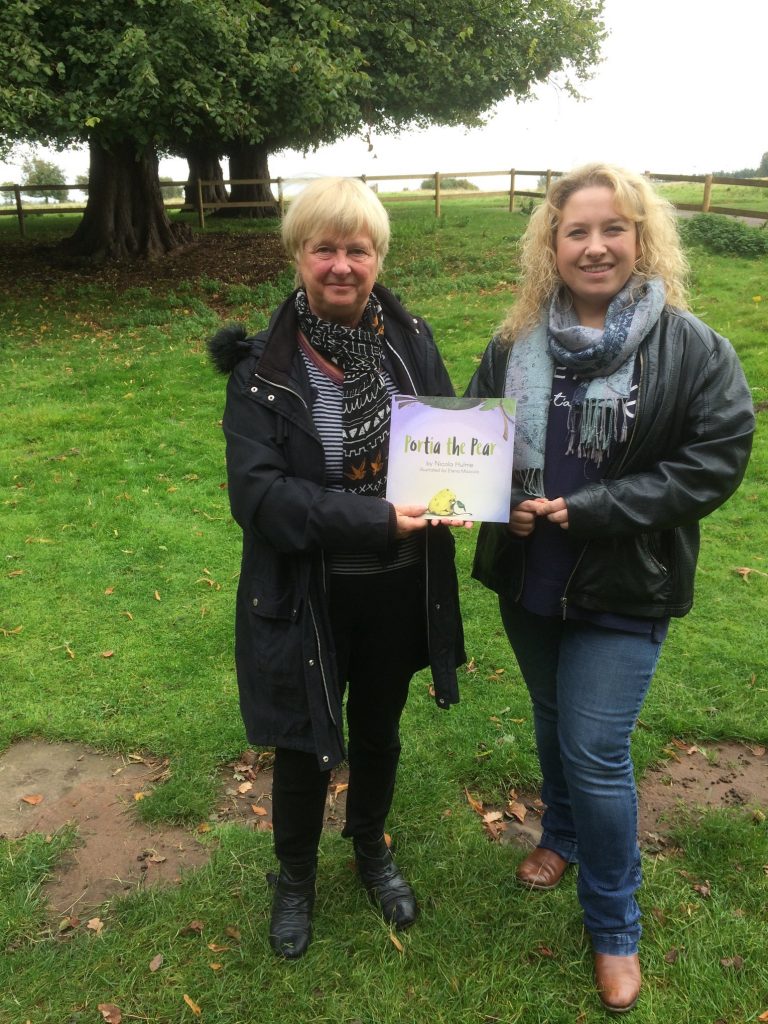
(Joy Winkler at Tatton Park)
Local poet Joy Winkler (Poet Laureate of Cheshire 2015) led the workshop which was truly inspirational. Joy fired up the passion in the room and gave sage advice on how to approach structuring a story for children. She then sent us out into Tatton’s Kitchen Gardens with the instruction to find a character and set the story in the grounds. There, I saw espaliers covered in the most beautiful pears. As I studied the fruit more closely, one knobbly, twisted pear stood out from the rest. It looked like it had a very sad face; the story of Portia the Pear was born. I received a fabulous reaction when I read it out and Joy suggested it was worthy of submission to a publisher. What happened next can only be described as serendipity..
The very next day I received an email saying a local children’s publisher would be visiting my writers’ group. I sent off Portia with the intention of asking them for feedback on how it may be improved. I received an email back asking me to call to their offices for a chat. A contract was offered and Portia the Pear was launched in September of the following year.
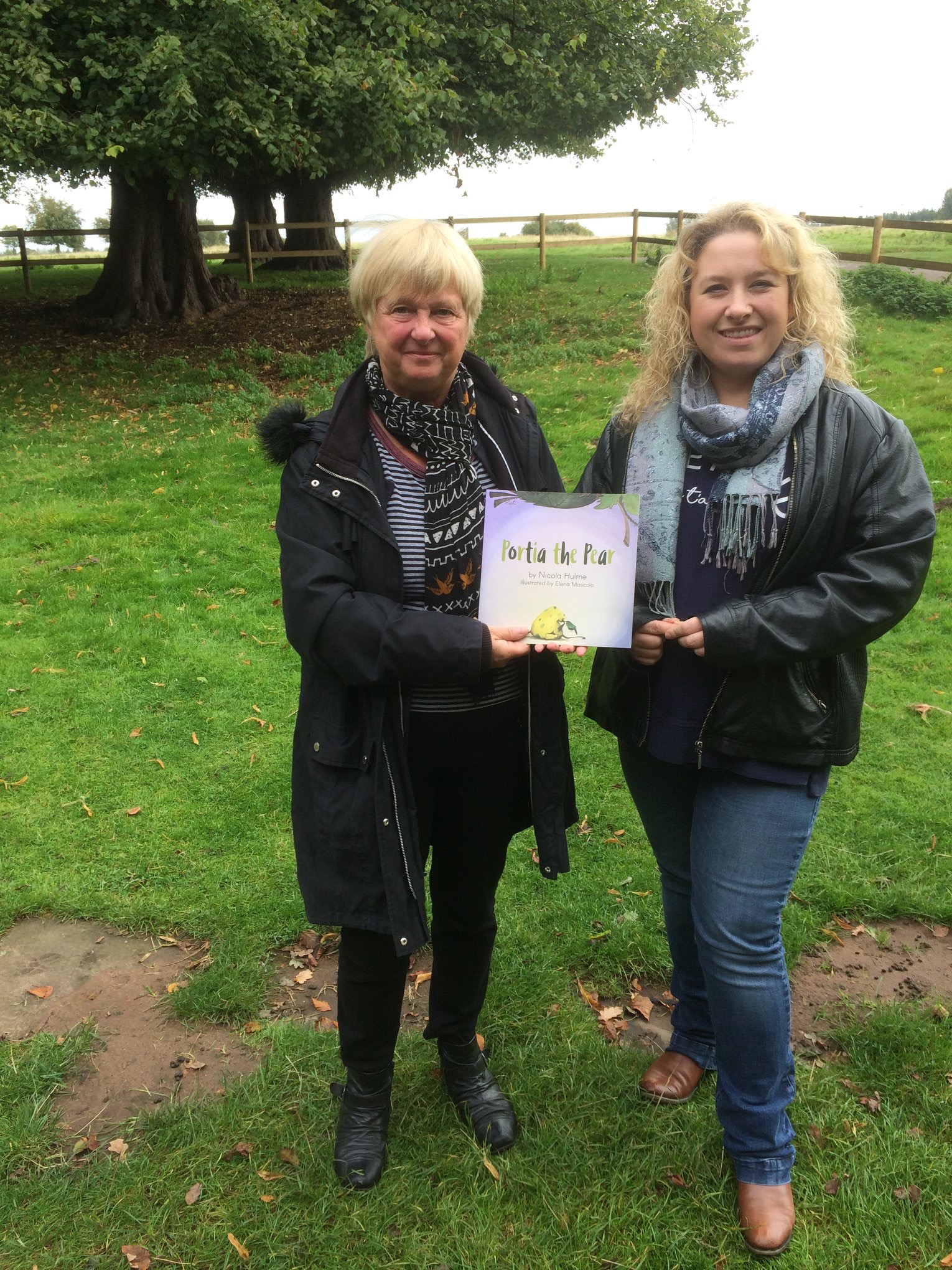
As a children’s picture book, the illustrations for Portia were pivotal. The clever chaps at Tiny Tree Children’s Books sent my text to the extremely talented Italian Illustrator Elena Mascolo and asked her to submit a concept piece. When I opened up the file, it was love at first sight. The colours jumped off the screen, the expressions on the pears’ faces were amazing, and the vibrancy of a very greedy caterpillar was fantastic. I knew the children would love them. Receiving illustrations for a story, which until that point has only existed in your head, is exhilarating. It is a truly magical gift. Elena lives and works in Italy and so we correspond online, and through our experience in producing the book together, we have become very good friends. Her work is so distinctive, I encourage anyone to look her up and see how unique her characters are. I was truly blessed to be able to work with her.
You are also a poet. Can you share with us a couple of your poems and walk us through the inspiration behind them?
I do enjoy poetry. I write mainly about my family, and of rural scenes, but I might write a rant, when I’m fired up about an issue, or a humorous piece when I observe quirks of human nature. I’m a member of Write Out Loud and we joke amongst ourselves about the depths of depression and solemnity we can reach in our collective writing, we do tend to stray into quite dark subjects. Poetry is an expression, so whatever feelings emerge are simply translated onto paper.
‘Nose-Blowing Days’ was written after an early morning school run. My little boy and I battled the wind and the rain which blew across the open school field. I was late for work, I had an important meeting scheduled, my hair and make-up was ruined, and I knew I would have to sit in awful traffic to get into the office. My stress levels were high. Half-way down the path, it dawned on me how much I would miss these days when Jack was grown. I smiled and relaxed and just enjoyed the moment, wiping his nose and holding his hand and splashing in puddles. At the time, I was taking part in the Napowrimo Challenge and the day’s prompt was to write a “Kay-Ryan-esque” poem using short, tight lines, rhymes interwoven throughout. Here is the result:
Nose-blowing Days
The walk to school
is sweet
‘tho puddles soak
our hasty feet.
Rain batters
‘brollies’ tatter
perfect make-up
runs and streaks,
but then I see
your innocent glee
finding a worm squirm
on the path.
The bird on highest
bough sounds
the roll call
as we scuttle past.
These hand-holding,
nose-blowing
days pass
too fast.
The following poem is reminiscent of my childhood in the mill town of Accrington, Lancashire, where I lived in a corner shop with my beloved grandma. Washing Day actually spanned three days, washing, drying and ironing day, and made a lasting impression on my very young mind. I was extremely touched when a fellow poet asked me if she could read my poem to her mum who suffers with Alzheimers, she believed that she would enjoy the memories the imagery invokes.
The Washing Line
Down dark cobbled back streets, clothes lines stretched
across cohorts of back yards, on Washing Day.
Regiments of white bed sheets hoisted high
flapping like flags, in threatening skies
supported by proud,
immoveable clothes props.
Garments not daring to fly loose,
straddled by dolly pegs
forced down hard.
Above boiling bleach buckets,
malevolent steam swirled, silently seething,
polluting the air with pungent peroxide.
The back door was wedged open, windows wide,
but still its clammy fingers clung to high corners.
Seized shirts submerged in the twin tub
were dragged out of the simmering broth
by oversized wooden tongs, grinning
toothless crocodiles.
A solitary circular spinner flipped its lid
with brutal force, revealing a gaping hole
which gobbled up garments,
firing it’s jet engine at the press
of an oversized button.
A bright warning label spelled danger
but I was more afraid of grandma
I did as I was bid
and stayed two full steps back,
watching a steady stream of captives
being fed into the mangle rollers,
pulled out prostrate, straight jacketed,
lobotomised on the other side.
Winched up on a maiden, by rope and pulley
squealing like a stuck pig, screaming in protest;
corsets and bloomers were discreetly dried indoors.
Ponderous drops dripped
onto the oilcloth floor beneath
missing expectant open mouthed buckets.
Hugging the gas fire, a burdened clothes horse
promised more than it could deliver.
A metal mesh fireguard, kept long after toddler years,
lent its flat roof to dry despondent socks.
From picture rail gallows, lifeless forms hung
closing in on the living,
One by one they were gathered,
folded and locked away in the airing cupboard
guarded by a gurgling old boiler in his
pillar-box red padded jacket.
Paroled for ironing; creases were pressed out
then forcibly pressed in.
Under a hellish red hot iron
wet handkerchiefs hissed and spat.
The board creaked and groaned,
along with grandma as she held her back.
Finally, the ordeal was over.
Clothes were locked into looming tall boys
with the turn of a tiny brass key.
The line stretches through time
from dolly tub to auto scrub.
My laundry is gently taken
from a silent washer,
that soaks and spins on demand,
conditioned smooth and wrinkle free
without need of an army of machines,
lightly clipped by brightly coloured pegs.
Still, I discreetly throw my underwear
into the dryer and smile
“What would the neighbours say?”
Mine is an easy load.
My line marks the ages of my babies
as their clothes grow.
Our favourite t-shirts old and tired,
out of shape and faded,
hang comfortably together, blowing in the wind.
Billowing white sheets release
their bouquet of jasmine and lily.
The sun warms my face,
the breeze caresses my skin
like the palm of a hand against my cheek,
or a kiss on the forehead from grandma.
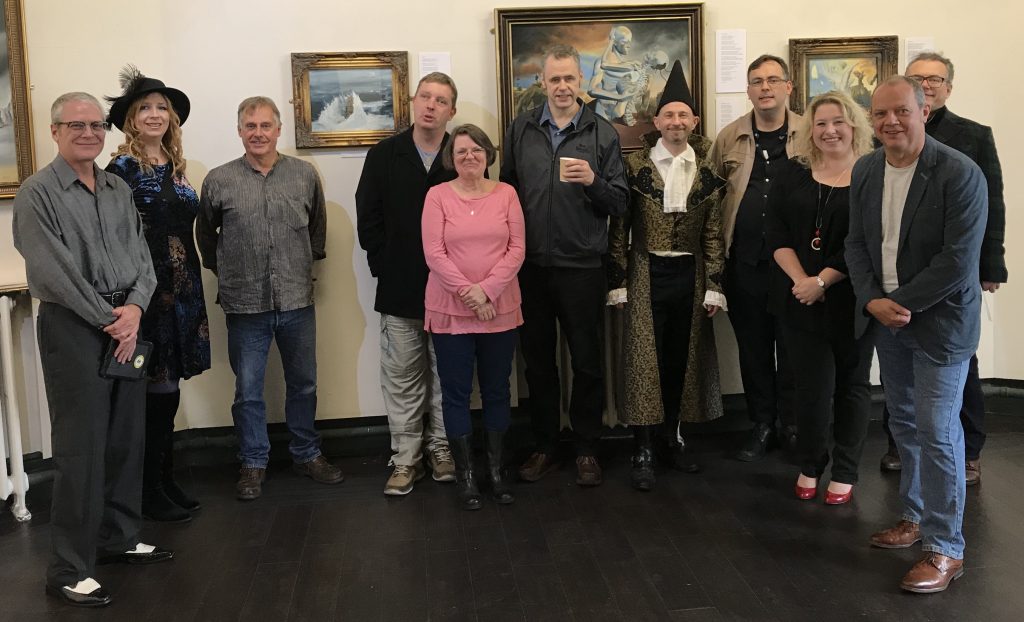
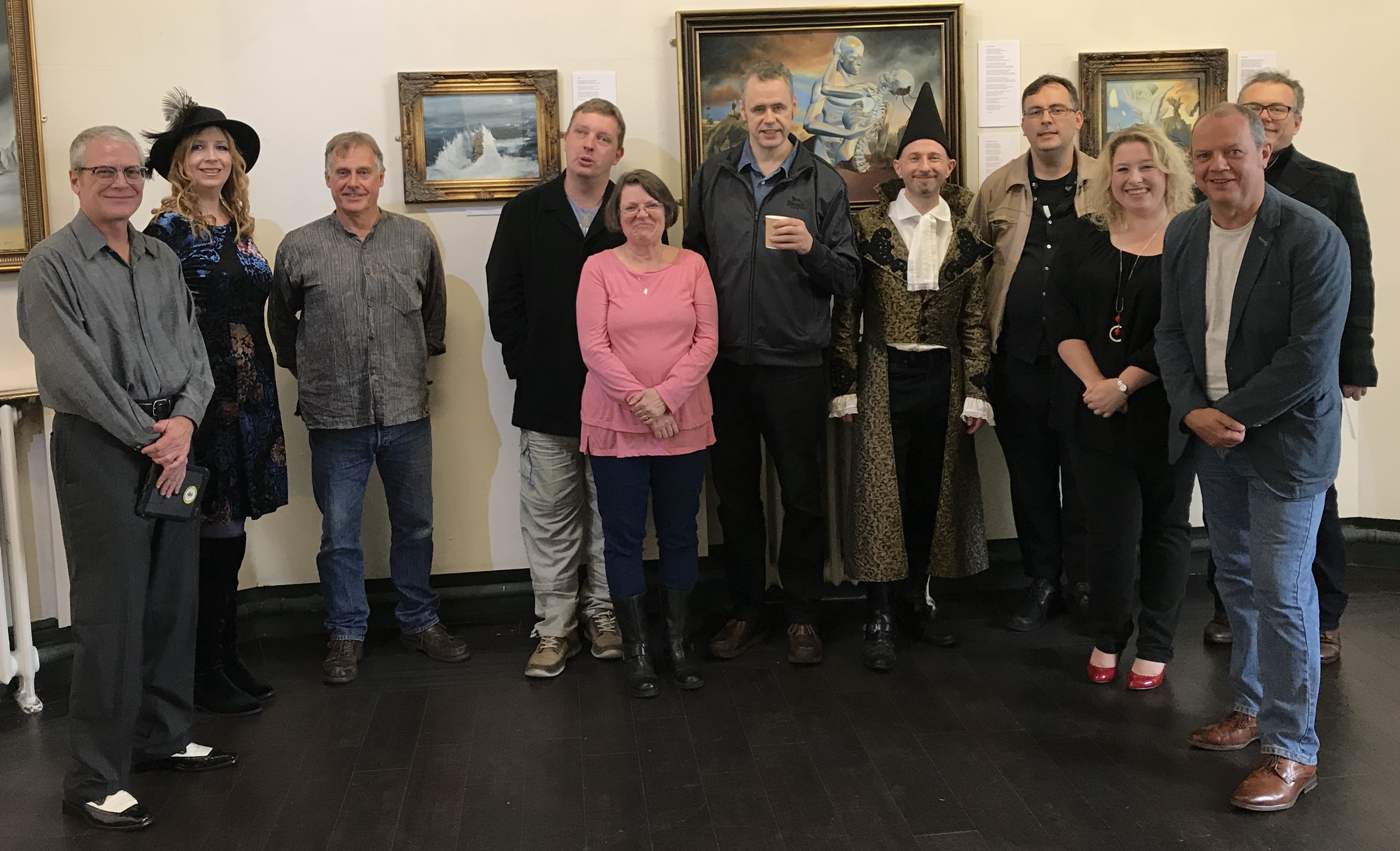
(Write Out Loud, Stockport, at Mark Sheeky’s 21st Century Surrealism Exhibition)
As part of the Write Out Loud group, you have recently written poems for Mark Sheeky’s 21st Century Surrealism art exhibition at the Stockport War Memorial. Can you give us an insight into this event and tell us how you approached writing a poem about an artwork? Did inspiration strike quickly, or did you have to ponder on the visuals before the words appeared? Did your words match the original ideas behind the visual art? What did you learn about this experience?
It was a great privilege for the Write Out Loud poets to be invited to take part in Mark’s exhibition, and it certainly created a buzz. We meet each month at Stockport’s War Memorial Gallery and we are surrounded by art whilst we read out our work. As exhibitions change we are incredibly fortunate to preview the paintings. When we were offered the chance to create ekphrastic poems for Mark’s work we jumped at the chance.
Mark added another layer of intrigue in that we weren’t allowed to know the titles or the inspiration behind the works. He wanted to know our interpretations without bias or influence. Poems flooded in and as a result we had multiple poems for some of the paintings, but we embraced this and all poems were displayed next to their respective piece. During the month of the exhibition we performed an open mic event, reading our poems out for a very well-attended gallery. After each poem was read, Mark gave an explanation of what influences inspired him. It was really interesting to see how in the majority of cases both poet and artist had picked out the same themes.
I loved the challenge of writing for Mark. I instantly picked out one of the most striking paintings which I now know to be ‘Triumph Of The Mechnauts’. It struck me immediately as a depiction of a dystopian scene. The central figures are two cyber robots, one male, one female, in an embrace. However there are many more images and symbols within the painting. I had to really study every inch to try to understand what story was being portrayed. Perhaps from my fictional writing, I like to understand the landscape, the characters, the mood etc., before beginning to write. I noted a city in ruin and an opposing rural scene with gentlemen walking over a hill beneath which there was another love scene reminiscent of Gone with the Wind. The skies were divided across the canvas, changing from bright blue to dark and stormy. In the detail there was a bright red rose and a contrasting drooping white rose. I took all of these images and created a poem which told a story which spanned time; from the old world of romance into a futuristic world of cyber dating, weaving in Shakespeare’s tragic Romeo and Juliet to illustrate doomed love. I did say we poets spiral down into dark places! I really enjoyed writing ‘City Of Promise‘. Once I had the concept, the words just flowed, and I had fun with it. Happily, Mark confirmed that he had intended the dystopian scene, but his inspiration had been simply the word ‘future’. What I learnt from the whole experience was how paintings can be a wonderful source of inspiration. It’s incredibly freeing to be given pieces of a puzzle, then letting the imagination carry you into creativity. I shall definitely use the ekphrastic technique again.
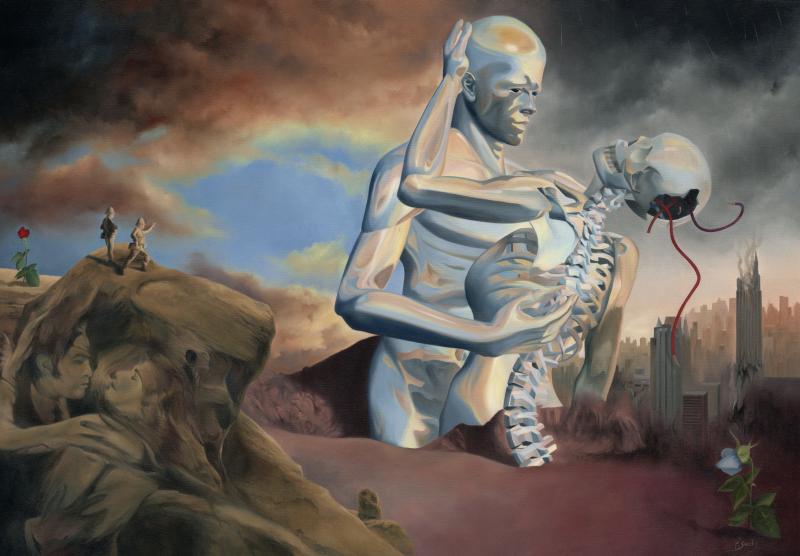
(‘Triumph of the Mechnauts’ by Mark Sheeky)
Have you tried any other genres of writing? Radio/plays etc?
My one and only venture into playwriting was a play I wrote aged 12 which was performed on stage at Moorhead High School. (I was actually a member of the same school drama club as Julie Hesmondhalgh who went on to play Hayley in Coronation Street).
I have recently written a short story, my first adult thriller. The main character is a disturbed teacher who, after learning her husband has cheated on her, reeks revenge on the male population. I really enjoyed the process, but gained a new respect for crime writers. I would wake in the early hours discovering problems with my plot, trying to figure out how a particular event could take place. I had to research poisons so I had my facts right, I questioned friends about their experiences commuting on public transport to ensure I was reflecting reality rather than just assuming facts. It was a lot more work than I had anticipated. The short story was created for a competition run by a University which added a degree of pressure to ensure my grammar, structure and punctuation was as polished as it could be. Compared to writing for children, the experience really stretched me, but that’s how we grow in our craft, so I will always opt for the uncomfortable over the familiar, for that purpose.
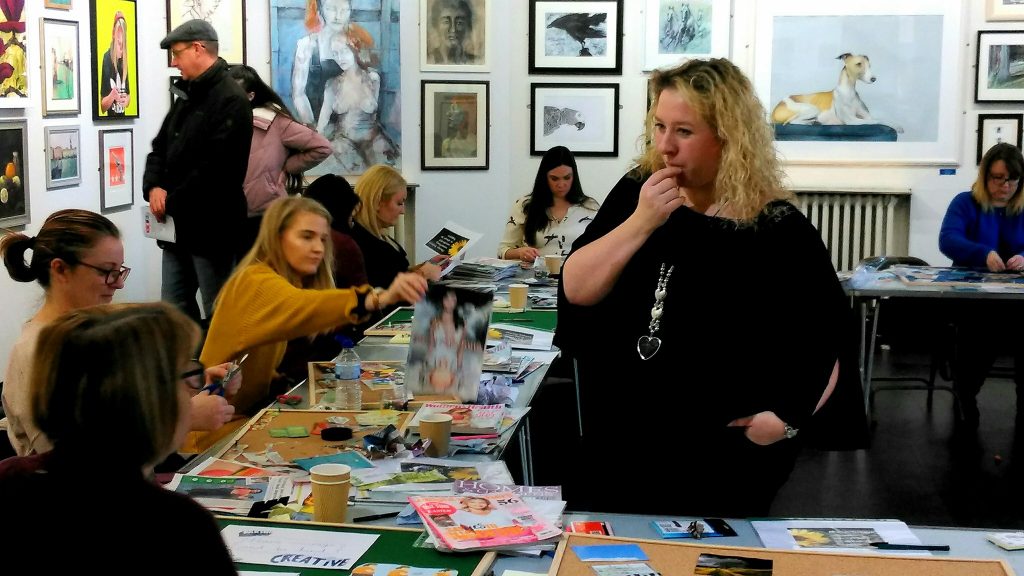
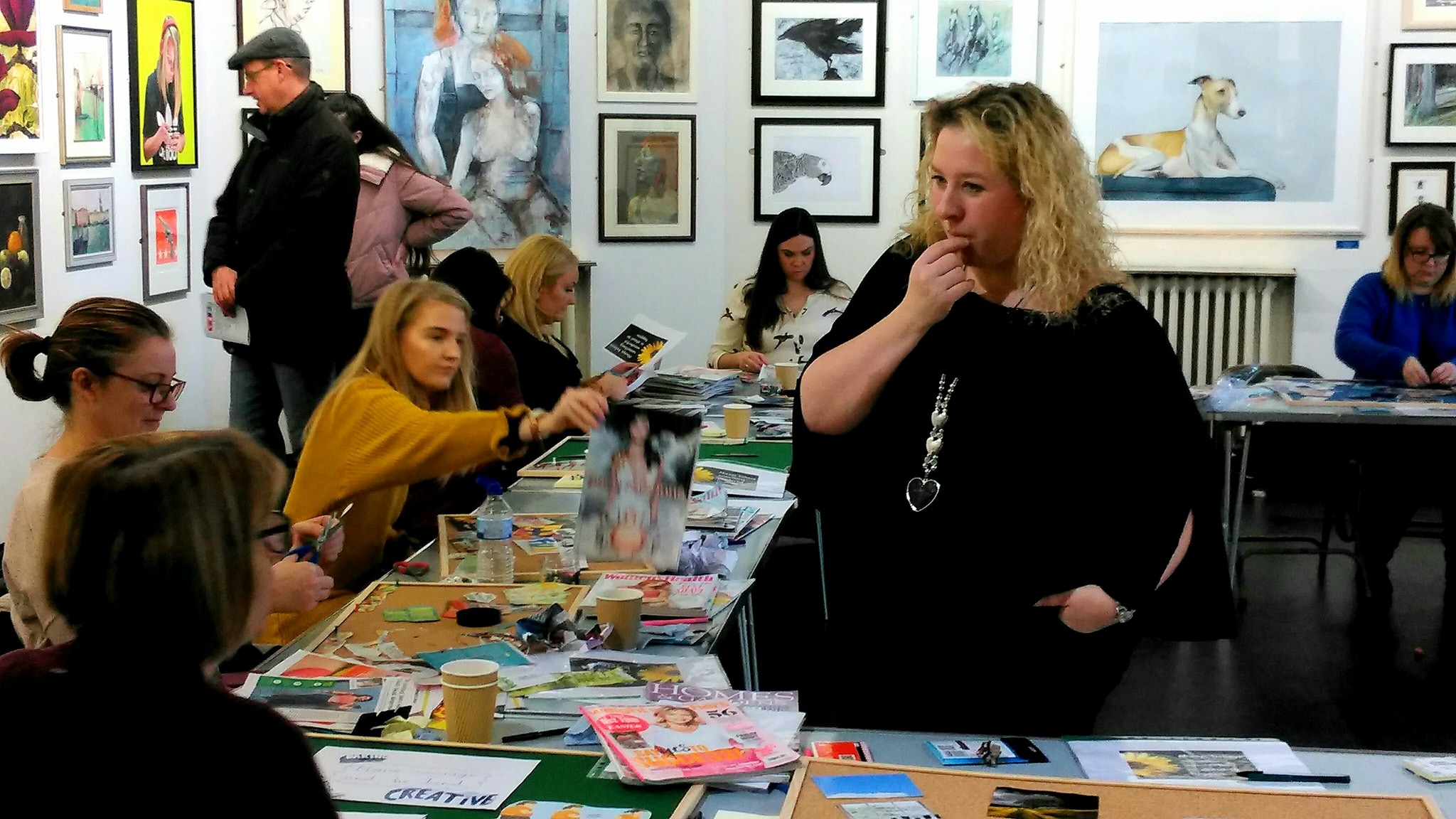
(Vision Board Workshop at Stockport War Memorial Art Gallery)
Who inspires you?
I was very fortunate to have been taught by an excellent English Literature Teacher who was passionate. if not zealous, about the subject. He introduced me to the Classics and the War Poets, and also to the theatre. I fell in love with Keats and marvelled at Shakespeare.
My late Father-In-Law took it upon himself to expand my literary knowledge. We would talk for hours on great poets and his favourite writers, Dickens, and Hardy. He also introduced me to classical music, something that never featured in my childhood. I’m extremely grateful for our time together.
I find inspiration everywhere and I have been inspired by a variety of sources over the years, however I’m beginning to realise that I’m largely influenced by pioneering women. It began with a passion for The Brontë Sisters, which opened my eyes to how female writers struggled to be heard. Maya Angelou and Oprah Winfrey are my heroines in challenging the status quo and breaking stereotypes. I respect anyone who stands up for a belief or challenges convention. I love Elizabeth Gilbert, who writes to encourage creatives to ‘write anyway’ and to ‘be stubborn about it’ (very similar to the message of Van Gogh: ‘by all means paint and that voice will be silent’. I have a fond spot for Jeanette Winterson, who was raised only a few streets away from my corner shop in Accrington. She opened a huge debate when she wrote Oranges Are Not the Only Fruit and continues to be a great ambassador for women’s rights.
What are you reading at the moment?
I’m having a cerebral holiday at present, reading a few bestsellers simply for the sheer pleasure of it. I have just read Eleanor Oliphant Is Completely Fine by Gail Honeyman and I can’t recommend it enough, a fabulous first novel from Gail. I’ve also just read The Keeper of Lost Things by Ruth Hogan, which was such a pleasure, it felt indulgent.
I’m currently re-reading a business classic in preparation for teaching a personal effectiveness course called ‘The 7 Habits of Highly Effective People’ by Stephen Covey. It was reading this book that gave me confidence to write, explore the craft, be proactive and keep the end in mind. I use Covey’s principles when I teach Vision Boarding at Stockport War Memorial Gallery. I have two workshops planned in for January 2018, when everyone is goal setting and thinking of long term plans. The combination of reading Covey and Elizabeth Gilbert, who I mentioned earlier, really sparked a fire within me to push myself out of my comfort zone to take on more challenges.
What’s next for you? What plans have you got?
I’m extremely excited to be working with Elena Mascolo again on our second children’s picture book. I cannot reveal any details yet other than tell you the story is the one I wrote on that fateful Boxing Day morning when I decide to write for children. It’s been fine-tuned and is now my next book (there may also be a third in the pipeline!)
I recently read my poetry at a Centenary Remembrance Day Service at St Matthew’s Church in Edgeley with the Write Out Loud Poets. We will also be performing a Christmas Open Mic Night on 12th December at The Samuel Oldknow, in Marple, which is always great fun and well received.
Into the New Year I’ll be Vision Boarding as I mentioned. I’ll be continuing to take Portia into bookshops, schools, book festivals and possibly Tatton Park at Easter and on Apple Day.
The new book will hopefully be launched mid 2019 so I’m looking forward to seeing that in print and holding a book launch.
I believe in constantly refreshing and learning new skills, so I’ll be studying under Joy Winkler at her workshops held at Tatton Park throughout 2019. Joy has now been named Writer in Residence, a title so well deserved.
Beyond that, I will be writing; children’s picture books, poetry and maybe, just maybe take on a novel that has been lurking at the back of my mind for some time. Time will tell.
Portia The Pear by Nicola Hulme
Nicola on Twitter