I keep a moonbeam in each afflicted eye, afflicted with neon and modern modes of light. They gloss my pupils with the sheen of pearls and shield their spheres from the evil spark, a celestial armour.
In my sleep their silver seeps into my mind. It arrays all figures with a cloak of white, subduing vermillion, charcoal, and black.
When people sunbathe to glow golden brown, I bare my bosom to Diana’s darts, each lunar night.
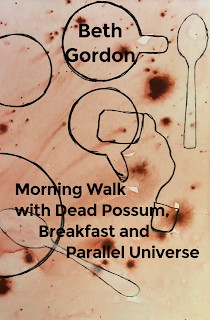
US poet Beth Gordon returned to writing poetry after a significant hiatus in order to process a number of tragic events in her family. In her poetry collection, Morning Walk with Dead Possum, Breakfast and Parallel Universe, she explores grief, loss, mortality, and how we can find moments of beauty through the darkness. Along the way, this poetic journey also follows trails into music, magic, and the ethereal.
Isabelle Kenyon, Managing Director of Fly on the Wall Press, Freelance Editor and Book Marketing Consultant, caught up with Beth Gordon.
Isabelle:
When you write a poem, do images or words come first?
Beth:
I would say most of the time words come first. Poems are like puzzles
to me – I read an article or see a headline and I take that idea,
or several ideas and talk about it with my friend. When I do write,
visual imagery emerges from that conversation.
Isabelle:
How does your environment and your upbringing inform your poetry?
Beth: I was fortunate that my parents thought it was very important we were exposed to books and music. One of my earliest memories was reading Mother Goose; memorising. From the first moment I picked up a pen, I wrote poems. My parents aren’t creative and my mum thinks my commas are in the wrong places! They support me and a big moment was to send them my book. My current environment is a local writers group I go to every Saturday and my network of family and friends – I have now connected the two. I have said, this is how I will be spending my time now. Mostly, they have supported this life change. People have had negative experiences of poetry from school.
Isabelle:
If you had to describe your collection in one sentence, what would it
be?
Beth: A book of poetry about my relationship with death and life.
Isabelle:
Which writers do you admire and does their work influence yours?
Beth: My earliest influences as a female writer would be Sylvia Plath and Mary Oliver. Oliver over time became more minimalist and I aspire to this. Sexton and Plath broke down barriers about “appropriate topics” – sex, periods. At the time, that was not what was expected, and I’m grateful to them for that. The current generation of young writers I find so inspiring- it’s easy to hear people my age criticising the millennials but I believe it is called change and revolution. The strong stance they take on inclusivity, even if it is just on social media, is fantastic. The abundance of literary journals is wonderful. I don’t think I could be writing what I am without them. When I got my MFA, doors were closed, and they have kicked them down.
Isabelle:
What is the worst writing advice you have ever received and the best?
Beth:
The worst advice I have ever had was when I was an undergraduate in
psychology and an English professor started a writing workshop, so I
picked up a minor in English just to take the classes. I went to see
an old teacher to say I was going to take an MFA after (he had always
been very supportive) but he said it would be useless and I wouldn’t
learn anything. Thankfully, I ignored him.
The best advice I have ever had was from Henry Taylor, a Pulitzer prize-winner. He said, “the power of your poem cannot be derived from the subject matter alone”. I wrote him a letter after that and sent him some poems. He said I needed to write through my grief and that after that, I would produce new work. In other words, simply writing about the death of a grandchild doesn’t necessarily mean I have refined my craft. Pushing my craft is important to me – to grow and evolve.
Hyena season genesis grasp secret psalm in search of duende… this eventuality’s carnival row exit in memory reclaiming time with unexpected grace notes vagabond of the margins, mantic flame burning up the green guardian assignations crestfallen between music and silence pledge of presence afterfall operative x knocking on the sky- vacillations of xerox and infinity, images in vogue amber soul sieve of moments preserved cascades of desire and nostalgia forming an umbrella of infallible truth new rules incubating in the absolute room in order to break free of the shadows the rupture of word and thing
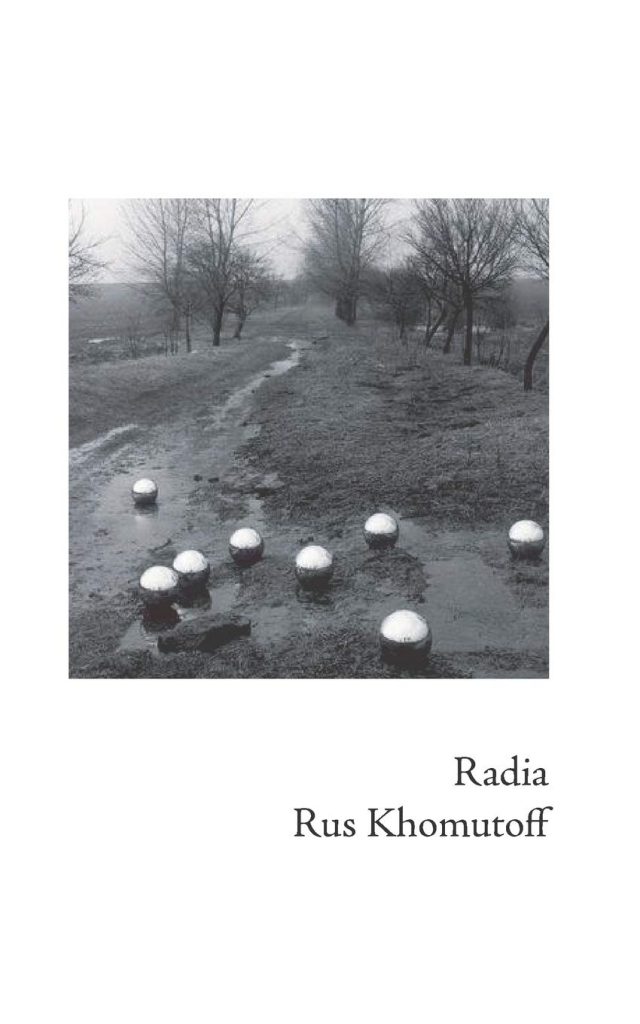
Rus Khomutoff dreams up the contemporary world into surprisingly familiar cosmic landscapes reminiscent of those suggested by the most idiosyncratic avantgardists—think Artaud, Char, Malraux, Panero, and other moderns unafraid to acknowledge the material quotidianity of mystical experience. Poems in Radia function as un-coders (rather than decoders), allowing the words to shine in their full resplendence while approaching each other artfully, almost naked, in unexpected ways, to take advantage of the oneiric gears hiding everywhere under the apparent simplicity of life – German Sierra
I heard it said trees can commune in an electrochemical style. Their fungal webs are like synapses and neurons, life flashes through this network deep in forest floors.
A bright white and yellow patchwork floor, fingers of fungus that are filaments, carbon, water and nutrient webs, flowing with such fervour flashing through underground rivers of love.
They are the Mother Trees who love with their nurturing neurons and mycelium strands of fungi. They fan out on the forest floor, with their fantastic filaments of food.
They feed the infant trees, with tree food rushing through a galaxy of motherlove down into the astonishing network of a weft of fungal filaments, reaching out beneath their feet.
No milky breasts, but spidery webs for feet, nested deep in the forest bed soaked in a nurturing fervour, and as they feed, they make the branches of the infant trees light up green, as spring shoots through.
When the Mother Tree dies through the ravages of time her wandering fungal webs dry up, they shrivel back, their filaments empty, the infant trees mewl, like abandoned babies, dying and starving.
I walk my dogs, they run sniffing the fields, starving for more rich smells of the rain-fresh grass, their yapping fervour fills the air, as they run through the little wood, with its silent soft floor, and I look for the oak tree with massive feet-like roots.
There, I see the oak tree now with its spiralling roots, and I feel the joy. ‘Why’, I have often thought,’ it’s just a tree.’ Still, it is as though she speaks to me. Suddenly I know, she is the Mother Tree. Her leaves rustle and whisper as she bears witness to my pain in her silent majesty.
at the counter she still gets nervous whenever she has to count someone’s change. the door rings an electric bell and while each customer browses she hopes aloud that they’ll pay by card. it’s easier. and each morning she asks me to do the totals – got in trouble once when it was short all a week and she was accused of scabbing pennies. a meeting with hr, and the eventual threat of retirement. afterward the manager did another account; got a promise from head office that going forward she wouldn’t have to open alone. I got the extra hours. he had justification to fire her if he’d wanted to, and he doesn’t like her much – but instead he kept her on, in this job of ten years part-time, allowing her the chance to mess up the totals each evening, to be snide at repeat customers, to stack the shelves neat at close of business and go home listening to 80s rock cds.
D.S. Maolalai is a graduate of English Literature from Trinity College in Dublin and has been nominated for Best of the Web, and twice for the Pushcart Prize. His poetry has been released in two collections, Love is Breaking Plates in the Garden (Encircle Press, 2016) and Sad Havoc Among the Birds (Turas Press, 2019).
Sienna steel slithers and huffs Through snow-dusted cedars and pines, Mumbling, dragging its steel tail behind it. And nestled between serpent and shore, Feigning indifference, a river sleeps Semi-conscious, beneath the frozen tears Of the land. A land that Still feels the incisions Made during the Surgeries that installed first iron Then steel runners on its back. And on The bank of the river three trees turn to
Peer at the young, scaly intruder; a bleak Memory rises from the earth And tells them: this is the interloper who Destroys the cacophony of peace In the forest. On a tight schedule. And behind, in the distance, Mountains who once believed They were immovable Wrap themselves in white Down and ignore the steel Stripling whose hiss they remember All too well; they heard it soon after Explosions removed their immovable Brothers that used to Rule the valley where the steel serpent Now reigns, unchallenged. But the mountains Tell the trees, the trees tell The river, and the river tells The land: be patient; his sovereignty Will not last forever.
Kristal Peace is a lover of words. She loves their puissance; their ability to charm, dazzle, puzzle, stun, comfort, help, heal, inform and transform. In her free time she indulges her love of words and uses those majestic creatures to write stories and poems.
Putting in the mail A copy of my new collection: The clerk asks about Liquids, perishables… Liquid—no, I tell him; Perishable is another matter, Words and pages. To be sure, it has a Library of Congress barcode, So I suppose you could Present yourself in Washington someplace And be led to the right shelf. Or I may be imaging that. Poets do not set out to be famous, Insights and images stuffed Into the backs of drawers. I think of 19th century composers, Famous at the time, Their works no longer performed,
We have saved copies For our grandchildren, which Their grandchildren may find In a box somewhere, Unless someone’s wife has hauled them To the church book fair, In which case they will Take their chances, like That single manuscript of Lucretius, But will know better than to count On a particular monk.
Robert Demaree is the author of four book-length collections of poems, including Other Ladders, published in 2017 by Beech River Books. His poems have received first place in competitions sponsored by the Poetry Society of New Hampshire and the Burlington Writers Club. He is a retired school administrator with ties to North Carolina, Pennsylvania and New Hampshire. Bob’s poems have appeared in over 150 periodicals including Cold Mountain Review and Louisville Review.
Notice the Pope’s white skin beneath the red velvet robe. Contemplate the thin papery silhouette of Italian hands touching himself – sometimes lovingly smoothing finger tips of the right hand over his perfect belly.
God has called him while he drifts toward sleep and the kingdom of his dreams – a sometimes white world of goodness made salient from the footprints left by tiny angels, the ones who have danced across the filigree of his indefectible batiste shirts angels who have enjoyed trampolining off the springy fat of his cheeks.
Hunter Boone is published in Sappho Magazine under the pen name of J. Hunter O’Shea, has a BA in Creative Writing, studied with Stuart Dybek, Eve Shelnutt, Herb Scott and Jaimy Gordon whilst completing a MA of Fine Arts at Western Michigan University, and plays a Fender Stratocaster.
Thomas had insisted that Joanna was a Lorrainer who conversed with angels in the heart of solitude, a shepherdess who saw God in forests and fountains, the fountain of Domrémy where fairies and fawns sought the sanctity of the woods.
The sagacity of her guileful judges is worth nothing but ridicule. They asked what language the angelic visitors employed in their discourse with her as if God could not breathe his whispers into her pure, innermost thoughts.
The Pucelle d’Orleans died grandly in her battle with fire and falsehood. The soldier who planned to throw a faggot on her scaffold regretted his plot. He spent the remainder of his life a penitent after he had seen the fluttering dove rise out of the ashes of the Maid of Arc.
Susie Gharib is a graduate of the University of Strathclyde with a Ph.D. on the work of D.H. Lawrence. Her poetry and fiction have appeared in multiple venues including Adelaide Literary Magazine, Green Hills Literary Lantern, A New Ulster, Crossways, The Curlew, The Pennsylvania Literary Journal, The Ink Pantry, Mad Swirl, Miller’s Pond Poetry Magazine, and Down in the Dirt.
30 minute solos all on a long tour of America, on a stage behind Miles Davis.
he spun it out in silver like a spider with a web, catching flies and sometimes juxtaposition.
supposedly in a bar once after ending a show with another one he said “I don’t know I just can’t seem to stop playing”
and Miles looked at him over his sloe gin and said “you ever think about taking the horn out your fucking mouth?”
D.S. Maolalai is a graduate of English Literature from Trinity College in Dublin and has been nominated for Best of the Web, and twice for the Pushcart Prize. His poetry has been released in two collections, Love is Breaking Plates in the Garden (Encircle Press, 2016) and Sad Havoc Among the Birds (Turas Press, 2019).