Inkphrastica: Dream Tiger: Maggie Waker (Words): Mark Sheeky (Oil Painting)

I dreamed of striped creature
Ochre. Black.

Fading and breaking with lightening fear
Claws ready to scrape cheese from
Fine sunlit moon.

Followed by hidden eyes
Strangely striped scarlet
Growing from thick tendrils.

Two or more tiny humanistic figures
Ventured from cold stone with their pins
Ready to slay said creature

Pins no more the size of a single hair of their foe
Whilst The Bishop of Accra was contacted
That very same day.

In a flash of lightening. Above pin spears held high
Striped fearless tiger leaps
Across green sky.

Maggie Waker: Write Out Loud

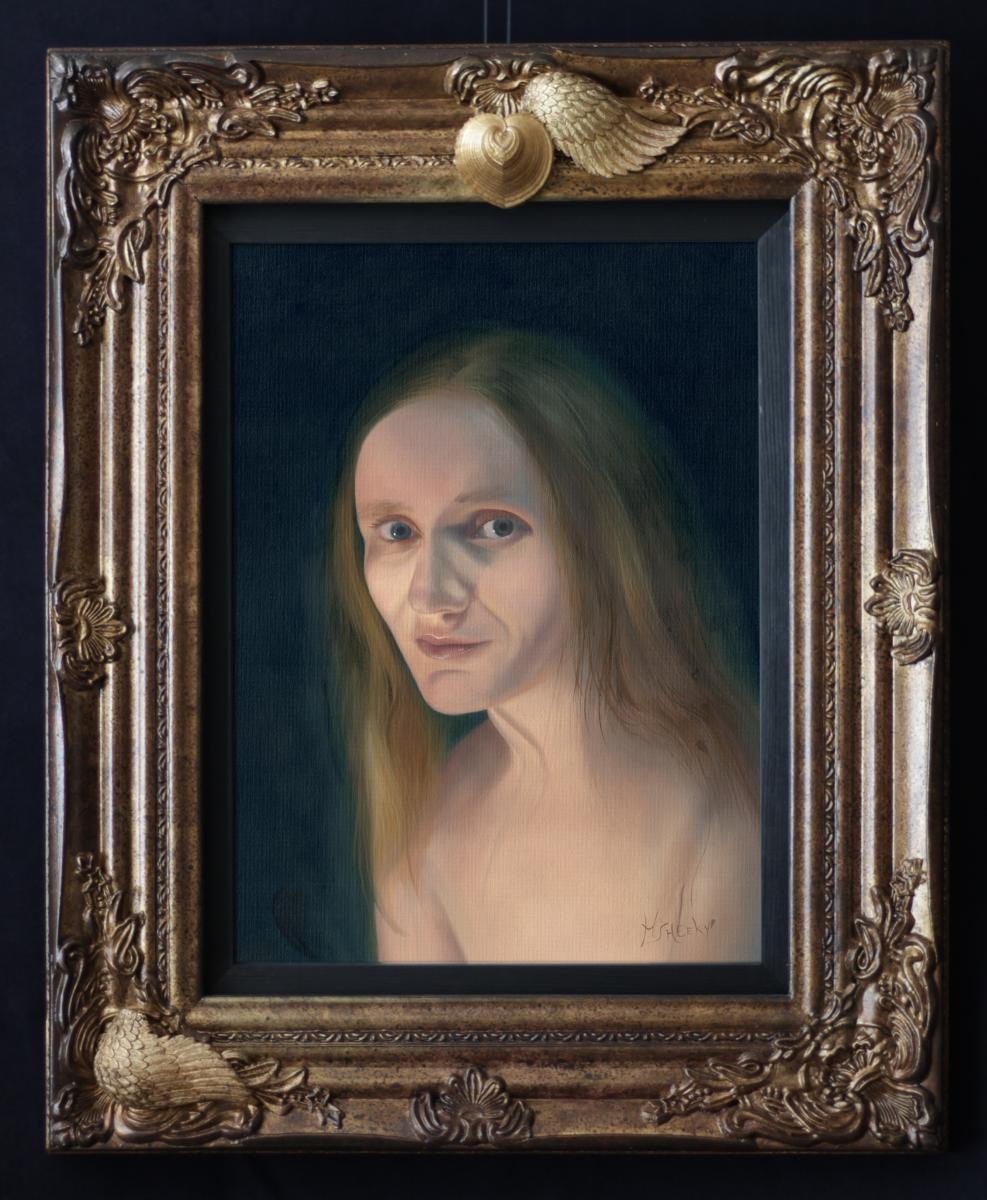
Mark Sheeky’s Oil Painting: Tiger Moving Nowhere At All (available for sale)

Inkphrastica: Nigel Astell—Martin Elder—Maggie Waker—Randall Horton—Poems inspired by Mark Sheeky’s Oil Painting

Till Death Do Us Part
(by Nigel Astell)

Bride was unfaithful
murdered by Groom
white wedding dress
soaking blood red
death sentence passed
lifeless hanging corpse
devil lovers whisper
honeymoon in hell
this ghost marriage
can now begin.

Look At Me
(by Martin Elder)

Is this how you really see me
Is this how you want to see me
Daubed here
Hung here for the whole world to see me
This nervous wisp of a sprite
In all her pasty glory
Look at me
LOOK AT ME
Please…please look at me
I am trying to smile
I really am

Are my eyes really that colour?
Are you sure
My skin is so beautiful
Don’t say just like me
It’s so crass
So obvious
So sad like the look in my eyes
Look at me
Tell me this is a lie
That this is just a cheap imitation
That I am something more than this
I have arms and legs
A whole body to
I have a mind
Ears that hear everything
Every last drop of gossamer breath
I see
I see you now
I see you yesterday
And the day before
And the day before that when you are moaning
And yet you just see today
Looking back at me
Am I a trophy
Your badge of honour
For a job well done
Look at me
No don’t look away
Look at me…please
O.K. I will be here
Waiting…
Until you come again to look at me

Last Picture
(by Randall Horton)

Last Picture

A girl

         Or a boy

Looks at the illusion of time

                        And imagines a future

Free from space.

                       A continuum breaks.

A smile, too.

Woman
(by Maggie Waker)

Some say she’s scary
I say she’s scared

Some say she’s pale
I say she’s poorly.

Some say she’s tired
I say she’s trapped

Some say she’s thin
I say she’s slim

Some say she’s delicate
I say she’s ethereal

Some say she’s plain
I say she’s ill – favoured

Some say she stares
I say she cares.

Some say they connect
I say I bond.

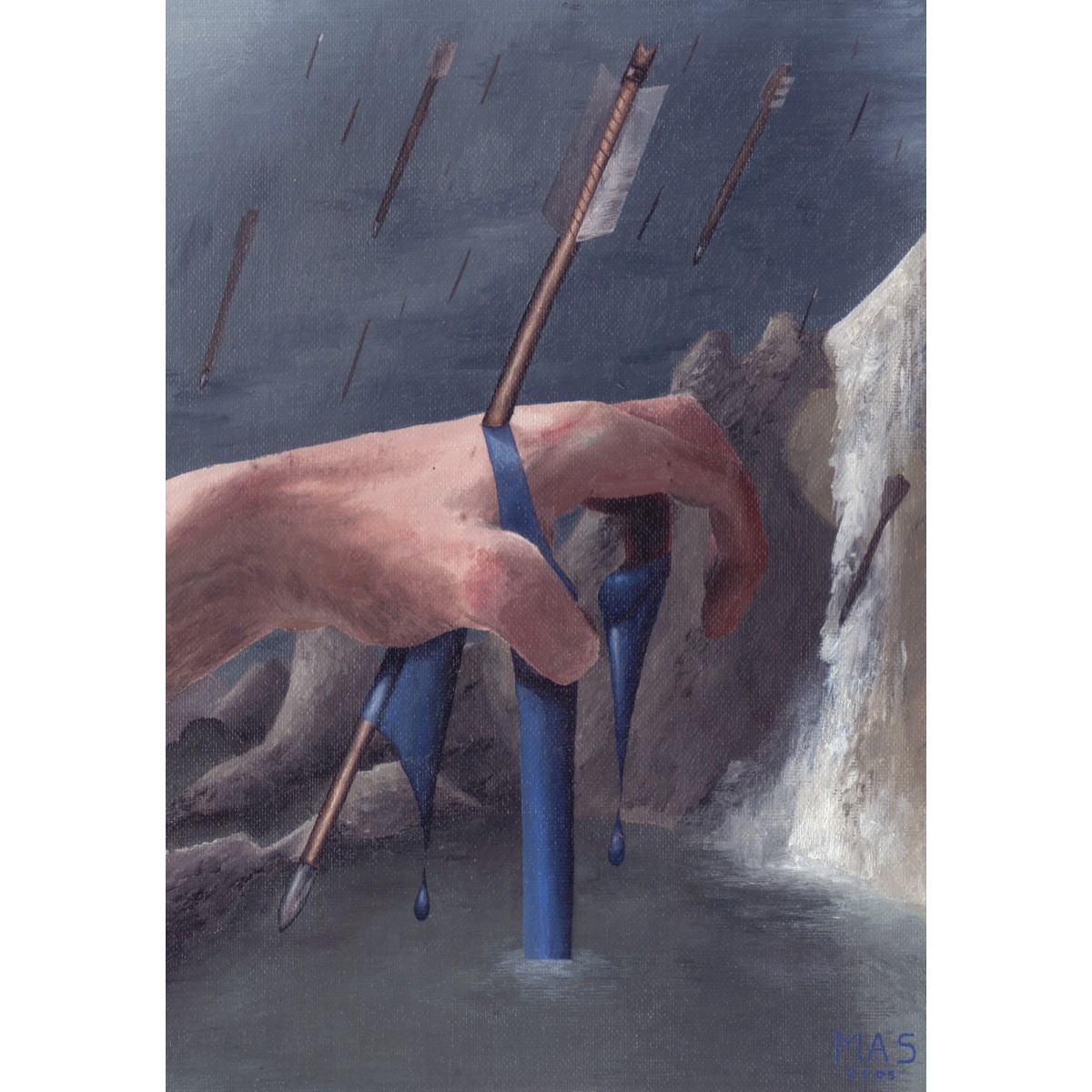
Mark Sheeky’s Oil Painting: Miss X (available for sale)

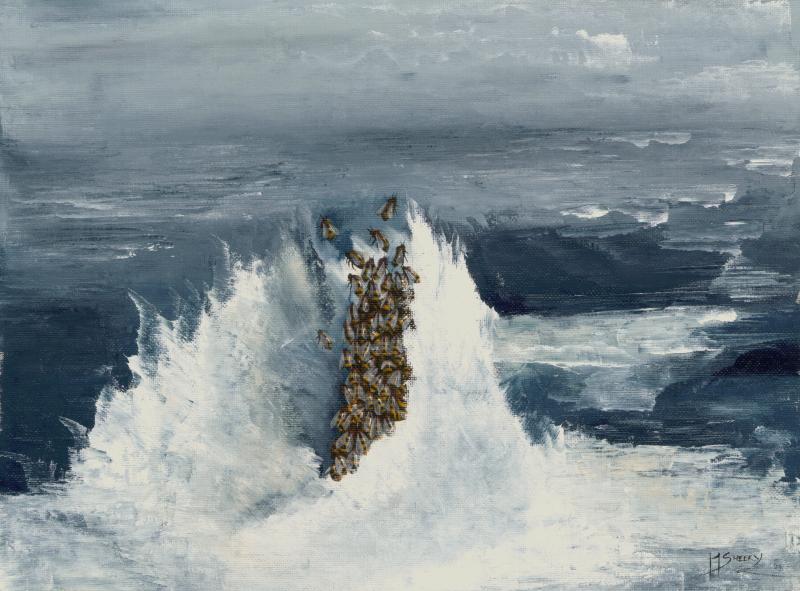
Inkphrastica: Spume: Andy Millican (Words) & Mark Sheeky (Oil Painting)

Even the hardest rock succumbs to time,
its unrelenting elements. Now spume
casts white blankets atop their home, a chime

unheard announces their collective doom.
No bee is an island. A paradigm
as much for them as man. And as their tomb

envelopes them a hundred bees will hum.
Ask not for whom the bees hum; it is them.
For this is their communal kingdom come
and as the sea becomes them, say Amen.

Andy Millican: Write Out Loud

Mark Sheeky’s Oil Painting: A Tower of Bees Hit by Forces Beyond Their Control (available for purchase)

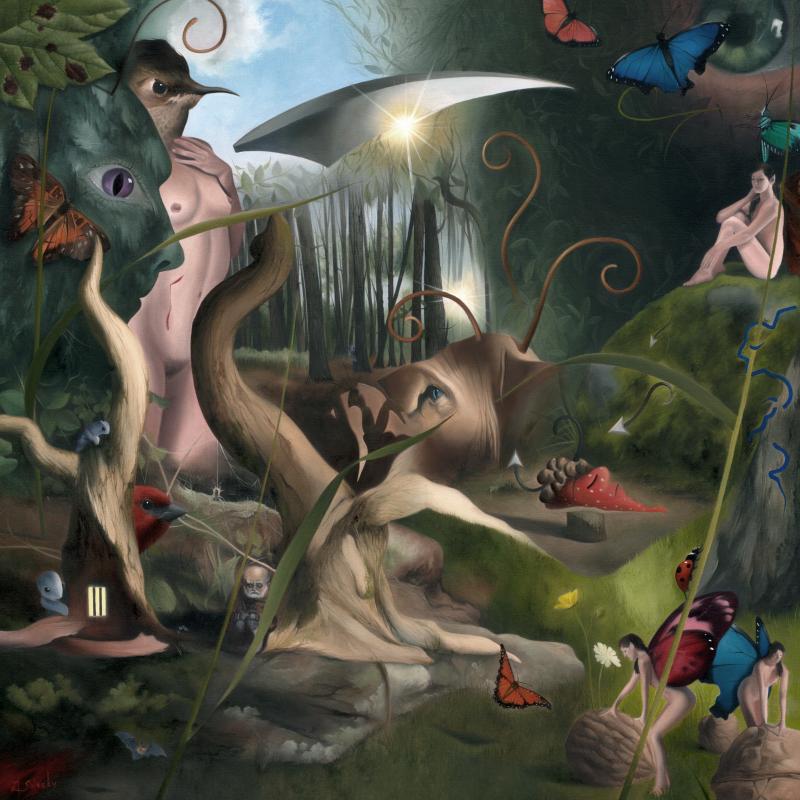
Inkphrastica: The Fairy-Feller’s Systems Failure: John Keane (Words) & Mark Sheeky (Oil Painting)

A fairy-feller hides in emerald shades
While feathered faces dance the perfect dance
Evading hope in pale, despondent glades
Where shadows stumble on a wild mischance:
And all of this beyond the edge of sleep
Where dreamers kill the things they care to keep.

A wedge of futuristic steel observes
And coolly calibrates this elfin scene
Kissed by a savage sun along its curve,
No form more dread than this has ever been:
It brings the future and the end of days
To wayward dreams and errant human ways.

Who knows if at some cold and vast remove
The wedge will raise again these faerie lands
Within its clouded circuits? Dreaming groves
Of rusting trees where still the gnomon stands:
Where robot birds hail corrugated skies
And elves of chrome kiss iron butterflies.

John Keane: Write Out Loud

Mark Sheeky’s Oil Painting: The Paranoid Schizophrenia Of Richard Dadd (available for purchase)

Poetry Drawer: Love in the Time of Cold by Laura Potts

Before the dawn that walks the northern morning from the moors;
before the swans sing winter on and cough the fog upon the ponds,
we ask that through the Christmas mist and bells that bring December in
you pause and long-remember this: ever through the blizzard lives

the hospice on the hill, sleeping in the heart of dark beneath the stars
and still. How that leaping garden laughs; how that wind will never gasp away
the ashes of our past that live until the last; how those staff with candle-eyes
will guard our sleepers through the night. And as the nurses lull the light

the sentry sets above and bright-as-life upon the skies: ever does that crust
of moon push a light into those rooms, and pull away the dusk and gloom.
Oh how soon the seasons turn, and how the folk will come and go and once
will leave to not return, and how that tree will never know defeat against

the snow. Know only that the flowers grow and show their Sunday best,
and bow towards that sleeping house, and death is that much less

This poem was first published on The Poetry Society’s Young Poets Network and was commended in the Wish List challenge in 2018.

Poetry Drawer: Flight by Laura Minning

Dreams
are meant to be fulfilled,
and dreams
are meant to be shared.

That’s what he thought.
That’s what he
always wanted.

He was so full of life.
His soul was free,
but his body
was weighted
with illness.

His heart grew heavy
with each passing day,
but he never gave up,
and he never lost sight
of his dreams.

I respected him for that.
I respected him
for who he was,
and I was grateful for
for the time
that we did have.

And every time
I think of him,
I will smile
because I know
that he
would have
wanted it that way.

Inky Interview: Author and Visual Artist Laura Minning

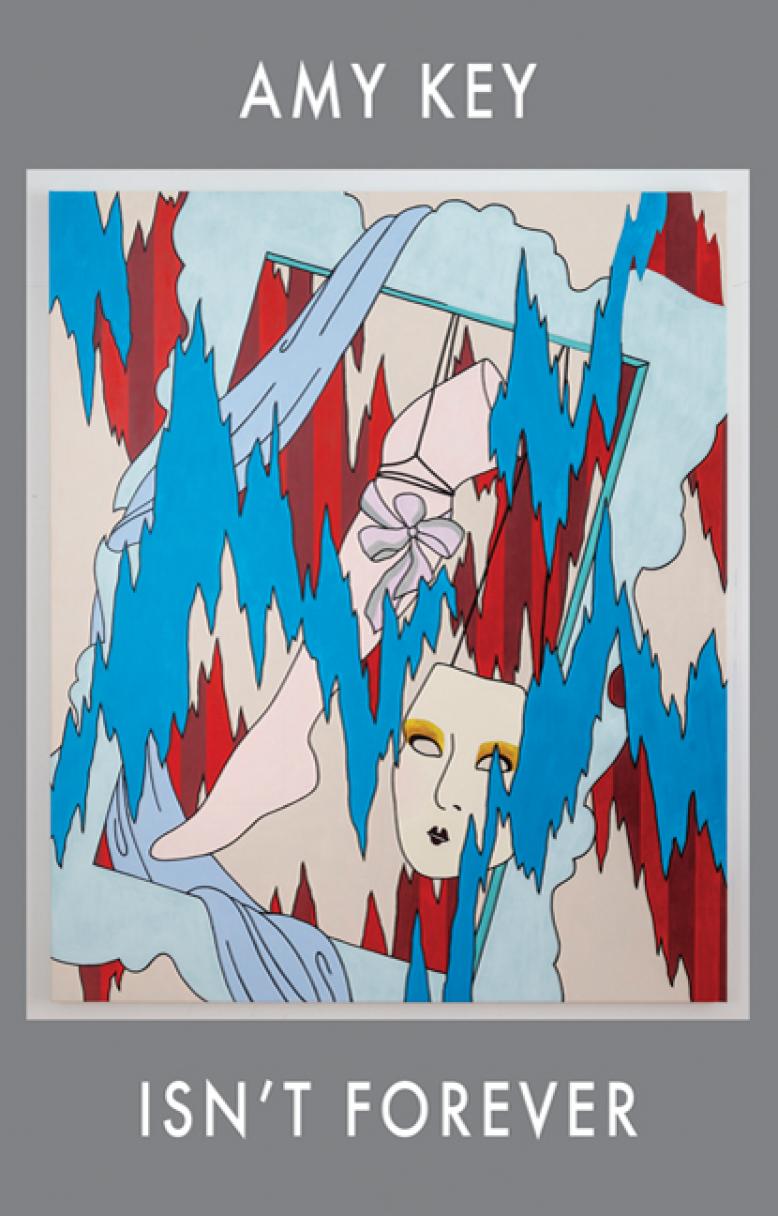
Books From The Pantry: Isn’t Forever by Amy Key: Reviewed by Claire Faulkner

Amy Key’s new collection, Isn’t Forever, published by Bloodaxe Books, is hypnotic and addictive. I became intoxicated by the verse. It’s full of poems that have a beautiful, almost dream like quality to them. They’re unique, strong and inspiring at the same time.

I particularly enjoyed the use of language in this collection. Sometimes harsh, sometimes with humour, but always with remarkable depth and insight.

Baby, wait a lifetime before you love somebody’ took my breath away. It has the lines:

Today I woke wishing for a baby.
I woke thinking – next year I will be married.
Strange since I’m not a mascot for such things.

It finishes with:

Starlight tastes less like snow than you might think
and I woke with a temporary sense of what love is,
like getting away with a good lie.
I am watching my breath mist up the windows
thinking – I made this.

The poem, ‘She lacks confidence, she craves admiration insatiably. She lives on the reflections of herself in the eyes of others. She does not dare to be herself’ is collaged from self help and agony aunt websites, and I adore the lines which give the reader advice:

Take a self-appreciation holiday.
Build a fortress
around your best self.
When you hear your worst
selves yelling from the ornamental moat of your
self-esteem. Ghost them.

Beauty, love and the female body are recurring themes throughout the collection. ‘No one should be scared of pleats’ is an amazing cento based on the words of Coco Chanel. It has the wonderful lines:

I don’t have to explain my creations; they have explained themselves

and

If I built aeroplanes, I would begin by making one that was too beautiful.

In ‘Two cats’, one of my favourites in the collection, Key demonstrates an elegant nature of vulnerability with the lines:

I whispered love to both cats
and tried to pay them equal attention. The vet prescribed
a hormone diffuser to take the edge off their fretfulness
and I worried about its effect on me. I had trouble both
sleeping and waking and was often in tears.

Hauntingly beautiful are the lines from ‘The Garden’:

I encountered a surface that was not safe to stand on
it was between me and the garden.
The garden said take as much time as you need.
It said you don’t even have to tell me.

I find myself intrigued by Amy Key’s style and words. The poems felt real to me, and one more than one occasion they made me pause for breath. I was delighted and surprised by them. It’s a stunning collection.


Photography by Jamie Drew

Get your copy of Isn’t Forever by Amy Key

Inkphrastica: Song of Freedom Oasis by Rus Khomutoff (Words) & Now That’s What I Call Blue by Mark Sheeky (Oil Painting)

Usurp of the jonquil intervoid
happenstance arrival pending
a severing of the apparent encore
distant cries and
blossom bones enduring eternity
a face of genius in
full measure of the spectacular now
the explicit nevermind
of bulletproog passingness
always unfinished
song of freedom oasis
buying exits

Artwork: Now That’s What I Call Blue by Mark Sheeky

Rus Khomutoff’s Poetry

Inky Interview Special: Author Joseph S. Pete

Your literary or photographic work has appeared in over 100 journals. Can you tell us about your journey towards being a writer? What subjects do you photograph? Do you combine words and pictures?

As a bookish person, I’ve aspired to be a writer since childhood. I read constantly. I keep paperbacks in my jacket pockets and my pants pockets so I can read at any time I am not otherwise occupied. I even pocketed paperbacks at my wedding, just in case. Understanding at an early age that few are fortunate enough to write literary fiction full-time, I sought out a career in the media so I could write for my day job, to develop the muscle memory. I first started photographing as a necessity for publications with limited resources, where I needed to both photograph and write up assignments. I’ve since evolved into a prolific shutterbug, and am most interested in architecture, urban landscapes, urban decay, graffiti, and natural landscapes. My iPhone photo albums are largely devoid of people–for whatever reason, I’m more drawn to art, architecture and the like. I seldom combine words and pictures, but my writing and photography sometimes draw inspiration from the same subjects.

You are an Iraq War veteran. How much has this experience fed into your work?

Iraq was rough. I often strive to tell war stories, and experiment by trying to tell them through different forms. It’s something I feel I have to do justice to as a storyteller.

You are also an award winning journalist. How did you get into journalism? Have you advice for any of our followers who want to enter this field?

In high school, I wrote an earth-shattering investigative exposé on how high school athletes used the dietary supplement creatine and how it was potentially harmful. Earlier in May, I received a prestigious Peter Lisagor Award from the Chicago Headline Club at the ritzy Union League Club in the Loop after watching a video presentation about the acclaimed Chicago Tribune journalist Anne Keegan, whose first high school story had been about birds nesting at the school, which somehow stirred up controversy with notoriously open-minded administrators. Anyone interested in entering the field should just amass clips, and use them to persuade editors of their writing chops. It’s largely all about what you can do. That being said, the transition from dead trees to online has taken more than a pound of flesh, and the carnage continues until they settle on a new, more viable business model. I’ve been sickened to see so many of my talented colleagues laid off, or just given up on a career that seems to be circling the drain and certainly has endured a great deal of political scorn over the last few years.

You were named poet laureate of Chicago BaconFest. Interesting! Can you tell us about this? What is the literary scene like where you live?

I get nervous reading my work at half-empty coffeeshops but somehow wasn’t daunted to read a dumb joke poem in front of thousands of people at the UIC Pavilion, including comedian Hannibal Buress and Chicago Bears players. I was also a runner-up in the PBR Art Contest for poetry, earning me a three-month supply of that hipster swill. For some reason I imagined a worker would dolly a few cases of Pabst Blue Ribbon to my door; instead, they sent a paltry check.

Northwest Indiana is the New Jersey of Chicago–it has a surprisingly vibrant literary scene that includes afew journals, the Zine and Small Press Festival in Michigan City, many lovingly crafted zines at cafes and boutiques, writers groups, the Indiana Writers Consortium Steel Pen Conference, open mics and more. Neighboring Chicago definitely has one of the best literary scenes in the country, with at least a few live lit events every week. Plenty of big-name authors pass through. I’m going to see National Book Award winner Jesmyn Ward at the Chicago Humanities Fest in Hyde Park.

What is it you love about the short story form? What about poetry? Any preference?

Short stories are one of the most digestible and accessible forms of literature, a narrative contained in a convenient package. I love the soaring heights of language poetry can ascend to. No preference. They’re both great expressions of creativity.

What do you care about? What themes keep cropping up in your writing?

I write a lot about industrial decline, abandonment, alienation, war, despondency, injustice and other themes. While my work may be thematically dark, it’s typically leavened by a lot of humour.

Describe a typical day in your life.

It’s a grind. I write, write, write for my newspaper…at a bar, a fellow reporter recently introduced me as the “journalist who wrote the entire Times of Northwest Indiana and produced 12 stories a day.” That’s a comedic exaggeration, but not by much. I write journalism by day and write literature by later at night, often working on short stories or poems into the wee hours of the morning. I read as much as possible, try to walk as much as possible, and frequent plays, museums and other cultural events on the weekends.

If you could change one thing about the world, what would it be?

There’s so much that’s so profoundly wrong with the world, from poverty to inequality to sexism to racism, to senseless gun violence. If you put a gun to my head, I would probably call for more appreciation for media, literature and the arts. I say that partly out of self-interest but truly believe, however Pollyannaish it may sound, that most of the world’s problems could be solved if people read a book a week, kept up with the news, developed empathy for other people, and maybe spent a few hours volunteering. So many intractable issues seem to be at least partly the result of ignorance.

Who inspires you and why?

This is perhaps the toughest question. Any author I’m reading, any painter whose work I’m looking at. It takes bravery to create art in a cruel, indifferent world.

What advice would you give to your younger self?

I was miserable for most of my youth but haven’t since attained any wisdom of note. Mostly, I would encourage my younger self to not be such a perfectionist with literature and just write. My biggest regrets are failing to submit to literary journals like Canvas at Indiana University because I held them in such high esteem and held myself in such low esteem that I didn’t think I was worthy. Now they’re gone and I missed the chance to develop as a literary writer, whether they accepted my work or passed on it with stale, dashed-off form letters that are almost always more error-ridden than the cast-aside submissions.

Tell us a story in five words.

Fiction: Baby shoes, never worn

Have you been on a literary pilgrimage?

I’ve frequently sought out literary sites, such as the Thurber House in Columbus, the James Whitcomb Riley mansion in Indianapolis and Jean Shepherd’s childhood home in Hammond, Indiana. I’ve frequented places like the American Writers Museum in Chicago and The Things They Carried exhibit at the National Veterans Art Museum. The closest I probably ever came to a pilgrimage proper was my cross-country road trip to Fort Lewis by Seattle, which I fancied was a modern-day version of On The Road even though it was far less exciting.

Do you have any advice for other writers?

As someone who suffers from Imposter Syndrome, no matter how widely I’ve been published, I probably shouldn’t be proffering advise on this subject. But read, write and read a lot. That’s the ticket. Read widely, and keep trying to incrementally improve. Reading’s the key thing.

What are you reading at the moment?

Katey Schultz’s Flashes of War, F. Scott Fitzgerald’s lost short story collection I’d Die for You, Alison Moore’s The Lighthouse, Michael DeForge’s Very Casual, Sam Graham-Felsen’s Green, Nathaniel Rich’s King Zeno, Tatjana Soli’s The Lotus Eaters, Eimear McBride’s The Lesser Bohemians and Alan Moore’s Swamp Thing. I’m also a professional book reviewer for a national magazine and read tons of books for work.

What is next for you? What plans have you got?

Novels, plays, maybe even screenplays. I’m been slowly but surely working my way up to longer works, and we’ll see how it goes. I’m trying. Everybody’s trying.

Pantry Prose: The Young Man and the Sand (a contemporary homage to Ernest Hemingway) by Joseph S. Pete