Inherent Vice by Thomas Pynchon reviewed by Steve Voyce

I didn’t like this book. Not at all and I’m hugely disappointed.

Going in, Inherent Vice felt like something that I should love – a noir detective story set at the end of the 60’s in South California. I should have lapped it up. But I didn’t. It actually made me feel tired when reading it – not a good review for a thriller.

I’ve never read any of Mr Pynchon’s books before and I doubt I’ll be reading another. I struggled to get to the end of this one. It was tough going. It should have been textbook stuff: Grizzly private eye, femme fatale, conspiracies, murder… But Pynchon’s style, tone and story-telling are so heavy handed and tricksy that one soon tires of the plot and the characters. Not even the odd amusing line or bright metaphor can pull you back. This should have been a book about light and shade, about the tough shell of life and the soft underbelly of existence. It should have revealed the 60’s era of freedom and experimentation for what it really was, but instead it’s head-scratchingly dull and confusing.

This is a novel that lumbers under the weight of it’s own concept. Setting a noir thriller in the fudgy, selfish, self-centred late days of the 60’s counter-culture is a great idea for a novel. Unfortunately this isn’t that novel. For a start, Pynchon has too many characters: a revolving door of Wodehousesian-names (Ensenada Slim, Flaco the Bad, Dr. Buddy Tubeside, Petunia Leeway, Jason Velveeta, Scott Oof ) race in and back out again, and I found myself turning back pages to double-check who-was-who. Most of them weren’t even integral to the plot so just served as extra floss on an already overcrowded stage.

This confusion was not aided by having the main character called “Doc” and an important secondary character “the Doctor”.  Surely someone at the publishers ought to have called this one out?

And a plot that attempts to juggle this amount of characters is always going to be too complicated. Complex plots can be a good thing, especially in modern thrillers, but the writer needs to reign himself in and remember that just because he knows what’s happening, it doesn’t mean that his readers will. He can have fun, but not at their expense. After about fifty or so pages, everything just merged into one muddy background.

What more, I found myself not caring about what was going to happen (or whodunit) and certainly not giving a hoot about the amount of drugs and free love on show. This appears to be Pynchon’s cornerstone of his narrative – it’s a book about the 60s after all… But it isn’t big and it isn’t clever. And it’s certainly not original.

Not one of the characters is remotely likeable, not even the protagonist. Without a detective to root for and hold the whole thing together, any mystery or thriller is doomed to fail. We need a hero to cheer for, to connect with, to want to win. In Raymond Chandler’s essay on detective fiction, he says that the best fiction detective needs to be a white knight; he can be a loner and he can be outside of society, but he must be a moral man, a man who walks the mean streets “the best man in his world and a good enough man for any world.” I feel Pynchon should have been aware of and taken heed to these words.

Later this year, a movie version of this book is due for release, directed by Paul Thomas Anderson. I’m not a huge fan of his work, but wait with interest to see what he does with this source material. Maybe a film adaptation is what it needs. For once I hope that the film is nothing like the book.

Sheer Purgatory by Robert Carter reviewed by Kev Milsom


robert carterSheer_PurgatoryLg

Excuse me,” Dan said, “but there really must be some mistake. You see, I can’t go down there; I’m an atheist.”

“Yeah?” The scrawny steward’s eyebrows lifted. “Well, I bet you feel like a right idiot now, then, don’t you?”

Most authors writing anything that focuses upon the “afterlife” – and on what happens to us after the point of physical demise – tend to pose a wide variety of “what if?” questions:

What if there is no heaven? What if there IS a heaven but they won’t let me in? What if God doesn’t really exist?

Within Robert Carter’s book, Sheer Purgatory, the two most pertinent questions are perhaps somewhat more unusual. First, “What if our safety on Earth was monitored at all times by guardian angels, who watched out for our every move and ensured that we get to live a rich and fulfilling life?” And second, “What if our guardian angel was a disastrous mix, whose abilities lay somewhere between Laurel & Hardy and Mr Bean?”

For poor Dan Trench – a man whose career is solely to clean and look after the lottery balls every week, thus earning him the unfortunate title “Keeper of the Balls” from his colleagues –  this last scenario is sadly all too true. Thus, a life, destined to last a contented eighty-three years and end with a serene passing, ends up rather messily under the wheels of a number twelve London bus aged only twenty-five – due in no small part to his guardian angel getting hopelessly lost and missing his cue to avert Dan from a nasty demise.

For the angel, named Vic, it is one mistake too many (in a very long line of mishaps) and his wings are clipped by higher authorities, probably offering many further humans the chance of long and happy lives. However, for Dan, the damage is done and his day is utterly ruined.  Not only does he not get to meet his girlfriend for dinner, but he finds himself thoroughly dead, with no chance to squeeze back into his body.

Worse still, the very, very long queue for heaven takes place not amongst Utopian clouds ascending upwards into a shining funnel of wondrous light, but rather in an underground tube station, the size of several Heathrow Airports – complete with angelic staff who seem determined to be abrasive and awkward at every turn, such as the archaic administrators at the “Commandments Verification Unit”, with a large line of Biblical questions concerning coveting neighbour’s asses and following “false gods”.

“Did you ever worship idols?”

“Definitely not,” Dan said.

“Certain about that?”

“Positive. Unless you count Led Zeppelin.”

“We don’t.”

If Dan’s day couldn’t get any worse, he is soon befriended by two fellow recent departures from Earth – Carlton: a loutish football hooligan with a slobbish disposition and an addiction for junk food, alongside Nena: a young, depressive, Goth female, whose hobbies include downing large quantities of drugs with bottles of vodka.

Welcome to Robert Carter’s tongue-in-cheek view of an afterlife “heaven” – which appears more like “hell” at times, especially for the hero of the story, Dan, for whom life after death quickly turns into one nightmare after another.

Not only is Purgatory completely unlike anything he had ever imagined, but the rumour going around is that finally the “Day of Judgement” may well be about to happen, depending precisely on when “The Boss” decides.

Not only do Dan, Carlton and Nena have to navigate their way around Purgatory and adapt to new – and often weird – surroundings, but each of them may only have a few weeks to discard a lifetime of mortal sins before the big day. Naturally, this latest gossip about Armageddon causes the entire population of Purgatory to sharpen up their game. Sins are to be shed before it’s too late. Crowds of people wander the streets of Purgatory like charity “chuggers”, looking to do good for others – even if they don’t want it. Gangs of “hoodies” sneak around housing estates, planting pretty flowers to make people smile, before running away in the shadows.

In Sheer Purgatory, the late author, who sadly passed away earlier this year, keeps the tempo at a fast pace; each page is supplied with a constant stream of jokes, puns and humorous quips.

It’s difficult at times to keep up with the stream of laughs, as poor Dan slides from one difficult scenario straight into another; whether it’s filling out endless, administrative forms just to get into Purgatory (familiar to anyone who has ever had to do battle with the Department of Employment, or any testy government official), or having to deal with the constant failings of his travelling companions and recently feather-plucked guardian angel, Vic.

Robert Carter not only maintains a brisk pace, but manages to deliver his words with a sense of depth and humanity – allowing the reader to slowly peel away layers of his characters, displaying deeper levels.

Robert also succeeds in creating a sense of wanting to read onwards – with characters who create images of mirth, alongside the gradual introduction of more sinister and shadier elements of the afterlife, and raising questions that positively beg to be answered in later chapters.


In memory of  Robert Carter.

Our sincere condolences to Robert’s family.

Rest in peace.


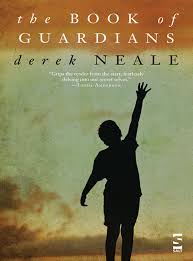
The Book of Guardians by Derek Neale reviewed by Tina Williams


Derek Neale Book of Guardians

Something in Philip Eyre’s life is dying. He doesn’t know what it is but he knows what to do. Toronto is beckoning – a new job and a chance to leave behind everything in Shrewsbury that torments him, including his ex-wife and two children. With the closure of just one more case of child adoption, he’ll be able to take the flight, starting a new adventure to bury the feelings of restlessness that have escalated since he turned forty. But ‘there’s no such thing as a last case’ his friend Richard insists, and it’s a sentiment that rings dramatically true when Eyre’s last case concerns the enigmatic Janet Burns.

With just the brush of her fingers across his knuckles, the fragile hold Eyre’s been keeping on life up until then is threatened. Her touch sparks the memory of some words from a poem: ‘How love burns…’, and suddenly his stability begins to falter. It should have been enough to have ticked all the appropriate boxes on the adoption forms – mother consents, father unknown – to end that part of his life. But something about Janet brings all his insecurities fluttering to the surface, and he becomes driven to track down the father of her baby daughter, Holly, even when she insists the father is arguably the greatest father of all… God.

Driven by a developing obsession with Janet and her chequered past, Eyre becomes disturbed by the gaps in his own memories of his now deceased father. His frustration with only random fragmented images and echoes of memories is further exaggerated when his mother dies, the only one capable of giving him the answers he craves. When Eyre is finally able to close the case and move to Toronto, his new career and new relationship with ‘K’ are not enough to banish the doubts and insecurities his encounter with Janet had brought to the fore. He returns home after his mother’s death amidst a flurry of questions, increasing paranoia, and a continuing preoccupation with Janet that threatens everything he thought he knew about himself, his family, and his past.

In essence this is a book about fatherhood: Eyre’s search for the ‘our father’ that will close his last case and allow him to move on; his role as father and relationship with his children which is awkward and strained at best; and his desperation to know more about what sort of man his own father was. Yet more than this, both Eyre and Burns are examples of how we precariously construct our lives and beliefs upon fractured and unreliable memories. Janet’s past is fogged by the drugs she is given to treat her mental illness, but when these drugs are reduced, recollections of her distant past return in a disturbing mix of reality tinged with the fiction her mother read to her as a child. When Eyre looks deeper within himself, the scattered images and words of his past twist, turn, and fall upon themselves until he is left with only a list of ‘probables’ and ‘possibles’ and an overwhelming urge to find the answer to an unknown question.

Neale’s first person narrator is an intelligent man; his marriage may have broken down, but he’s been a hard worker, successful at his job. And yet, as the novel progresses, the reader’s attentions are drawn away from Janet’s mental instability towards the narrator himself, and an increasing sense that none of us are immune to the fragility of our own minds.

I read this book twice. The first time was with pen and notepad and good intentions of making detailed notes, but by chapter three the notes were thinning out and by chapter four they were abandoned altogether as I got swept along by the intense and unpredictable plot. The second read was to capture the subtle layering and echoes of the novel that had subconsciously driven me to read without stopping the first time and which I feared I may not have captured fully in my initial haste. I was not disappointed; the novel lost none of its intensity on second reading, and I gained more insight into the subtle signs of Philip Eyre’s unravelling.

As Linda Anderson’s testimony on the front of the book declares, this is a story that ‘fearlessly [delves] into our secret selves’. While Eyre’s past sends him spiralling towards an uncertain future, we have little choice but to go with him. And if there is one question the reader will be left asking themselves by the end of the book, it will be – Can I trust what I have always believed to be true?


The Book of Guardians was published in 2012 by Salt Publishing, London. Visit www.derekneale.com to learn more about Derek and how you can purchase his book.