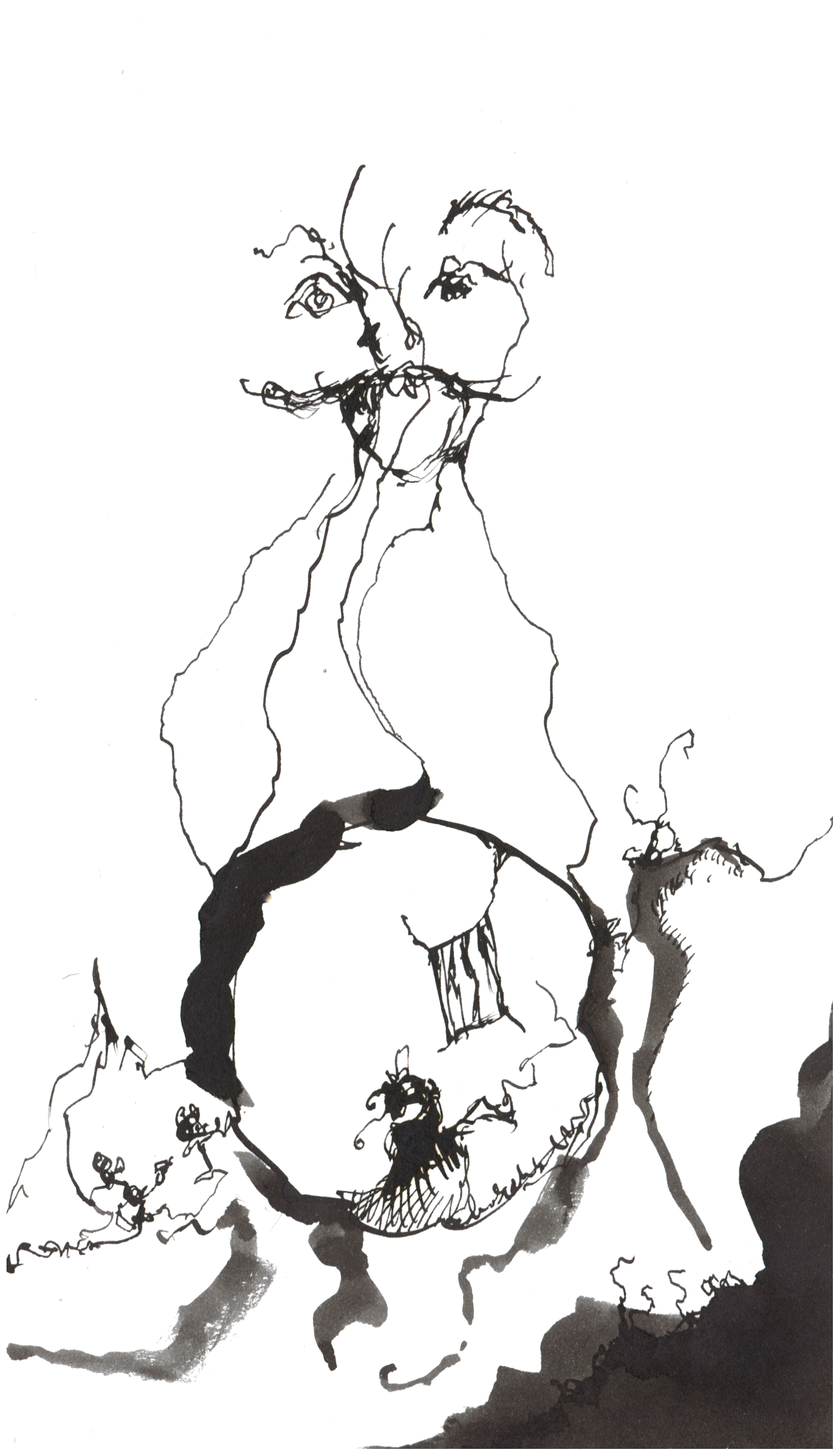
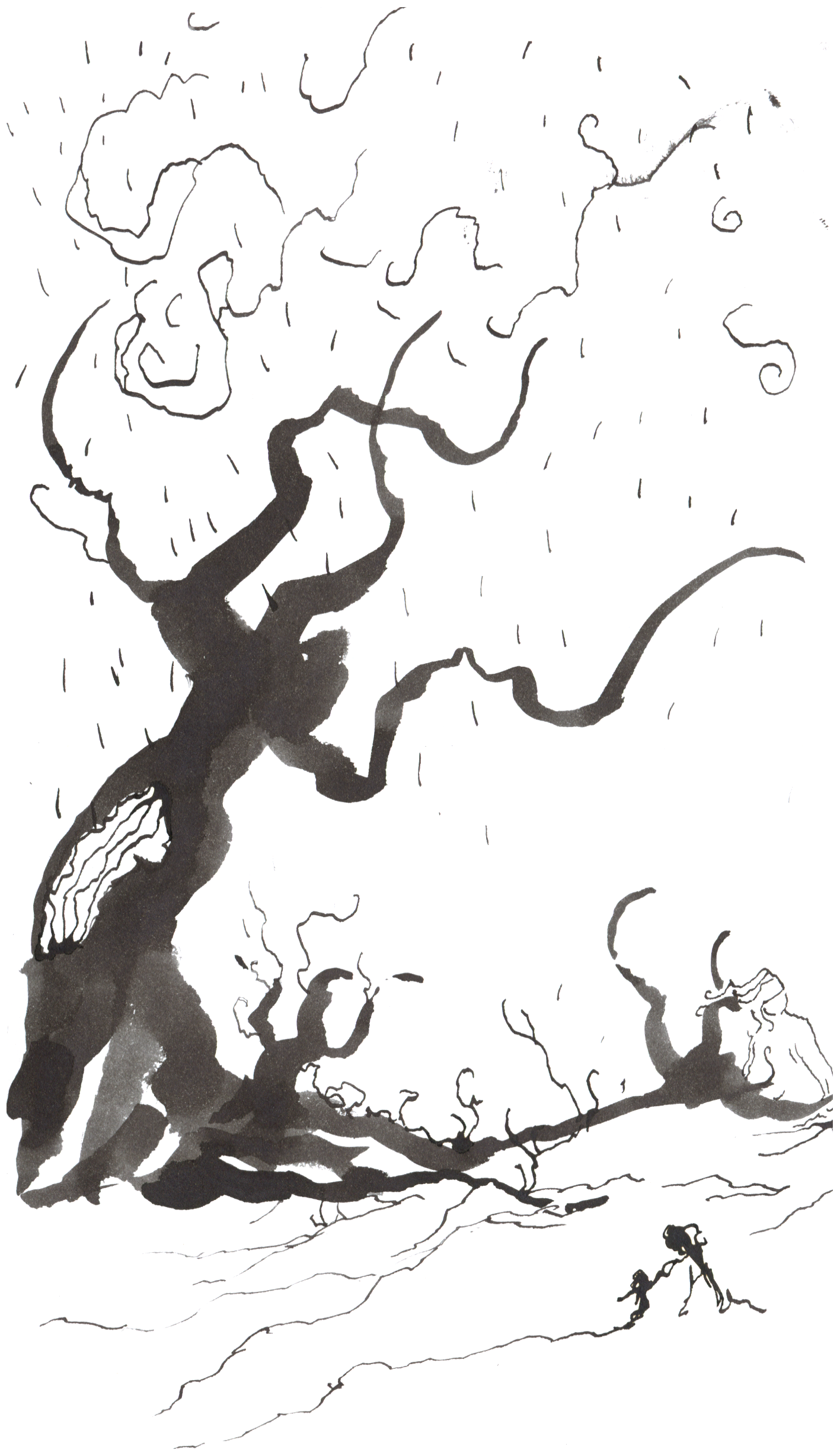
Inky Flash Fiction Spring Competition 2018: Winner: A Deuce Of Spring Brides by Lavinia Murray

I am a Right Madam and I know my place. It’s here. Up is a weight-loss Moon under a sheet, rolling inexorably to the right on this mild Spring dusk. Down is Peace-Rose lying by my feet with babies crawling out of her ears as she sleeps on the Historic Battlefield. Manageably small babies, bean-sized, earwax coated, armed with miniature pikes and muskets – one even trundles a tiny cannon. Homeward-bound nest-ready birds pick up and stick the tiny babies to the nearest glass pane (a slanted viewing window into the earth below where the unclaimed/resistant-to-ritual-burial battlefield bones are dragged in mordant procession by the earth worms who curate them). The earwax, similar in tackiness to sticky notes, means that the babies slowly riprap down the window and are lost in the tussocks beneath. Oh yes, the Spring Moon winds-wends beneath a sheet. I wake Peace-Rose and we toddle home to frame our mud-spattered, hand-made lace wedding veil. It will cover the walls of our front room seven times over and the pattern tells a tale – it is like the Bayeux Tapestry with holes. It tells the story of one Spring Day years back when we had a double wedding, two brides marrying two Spring gusts of air which were driven to the Register Office by a rotating fan.

Our Spring husbands, those great gusts, those great winds, fill a double-bed duvet cover each with the ends knotted, like a pair of big balloons, and they float in the air, anchored by extendable dog leashes with their grips forced into the ground by a single tent hook. Our husbands will slowly leak away and join the prevailing winds and then we can marry again; we two Spring Brides can hitch ourselves to whomsoever. Put on our Spring lace veil and say ‘yes’ to a bluster or a breeze.

Our issue from previous Spring’s high wind marriages heft the curtains about. Push, Shove and Flutter. Shake, Shiver and Twitch. Thrash, Ripple and Fill.

Spring brides holding ourselves like a persistent drone in your eardrum. Marry us.

I am Carmel, Peace-Rose’s irregular Spring twin. I am a Herm. I am a counter marking the planting of a boundary. I make faux human ashes out of clay cat litter and I pack it into urns and I sell it to people who have lost track of ancestors. In Spring I create eleven new imaginary deceased entities out of grey clay cat litter and pack it loosely into ceramic or brushed-steel urns. Sometimes in Spring I scatter cat litter in the Gusts-my-Husband. When I got married my grandmother’s ashes were scattered on me, for I was the bride of a Nor’ Easterly smelling of dead-men’s feet. Peace-Rose married a former Trade Wind and did very nicely. Their children veered wildly and were imprisoned all Spring in a weathervane.

Inky Flash Fiction Spring Competition 2018: Runner Up: The Drip by A.K.Hepburn

The girl Moth had never been outside of the cave. Born amongst the steady drip-drip of the rocky pinnacles that hung from the ceiling. Playing on stone, dimly lit by the precious blubber flames. Her mother pointed out constellations of glowing bugs on the ceiling: the Tiger, the Big Walrus, the Bear. She didn’t understand the names. Outside the Great Cold raged, as it always had.

Men went out to hunt. Moth’s father wrapped thick, woolly skins around himself until she could see only his eyes. He’d take up the flinty spear and disappear into the Light. She’d begged to go with him, but he’d never let her; said her toes would all turn black like Old Gulp. Gulp didn’t go out to hunt anymore. Sometimes they came back hauling some big hunk of furry flesh to cook over the blubber flame; sometimes with nothing at all and their stomachs would gnaw. Sometimes they’d come back missing one or two of their number.

Wondering what was out there, Moth imagined the rocky ceiling to be much higher and the walls to be further apart. Her mother said that, out there, the woolly beasts they ate ran ferociously around on their four legs. Someone daubed an image on the cave wall in wet red clay, and Moth tried to animate it with her imagination. Then there was the Cold White, which followed the hunters back as a dusting on their furs, then soon disappeared into wetness. Once, she’d peeked a little further than permitted, and the Cold White was all she could see. It filled her vision and flurried around too quickly. It bit at her face, and she hurried back inside.

The Drip began gradually. They hardly noticed it at first. Then it became more persistent. Dampness permeated the floor and walls as water leeched through the cracks. Puddles formed. Somewhere deeper in the rock, a rushing sound grew into a roar. Too wet to stay, they wrapped up and edged cautiously toward the Light, flinty spears raised.

The further Moth stepped, the more her eyes stung. At first she thought it was the Cold White, like before, but then she realised that although it was White, it was not actually Cold, but rather more warm, like the blubber flame. Gradually opening her squinting eyes, she realised, too, that it was hardly even white, but more golden. The Golden Warm, she thought. This was new. The White coated the ground, but it was peppered with green – with life. She looked up; the ceiling was impossibly, dizzyingly far away. She didn’t have a name for the colour.

They wrapped themselves in furs; huddled around a blubber flame. The orb of Golden Warm sank and disappeared, but it wasn’t unbearably cold. (Moth wondered if it would return; she hoped it would.) The far-away ceiling grew dim. Distantly, above, the glow worms lit up one by one, just like home. In her mind, she traced them into pictures; gave them new names.

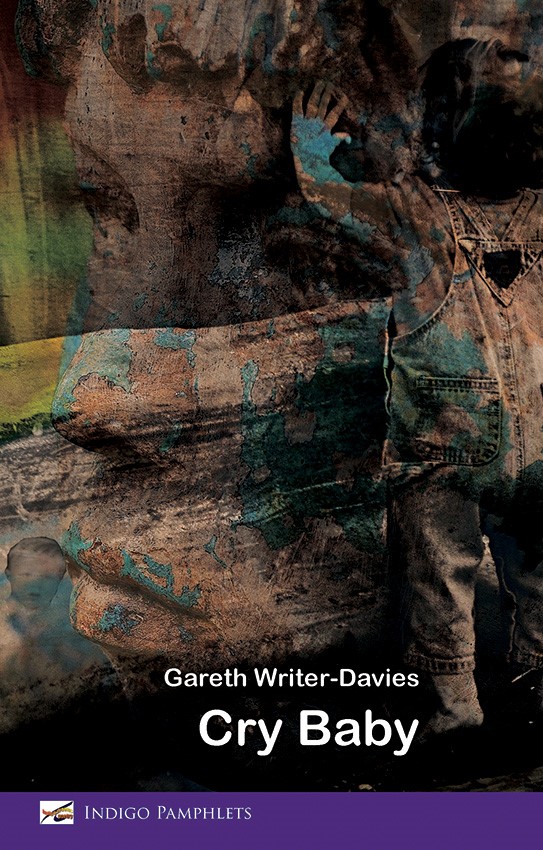
Books From The Pantry: Cry Baby by Gareth Writer-Davies: Reviewed by Giles Turnbull

There is a sense of transport and movement in Gareth Writer-Davies’ poetry collection, Cry Baby. The pamphlet opens with the title poem which reveals a sense of disappointment that pervades the writing from start to finish:

I was not the imagined girl
ready for gingham ribbons and ankle socks
I was something else … a fist of a child
who bit my mother’s breast
and kicked out at rainbows.

In ‘Milko’:

the milk van delivered
dairy goods
for breakfast and pud
like a carnival float
the bouncing cargo
of gold and silver tops
danced in the crate
as if the party ends at the child’s front door.

These are very sparse poems, not weighted down with adjectives and adverbs; punctuation is rarely present and upper case letters are reserved for proper nouns. The poems are all short, the detail pared back to the bone. It creates a no-fuss remembrance of childhood from the adult’s perspective; a truth that invites no argument:

and when the little train stopped for breath
I came up for air
in Kentish Town
alone and inexact
my parents
two hundred feet below
lost in the puzzle of the map
(from ‘The Train Is Coming’)

The effect is not dissimilar to standing in front of Munch’s painting, The Scream, suspecting there is an immense story lurking in the unspoken words underneath the visible anguish. The poem ‘Child’ suggests that the feeling has persisted into adulthood:

I have grown used to the idea
and set a trap
using the window as a mirror

I am startled
by my own silhouette

Short as they are, there are some intriguing tales in this pamphlet. How the mother tries to escape by swimming the estuary to Ynyslas (in ‘Swimming At Aberdovey’), and how the child’s sister is kicked out of home for having sex with her boyfriend (in ‘Lilac Ladies’). There are moments of humour, such as in ‘Pyjamas’:

when once I saw a yellowhammer
and confusing it for a tennis ball
hammered it for six […] sometimes
there was a knock on the door
then I’d dream
I was walking the streets in my pyjamas.

When you read this pamphlet from start to finish, you really do get to experience the child growing to adulthood like you are part of the family.

Cry Baby by Gareth Writer-Davies is published by Indigo Dreams Publishing.

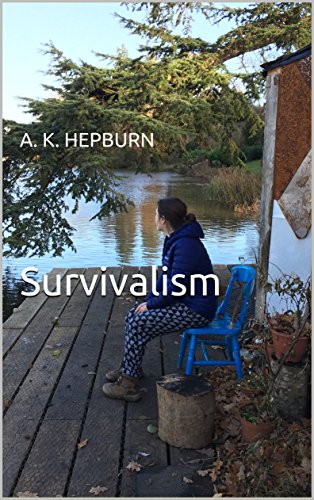
Books From The Pantry: Survivalism by A. K. Hepburn: Reviewed by Giles Turnbull

A.K. Hepburn’s poetry pamphlet, Survivalism, leaves you in no doubt that these poems are deliciously dangerous. The very first lines of the first poem alert the reader to the inescapable intrusion of shadows under the trees:

Lauren was a pianist.
I could tell that from the way
her fingers played the protrusion
of my hip bone, sprawling on the
hillside,
ignoring something threatening
brewing just below the horizon.

Poets have always battled with matters of life and death. In the poetry of Ted Hughes, crows are symbolic of creation. In ‘The Crow People’ Hepburn gives us her take on crows:

The crow people
Walk upright,
Smudgy charcoal outlines
On grey concrete

To me this reads like a picture of a city full of commuters who:

Leer and gape,
Gaudy faces open
In mockery

evoking a scene similar to that in part 1 of T. S. Eliot’s The Waste Land:

A crowd flowed over London Bridge, so many,

I had not thought death had undone so many.

By the third poem, ‘Coracle’, we have images of dead animals and dead trees:

He drifted up the spine
of the Pennines.
Peaks jutted from the water
like the vertebrae
of a long-dead whale
breaching the surface
[…]
an English sea,
breaking over the
skeletons of old oaks
littering the sea floor.

A few poems further on and we find pianistic Lauren again. This time it is ‘On the Coldest Night of the Year’, with the:

electricity off, fractals
forming inside the glass.
Outside, it’s eighteen below

and:

Lauren’s fingers glide
through a Nocturne, until
they’re too blue, too numb
to wring out another tune

the last notes of this poem bringing with them further death.

As we get to the title poem, Survivalism, we have almost become accustomed to the world being none-too hospitable. I was reminded of The Hunger Games books by Suzanne Collins. In that book, Katniss Eberdeen risks her life to salvage a bright orange backpack which contains a ‘half-gallon plastic bottle with a cap for carrying water that’s bone dry’ amongst other things. In this poem our survivor also has a knapsack and a:

Water bottle, leaching
chemicals, probably

There are, appropriately enough, 13 poems in this pamphlet, beginning with ‘Before’ and ending with ‘Apocalypse, Then’. If you enjoy your worlds dystopian, as I do, you will love them — it may be wise to wear thimbles on your fingertips whilst reading, lest turning the pages slices them clean off.

Get your copy of Survivalism

Poetry Drawer: Modern-Day Ms. Dickinson’s 5am Diary Entry-Sleepless Starting Summer Not In Seattle by Gerard Sarnat

A blue-blooded rock-ribbed Amherstian —
Confined to home — I do seem quite adverse
To going out much — except by poem or coffin.

Often one niece might bring me her new baby
— Liav’s quarter Turkish + quarter Iraqi — post
Hebrew diaspora she equates it to be half Israeli.

Then Sis’s 2nd girl — along with both boys — will
Fly in a blue metal bird – from what maybe were
Mexican Possessions when Emily was born in 1830.

After Memorial Day holidays — recognitions of fallen
U.S. soldiers which once were thought to have begun
as markers decorating graves during our unCivil War —

Around about the time that Woman in White became
Reclusive – whispering to visitors from the other side
Of a hewn oak door – started getting carted to doctors.

If these innards & outards score A-OK, you ladies I grew
Up near but haven’t seen since turning 30 — are slotted to
Spend July 4th convening here within my garden cottage.

Inky Interview Exclusive: Award Winning Poet Sara Hirsch at The Storyhouse, Chester: with Claire Faulkner

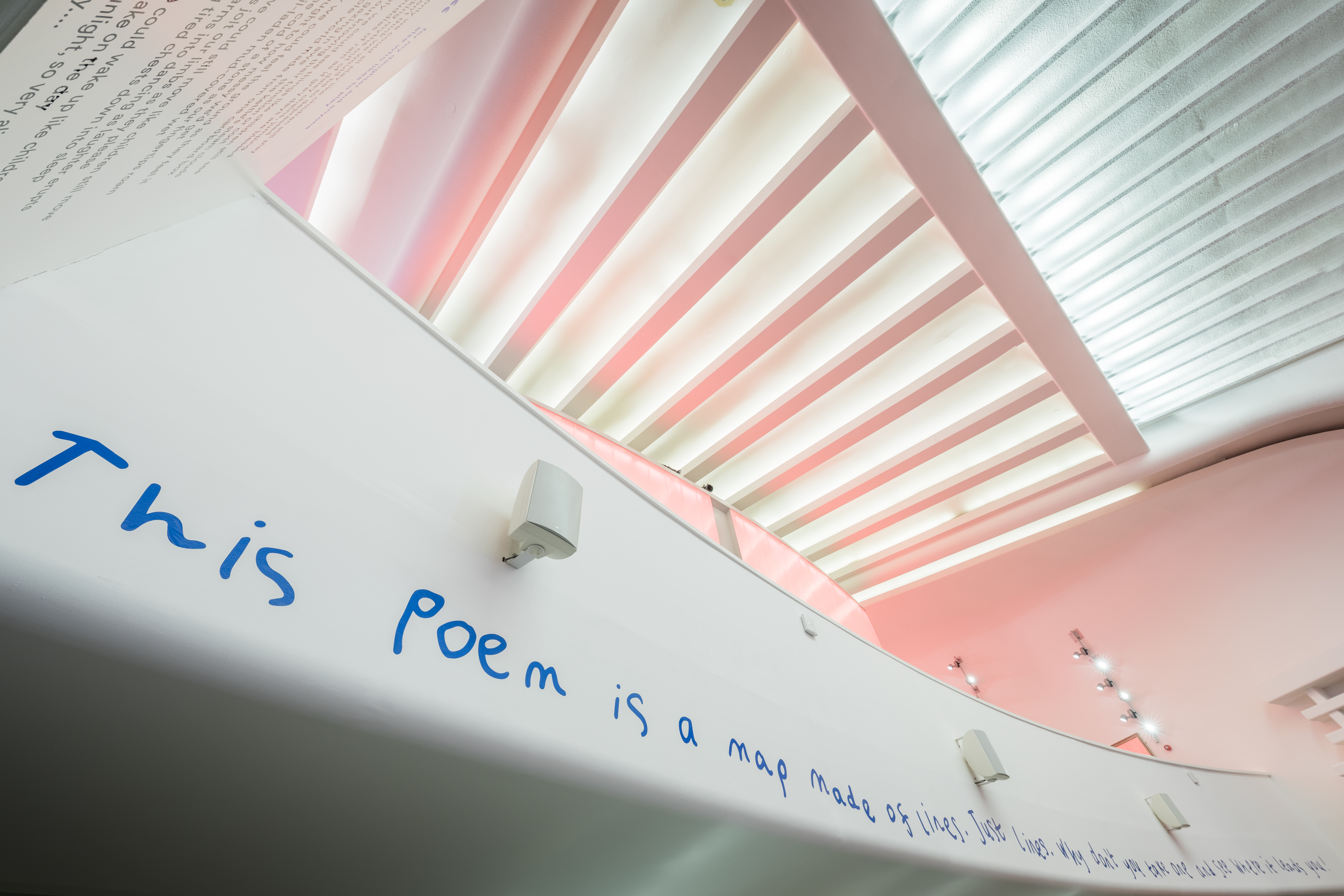
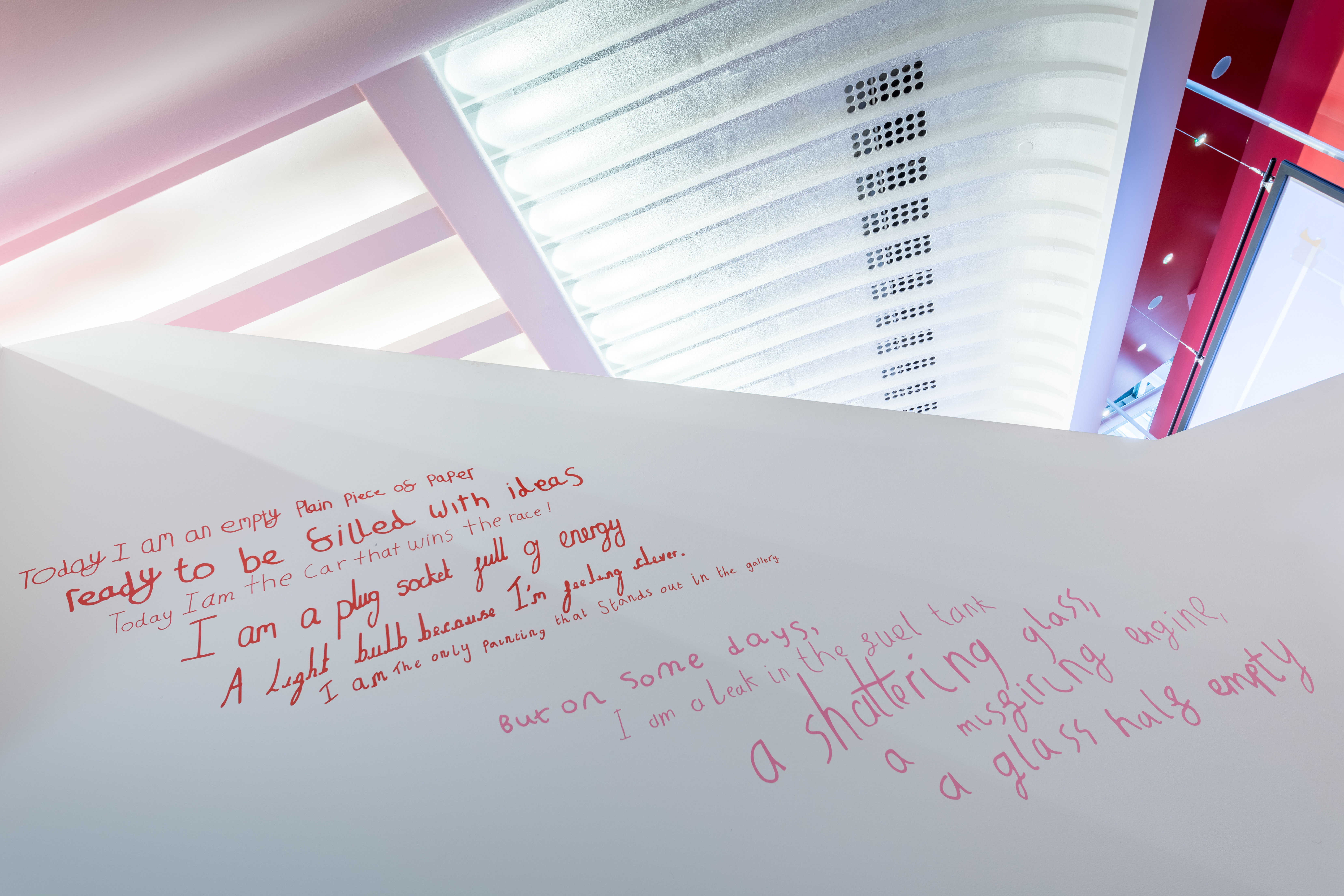
I often find poetry at its most magical when I least expect it. So when I stumbled into The Storyhouse in Chester one rainy afternoon, looked up at the balcony and saw in child’s handwriting ‘this poem is a map made of lines. Just lines. Why don’t you take one and see where it leads you’. I was immediately hooked and spent the next hour walking around the building reading the poetry installations which emerged from the WayWord festival.

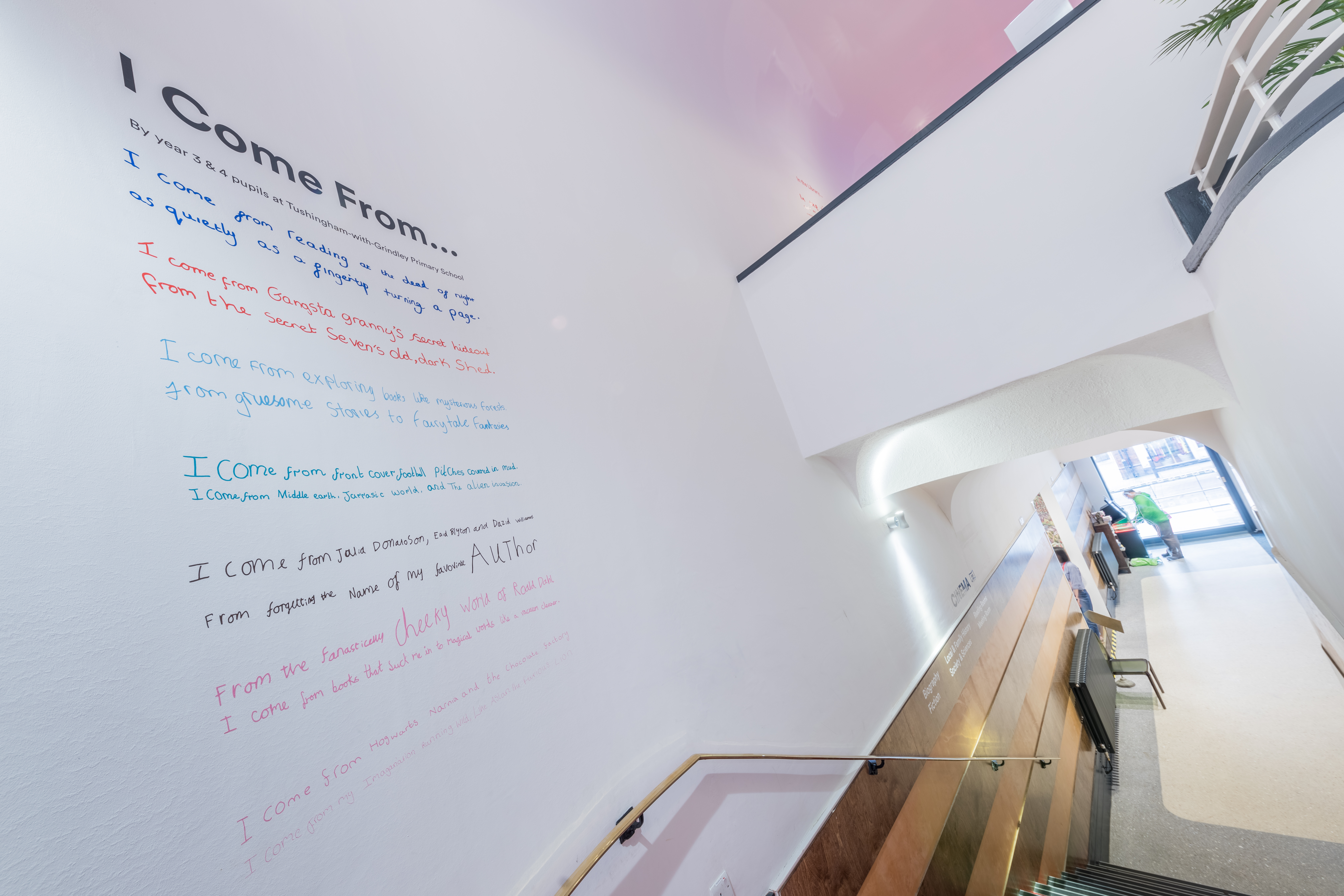
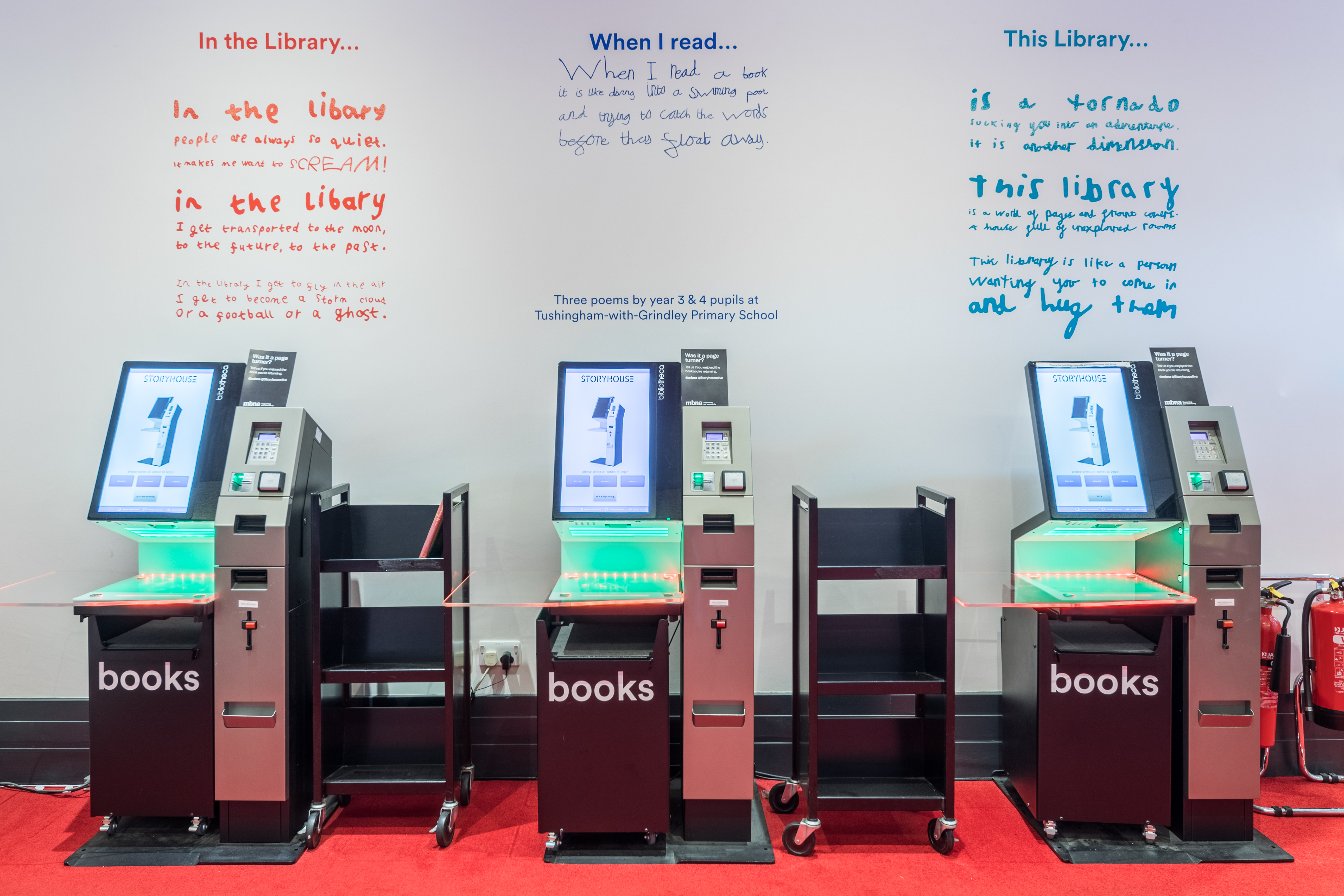
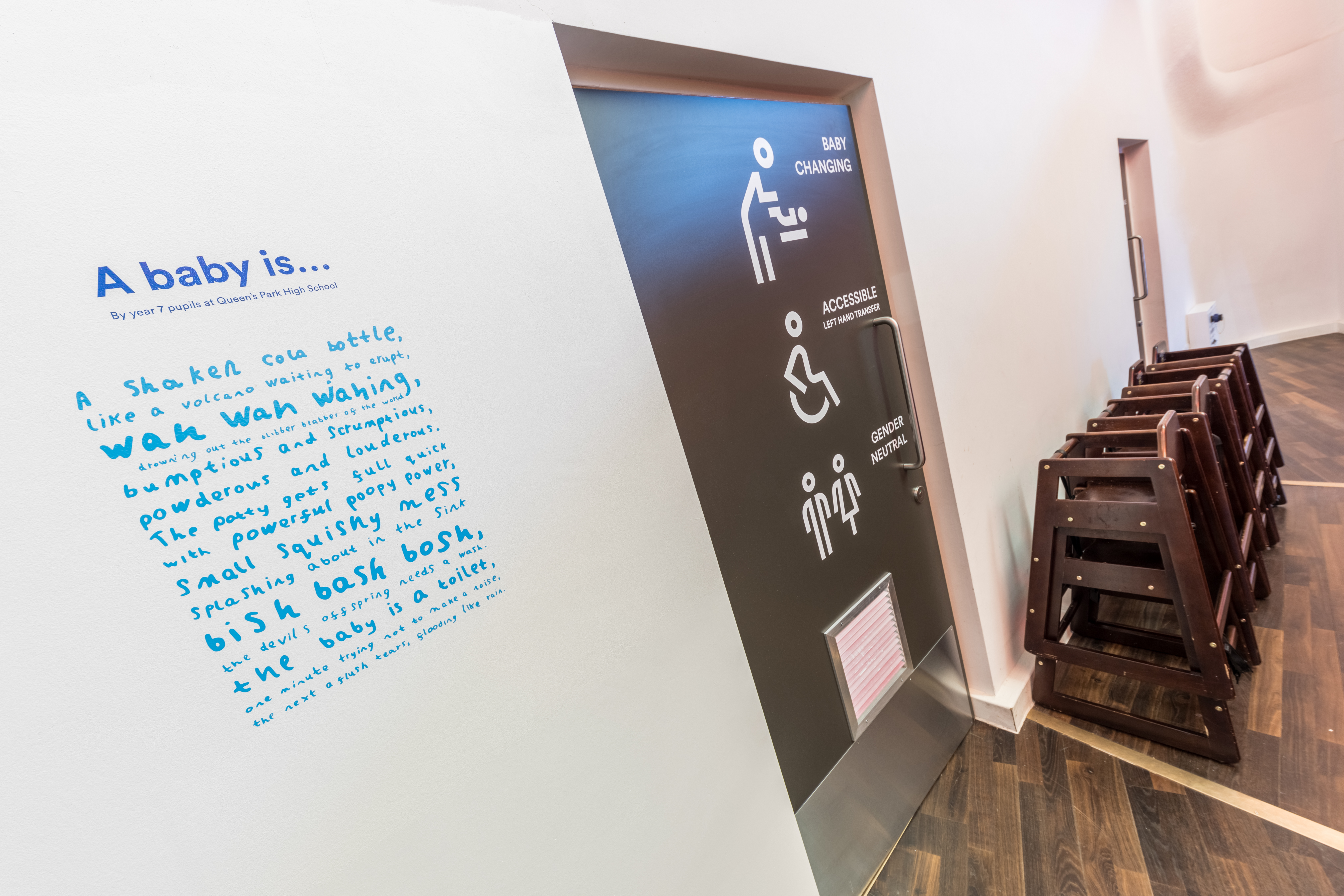
The poems are written by children from three local schools; Tushingham-with-Gringley C of E Primary School, J.H. Godwin Primary School, and Queen’s Park High School. The pupils took part in workshops with award winning poet Sara Hirsch, and together they created poems about identity, libraries, history, and stories.

The verses are all surprising, inspirational and delightful to read.

‘I Come From…’ opens with the lines:

I come from reading at the dead of night

as quietly as a fingertip turning a page.

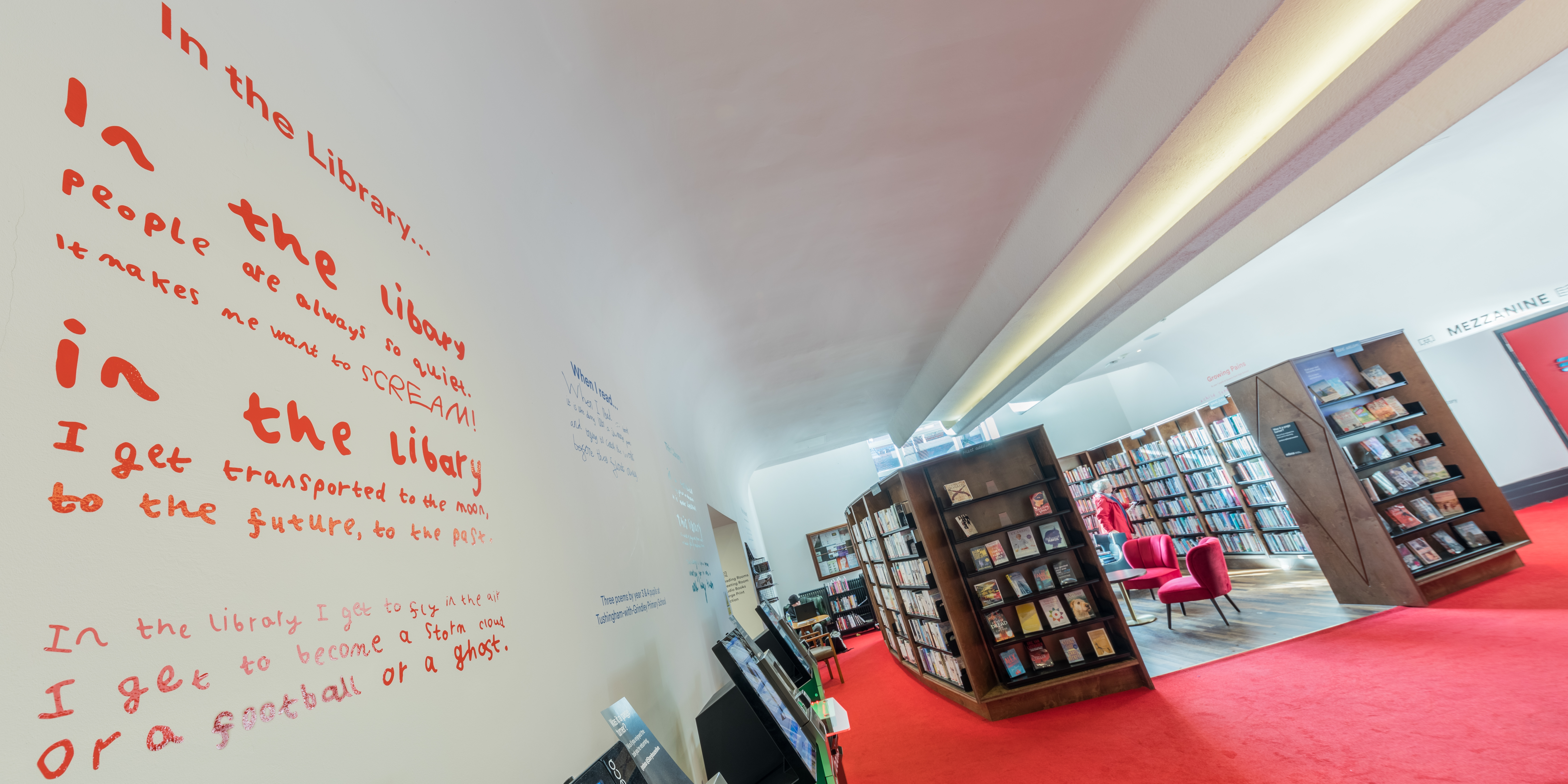
Each poem appears on the walls in the child’s own handwriting, and this adds an extra impact when viewing the installation.

In ‘This Library…’ The Storyhouse is described as:

a tornado

sucking you into an adventure

it is another dimension

When trying to answer the question in the poem ‘What is History?’, the children have written:

It is a complex question waiting to be asked

It is a record player that has stopped working

A guitar that has been played a little too much.

And further on in the poem, history is described as:

a locked door

a code waiting to be cracked

it is lonely

a broken time machine

I enjoyed the experience of finding the poems, and took delight from the positive input that the children must have had in the writing and creative process. I wanted to know more about the installation, so I contacted Sara for more information.

What was your involvement in the WayWord festival?

I worked with local primary school children in January to create the poems for the walls of the Storehouse, to be unveiled during the WayWord festival. I then returned during the festival itself to perform a family show and lead a workshop for the 16-25 youth theatre group, so I got to see the finished poetry murals for myself. They look fabulous and I was so proud to see the children’s poetry displayed in such a unique way around the building.

How did the children react to the poetry workshops?

They really loved them! I never know in advance what the reaction will be and how the children will take to me and my workshops. But these ones were particularly memorable, perhaps because we were working towards an end goal. The fact that they knew their words might make it onto the walls of this amazing building really got them excited and it created a brilliant atmosphere in all 3 schools I visited. I usually really like the fact that my workshops aren’t leading up to anything in particular, as it takes the pressure off the kids to create something ‘finished’. But this was really different and really gave the kids a sense of pride in their work, because it was being valued by a venue that they love and respect.

Were you surprised by their reaction?

I was surprised with how they stepped up to the challenge and worked together to produce something really grown up and professional. I usually set no expectations on a workshop so that the children are free to explore their ideas and imagination. So the fact that they were so focussed on creating something they would be proud to show off to the public was really amazing.

Seeing the verse displayed in the children’s own handwriting is extremely effective. How did this idea develop?

Isn’t it! I really can’t claim the credit for this idea. It was thought up by the Storyhouse and the designer (Matt Lewis) and I just did what I was told! However, it was a big part of the workshops – to get the kids to write up their lines in their own handwriting and it was really fun to be a part of it. My rule in all my workshops is to be as messy as possible (scribble things out, say whatever comes into your head etc.) and so giving them permission to carry this idea on for the final product was really liberating. I love that there are spelling mistakes in the poems. It makes them feel really authentic.

Do you think it’s important to encourage children to write poetry?

Of course! Regardless of the fact that it is fun, educational and creative – giving young people the chance to express themselves in different ways is so important for emotional wellbeing and development. Creativity is being sucked from the curriculum, which is an absolute travesty and so the more poets, authors, artists and creatives we can get visiting schools, and giving kids an alternative to the academic standards they are constantly measured against, the better.

Can you share with us what other projects you’re currently working on?

I am currently setting up a spoken word production company in New Zealand called Motif Poetry with Kiwi poet/producer Ben Fagan. I will be heading up the education side of it and hopefully it will eventually be an international venture to connect poetry scenes in the UK and down under. I am also running a lot of international workshops at the moment (I will have performed in 7 countries before the end of March so far this year!) and am working on my third poetry collection which explores feminism and architecture. So lots going on…but I wouldn’t have it any other way.

Image credits: Mark Carline

Poetry Drawer: Closure by Michael Murray


Bricks and mortar layer-cake. Dearly behoven,
loom workers and machinists, here gather to witness
this severance, divorce, of mill and money.
The empty machine hall, flown nest, distressed
and rendered, jollied out with Victoriana.

Say hello to granny, her poor-house museum existence,
while money sprees his freedom. Fresh blooded,
begets wealth on the city – the waifs, the bullyboys
who barge through homes, communities.
They partition the streets into no-gos
until there is only one road in, and it‘s theirs.

The come-on of laptop glitz, tablets high on gizmos –
the fondant, and the faux-royal icing, the ganache.
The city sweats and river stinks, coin-chunky,
swears – Just One More Drink. Perspective teeters
in smoked-glass, whose interest is offshore;
and maybe thinking of us, wiping memories, accounts,
as if just the dust of passing showers.

A body, face down in the river. And no claimants.

Poetry Drawer: Ahem by Michael Murray

To meet his mother for a coffee in the market place:
not the best café; to take in the shops: not the best shops –
a lightweight coat, a pair of shoes, camel gloves.
To have grown up with catalogues, delayed payments,
life as a web of transactions, gratifications.

To dip into the hot malted froth of a cheap cappuccino.
The dutiful son; does he, ahem, convince?
Attentive, yes interested, in this wrecked relationship;
love, like meaning, is a concern with ephemera,
the comestibles and glue of gossip, is in the tut, shh, smirk.
The smear of emotions, like face powder over moisturiser,
in a kiss as the day ends. There is talk of meeting more often.
That is all. But that is not all.

Poetry Drawer: Let Them Eat Tenderloin Words by Gerard Sarnat

Before doing centrist Op-Eds, Frank Bruni
was chief restaurant critic for The New York Times,
Top Chef guest judge and struggled with bulimia…

Though some fat or sassy ragazine guidelines
caveat their submitters, Do not write about writing,
I assume we poets are among our top-heaviest

consumers of poetry: so how does it feel
for you now after that feast-of-acceptances
gobbledygook gorge’s followed by publication famine

of pan-African proportions greater than when half
the tattered inhabitants of Timbuktu starved
in 1738-56, hunger beyond any known

statistically significant shortages
within a twenty-five hundred year recorded history
of cutting food reviews by the civilized literary world?

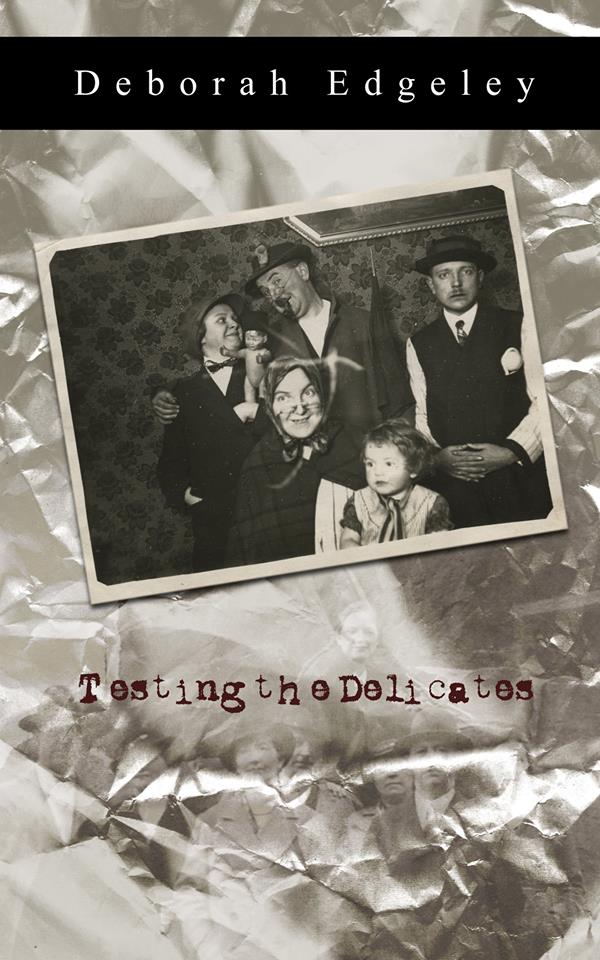
Books From The Pantry: Testing The Delicates by Deborah Edgeley: reviewed by Kev Milsom

Testing the Delicates is a collection of poetry to raise awareness about the stigma surrounding mental health, ignorance about it and prejudice towards it, identity, isolation, memories, and understanding the past through photographs.

The voyage of this short (but perfectly formed) book plots the course of personal thoughts, emotions and memories of its author, Deborah Edgeley, as she retraces many poignant steps of her life, particularly in relation to her early years, and the connection to her mother.

Initial, cursory glances at Testing the Delicates reveal unto the reader a cocktail of emotional depth, portrayed within the forty-three pages of poetry, and prepare us for the literary voyage ahead.

As with all personal journeys, the largest challenges for the author involve:

a) including us readers as enthralled passengers for the duration of the journey.

b) providing us with relevant sources of information and education and

c) allowing us to gain a sense of empathy from our voyage into often-choppy, emotional waters that may easily infringe into whirlpool eddies formed from mental illness and depression.

For this, we naturally require a competent captain at the helm to guide us safely through these waters. Thankfully, for the reader, Captain Deborah Edgeley’s literary skills enhance our journey in two main aspects.

Firstly, the writing is beautifully expressed. This allows all passengers to relax and ease into the words, without fear of any misunderstanding, or vagueness, about the importance of the emotional messages being relayed to us.

An excellent example of this lies within the poem, ‘Thought Pictures’, which focuses on the particular aspect of depression, and how isolating this can make us feel, meaning that expressing our feelings to others becomes much more difficult. The severity of the mental downsides of watching a beloved soul dealing with mental/emotional difficulties is balanced beautifully with lighter, more comforting tones, especially when dealing with ‘imagined’ conversations with the self, at such difficult times. If the beauty and skill of wordsmithing is to conjure up relevant and powerful images via literal expression, then this nails it for me personally, as each line conjured up images of my late mother in a very similar state. Through Deborah’s words, I was able to return to my thoughts from a decade previous; each description supremely apt and meaningful.

…’See your stare, your blink
your unkempt eyebrow raise…
your tongue poke
through your wetted lip

I taste your imagined words
as you jigsaw another shade
to my thought pictures
that float in my head.

Secondly, our understanding is greatly increased, as the author has provided us with a detailed map of our journey with the inspired addition of nine full pages of notes, relating to every given poem.

This is genius, and I sincerely wish that more writers employed this option, especially within the expression of personal poetry. As passengers, we instantly know exactly where we’re going, as we are in possession of a skilled ‘tour guide’, providing us with precise information about every valuable sight along the way.

On a personal level, as someone who can easily empathise with various aspects of the subject matter, so beautifully relayed via Deborah’s words, this ‘map’ addition increases both the closeness and power of the poetry, allowing me to nod along throughout the verses, and relate them to my own personal experiences.

Criticisms? I have two:

Firstly, I got to the end of this book and eagerly wanted to hear more. The writing is so ‘spot on’ that I didn’t want the voyage to end, and became disappointed to return to the home port and disembark back on shore.

Secondly, Deborah is clearly a very skilled writer, and the prose contained within her ‘Notes’ section is relayed both simply and effectively.

As such, if there is to be a follow up book (hint hint) I would personally love to see this aspect expanded into some sections of ‘life writing’.

Like Deborah, I gave up my job to care for my ailing mother. One poem leapt out at me, ‘Act One, Scenes 1-12’, because it so beautifully emphasises those days when emotional closeness is eclipsed by the dark difficulties of basic communication, both within everyday, mundane topics, and those covering more difficult scenarios.

Shall I take you to Daddy’s grave,
tulips or sweet peas?
Talk to him or stay silent?
Trace the gold letters
with your hand or mine?

From the heart, exemplifying intelligent, thoughtful, caring words which stretch both the mind and soul, aided perfectly by illustrations from the talented artist, Mark Sheeky.

Encore please!

Whose Apple Thou Art? 

In Greenwood, studded with crab and perry,
out of tempest mind tumbled Caliban.
So say yeomen of sixteenth century,
‘Bring thee where the crabs grow,’ said the madman.

Drinking proverbial acidity,
Gossip’s Bowl was spice sipped by Bidford folk
in restaurants of ancient forestry
acid draughts intoxicate shallow jokes.

But three crabbed months had soured themselves to death.
‘He’ll never have Miranda,’ they concurred.
The Bidford souls muttered under their breath
‘Goddess and a madman?’ with spoon they stirred.

‘Whose apple thou art, gem grown from deep root?’
‘Yours, but I will never bear sweet fruit.’

Testing The Delicates from Amazon

Deborah Edgeley on FacebookTwitterSoundcloud

Mark Sheeky ArtFacebookTwitterSoundcloud