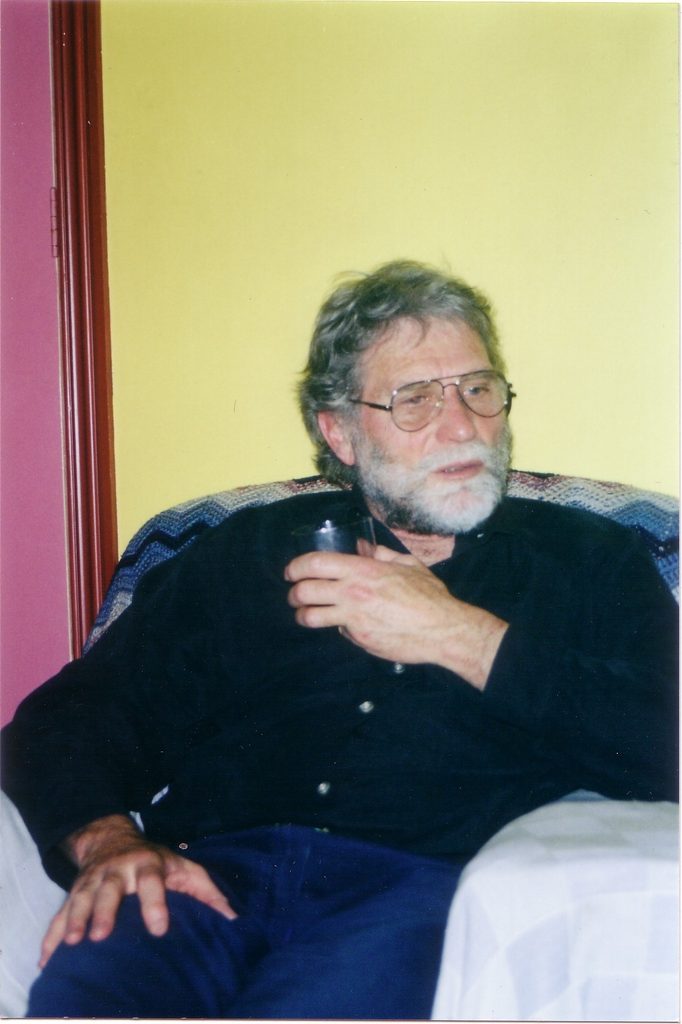
A boy emigrates to Australia on an ex-WW11 troopship, sees fathomless sights, flying fish skimming the deck in the heaving Indian Ocean, an Irish bantamweight boxer training in a storage area. On arrival he picks up local idiom and other assets like the rough and tumble of their football, poses in school, a laughing larrikin, the classroom kookaburra, but his parents are scarred. Escaping outside after his family’s angry evening meals, with his dog, smoking, the only sound, bullfrogs’ croaking, he longs to live like moody characters in urban movies, or stories.
He sells newspapers, hefts travellers’ suitcases from train station to bus stop on weekends, saving hustled tips to buy his first camera at thirteen. Waiting between trains in that terminal town burned by the sun he composes pictures with captions in a notebook he shall one day wish had survived. Those robbed of their past are the most avid photographers.
Irritated by his parents’ jealousy of his integration, then obsession, their sorrowful bandaged past, not understanding how this shall one day influence his art, he budgets for his initial monochrome efforts’ developing and new rolls of film, analysing his expectations: intention, results, self-editing honestly, chiaroscuro, soft focus, still in his future.
Reading about Man Ray leads to Arbus, whose art gave her a perverse thrill, Doisneau, Kapa, heart pierced by this stark calling. Seeking ways of utilising Australia’s fierce light, excited by shadow’s prospects, he admires Max Dupain, and Olive Cotton’s work, paintings by Russell Drysdale, the film Blow-Up starring a young man with a camera. Itching to see his birthplace again, he embarks for the Old World, contact addresses of holy grail journals in a new notebook next to his passport with its self-portrait photo.
He enters Europe like entering a ruined temple. His decrepit car amusing border guards as he tracks history’s blitzed legacy, he captures their sneered pose that a small journal accepts, his CV beginning. In the rain near Lubeck he frames holidaymakers, hard-boiled noir images illustrating a breakthrough photojournalistic article about the Mann family.
Another time, tailed from above by East German polizei along the potholed autobahn past Leipzig’s cindering orange pollution haze, he surreptitiously shoots their chopper in the carpark of an inexpensive servo where he eats and gases up, joking with locals. Sturm und Drang stimulate him despite Auden’s claim photography brought a new sadness to the world. As if there isn’t already enough.
Galleries of years elapsed, back in Australia at the forty-second place he has lived, locked in the dark room of late life, his memory playing catch-me-if-you-can, it’s his safety now, not this icy silence, that does him in. No more vodka, marriages kaput, grown children estranged, basic needs those of the lone wolf, he sits, retired bedroll gathering dust, with the records of his achievements, precious lenses in leather pouches with other talismans of devotion to timing and silver emulsion.
When the eye blinks it sucks someone else inside it. He sees refugees on TV, their tears coursing for what once was, recalls seeing a man jump into the Le Havre night from their docking ferry. Oh, what he would give for life to be pre-digital again, to concentrate once more on composition and the miracle of light, eagerly rounding corners of the human map, snow falling, silent.

Ian C Smith’s work has been published in Cable Street, Griffith Review, Muleskinner, New English Review, North of Oxford, Rundelania,The Umbrella Factory, & Westerly. His seventh book is wonder sadness madness joy, Ginninderra (Port Adelaide). He writes in the Gippsland Lakes area of Victoria, and on Flinders Island.
You can find more of Ian’s work here on Ink Pantry.